A Language Independent Algorithm for
Single and Multiple Document Summarization
Rada Mihalcea and Paul Tarau
Department of Computer Science and Engineering University of North Texas
{rada,tarau}@cs.unt.edu
Abstract
This paper describes a method for
lan-guage independent extractive
summariza-tion that relies on iterative graph-based ranking algorithms. Through evalua-tions performed on a single-document summarization task for English and Por-tuguese, we show that the method per-forms equally well regardless of the lan-guage. Moreover, we show how a meta-summarizer relying on a layered appli-cation of techniques for single-document summarization can be turned into an ef-fective method for multi-document sum-marization.
1 Introduction
Algorithms for extractive summarization are typi-cally based on techniques for sentence extraction, and attempt to identify the set of sentences that are most important for the overall understanding of a given document. Some of the most successful ap-proaches consist of supervised algorithms that at-tempt to learn what makes a good summary by training on collections of summaries built for a rela-tively large number of training documents, e.g. (Hi-rao et al., 2002), (Teufel and Moens, 1997). How-ever, the price paid for the high performance of such supervised algorithms is their inability to eas-ily adapt to new languages or domains, as new train-ing data are required for each new data type. In this paper, we show that a method for extractive summarization relying on iterative graph-based al-gorithms, as previously proposed in (Mihalcea and Tarau, 2004) can be applied to the summarization of documents in different languages without any re-quirements for additional data. Additionally, we also show that a layered application of this single-document summarization method can result into an efficient multi-document summarization tool.
Earlier experiments with graph-based ranking al-gorithms for text summarization, as previously re-ported in (Mihalcea and Tarau, 2004) and (Erkan and Radev, 2004), were either limited to single-document English summarization, or they were ap-plied to English multi-document summarization, but in conjunction with other extractive summariza-tion techniques that did not allow for a clear evalua-tion of the impact of the graph algorithms alone. In this paper, we show that a method exclusively based on graph-based algorithms can be successfully ap-plied to the summarization of single and multiple documents in any language, and show that the re-sults are competitive with those of state-of-the-art summarization systems.
The paper is organized as follows. Section 2 briefly overviews two iterative graph-based ranking algorithms, and shows how these algorithms can be applied to single and multiple document summa-rization. Section 3 describes the data sets used in the summarization experiments and the evaluation methodology. Experimental results are presented in Section 4, followed by discussions, pointers to re-lated work, and conclusions.
2 Iterative Graph-based Algorithms for Extractive Summarization
only on local vertex-specific information. The ba-sic idea implemented by the ranking model is that of “voting” or “recommendation”. When one vertex links to another one, it is basically casting a vote for that other vertex. The higher the number of votes that are cast for a vertex, the higher the importance of the vertex.
LetG = (V, E)be a directed graph with the set of verticesV and set of edgesE, whereEis a sub-set ofV×V. For a given vertexVi, letIn(Vi)be the set of vertices that point to it (predecessors), and let Out(Vi)be the set of vertices that vertexVi points to (successors).
PageRank. P ageRank (Brin and Page, 1998) is perhaps one of the most popular ranking algo-rithms, and was designed as a method for Web link analysis. Unlike other graph ranking algorithms, P ageRankintegrates the impact of both incoming and outgoing links into one single model, and there-fore it produces only one set of scores:
P R(Vi) = (1−d) +d∗ X
Vj∈In(Vi)
P R(Vj)
|Out(Vj)| (1)
wheredis a parameter set between 0 and 1.
HITS. HIT S (Hyperlinked Induced Topic Search) (Kleinberg, 1999) is an iterative algorithm that was designed for ranking Web pages according to their degree of “authority”. The HIT S algo-rithm makes a distinction between “authorities” (pages with a large number of incoming links) and “hubs” (pages with a large number of outgoing links). For each vertex, HIT S produces two sets of scores – an “authority” score, and a “hub” score:
HIT SA(Vi) = X
Vj∈In(Vi)
HIT SH(Vj) (2)
HIT SH(Vi) = X
Vj∈Out(Vi)
HIT SA(Vj) (3)
For each of these algorithms, starting from arbitrary values assigned to each node in the graph, the com-putation iterates until convergence below a given threshold is achieved. After running the algorithm, a score is associated with each vertex, which rep-resents the “importance” or “power” of that vertex within the graph.
In the context of Web surfing or citation analy-sis, it is unusual for a vertex to include multiple or partial links to another vertex, and hence the orig-inal definition for graph-based ranking algorithms is assuming unweighted graphs. However, when
the graphs are built starting with natural language texts, they may include multiple or partial links be-tween the units (vertices) that are extracted from text. It may be therefore useful to integrate into the model the “strength” of the connection between two vertices Vi and Vj as a weight wij added to the corresponding edge that connects the two ver-tices. The ranking algorithms are thus adapted to include edge weights, e.g. forP ageRankthe score is determined using the following formula (a similar change can be applied to theHIT Salgorithm):
P RW(Vi) = (1−d)+d∗ X
Vj∈In(Vi) wji
P RW(V j) P
Vk∈Out(Vj) wkj
(4)
[1] Watching the new movie, “Imagine: John Lennon,” was very painful for the late Beatle’s wife, Yoko Ono.
[2] “The only reason why I did watch it to the end is because I’m responsible for it, even though somebody else made it,” she said.
[3] Cassettes, film footage and other elements of the acclaimed movie were collected by Ono.
[4] She also took cassettes of interviews by Lennon, which were edited in such a way that he narrates the picture. [5] Andrew Solt (“This Is Elvis”) directed, Solt and David L. Wolper produced and Solt and Sam Egan wrote it.
[6] “I think this is really the definitive documentary of John Lennon’s life,” Ono said in an interview.
1
2
3
4
5 6 0.16
0.30 0.46 0.15 [1.34]
[1.75]
[0.70]
[0.74]
[0.52]
[0.91] 0.15
0.29 0.32
0.15
Figure 1: Graph of sentence similarities built on a sample text. Scores reflecting sentence importance are shown in brackets next to each sentence.
While the final vertex scores (and therefore rank-ings) for weighted graphs differ significantly as compared to their unweighted alternatives, the num-ber of iterations to convergence and the shape of the convergence curves is almost identical for weighted and unweighted graphs.
2.1 Single Document Summarization
are defined using a similarity relation, where “simi-larity” is measured as a function of content overlap. Such a relation between two sentences can be seen as a process of “recommendation”: a sentence that addresses certain concepts in a text gives the reader a “recommendation” to refer to other sentences in the text that address the same concepts, and there-fore a link can be drawn between any two such sen-tences that share common content.
The overlap of two sentences can be determined simply as the number of common tokens between the lexical representations of two sentences, or it can be run through syntactic filters, which only count words of a certain syntactic category. More-over, to avoid promoting long sentences, we use a normalization factor, and divide the content overlap of two sentences with the length of each sentence.
The resulting graph is highly connected, with a weight associated with each edge, indicating the strength of the connections between various sen-tence pairs in the text. The graph can be repre-sented as: (a) simple undirected graph; (b) directed weighted graph with the orientation of edges set from a sentence to sentences that follow in the text (directed forward); or (c) directed weighted graph with the orientation of edges set from a sentence to previous sentences in the text (directed backward).
After the ranking algorithm is run on the graph, sentences are sorted in reversed order of their score, and the top ranked sentences are selected for inclu-sion in the extractive summary. Figure 1 shows an example of a weighted graph built for a sample text of six sentences.
2.2 Multiple Document Summarization
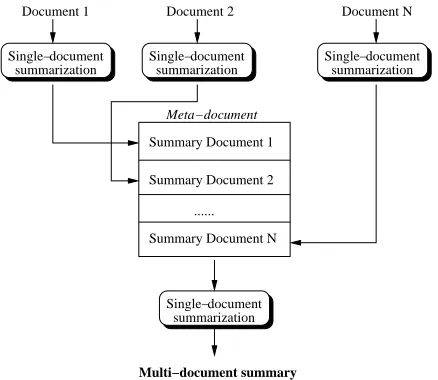
Multi-document summaries are built using a “meta” summarization procedure. First, for each document in a given cluster of documents, a single document summary is generated using one of the graph-based ranking algorithms. Next, a “summary of sum-maries” is produced using the same or a different ranking algorithm. Figure 2 illustrates the meta-summarization process used to generate a multi-document summary starting with a cluster of N documents.
Unlike single documents – where sentences with highly similar content are very rarely if at all en-countered – it is often the case that clusters of mul-tiple documents, all addressing the same or related topics, would contain very similar or even identical sentences. To avoid such pairs of sentences, which may decrease the readability and the amount of in-formation conveyed by a summary, we introduce a maximum threshold on the sentence similarity mea-sure. Consequently, in the graph construction stage, no link (edge) is added between sentences (ver-tices) whose similarity exceeds this threshold. In
Single−document summarization
Single−document summarization
Summary Document 1
Summary Document 2
Summary Document N ...
Single−document summarization Single−document
summarization
Document 1 Document 2 Document N
Meta−document
Multi−document summary
Figure 2: Generation of a multi-document summary using meta-summarization.
the experiments reported in this paper, this similar-ity threshold was empirically set to 0.5.
3 Materials and Evaluation Methodology
Single and multiple English document summariza-tion experiments are run using the summarizasummariza-tion test collection provided in the framework of the Document Understanding Conference (DUC). In particular, we use the data set of 567 news arti-cles made available during the DUC 2002 evalu-ations (DUC, 2002), and the corresponding 100-word summaries generated for each of these doc-uments (single-document summarization), or the 100-word summaries generated for each of the 59 document clusters formed on the same data set (multi-document summarization). These are the summarization tasks undertaken by other systems participating in the DUC 2002 document summa-rization evaluations.
corre-sponding documents, i.e. a summary has to account for about 25-30% of the original document. Con-sequently, the automatic summaries generated for the documents in this collection are not restricted to 100 words, as in the English experiments, but are required to have a length comparable to the corre-sponding manual summaries, to ensure a fair evalu-ation.
For evaluation, we are using the ROUGE
evalu-ation toolkit1, which is a method based on Ngram statistics, found to be highly correlated with human evaluations (Lin and Hovy, 2003a). The evaluation is done using the Ngram(1,1) setting of ROUGE, which was found to have the highest correlation with human judgments, at a confidence level of 95%.
4 Experimental Results
The extractive summarization algorithm is evalu-ated in the context of: (1) A single-document sum-marization task, where a summary is generated for each of the 567 English news articles provided dur-ing the Document Understanddur-ing Evaluations 2002 (DUC, 2002), and for each of the 100 Portuguese documents in the TeM´ario data set; and (2) A multi-document summarization task, where a summary is generated for each of the 59 document clusters in the DUC 2002 data. Since document clusters and multi-document summaries are not available for the Portuguese documents, a multi-document summa-rization evaluation could not be conducted on this data set. Note however that the multi-document summarization tool is based on the single-document summarization method (see Figure 2), and thus high performance in single-document summarization is expected to result into a similar level of perfor-mance in multi-document summarization.
4.1 Single Document Summarization for English
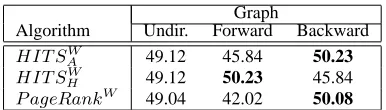
For single-document summarization, we evaluate the extractive summaries produced using each of the two graph-based ranking algorithms described in Section 2 (HIT S and P ageRank). Table 1 shows the results obtained for the 100-words au-tomatically generated summaries for the English DUC 2002 data set. The table shows results us-ing the two graph algorithms described in Section 2 when using graphs that are: (a) undirected, (b) directed forward, or (c) directed backward2.
For a comparative evaluation, Table 2 shows the results obtained on this data set by the top 5 (out
1R
OUGEis available at http://www.isi.edu/˜cyl/ROUGE/. 2
Note that the first two rows in the table are in fact redun-dant, since the “hub” variation of the HITS algorithm can be derived from its “authority” counterpart by reversing the edge orientation in the graphs.
Graph
Algorithm Undir. Forward Backward
HIT SW
A 49.12 45.84 50.23
HIT SW
H 49.12 50.23 45.84
P ageRankW
49.04 42.02 50.08
Table 1: Results for English single-document sum-marization.
of 15) performing systems participating in the sin-gle document summarization task at DUC 2002. It also lists the baseline performance, computed for 100-word summaries generated by taking the first sentences in each article.
Top 5 systems (DUC, 2002)
S27 S31 S28 S21 S29 Baseline
50.11 49.14 48.90 48.69 46.81 47.99
Table 2: Results for top 5 DUC 2002 single docu-ment summarization systems, and baseline.
4.2 Single Document Summarization for Portuguese
The single-document summarization tool was also evaluated on the TeM´ario collection of Portuguese newspaper articles. We used the same graph set-tings as in the English experiments: graph-based ranking algorithms consisting of either HIT S or P ageRank, relying on graphs that are undirected, directed forward, or directed backward. As men-tioned in Section 3, the length of each automatically generated summary was constrained to match the length of the corresponding manual summary, for a fair comparison. Table 3 shows the results obtained on this data set, evaluated using the ROUGE evalu-ation toolkit. A baseline was also computed, using the first sentences in each document, and evaluated at 0.4963.
Graph
Algorithm Undir. Forward Backward
HIT SW
A 48.14 48.34 50.02
HIT SW
H 48.14 50.02 48.34
P ageRankW
49.39 45.74 51.21
Table 3: Results for Portuguese single-document summarization.
4.3 Multiple Document Summarization
We evaluate multi-document summaries gener-ated using combinations of the graph-based rank-ing algorithms that were found to work best in the single document summarization experiments – P ageRankW and HIT SW
process may conceivably be of any size, in this eval-uation their length is limited to 100 words.
As mentioned earlier, different graph algorithms can be used for producing the single document sum-mary and the “meta” sumsum-mary; Table 4 lists the results for multi-document summarization experi-ments using various combinations of graph algo-rithms. For comparison, Table 5 lists the results ob-tained by the top 5 (out of 9) performing systems in the multi-document summarization task at DUC 2002, and a baseline generated by taking the first sentence in each article.
Since no multi-document clusters and associ-ated summaries were available for the other lan-guage considered in our experiments, the multi-document summarization experiments were con-ducted only on the English data set. However, since the multi-doc summarization technique consists of a layered application of single-document summa-rization, we believe that the performance achieved in single-document summarization for Portuguese would eventually result into similar performance figures when applied to the summarization of clus-ters of documents.
Top 5 systems (DUC, 2002)
S26 S19 S29 S25 S20 Baseline
35.78 34.47 32.64 30.56 30.47 29.32
Table 5: Results for top 5 DUC 2002 multi-document summarization systems, and baseline.
4.4 Discussion
The graph-based extractive summarization algo-rithm succeeds in identifying the most important sentences in a text (or collection of texts) based on information exclusively drawn from the text itself. Unlike other supervised systems, which attempt to learn what makes a good summary by training on collections of summaries built for other articles, the graph-based method is fully unsupervised, and re-lies only on the given texts to derive an extractive summary.
For single document summarization, the HIT SW
A and P ageRankW algorithms, run on a graph structure encoding a backward direction across sentence relations, provide the best per-formance. These results are consistent across languages – with similar performance figures observed on both the English DUC data set and on the Portuguese TeM´ario data set. The setting that is always exceeding the baseline by a large margin is P ageRankW on a directed backward graph, with clear improvements over the simple (but powerful) first-sentence selection baseline. Moreover, comparative evaluations performed with respect to other systems participating in the
DUC 2002 evaluations revealed the fact that the performance of the graph-based extractive summa-rization method is competitive with state-of-the-art summarization systems.
Interestingly, the “directed forward” setting is consistently performing worse than the baseline, which can be explained by the fact that both data sets consist of newspaper articles, which tend to concentrate the most important facts toward the be-ginning of the document, and therefore disfavor a forward direction set across sentence relations.
For multiple document summarization, the best “meta” summarizer is theP ageRankW algorithm applied on undirected graphs, in combination with a single summarization system using theHIT SAW ranking algorithm, for a performance similar to the one of the best system in the DUC 2002 multi-document summarization task.
The results obtained during all these experiments prove that graph-based ranking algorithms, previ-ously found successful in Web link analysis and so-cial networks, can be turned into a state-of-the-art tool for extractive summarization when applied to graphs extracted from texts. Moreover, the method was also shown to be language independent, lead-ing to similar results when applied to the summa-rization of documents in different languages.
The better results obtained by algorithms like HIT SW
A and PageRank on graphs containing only backward edges are likely to come from the fact that recommendations flowing toward the beginning of the text take advantage of the bias giving higher summarizing value of sentences occurring at the be-ginning of the document.
Another important aspect of the method is that it gives a ranking over all sentences in a text (or a collection of texts) – which means that it can be easily adapted to extracting very short summaries, or longer more explicative summaries.
4.5 Related Work
Single document “Meta” summarization algorithm summarization algo. P ageRankW
-U P ageRankW
-DB HIT SW
A-U HIT SAW-DB P ageRankW
-U 35.52 34.99 34.56 34.65
P ageRankW
-DB 35.02 34.48 35.19 34.39
HIT SW
A-U 33.68 32.59 32.12 34.23
HIT SW
A-DB 35.72 35.20 34.62 34.73
Table 4: Results for multi-document summarization (U = Undirected; DB = Directed Backward)
which emphasizes the need of accurate tools for sentence extraction as an integral part of automatic summarization systems.
5 Conclusions
Intuitively, iterative graph-based ranking algo-rithms work well on the task of extractive summa-rization because they do not only rely on the local context of a text unit (vertex), but they rather take into account information recursively drawn from the entire text (graph). Through the graphs it builds on texts, a graph-based ranking algorithm identifies connections between various entities in a text, and implements the concept of recommendation. A text unit recommends other related text units, and the strength of the recommendation is recursively com-puted based on the importance of the units making the recommendation. In the process of identifying important sentences in a text, a sentence recom-mends another sentence that addresses similar con-cepts as being useful for the overall understanding of the text. Sentences that are highly recommended by other sentences are likely to be more informa-tive for the given text, and will be therefore given a higher score.
In this paper, we showed that a previously pro-posed method for graph-based extractive summa-rization can be successfully applied to the sum-marization of documents in different languages, without any requirements for additional knowl-edge or corpora. Moreover, we showed how a meta-summarizer relying on a layered application of techniques for single-document summarization can be turned into an effective method for multi-document summarization. Experiments performed on standard data sets have shown that the results ob-tained with this method are comparable with those of state-of-the-art systems for automatic summa-rization, while at the same time providing the bene-fits of a robust language independent algorithm.
Acknowledgments
We are grateful to Lucia Helena Machado Rino for making available the TeM´ario summarization test collection and for her help with this data set.
References
S. Brin and L. Page. 1998. The anatomy of a large-scale hypertextual Web search engine. Computer Networks and ISDN Systems, 30(1–7).
DUC. 2002. Document understanding conference 2002. http://www-nlpir.nist.gov/projects/duc/.
G. Erkan and D. Radev. 2004. Lexpagerank: Prestige in multi-document text summarization. In Proceedings of the Conference on Empirical Methods in Natural Language Processing, Barcelona, Spain, July. T. Hirao, Y. Sasaki, H. Isozaki, and E. Maeda. 2002.
Ntt’s text summarization system for duc-2002. In Proceedings of the Document Understanding Confer-ence 2002.
J.M. Kleinberg. 1999. Authoritative sources in a hyper-linked environment. Journal of the ACM, 46(5):604– 632.
C.Y. Lin and E.H. Hovy. 2003a. Automatic evalua-tion of summaries using n-gram co-occurrence statis-tics. In Proceedings of Human Language Technology Conference (HLT-NAACL 2003), Edmonton, Canada, May.
C.Y. Lin and E.H. Hovy. 2003b. The potential and lim-itations of sentence extraction for summarization. In Proceedings of the HLT/NAACL Workshop on Auto-matic Summarization, Edmonton, Canada, May. R. Mihalcea and P. Tarau. 2004. TextRank – bringing
order into texts. In Proceedings of the Conference on Empirical Methods in Natural Language Processing (EMNLP 2004), Barcelona, Spain.
R. Mihalcea, P. Tarau, and E. Figa. 2004. PageR-ank on semantic networks, with application to word sense disambiguation. In Proceedings of the 20st In-ternational Conference on Computational Linguistics (COLING 2004), Geneva, Switzerland.
T.A.S. Pardo and L.H.M. Rino. 2003. TeMario: a cor-pus for automatic text summarization. Technical re-port, NILC-TR-03-09.
G. Salton, A. Singhal, M. Mitra, and C. Buckley. 1997. Automatic text structuring and summarization. Infor-mation Processing and Management, 2(32).
S. Teufel and M. Moens. 1997. Sentence extraction as a classification task. In ACL/EACL workshop on ”Intelligent and scalable Text summarization”, pages 58–65, Madrid, Spain.