Morphological features help POS tagging of unknown words across
language varieties
Huihsin Tseng
Dept. of Linguistics
University of Colorado
Boulder, CO 80302
Daniel Jurafsky
Dept. of Linguistics
Stanford University
Stanford, CA 94305
Christopher Manning
Dept. of Computer Science
Stanford University
Stanford, CA 94305
Abstract
Part-of-speech tagging, like any supervised statistical NLP task, is more difficult when test sets are very different from training sets, for example when tag-ging across genres or language varieties. We exam-ined the problem of POS tagging of different varieties of Mandarin Chinese (Mainland, PRC-Hong Kong, and Taiwan). An analytic study first showed that unknown words were a major source of difficulty in cross-variety tagging. Unknown words in English tend to be proper nouns. By contrast, we found that Mandarin unknown words were mostly common nouns and verbs. We showed these results are caused by the high frequency of morphological compounding in Mandarin; in this sense Mandarin is more like German than English. Based on this analy-sis, we propose a variety of new morphological un-known-word features for POS tagging, extending earlier work by others on unknown-word tagging in English and German. Our features were implemented in a maximum entropy Markov model. Our system achieves state-of-the-art performance in Mandarin tagging, including improving unknown-word tagging performance on unseen varieties in Chinese Treebank 5.0 from 61% to 80% correct.
1
Introduction
Part-of-speech tagging is an important enabling task for natural language processing, and state-of-the-art taggers perform quite well, when training and test data are drawn from the same corpus. Part-of-speech tagging is more difficult, however, when a test set is drawn from a corpus that includes significantly dif-ferent varieties of the language. One factor that may play a role in this cross-variety difficulty is the pres-ence of test-set words that were unseen in cross-variety training sets.
We chose Mandarin Chinese to study this question of cross-variety and unknown-word POS tagging. Man-darin is both a spoken and a written language; as a written language, it is the official written language of the PRC (Mainland and Hong Kong), and Taiwan.
Thus regardless of which dialect people speak at home, they write in Mandarin. But the varieties of Mandarin written in the PRC (Mainland and Hong Kong) and Taiwan differ in orthography, lexicon, and even grammar about as much as the British, American, and Australian varieties of English (or more in some cases). The corpus we use, Chinese Treebank 5.0 (Palmer et al., 2005), contains data from the three language varieties as well as different genres within the varieties. It thus provides a good data set for the impact of language variation on tag-ging performance.
Previous work on POS tagging of unknown words has proposed a number of features based on prefixes and suffixes and spelling cues like capitalization (Toutanova et al. 2003, Brants 2000, Ratnaparkhi 1996). For example, these systems followed Samuelsson (1993) in using n-grams of letter se-quences ending and starting each word as unknown word features. But these features have mainly been tested on inflectional languages like English and German, whose derivational and inflectional affixes tend to be a strong indicator of word classes; Brants (2000), for example, showed that an English word ending in the suffix -able was very likely to be an adjective. Chinese, by contrast, has more than 4000 frequent affix characters. The amount of training data for each affix is thus quite sparse and (as we will show later) Chinese affixes are quite ambiguous in their part-of-speech identity. Furthermore, it is possi-ble that n-gram features may not be suited to Chinese at all, since Chinese words are much shorter than English (averaging 2.4 characters per word compared with 7.7 for English, for unknown words in CTB 5.0 and Wall Street Journal (Marcus et el., 1993)).
The remainder of the paper is organized as follows. The next section is concerned with a corpus analysis of cross language variety differences and introduces Chinese morphology. In Section 3, we evaluate a number of lexical, sequence, and linguistic features. Section 4 reviews related work and summarizes our contribution.
2
Data
Chinese Treebank 5.0 (CTB) contains 500K words of newspaper and magazine articles annotated with seg-mentation, part-of-speech, and syntactic constituency information. It includes data from three major media sources, XH1 from PRC, HKSAR2from Hong Kong, and SM3 from Taiwan. In terms of genre, both XH and HKSAR focus on politics and economic issues, and SM more on topics such as culture, health, edu-cation and travel. All of the files in CTB are encoded using Guo Biao (GB) and use simplified characters.
We did some cleanup of character encoding errors in CTB before running our experiments. Taiwan and Hong Kong still use the traditional forms of charac-ters, while PRC-Mainland has adopted simplified forms of many characters, which also collapse some distinctions between characters. Additionally a dif-ferent character set encoding is standardly used. The articles in HKSAR and SM originally used tradi-tional characters and Big 5 encoding, but prior to inclusion in the CTB corpus they had been converted into simplified characters and GB. Some errors seem to have crept into this conversion process, acciden-tally leaving traditional characters such as ᕠ instead of simplified ৢ (after), ᮐ for Ѣ (for), ⫮咑 and
Ҕ咑 and ҔМ (what), all of which we fixed. We also normalized half width numbers, alphabets, and punctuation to full width. Finally we removed the -NONE- traces left over from CTB parse trees.
3
Corpus analysis
We begin with an analytic study of potential prob-lems for POS tagging on cross language variety data.
3.1
More unknown words across varieties?
We first test our hypothesis that a test set from a dif-ferent language variety will contain more unknown words. Table 1 has the number of words in our devset that were unseen in the XH-only training set (we describe our training/dev/test split more fully in the next section). The devset contains equal amounts of data from all three varieties (XH, HKSAR, and SM). As table 1 shows, in data taken from the same
1 Xinhua Agency
2 Information Services Department of Hong Kong Special
Admin-istrative Region
3 Sinorama magazine
source as the training data (XH), 4.63% of the words were unseen in training, compared to the much larger numbers of unknown words in the cross-variety data-sets (14.3% and 16.7%). Some of this difference is probably due to genre as well, especially for the out-lier-genre SM set.
Table 1 Percent of words in devset that were unseen in an XH-only training set. See Table 4 for more details.
Data Set Lang Variety Source Genre % unk
XH Mainland
Mandarin
Xinhua News 4.6
HKSAR Hong Kong
Mandarin
HKSAR News 14.2
SM Taiwan
Mandarin
Sino-rama
Magazine 16.7
Devset Mix Mix Mix 12.0
3.2
What are the unknown words?
In this section, we analyze the part-of-speech charac-teristics of the unknown words in our devset.
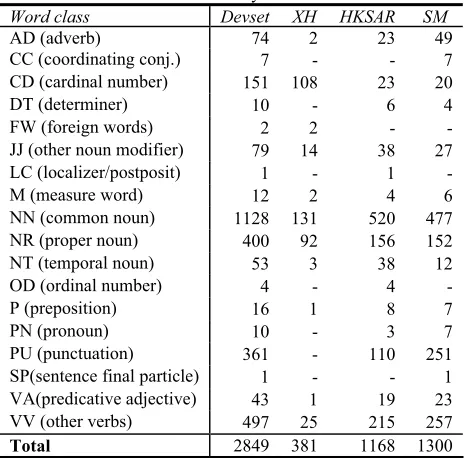
Table 2 Word class distribution of unknown words in devset, XH, HKSAR, SM. Devset represents the conjunc-tion of the three varieties. CC, DT, LC, P, PN, PU, and SP are considered as closed classes by CTB.
Word class Devset XH HKSAR SM
AD (adverb) 74 2 23 49
CC (coordinating conj.) 7 - - 7
CD (cardinal number) 151 108 23 20
DT (determiner) 10 - 6 4
FW (foreign words) 2 2 -
-JJ (other noun modifier) 79 14 38 27
LC (localizer/postposit) 1 - 1
-M (measure word) 12 2 4 6
NN (common noun) 1128 131 520 477
NR (proper noun) 400 92 156 152
NT (temporal noun) 53 3 38 12
OD (ordinal number) 4 - 4
-P (preposition) 16 1 8 7
PN (pronoun) 10 - 3 7
PU (punctuation) 361 - 110 251
SP(sentence final particle) 1 - - 1
VA(predicative adjective) 43 1 19 23
VV (other verbs) 497 25 215 257
Total 2849 381 1168 1300
Table 2 shows that the majority of Chinese unknown words are common nouns (NN) and verbs (VV). This holds both within and across different varieties. Be-yond the content words, we find that 10.96% and 21.31% of unknown words are function words in HKSAR and SM data. Such unknown function words include the determiner gewei (“everybody”), the con-junction huoshi (“or”), the preposition liantong
“or”, yu “with”, dajia “everybody”, quotation marks “Ǎ”and “ǎ”). Our result thus suggests that each Mandarin variety may have characteristic function words.
3.3
Cross language comparison
A key goal of our work is to understand the way that unknown words differ across languages. We thus compare Chinese, German, and English. Following Brants (2000), we extracted 10% of the data from the Penn Treebank Wall Street Journal (WSJ4) and NEGRA5 (Brants et al., 1999) as observation samples to compare to the rest of the corpora.
In these observation samples, we found that Chinese words are more ambiguous in POS than English and German; 29.9% of tokens in CTB have more than one POS tag, while only 19.8% and 22.9% of tokens are ambiguous in English and German, respectively.
Table 3 shows that 40.6% of unknown words are proper nouns6 in English, while both Chinese and German have less than 15% of unknown words as proper nouns. Unlike English, 60% of the unknown words in Chinese and German are verbs and common nouns. In the next section we investigate the cause of this similarity between Chinese and German un-known word distribution.
Table 3 Comparison of unknown words in English, Ger-man and Mandarin. The English and GerGer-man data are ex-tracted from WSJ and NEGRA. Chinese data is our CTB devset.
Language English% German% Chinese%
Proper nouns 40.6 12.2 14.0
Other nouns 24.0 53.0 41.5
Verbs 6.8 11.4 19.0
ALL 100.0 100.0 100.0
4
Morphological analysis
In order to understand the causes of the similarity of Chinese and German, and to help suggest possible features, we turn here to an introduction to Chinese morphology and its implications for part-of-speech tagging.
4 WSJ unknown words are those in WSJ 19-21 but unseen in WSJ
0-18; these are the devset and training set from Toutanova et al. (2003).
5
The unknown words of NEGRA are words in a 10% randomly extracted set that were unseen in the rest of the corpus.
6 We treat NNP (proper noun) and NNPS(proper noun plural) as
proper nouns, NN(noun) and NNS(noun plural) as other nouns, and V* as verbs in WSJ. We treat NE (Eigennamen) as proper nouns, NN (Normales Nomen) as other nouns, and V* as verbs in NEGRA. We treat NR as proper nouns, NN and NT as other nouns, and V* as verbs in CTB.
4.1
Chinese morphology
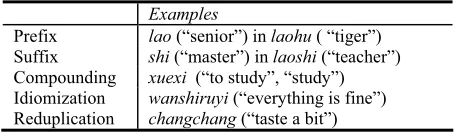
Chinese words are typically formed by four morpho-logical processes: affixation, compounding, idiomi-zation, and reduplication, as shown in Table 4.
In affixation, a bound morpheme is added to other morphemes, forming a larger unit. Chinese has a small number of prefixes and infixes7 and numerous suffixes (Chao 1968, Li and Thompson 1981). Chi-nese prefixes include items such as gui (“noble”) in
guixing (“your name”), bu (“not”) in budaode (“im-moral”), and lao (“senior”) in laohu (“tiger”) and
laoshu (“mouse”). There are a number of Chinese suffixes, including zhe (“marks a person who is an agent of an action”) in zuozhe (“author”), shi (“mas-ter”) in laoshi (“teacher”), ran (-ly) in huran (“sud-denly”), and xin (-ity or –ness) in kenengxin
(“possibility”).
Compound words are composed of multiple stem morphemes. Chao (1968) describes a few of the dif-ferent compounding rules in Mandarin, such as coor-dinate compound, subject predicate compound, noun noun compound, adj noun compound and so on. Two examples of coordinate compounds are anpai
ARRANGE-ARRANGE (“to arrange, arrangement”) andxuexiSTUDY-STUDY (“to study”).
Table 4 Chinese morphological rules and examples
Examples
Prefix lao (“senior”) in laohu ( “tiger”) Suffix shi(“master”) in laoshi (“teacher”) Compounding xuexi (“to study”, “study”) Idiomization wanshiruyi (“everything is fine”) Reduplication changchang(“taste a bit”)
Compounding is extremely common in both Chinese and German. The phrase “income tax” is treated as an NP in English, but it is a word in German, Ein-kommensteuer, and in Chinese, suodesui. We suggest that it is this rich use of compounding that causes the wide variety of unknown common nouns and verbs in Chinese and German. However, there are still dif-ferences in their compound rules. German com-pounds can compose with a large number of elements, but Chinese compounds normally consist of two bases. Most German compounds are nouns, but Chi-nese has both noun and verb compounds.
Two final types of Chinese morphological processes that we will not focus on are idiomization (in which a whole phrase such as wanshiruyi (“everything is fine”) functions as a word, and reduplication, in which a morpheme or word is repeated to form a new word such as the formation of changchang (“taste a
7 Chinese only has two infixes, which are de and bu(not). We do
bit”), from chang “taste”. (Chao 1968, Li and Thompson 1981).
4.2
Difficulty
The morphological characteristics of Chinese create various problems for part-of-speech tagging. First, Chinese suffixes are short and sparse. Because of the prevalence of compounding and the fact that the mor-phemes are short (1 character long), there are more than 4000 affixes. This means that the identity of an affix is often a sparsely-seen feature for predicting POS. Second, Chinese affixes are poor cues to POS because they are ambiguous; for example 63% of Chinese suffix tokens in CTB have more than one possible tag, while only 31% of English suffix tokens in WSJ have more than one tag. Most English suffixes are derivational and inflectional sufsuffixes like
-able, -s and -ed. Such functional suffixes are used to indicate word classes or syntactic function. Chinese, however, has no inflectional suffixes and only a few derivational suffixes and so suffixes may not be as good a cue for word classes. Finally, since Chinese has no derivational morpheme for nominalization, it is difficult to distinguish a nominalization and a verb.
These points suggest that morpheme identity, which is the major feature used in previous research on un-known words in English and German, will be insuffi-cient in Chinese. This suggests the need for more sophisticated features, which we will introduce be-low.
5
Experiments
We evaluate our tagger under several experimental conditions: after showing the effects of data cleanup we show basic results based on features found to be useful by previous research. Next, we introduce addi-tional morphology-based unknown word features, and finally, we experiment with training data of vari-able sizes and different language varieties.
5.1
Data sets
To study the significance of training on different varieties of data, we created three training sets: train-ing set I contains data only from one variety, traintrain-ing set II contains data from 3 varieties, and is similar in total size to training set I. Training set III also con-tains data from 3 varieties and has twice much data as training set I. To facilitate comparison of perform-ance both between and within Mandarin varieties, both the devset and the test set we created are com-posed of three varieties of data. The XH test data we selected was identical to the test set used in previous parsing research by Bikel and Chiang (2000). For the remaining data, we included HKSAR and SM data that is similar in size to the XH test set. Table 5 de-tails characteristics of the data sets.
Table 5 Data set splits used. The unknown word tokens are with respect to Training I.
Data set Sect'ns Token Un-known
Training I 26-270, 600-931 213986 -
Training II 600-931, 500-527, 1001-1039
204701 -
Training III 001-270, 301-527, 590-593, 600-1039, 1043-1151
485321 -
Devset 23839 2849
XH 001-025 7844 381
HKSAR 500-527 8202 1168
SM 590-593, 1001-1002 7793 1300
Test set 23522 2957
XH 271-300 8008 358
HKSAR 528-554 7153 1020
SM 594-596, 1040-1042 8361 1579
5.2
The model
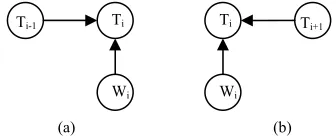
Our model builds on research into loglinear models by Ng and Low (2004), Toutanova et al., (2003) and Ratnaparkhi (1996). The first research uses inde-pendent maximum entropy classifiers, with a se-quence model imposing categorical valid tag sequence constraints. The latter two use maximum entropy Markov models (MEMM) (McCallum et al., 2000), that use log-linear models to obtain the prob-abilities of a state transition given an observation and the previous state, as illustrated in Figure 1 (a).
Figure 1 Graphical representation of transition probability calculation used in maximum entropy Markov models. (a) The previous state and the current word are used to calcu-late the transition probabilities for the next state transition. (b) Same as (a), but when model is run right to left.
Using left-to-right transition probabilities, as in Fig-ure 1 (a), the equation for the MEMM can be for-mally stated as the following, where by di represents the set of features the transition probabilities are con-ditioned on:
(
)
(
i i)
iP
t
|
d
w
t,
P
=
∏
Maximum entropy is used to calculate the probability P(ti| di) using the equation below. Here, fj(ti,di) repre-sents a feature derived from the available contextual information (e.g. current word, previous tag, next word, etc.)
Ti
Ti-1
Wi
Ti
Wi
(a) (b)
(
)
We also used Gaussian prior to prevent overfitting. This technique allows us to utilize a large number of lexical and MEMM state sequence based features and also provides an intuitive framework for the use of morphological features generated from unknown word models.
5.3
Data cleanup
Before investigating the effect of our new features, we show the effects of data cleanup. Table 6 illus-trates the .46 (absolute) performance gain obtained by cleaning character encoding errors and normaliz-ing half width to full width.
We also clustered punctuation symbols, since train-ing set I has too many (36) variety of punctuations, compared to 9 in WSJ. We clustered punctuations, for example grouping “lj” and “LJ” together. This mapping renders an overall improvement of .08%. All models in the following sections are then trained on font-normalized and punctuation clustered data.
Table 6 Improvement of tagging accuracy after data cleanup. The features used by all of the models are the identity of the two previous words, the current word and the two following word. No features based on the sequence of tags were used.
These features have been shown to be useful in pre-vious research on English (Toutanova et al, 2003, Brants 2000, Thede and Harper 1999)
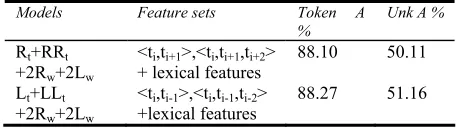
The models9 in Table 7 list the different tag sequence features used; they also use the same lexical features from the model 2Rw+2Lwshown in Table 6. The ta-ble shows that Model Lt+LLt conditioning on the previous tag and the conjunction of the two previous
8 We abbreviate accuracy as “A”.
9 Except where otherwise stated, during training, a count cutoff of
3 is applied to all features found in the training set. If a feature occurs fewer than 3 times, it is simply removed from the training data. All models are trained on training set I and evaluated on the devset.
tags yields 88.27%. As such, using the sequence fea-tures<ti-1, ti-1ti-2> achieves the current best result.
So far, there are no features specifically tailored to-ward unknown words in the model.
Table 7 Tagging accuracy of different sequence feature sets.
Models Feature sets Token A
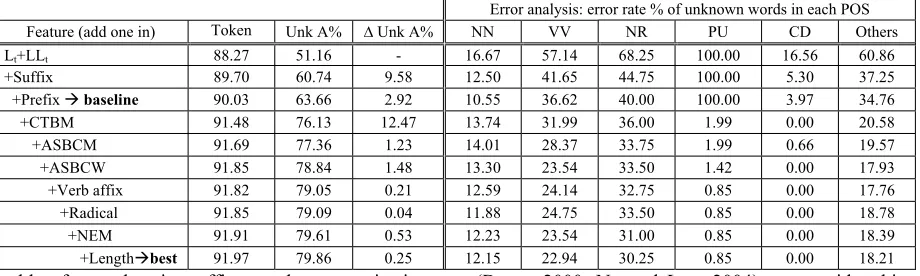
Starting with Model Lt+LLt from the last section, we introduce 8 features to improve the performance of the tagger on unknown words. In the sections that follow, the model using affixation in conjunction with the basic lexical features described above is considered to be our baseline.
We considered words that occur less than 7 times in the training set I as rare; if Wi is rare, an unknown
word feature is used in place of a feature based on the actual word’s identity. During evaluation, un-known word features are used for all words that oc-curred zero to 7 times in the training data. In addition, when tagging such rare and unknown words, we re-Low 2004, Toutanova et al, 2003, Brants 2000, Rat-naparkhi 1996, Samuelsson 1993). Since Chinese also has affixation, it is reasonable to incorporate this feature into our model. For this feature, we use char-actern-gram prefixes and suffixes for n up to 4.10 An
While affix information can be very informative, we showed earlier that affixes in Chinese are sparse, short, and ambiguous. Thus as our first new feature we used a POS-vector of the set of tags a given affix could have. We used the training set to build a mor-pheme/POS dictionary with the possible tags for each
10 Despite the short average word length, we found that affixes up
morpheme. Thus for each prefix and suffix that oc-curs with each CTB tag in the training set I, we asso-ciate a set of binary features corresponding to each CTB tag. In the example below the prefix 䌘 oc-curred in both NN and VV words, but not AD or AS.
Prefix1=䌘, suffix1=㹟
FCTBM-pre= {(AD,0),(AS,0),…(NN,1),…(VV,1)}
FCTBM-suf= {(AD,0),(AS,0),…(NN,1),…(VV,0)}
This model smoothes affix identity and the quantity of active CTBMorph features for a given affix ex-presses the degree of ambiguity associated with that affix.
Figure 2 Pseudo-code for CTBMorph GenCTBMorphFeatureSet (Word W) FeatureSet f;
for each t in CTB tag set:
for each single-character prefix or suffix kof W if t.affixList contain k f.appendPair(t, 1) else f.appendPair(t, 0)
5.5.3 ASBC
One way to deal with robustness is to add more var-ied training data. For example the Academic Sinica Balanced Corpus11 contains POS-tagged data from a different variety (Taiwanese Mandarin). But the tags in this corpus are not easily converted to the CTB tags. This problem of labeled data from very differ-ent tagsets can happen more generally. We introduce two alternative methods for making use of such a corpus.
5.5.3.1 ASBCMorph (ASBCM)
The ASBCMorph feature set is generated in an iden-tical manner to the CTBMorph feature set, except that rather than generating the morpheme table using CTB, another corpus is used. The morpheme table is generated from the Academic Sinica Balanced Cor-pus, ASBC (Huang and Chen 1995), a 5 M word balanced corpus written in Taiwanese Mandarin. As the CTB annotation guide12 states, the mapping be-tween the tag sets used in the two corpora is non-trivial. As such, the ASBC data can not be directly used to augment the training set. However, using our ASBCMorph feature, we are still able to derive some benefit out of such an alternative corpus.
5.5.3.2 ASBCWord (ASBCW)
The ASBCWord feature is identical to the ASBCMorph feature, except that instead of using a table of tags that occur with each affix, we use a table of tags that a word occurs with in the ASBC data.
11 The ASBC was originally encoded in traditional Big5 character,
and we converted it to simplified GB.
12 http://www.cis.upenn.edu/~chinese/posguide.3rd.ch.pdf
Thus, a rare word in the CTB training/test set is augmented with features that correspond to all of the tags that the given word occurred with in the ASBC corpus, i.e. in this case, the pos tag of the identical word in ASBC, 䌘᭭㹟.
Wi=䌘᭭㹟
FASBCWord={(A,0),(Caa,0),(Cab,0)…(V_2,0)}
5.5.4 Verb affix
This feature set contains only two feature values, based on whether a list of verb affixes contains the prefix or suffix of an unknown word. We use the verb affix list created by the Chinese Knowledge Information Processing Group13 at Academia Sinica. It contains 735 frequent verb prefixes and 282 fre-quent verb suffixes. For example,
Prefix1=䌘, suffix1=㹟
Fverb={(verb prefix, 1), (verb suffix, 0)}
5.5.5 Radicals
Radicals are the basic building blocks of Chinese characters. There are over 214 radicals, and all Chi-nese characters contain one or more of them. Some-times radicals reflect the meaning of a character. For example, the characters ⤈ (monkey), ⣾ (pig) ⣿
(kitty cat) all contain the radical ⢁ that roughly means “something that is an animal”. For our radical based feature, we use the radical map from the Uni-han database.14 The radicals associated with the char-acters in the prefix and suffix of unknown words were incorporated into the model as features, for ex-ample:
Prefix1=䌘, suffix1=㹟
FRADICAL={(radical prefix, 䋱), (radical suffix,㸷)}
5.5.6 Named Entity Morpheme (NEM)
There is a convention that the suffix of a named en-tity points out the essential meaning of the named entity. For example, the suffix bao (newspaper) ap-pears in Chinese translation of “WSJ”, huaerjierebao.
The suffix he (river) is used to identify rivers, for example in huanghe (yellow river).
To take advantage of this fact, we made 3 tables of named entity characters from the Chinese English Named Entity Lists (CENEL) (Huang 2002). These lists consist of a table of Chinese first name charac-ters, a table of Chinese last name characcharac-ters, and a
13 http://turing.iis.sinica.edu.tw/affix/
14 Unihan database is downloadable from their website:
Table 8 Devset performance of the cumulatively rare word models, starting with the baseline. The second and third columns show the change in token accuracies and unknown word accuracies from the baseline for each feature introduced cumulatively. The fourth column shows the improvement from each feature set. The six columns on the right side of the table shows the error rate for the 5 most frequent tagsets of unknown words and the rest of unknown words.
Error analysis: error rate % of unknown words in each POS
Feature (add one in) Token Unk A% ¨ Unk A% NN VV NR PU CD Others
Lt+LLt 88.27 51.16 - 16.67 57.14 68.25 100.00 16.56 60.86
+Suffix 89.70 60.74 9.58 12.50 41.65 44.75 100.00 5.30 37.25
+Prefix Æ baseline 90.03 63.66 2.92 10.55 36.62 40.00 100.00 3.97 34.76
+CTBM 91.48 76.13 12.47 13.74 31.99 36.00 1.99 0.00 20.58
+ASBCM 91.69 77.36 1.23 14.01 28.37 33.75 1.99 0.66 19.57
+ASBCW 91.85 78.84 1.48 13.30 23.54 33.50 1.42 0.00 17.93
+Verb affix 91.82 79.05 0.21 12.59 24.14 32.75 0.85 0.00 17.76 +Radical 91.85 79.09 0.04 11.88 24.75 33.50 0.85 0.00 18.78 +NEM 91.91 79.61 0.53 12.23 23.54 31.00 0.85 0.00 18.39 +LengthÆbest 91.97 79.86 0.25 12.15 22.94 30.25 0.85 0.00 18.21
table of named entity suffixes such as organization, place, and company names in CENEL. Our named entity feature set contains 3 features, each corre-sponding to one of the three tables just described. To generate these features, first, we check if the prefix of an unknown is in the Chinese last name table. Sec-ond, we check if the suffix is in the Chinese first name table. Third, we check if the suffix of an un-known word is in the table of named entity suffixes. In Chinese last names are written in front of a first name, and the whole name is considered as a word, for example:
Prefix1=䌘, suffix1=㹟
FNEM={(last name, 0), (first name, 0), (NE suffix,
1)}
5.5.7 Length of a word
The length of a word can be a useful feature, because the majority of words in CTB have less than 3 char-acters. Words that have more than 3 characters are normally proper nouns, numbers, and idioms. There-fore, we incorporate this feature into the system. For example:
Wi=䌘᭭㹟, Flength={(length , 3)}
5.5.8 Evaluation
Table 8 shows our results using the standard maxi-mum entropy forward feature selection algorithm; at each iteration we add the feature family that most significantly improves the log likelihood of the train-ing data given the model. We seed the feature space search with the features in Model Lt+LLt. From this model, adding suffix information gives a 9.58% (ab-solute) gain on unknown word tagging. Subsequently adding in prefix makes unknown word accuracy go up to 63.66%. Our first result is that Chinese affixes are indeed informative for unknown words. On the right side of Table 8, we can see that this perform-ance gain is derived from better tagging of common nouns, verbs, proper nouns, numbers and others. Be-cause earlier work in many languages including Chi-nese uses these simple prefix and suffix features
(Brants 2000, Ng and Low 2004) we consider this performance (63.66% on unknown words) as our baseline.
Adding in the feature set CTBM gives another 12.47% (absolute) improvement on unknown words. With this feature, punctuation shows the largest tag-ging improvement. The CTBM feature helps to iden-tify punctuation since all other characters have been seen in different morpheme table made from the training set. That is, for a given word the lack of CTBM features cues that the word is a punctuation mark. Also, while this feature set generally helps all tagsets, it hurts a bit on nouns.
Adding in the ASBC feature sets yields another 1.23% and 1.48% (absolute) gains on unknown words. These two feature sets generally improve per-formance on all tagsets. Including the verb affix fea-ture helps with common nouns and proper nouns, but hurts the performance on verbs. Overall, it yields 0.21% gain on unknown words. Finally, adding the radical feature helps the most on nouns, while subse-quently adding in the name entity morphemes help to reduce the error on proper nouns by 2.50%. Finally, adding in feature length renders a 0.25% gain on unknown words. Commutatively, applying the fea-ture sets results in an overall accuracy of 91.97% and an unknown word accuracy of 79.86%.
5.6
Experiments with the training sets of
variable sizes and varieties
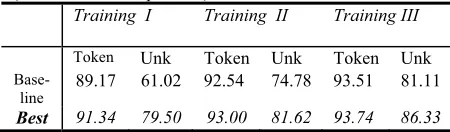
In this section, we compare our best model with the baseline model using different corpora size and lan-guage varieties in the training set. All the evaluations are reported on the test set, which has roughly equal amounts of data from XH, HKSAR, and SM.
Table 9 Comparison of the baseline and our best model. Using different training sets to evaluate on the test set. (McNemar’s Test p <.001)
Training I Training II Training III
Token Unk Token Unk Token Unk
Base-line
89.17 61.02 92.54 74.78 93.51 81.11
Best 91.34 79.50 93.00 81.62 93.74 86.33
The right column shows the effect of doubling the training set size, using mixed varieties. As expected, using more data benefits both models.
These results show that having training data from different varieties is better than having data from one source. But crucially, our morphological-based fea-tures improve the tagging performance on unknown words even when the training set includes some data that resembles the test set.
How good are our best numbers, i.e. 93.7% on POS tagging in CTB 5.0? Unfortunately, there are no clean direct comparisons in the literature. The closest result in the literature is Xue et al. (2002), who re-train the Ratnaparkhi (1996) tagger and reach accu-racies of 93% using CTB-I. However CTB-I contains only XH data and furthermore the data split is no longer known for this experiment (Xue p.c.) so a comparison is not informative. However, our per-formance on tagging when trained on Training I and tested on just the XH part of the test set is 94.44%, which might be a more relevant comparison to Xue et al. (2002).
6
Conclusion
Previous research in part-of-speech tagging has re-sulted in taggers that perform well when the training set and test set are both drawn from the same corpus. Unfortunately, for many potential real world applica-tions, such an arrangement is just not possible.
Our results show that using sophisticated morpho-logical features can help solve this robustness prob-lem. These features would presumably also be applicable to other languages and NLP tasks that could benefit from the use of morphological informa-tion
Besides these tagging results, our research provides valuable analytic results on understanding the nature of unknown words cross-linguistically. Our results that unknown words in Chinese are not proper nouns like in English, but rather common nouns and verbs, suggest a similarity to German. We suggest this is because both German and Chinese, despite their huge differences in genetic, area, and other typological characteristics, tend to form unknown words through a similar word formation rule, compounding.
7
Acknowledgement
Thanks to Kristina Toutanova and Galen Andrew for their generous help and to the anonymous reviewers. This work was partially funded by ARDA
AQUAINT and by NSF award IIS-0325646.
8
References
Bikel, Daniel and David Chiang. 2000. Two statisti-cal parsing models applied to the Chinese Tree-bank. In CLP2.
Brants, Thorsten. 2000. TnT: a statistical part-of-speech tagger. In ANLP 6.
Brants, Thorsten Wojciech Skut, Hans Uszkoreit. 1999. Syntactic Annotation of a German Newspa-per Corpus In: Anne Abeillé: ATALA sur le Corpus Annotés pour la Syntaxe Treebanks.
Chao, Yuen Ren. 1968. A Grammar of Spoken Chi-nese. Berkeley: University of California Press. Huang, Chu-ren. and Keh-Jiann Chen. 1995.
Aca-demic Sinica Balanced Corpus. Technical Report 95-02/98-04. Academic Sinica.
Huang, Shudong. 2002. Chinese <-> English Name Entity Lists Version 1.0 beta. Catalog number: LDC2003E01.
Li, Charles and Sandra A Thompson. 1981. Manda-rin Chinese: A Functional Reference Grammar. Berkeley: University of California Press. McCallum, Andrew, Dayne Freitag, Fernando
Pereira. 2000. Maximum Entropy Markov Models for Information Extraction and Segmentation. In
ICML 17.
Marcus, Mitchel, Beatrice Santorini and Mary Ann Marcinkiewicz. 1993. Building a large annotated corpus of English: The Penn Treebank. In Compu-tational Linguistics, 19.
Ng, Hwee Tou and Jin Kiat Low. 2004. Chinese Part-of-Speech Tagging: One-at-a-Time or All-at-Once? Word-Based or Character-Based? In EMNLP 9. Martha Palmer, Fu-Dong Chiou, Nianwen Xue,
Tsan-Kuang Lee. 2005. Chinese Treebank 5.0. Catalog number: LDC2005T01.
Ratnaparkhi, Adwait. 1996. A maximum entropy model forpart-of-speech tagging. In EMNLP 1. Thede, Scott and Mary P. Harper. 1999. Second-order hidden Markov model for part-of-speech tagging. In ACL 37.
Toutanova, Kristina, Dan Klein, Christopher Man-ning, and Yoram Singer. 2003. Feature-Rich Part-of-Speech Tagging with a Cyclic Dependency Net-work. In HLT-NAACL 2003.
Samuelsson, Christer. 1993. Morphological tagging based entirely on bayesian inference. In NCCL 9. Xue, Nianwen, Fu-dong Chiou and Martha Palmer.