Automatic Extraction of Idioms using Graph Analysis and Asymmetric
Lexicosyntactic Patterns
Dominic Widdows MAYA Design, Inc. Pittsburgh, Pennsylvania
Beate Dorow
Institute for Natural Language Processing University of Stuttgart
Abstract
This paper describes a technique for ex-tracting idioms from text. The tech-nique works by finding patterns such as “thrills and spills”, whose reversals (such as “spills and thrills”) are never encoun-tered.
This method collects not only idioms, but also many phrases that exhibit a strong tendency to occur in one particular order, due apparently to underlying semantic is-sues. These include hierarchical relation-ships, gender differences, temporal order-ing, and prototype-variant effects.
1 Introduction
Natural language is full of idiomatic and metaphor-ical uses. However, language resources such as dic-tionaries and lexical knowledge bases give at best poor coverage of such phenomena. In many cases, knowledge bases will mistakenly ‘recognize’ a word and this can lead to more harm than good: for exam-ple, a typical mistake of blunt logic would be to as-sume that “somebody let the cat out of the bag” im-plied that “somebody let some mammal out of some container.”
Idiomatic generation of natural language is, if anything, an even greater challenge than idiomatic language understanding. As pointed out decades ago by Fillmore (1967), a complete knowledge of En-glish requires not only an understanding of the se-mantics of the word good, but also an awareness
that this special adjective (alone) can occur with the word any to construct phrases like “Is this paper any good at all?”, and traditional lexical resources were not designed to provide this information. There are many more general examples occur: for exam-ple, “the big bad wolf” sounds right and the “the bad big wolf” sounds wrong, even though both versions are syntactically and semantically plausible. Such examples are perhaps ‘idiomatic’, though we would perhaps not call them ‘idioms’, since they are com-positional and can sometimes be predicted by gen-eral pattern of word-ordering.
In general, the goal of manually creating a com-plete lexicon of idioms and idiomatic usage patterns in any language is unattainable, and automatic ex-traction and modelling techniques have been devel-oped to fill this ever-evolving need. Firstly, auto-matically identifying potential idioms and bringing them to the attention of a lexicographer can be used to improve coverage and reduce the time a lexicog-rapher must spend in searching for such examples. Secondly and more ambitiously, the goal of such work is to enable computers to recognize idioms in-dependently so that the inevitable lack of coverage in language resources does not impede their ability to respond intelligently to natural language input.
In attempting a first-pass at this task, the exper-iments described in this paper proceed as follows. We focus on a particular class of idioms that can be extracted using lexicosyntactic patterns (Hearst, 1992), which are fixed patterns in text that suggest that the words occurring in them have some inter-esting relationship. The patterns we focus on are occurrences of the form “Aand/orB”, whereAand
B are both nouns. Examples include “football and cricket” and “hue and cry.” From this list, we extract those examples for which there is a strong prefer-ence on the ordering of the participants. For exam-ple, we do see the pattern “cricket and football,” but rarely if ever encounter the pattern “cry and hue.” Using this technique, 4173 potential idioms were ex-tracted. This included a number of both true idioms, and words that have regular semantic relationships but do appear to have interesting orderings on these relationships (such as earlier before later, strong be-fore weak, prototype bebe-fore variant).
The rest of this paper is organized as follows. Sec-tion 2 elaborates on some of the previous works that motivate the techniques we have used. Sec-tion 3 describes the precise method used to extract idioms through their asymmetric appearance in a large corpus. Section 4 presents and analyses several classes of results. Section 5 describes the methods attempted to filter these results into pairs of words that are more and less contextually related to one an-other. These include a statistical method that analy-ses the original corpus for evidence of semantic re-latedness, and a combinatoric method that relies on link-analysis on the resulting graph structure.
2 Previous and Related Work
This section describes previous work in extracting information from text, and inferring semantic or id-iomatic properties of words from the information so derived.
The main technique used in this paper to ex-tract groups of words that are semantically or id-iomatically related is a form of lexicosyntactic pat-tern recognition. Lexicosyntactic patpat-terns were pio-neered by Marti Hearst (Hearst, 1992; Hearst and Sch¨utze, 1993) in the early 1990’s, to enable the addition of new information to lexical resources such as WordNet (Fellbaum, 1998). The main in-sight of this sort of work is that certain regular pat-terns in word-usage can reflect underlying seman-tic relationships. For example, the phrase “France, Germany, Italy, and other European countries” sug-gests that France, Germany and Italy are part of the class of European countries. Such hierarchi-cal examples are quite sparse, and greater coverage was later attained by Riloff and Shepherd (1997)
and Roark and Charniak (1998) in extracting rela-tions not of hierarchy but of similarity, by find-ing conjunctions or co-ordinations such as “cloves, cinammon, and nutmeg” and “cars and trucks.” This work was extended by Caraballo (1999), who built classes of related words in this fashion and then rea-soned that if a hierarchical relationship could be ex-tracted for any member of this class, it could be ap-plied to all members of the class. This technique can often mistakenly reason across an ambiguous middle-term, a situation that was improved upon by Cederberg and Widdows (2003), by combining pattern-based extraction with contextual filtering us-ing latent semantic analysis.
Prior work in discovering non-compositional phrases has been carried out by Lin (1999) and Baldwin et al. (2003), who also used LSA to distinguish between compositional and non-compositional verb-particle constructions and noun-noun compounds.
At the same time, work in analyzing idioms and asymmetry within linguistics has become more so-phisticated, as discussed by Benor and Levy (2004), and many of the semantic factors underlying our re-sults can be understood from a sophisticated theoret-ical perspective.
Other motivating and related themes of work for this paper include collocation extraction and ex-ample based machine translation. In the work of Smadja (1993) on extracting collocations, prefer-ence was given to constructions whose constituents appear in a fixed order, a similar (and more generally implemented) version of our assumption here that asymmetric constructions are more idiomatic than symmetric ones. Recent advances in example-based machine translation (EBMT) have emphasized the fact that examining patterns of language use can significantly improve idiomatic language generation (Carl and Way, 2003).
3 The Symmetric Graph Model as used for Lexical Acquisition and Idiom
Extraction
The main extraction technique is to use lexicosyn-tactic patterns of the form “A, B and/orC” to find nouns that are linked in some way. For example, consider the following sentence from the British Na-tional Corpus (BNC).
Ships laden with nutmeg, cinnamon, cloves or coriander once battled the
Seven Seas to bring home their precious
cargo.
Since the BNC is tagged for parts-of-speech, we know that the words highlighted in bold are nouns. Since the phrase “nutmeg, cinnamon, cloves or co-riander” fits the pattern “A, B,C orD”, we create nodes for each of these nouns and create links be-tween them all. When applied to the whole of the BNC, these links can be aggregated to form a graph with 99,454 nodes (nouns) and 587,475 links, as de-scribed by Widdows and Dorow (2002). This graph was originally used for lexical acquisition, since clusters of words in the graph often map to recog-nized semantic classes with great accuracy (>80%, (Widdows and Dorow, 2002)).
However, for the sake of smoothing over sparse data, these results made the assumption that the links between nodes were symmetric, rather than directed. In other words, when the pattern “Aand/orB” was encountered, a link fromAtoBand a link fromB
toAwas introduced. The nature of symmetric and antisymmetric relationships is examined in detail by Widdows (2004). For the purposes of this paper, it suffices to say that the assumption of symmetry (like the assumption of transitivity) is a powerful tool for improving recall in lexical acquisition, but also leads to serious lapses in precision if the directed nature of links is overlooked, especially if symmetrized links are used to infer semantic similarity.
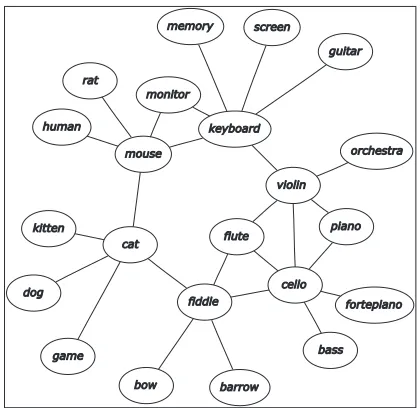
This problem was brought strikingly to our atten-tion by the examples in Figure 1. In spite of appear-ing to be a circle of related concepts, many of the nouns in this group are not similar at all, and many of the links in this graph are derived from very very different contexts. In Figure 1,catandmouseare linked (they are re both animals and the phrase “cat and mouse” is used quite often): but then mouse
andkeyboardare also linked because they are both
objects used in computing. A keyboard, as well as being a typewriter or computer keyboard, is also
[image:3.612.320.530.65.269.2]fiddle fiddle fiddle cat cat cat barrow barrow barrow bow bow bow cello cello cello flute flute flute mouse mouse mouse dog dog dog game game game kitten kitten kitten violin violin violin piano piano piano bass bass bass fortepiano fortepiano fortepiano orchestra orchestra orchestra keyboard keyboard keyboard screen screen screen monitor monitor monitor memory memory memory guitar guitar guitar rat rat rat human human human
Figure 1: A cluster involving several idiomatic links
used to mean (part of) a musical instrument such as an organ or piano, andkeyboard is linked to
vio-lin. Aviolinand afiddleare the same instrument (as
often happens with synonyms, they don’t appear to-gether often but have many neighbours in common). The unlikely circle is completed (it turns out) be-cause of the phrase from the nursery rhyme
Hey diddle diddle, The cat and the fiddle,
The cow jumped over the moon;
It became clear from examples such as these that idiomatic links, like ambiguous words, were a seri-ous problem when using the graph model for lexical acquisition. However, with ambiguous words, this obstacle has been gradually turned into an opportu-nity, since we have also developed ways to used the apparent flaws in the model to detect which words are ambiguous in the first place (Widdows, 2004, Ch 4). It is now proposed that we can take the same op-portunity for certain idioms: that is, to use the prop-erties of the graph model to work out which links arise from idiomatic usage rather than semantic sim-ilarity.
3.1 Idiom Extraction by Recognizing
Asymmetric Patterns
Table 1: Sample of asymmetric pairs extracted from the BNC.
First word Second word highway byway
cod haddock
composer conductor wood charcoal element compound
assault battery
north south
rock roll
god goddess
porgy bess
middle class war aftermath
god hero
metal alloy
salt pepper
mustard cress stocking suspender
bits bobs
stimulus response committee subcommittee
continent ocean
However, no corpus examples were ever found of the converse phrase, “the fiddle and the cat.” In cases like these, it may be concluded that placing a sym-metric link between these two nodes is a mistake. Instead, a directed link may be more appropriate.
We therefore formed the hypothesis that if the phrase “Aand/orB” occurs frequently in a corpus, but the phrase “B and/orA” is absent, then the link betweenAandB should be attributed to idiomatic usage rather than semantic similarity.
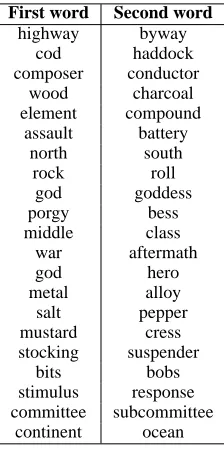
The next step was to rebuild, finding those rela-tionships that have a strong preference for occurring in a fixed order. Sure enough, several British English idioms were extracted in this way. However, several other kinds of relationships were extracted as well, as shown in the sample in Table 1.1
After extracting these pairs, groups of them were gathered together into directed subgraphs.2 Some of these directed subgraphs are reporduced in the anal-ysis in the following section.
1
The sample chosen here was selected by the authors to be representative of some of the main types of results. The com-plete list can be found at http://infomap.stanford. edu/graphs/idioms.html.
2
These can be viewed at http://infomap. stanford.edu/graphs/directed_graphs.html
4 Analysis of Results
The experimental results include representatives of several types of asymmetric relationships, including the following broad categories.
‘True’ Idioms
There are many results that display genuinely id-iomatic constructions. By this, we mean phrases that have an explicitly lexicalized nature that a native speaker may be expected to recognize as having a special reference or significance. Examples include the following:
thrills and spills bread and circuses Punch and Judy Porgy and Bess lies and statistics cat and fiddle bow and arrow skull and crossbones
This category is quite loosely defined. It includes
1. historic quotations such as “lies, damned lies and statistics”3and “bread and circuses.”4
2. titles of well-known works.
3. colloquialisms.
4. groups of objects that have become fixed nom-inals in their own right.
All of these types share the common property that any NLP system that encounters such groups, in or-der to behave correctly, should recognize, generate, or translate them as phrases rather than words.
Hierarchical Relationships
Many of the asymmetric relationships follow some pattern that may be described as roughly hi-erarchical. A cluster of examples from two domains is shown in Figure 2. In chess, a rook outranks a bishop, and the phrase “rook and bishop” is encoun-tered much more often than the phrase “bishop and
3
Attributed to Benjamin Disraeli, certainly popularized by Mark Twain.
4
Figure 2: Asymmetric relationships in the chess and church hierarchies
Figure 3: Different beverages, showing their di-rected relationships
rook.” In the church, a cardinal outranks a bishop, a bishop outranks most of the rest of the clergy, and the clergy (in some senses) outrank the laity.
Sometimes these relationships coincide with fig-ure / ground and agent / patient distinctions. Ex-amples of this kind, as well as “clergy and laity”, include “landlord and tenant”, “employer and em-ployee”, “teacher and pupil”, and “driver and pas-sengers”. An interesting exception is “passengers and crew”, for which we have no semantic explana-tion.
[image:5.612.105.266.278.397.2]Pedigree and potency appear to be two other di-mensions that can be used to establish the directed-ness of an idiomatic construction. For example, Fig-ure 3 shows that alcoholic drinks normally appear before their cocktail mixers, but that wine outranks some stronger drinks.
Figure 4: Hierarchical relationships between aristo-crats, some of which appear to be gender based
Gender Asymmetry
The relationship between corresponding concepts of different genders also appear to be heavily biased towards appearing in one direction. Many of these relationships are shown in Figure 4. This shows that, in cases where one class outranks another, the higher class appears first, but if the classes are iden-tical, then the male version tends to appear before the female. This pattern is repeated in many pairs of words such as “host and hostess”, “god and god-dess”, etc. One exception appears to be in parent-ing relationships, where female precedes male, as in “mother and father”, “mum and dad”, “grandma and grandpa”.
Temporal Ordering
If one word refers to an event that precedes an-other temporally or logically, it almost always ap-pears first. The examples in Table 2 were extracted by our experiment. It has been pointed out that for cyclical events, it is perfectly possible that the order of these pairs may be reversed (e.g., “late night and early morning”), though the data we extracted from the BNC showed strong tendencies in the directions given.
A directed subgraph showing many events in hu-man lives in shown in Figure 5.
Prototype precedes Variant
Table 2: Pairs of events that have a strong tendency to occur in asymmetric patterns.
Before After spring autumn morning afternoon morning evening evening night morning night beginning end
question answer shampoo conditioner marriage divorce
arrival departure eggs larvae
molecules”, “metals and alloys”. Also, we see “ap-ples and pears”, “apple and plums”, and “ap“ap-ples and oranges”, suggesting that an apple is a prototypical fruit (in agreement with some of the results of pro-totype theory; see Rosch (1975)).
Another possible version of this tendency is that core precedes periphery, which may also account for asymmetric ordering of food items such as “fish and chips”, “bangers and mash”, “tea and coffee” (in the British National Corpus, at least!) In some cases such as “meat and vegetables”, a hierarchical or fig-ure / ground distinction may also be argued.
Mistaken extractions
Our preliminary inspection has shown that the ex-traction technique finds comparatively few genuine mistakes, and the reader is encouraged to follow the links provided to check this claim. However, there are some genuine errors, most of which could be avoided with more sophisticated preprocessing.
To improve recall in our initial lexical acquisition experiments, we chose to strip off modifiers and to stem plural forms to singular forms, so that “apples and green pears” would give a link betweenapple
andpear.
However, in many cases this is a mistake, be-cause the bracketing should not be of the form “A
[image:6.612.135.236.95.228.2]and (B C),” but of the form “(A and B) C.” Us-ing part-of-speech tags alone, we cannot recover this information. One example is the phrase “hard-ware and soft“hard-ware vendors,” from which we ob-tain a link between hardware and vendors, in-stead of a link between hardware and software. A fuller degree of syntactic analysis would improve this situation. For extracting semantic relationships,
Figure 5: Directed graph showing that life-events are usually ordered temporally when they occur to-gether
Cederberg and Widdows (2003) demonstrated that nounphrase chunking does this work very satisfacto-rily, while being much more tractable than full pars-ing.
The mistaken pair middle and class shown in Table 1 is another of these mistakes, arising from phrases such as “middle and upper class” and “mid-dle and working class.” These examples could be avoided simply by more accurate part-of-speech tag-ging (since the word “middle” should have been tagged as an adjective in these examples).
This concludes our preliminary analysis of re-sults.
5 Filtering using Latent Semantic Analysis and Combinatoric Analysis
From the results in the previous section, the follow-ing points are clear.
1. It is possible to extract many accurate exam-ples of asymmetric constructions, that would be necessary knowledge for generation of natural-sounding language.
2. Some of the pairs extracted are examples of general semantic patterns, others are examples of genuinely idiomatic phrases.
would be useful to be able to tell which of the asym-metric patterns extracted by our experiments corre-spond to semantically regular phrases which hap-pen to have a conventional ordering preference, and which phrases correspond to genuine idioms. This final section demonstrates two techniques for per-forming this filtering task, which show promising re-sults for improving our classification, though should not yet be considered as reliable.
5.1 Filtering using Latent Semantic Analysis
Latent semantic analysis or LSA (Landauer and Du-mais, 1997) is by now a tried and tested technique for determining semantic similarity between words by analyzing large corpus (Widdows, 2004, Ch 6). Because of this, LSA can be used to determine whether a pair of words is likely to participate in a regular semantic relationship, even though LSA may not contribute specific information regarding the na-ture of the relationship. However, once a relation-ship is expected, LSA can be used to predict whether this relationship is used in contexts that are typical uses of the words in question, or whether these uses appear to be anomalies such as rare senses or idioms. This technique was used successfully by (Cederberg and Widdows, 2003) to improve the accuracy of hy-ponymy extraction. It follows that it should be use-ful to tell the difference between regularly related words and idiomatically related words.
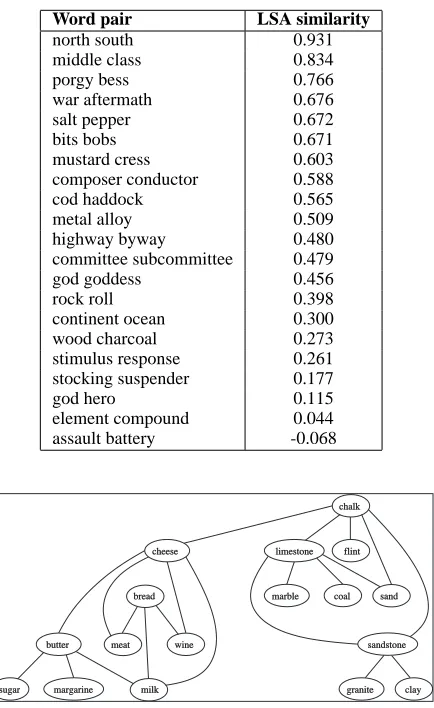
To test this hypothesis, we used an LSA model built from the BNC using the Infomap NLP soft-ware.5 This was used to measure the LSA similar-ity between the words in each of the pairs extracted by the techniques in Section 4. In cases where a word was too infrequent to appear in the LSA model, we used ‘folding in,’ which assigns a word-vector ‘on the fly’ by adding together the vectors of any surrounding words of a target word that are in the model.
The results are shown in Table 3. The hypothesis is that words whose occurrence is purely idiomatic would have a low LSA similarity score, because they are otherwise not closely related. However, this hypothesis does not seem to have been confirmed, partly due to the effects of overall frequency. For example, the wordPorgyonly occurs in the phrase
5
[image:7.612.321.538.96.450.2]Freely available from http://infomap-nlp. sourceforge.net/
Table 3: Ordering of results from semantically sim-ilar to semantically dissimsim-ilar using LSA
Word pair LSA similarity
north south 0.931
middle class 0.834
porgy bess 0.766
war aftermath 0.676
salt pepper 0.672
bits bobs 0.671
mustard cress 0.603
composer conductor 0.588
cod haddock 0.565
metal alloy 0.509
highway byway 0.480
committee subcommittee 0.479
god goddess 0.456
rock roll 0.398
continent ocean 0.300
wood charcoal 0.273
stimulus response 0.261 stocking suspender 0.177
god hero 0.115
element compound 0.044 assault battery -0.068
granite granite cheese
cheese
bread bread
chalk chalk
limeston limestonee flint flint
marbl
marblee coa coall sandsand
sandstone sandstone butte
butterr meameatt winewine
suga
sugarr margarin margarinee milkmilk clay clay
Figure 6: Nodes in the original symmetric graph in the vicinity ofchalkandcheese
“Porgy and Bess,” and the wordbobsalmost always occurs in the phrase “bits and bobs.” A more effec-tive filtering technique would need to normalize to account for these effects. However, there are some good results: for example, the low score between
assaultandbatteryreflects the fact that this usage,
though compositional, is a rare meaning of the word
battery, and the same argument can be made for
el-ementandcompound. Thus LSA might be a better
guide for recognizing rarity in meaning of individual words than it is for idiomaticity of phrases.
5.2 Link analysis
areas of meaning that are otherwise unconnected. A hallmark example of this phenomenon is the “chalk and cheese” example shown in Figure 6.6 Note that none of the other members of the rock-types clus-ters is linked to any of the other foodstuffs. We may be tempted to conclude that the single link between these clusters is an idiomatic phenomenon. This technique shows promise, but has yet to be explored in detail.
6 Conclusions and Further Work
It is possible to extract asymmetric constructions from text, some of which correspond to idioms which are indecomposable (in the sense that their meaning cannot be decomposed into a combination of the meanings of their constituent words).
Many other phrases were extracted which exhibit a typical directionality that follows from underlying semantic principles. While these are sometimes not defined as ‘idioms’ (because they are still compos-able), knowledge of their asymmetric behaviour is necessary for a system to generate natural language utterances that would sound ‘idiomatic’ to native speakers.
While all of this information is useful for cor-rectly interpreting and generating natural language, further work is necessary to distinguish accurately between these different categories. The first step in this process will be to manually classify the results, and evaluate the performance of different classifica-tion techniques to see if they can reliably identify different types of idiom, and also distinguish these cases from false positives that were mistakenly ex-tracted. Once some of these techniques have been evaluated, we will be in a better position to broaden our techniques by turning to larger corpora such as the Web.
References
Timothy Baldwin, Colin Bannard, Takaaki Tanaka, and
Dominic Widdows. 2003. An empirical model of
multiword expression decomposability. In
Proceed-ings of the ACL-2003 Workshop on Multiword
Expres-6
“Chalk and cheese” is a widespread idiom in British En-glish, used to contrast two very different objects, e.g. “They are as different as chalk and cheese.” A roughly corresponding (though more predictable) phrase in American English might be “They are as different as night and day.”
sions: Analysis, Acquisition and Treatment, Sapporo,
Japan.
Sarah Bunin Benor and Roger Levy. 2004. The chicken
or the egg? a probabilistic analysis of english
bi-nomials. http://www.stanford.edu/˜rog/
papers/binomials.pdf.
Sharon Caraballo. 1999. Automatic construction of a hypernym-labeled noun hierarchy from text. In 37th
Annual Meeting of the Association for Computational Linguistics: Proceedings of the Conference, pages
120–126.
M Carl and A Way, editors. 2003. Recent Advances in
Example-Based Machine Translation. Kluwer.
Scott Cederberg and Dominic Widdows. 2003. Using LSA and noun coordination information to improve the precision and recall of automatic hyponymy ex-traction. In Conference on Natural Language
Learn-ing (CoNNL), Edmonton, Canada.
Christiane Fellbaum, editor. 1998. WordNet: An
Elec-tronic Lexical Database. MIT Press, Cambridge MA.
Charles J. Fillmore. 1967. The grammar of hitting and breaking. In R. Jacobs, editor, In Readings in English:
Transformational Grammar, pages 120–133.
Marti Hearst and Hinrich Sch¨utze. 1993. Customizing a lexicon to better suit a computational task. In ACL
SIGLEX Workshop, Columbus, Ohio.
Marti A. Hearst. 1992. Automatic acquisition of hy-ponyms from large text corpora. In COLING, Nantes, France.
Thomas Landauer and Susan Dumais. 1997. A solution to plato’s problem: The latent semantic analysis the-ory of acquisition. Psychological Review, 104(2):211– 240.
Dekang Lin. 1999. Automatic identification of
non-compositional phrases. In ACL:1999, pages 317–324.
Ellen Riloff and Jessica Shepherd. 1997. A corpus-based
approach for building semantic lexicons. In Claire
Cardie and Ralph Weischedel, editors, Proceedings of
the Second Conference on Empirical Methods in Natu-ral Language Processing, pages 117–124. Association
for Computational Linguistics, Somerset, New Jersey.
Brian Roark and Eugene Charniak. 1998. Noun-phrase co-occurence statistics for semi-automatic semantic lexicon construction. In COLING-ACL, pages 1110– 1116.
Eleanor Rosch. 1975. Cognitive representations of se-mantic categories. Journal of Experimental
Frank Smadja. 1993. Retrieving collocations from text: Xtract. Computational Linguistics, 19(1):143–177.
Dominic Widdows and Beate Dorow. 2002. A graph model for unsupervised lexical acquisition. In 19th
In-ternational Conference on Computational Linguistics,
pages 1093–1099, Taipei, Taiwan, August.
Dominic Widdows. 2004. Geometry and Meaning.
CSLI publications, Stanford, California.
David Yarowsky. 1995. Unsupervised word sense dis-ambiguation rivaling supervised methods. In