Incremental Chart Parsing with Predictive Hints
Abstract
This paper describes an incremental chart parser that generates look-ahead catego-ries on the fly for a controlled natural lan-guage. These predictive hints tell the au-thor what kind of syntactic (or semantic) structure can follow the current input string and thereby aim at helping the au-thor to reduce the cognitive burden to learn and remember the rules of the con-trolled language. The parser can handle modifications (insertion, deletion, and re-placement) to the input string without the need to reparse the entire string. These modifications are a function of the size of the tokens changed rather than the size of the entire input.
1 Introduction
Over the last decade two types of controlled natu-ral languages have been developed: human-ori-ented controlled languages and machine-orihuman-ori-ented controlled languages (Huijsen, 1998; O’Brien, 2003).
The main goal of human-oriented controlled natural languages is to improve the readability and understandability of technical documents for hu-man readers, especially non-native speakers (AECMA, 2001). Machine-oriented controlled nat-ural languages, on the other hand, try to ease the translation process (Kamprath, 1998) and to facili-tate the subsequent inference processes (Fuchs and Schwertel, 2003; Schwitter et al., 2003; Sukkarie, 2003).
In general, a controlled natural language can be defined as a subset of a natural language that has been restricted with respect to its grammar and its lexicon. Grammatical restrictions usually result in less complex and less ambiguous texts. Lexical re-strictions reduce the size of the vocabulary and the meaning of the lexical entries for a particular ap-plication domain.
To allow writing unambiguous and precise spe-cifications, we have developed a machine-oriented controlled natural language (PENG – Processable ENGlish) for knowledge representation (Schwitter, 2002). Specifications written in PENG can be translated unambiguously into first-order predicate logic via discourse representation structures and can be automatically checked for consistency and informativeness with the help of third-party reas-oning services (McCune, 2001; Bos, 2001; McCune, 2003; Bos, 2003).
It is well known that writing documents in a controlled natural language is hard and time-con-suming without the support of intelligent writing assistance (Goyvaerts, 1996; Power et al., 2003). To ease the writing process and to guarantee well-formed syntactic structures, PENG uses a look-ahead editor that displays after each word form a set of syntactic categories that inform the author how the input string can be continued (Schwitter et al., 2003).
The look-ahead editor of PENG communicates with a chart parser that processes a unification-based grammar. The chart parser generates these predictive hints dynamically while the text is writ-ten and thereby enforces the restrictions placed upon the language. Apart from these hints, the chart parser also generates for each input string a discourse representation structure (Kamp and Reyle, 1993) as well as a paraphrase (Schwitter Rolf Schwitter
Centre for Language Technology Macquarie University Sydney, NSW 2109, Australia
and Ljungberg, 2002) that reflects the interpreta-tion of the machine in controlled natural language. So far, it has not been possible to modify a sub-string of the text without having to reparse the en-tire text and regenerate the output (discourse re-presentation structure and paraphrase) from scratch. This is unsatisfactory and demands for a more sophisticated approach to deal with modifica-tions. It would be desirable to be able to edit the text during the writing process without the need for extensive reparsing. The chart parser should be able to handle modifications (insertion, deletion, and replacement) as efficiently as possible and to do its job in a piecemeal fashion constructing the representation of the text word by word and pro-viding, at the same time, look-ahead categories that are contingent on the current input.
We will call such a chart parser that is capable of constructing a representation bit by bit and han-dling modifications without the need for exhaus-tive reparsing and reconstructing of the underlying representation an incremental chart parser.
Ideally, the time that the incremental parser spends to process a modification of arbitrary length (without violating the approved rules of the con-trolled language) should be proportional to the complexity of the change.
The reminder of this paper is organised in the following way: In Section 2, I will set up the re-quirements for an incremental chart parser. In Sec-tion 3, I will discuss the properties and short-comings of a naïve chart parser for the task at hand. In Section 4, I will present the benefits of an incremental chart parser and show that the in-tended solution fulfills the requirements that have been specified in Section 2. In Section 5, I will present update handling algorithms for generating look-ahead categories and for dealing with modifi-cations. In Section 6, I will evaluate the introduced algorithms and compare them with naïve reparsing. Finally, in Section 7, I will summarize the advan-tages of the presented approach and give some in-dicators for further research.
2 Requirements to an Incremental Chart Parser for PENG
PENG is a machine-oriented controlled natural language designed to write precise specifications and aims at supporting the knowledge acquisition process for various tasks (Schwitter, 2002). PENG
consists of a strict subset of standard English. The restrictions of the language are defined with the help of a controlled grammar and a controlled lexi-con, and enforced by a look-ahead editor (Schwit-ter et al., 2003).
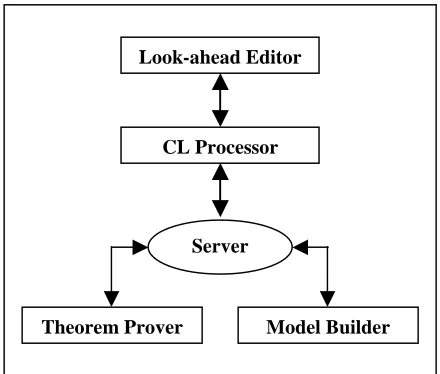
[image:2.595.317.537.300.487.2]As shown in the dataflow diagram for the PENG system in Figure 1, sentences written in PENG are first sent to the controlled language (CL) processor and then translated into first-order predicate logic via discourse representation struc-tures. This logical representation is subsequently checked for consistency and informativeness with the help of a theorem prover and a model builder.
Figure 1: Dataflow diagram for the PENG system
The look-ahead editor of PENG communicates with the CL processor (chart parser and unifica-tion-based grammar) via a socket interface. The CL processor is running as a client process and is connected via a server with a theorem prover (OT-TER; McCune, 2003) and a model builder (MACE; McCune 2001). The theorem prover and the model builder are both running separate client processes.
One of the deciding factors for the acceptability of a controlled language is the availability of auto-matic writing assistance. Texts in controlled natu-ral language should not only be easy to write but also easy to modify without the need for time-con-suming reprocessing.
This is why we need a processing strategy that informs the author about the permissible structure of the text and that supports basic editing opera-tions in an efficient way.
Look-ahead Editor
CL Processor
Server
2.1 Look-ahead categories
Given a set of grammar rules that define a con-trolled natural language such as PENG, the incre-mental chart parser should be able to generate a set of look-ahead categories after each word form that the author enters. For example, for the sentence
1. The customer inserts a credit card.
the following look-ahead categories should be gen-erated (simplified here):
The [ adjective | noun ]
… customer [ relpron | negation | verb ]
… inserts [ determiner ]
… the [ adjective | noun ]
… credit [ 'card' | relpron | prep | conj | '. ' ]
… card [ relpron | prep | conj | '. ' ]
In this example, all the look-ahead categories are either lexical categories or word forms. How-ever, the algorithm should be easily parameteriz-able so that predictive categories for various syn-tactic strata as well as for semantic information can be generated.
2.2 Insertion
The insertion operation should allow the addition of an arbitrary number of words into the input string as long as this modification does not violate the rules of the controlled language. For example, the insertion of the relative pronoun who into sen-tence 1 should lead to the noun phrase:
2. The customer who inserts the credit card …
that is part of the controlled natural language PENG.
Note that the insertion results here in a cate-gorial change; instead of a complete sentence we have now to deal with a complex noun phrase. This means that the punctuation mark introduced by the sentence needs to be removed automatically and a new set of look-ahead categories has to be generated and displayed for the last word form of the input string:
… card [ relpron | prep | verb | conj ]
As this example shows, the noun phrase in 2 could now be continued with a relative clause (3),
a prepositional phrase (4), a verb phrase (5), or a coordinated nominal structure (6):
3. … that is valid owns a password. 4. … into the slot owns a password. 5. … owns a password.
6. … and enters the PIN owns a password.
Each of these sentences constitutes a well-formed structure in the controlled natural language.
2.3 Deletion
The deletion operation should allow the cutting of an arbitrary sequence of words in the input string. For example, the deletion of the prepositional phrase into the slot in
6. The customer who inserts the credit card into the slot owns a password.
should result in a well-formed sentence in con-trolled language:
7. The customer who inserts the credit card owns a password.
The author should be able to delete a substring first by highlighting it and then by cutting it:
8. The customer who inserts the credit card
into the slot owns a password.
This design decision reduces the complexity of the algorithm, since it results in one single cutting event that tells the parser when recomputation should be resumed.
2.4 Replacement
If the insertion and deletion operation are in place, then the infrastructure for the replacement opera-tion exists. In essence, the replacement operaopera-tion is a deletion followed by an insertion operation. For example, the replacement of the compound noun
credit card with MasterCard in sentence 1 results
in
9. The customer inserts the MasterCard.
3 Chart Parsing
Parsing is the process of analyzing the syntactic structure of an input string and has traditionally been understood as a batch-mode process.
The problem with any naïve parsing algorithm – independent of the parsing strategy – is the un-necessary repetition of work that will occur for processing any non-trivial grammar.
Suppose a top-down parser is attempting to parse the sentence:
10. The password is valid.
Given the following simple (context-free) phrase structure grammar
s → np, vp.
np → det, noun, rc.
np → det, noun.
rc → relpro, vp.
vp → verb, adj.
the parser will first attempt using the rule
np → det, noun, rc.
and then after failing with that rule, it will try the alternative rule
np → det, noun.
That means the parser will repeat the work of analyzing the determiner (det) and the noun (noun) once for each rule.
An active chart parser (Kay, 1980; Gazdar and Mellish, 1989; Ferro and Pardo, 1995) avoids this repetition of work by storing information about well-formed substrings as well as information about substring hypotheses that it has partially ex-plored in a table (chart). The chart parser can then look up these substrings in the chart and expand them – if necessary – instead of recomputing them. Given an input string I and a grammar G, we can define a chart as a set of edges where an edge is a triple of the form <vi, vt, R>. The first two
elements vi and vt are integers and represent
start-ing and endstart-ing vertices of I or of a substrstart-ing of I and R represents a dotted rule. A dotted rule is a rule of the form X → α•β and corresponds to an
X edge containing an analysis of confirmed
con-stituents α that are seeking for constituents β. For example, if s→ np,vp. is a rule of the grammar and sentence 10 is an input string, then
the first two dotted rules below represent uncon-firmed hypotheses while the third rule represents a fully confirmed hypothesis:
<0,0,s → np vp>
<0,2,s → np vp>
<0,4,s → np vp >
Edges that correspond to unconfirmed hypothe-ses are known as active edges and those that corre-spond to confirmed hypotheses as inactive edges.
The basic operation of a chart parser involves combining an active edge with a completed inac-tive edge. The result is either a new inacinac-tive edge or a new active edge that spans both the active and inactive edges. This fundamental rule cannot be applied to a chart that contains no edges. Before anything can happen, an initialization process needs to set the chart up with inactive word edges and a rule invocation strategy needs to be defined that creates new active edges as a result of the ap-plication of the fundamental rule.
A chart parser usually uses an agenda to keep track of the edges that need to be processed. Such an agenda can be thought of as a list of edges. Adding new edges to the front of the agenda leads to a depth-first search strategy and adding them to the end would lead to breath-first search.
In our implementation, edges are stored in the following modified format:
edge(ID,vs,vt,LHS,RHSL)
ID is an integer that stands for a sentence
iden-tifier. LHS represents the category on the left hand side of a dotted rule and RHSL represents a list of unconfirmed daughter categories on the right hand side of the rule. If RHSL is empty ([]), then the edge is inactive, otherwise active.
For example, a top-down chart parser will pro-duce the following edges1 for sentence 10 using our simplified grammar rules introduced above:
edge(0,0,s,[np,vp])
edge(0,0,np,[det,noun])
edge(0,1,np,[noun])
1
The sentence identifier is not displayed in the edges. The categories of the grammar are atomic and do not contain any additional syntactic or semantic arguments. The grammar is not complete, since preterminal rules such as det→[the] are missing. As a consequence inactive edges such as
edge(0,2,np,[])
edge(0,2,s,[vp])
edge(2,2,vp,[verb,adj])
edge(2,3,vp,[adj])
edge(2,4,vp,[])
edge(0,4,s,[])
edge(0,0,np,[det,noun,rc])
edge(0,1,np,[noun,rc])
edge(0,2,np,[rc])
edge(2,2,rc,[relpro,vp])
Although such a batch-mode chart parser avoids repeating work and keeps active and pas-sive edges in the chart, it cannot deal with modifi-cations to the current input string without repro-cessing the entire string.
4 Incremental Chart Parsing
An incremental chart parser, by contrast, can handle modifications to an input string that it has already parsed without having to reprocess the en-tire string from scratch. The key idea of incre-mental chart parsing is to use information about edge dependencies for keeping track of edges that have to be updated (Wirén, 1989; Wirén 1994).
Let us explore this idea by an example and then refine it. Suppose we modify sentence 10 by insert-ing the relative pronoun that between the noun phrase and the verb phrase, then we get a complex noun phrase as result:
11. The password that is valid …
In comparison to the chart for sentence 10 in Section 3, the processing of this noun phrase re-sults in 4 new edges
edge(2,3,rc,[vp])
edge(2,5,rc,[])
edge(0,5,np,[])
edge(5,5,vp,[verb,adj])
and in 4 modified edges (with modifications in bold face)
edge(3,3,vp,[verb,adj])
edge(3,4,vp,[adj])
edge(3,5,vp,[])
edge(0,5,s,[vp])
We can make the following observations when we compare the charts for sentence 10 and for the noun phrase 11 in more detail:
• The active edge edge(0,2,np,[rc]) for sentence 10 hypothesizing that the password was the beginning of a noun phrase followed by a relative clause has been expanded to an inac-tive edge edge(0,5,np,[]) to cover the relative clause in 11.
• All the edges that make up the noun phrase the
password in sentence 10 remain unaffected by
the modification.
• All the edges that make up the verb phrase is
valid in sentence 10 remain unaffected apart
from the indices of the vertices (displayed in bold face) that have been updated.
• The passive edge edge(0,4,s,[]) repre-senting sentence 10 has been replaced by an active edge edge(0,5,s,[vp]), because 11 is a noun phrase and not a complete sentence.
In summary, we can state that there is no need to recompute an edge, if that edge does not in any way depend upon the vertices that have been changed or on any edges that were based on those edges.
A closer look into the chart for sentence 10 re-veals that the edge edge(0,4,s,[]) is the only one that spans the vertex (insertion point) where the relative pronoun would be inserted. This sug-gests the following informal solution to process the modification:
1) Find all edges on the right hand side of the in-sertion point, in our case all those edges whose starting vertex is greater than or equal to the in-sertion point, and create a new subchart CR for them.
2) Renumber all starting and ending vertices of the edges in CR to be vs+1 and vt+1.
3) Find all edges on the left hand side of the inser-tion point, in our case all those edges whose ending vertex is smaller than or equal to the in-sertion point, and create a new subchart CL for them.
4) Create a new chart C by appending the subchart
CR to the end of the subchart CL.
6) Reparse the string, using only the new edges in the agenda and the new chart C.
Note that this solution automatically excludes edges such as edge(0,4,s,[]) from the new chart C, since we considered only edges that do not bridge the insertion point. At first glance, it seems that an optimization should be possible, since not all edges in the subcharts are affected by the edit-ing operation. For example, only the modified edge
edge(3,5,vp,[]) in the subchart CR spanning
the verb phrase on the right hand side of the inser-tion point takes part in reparsing. Similar observa-tions can be made for the subchart CL where only those edges that end at the insertion point are af-fected by reparsing. However, it turns out that first filtering the subchart CR and then reconstructing the entire chart after parsing is costly and does not result in a speed-up of parsing in comparison with the unfiltered version of the chart.
5 Update Handling Algorithms
After this informal discussion of the problem, I will give a more formal description of the update handling algorithms for finding look-ahead catego-ries and for dealing with modification (insertion, deletion, and replacement).
5.1 Finding look-ahead categories
Look-ahead categories are generated after each word form that the author enters or whenever an approved modification results in a syntactic struc-ture that needs to be completed by the author.
Formally, a set of look-ahead categories LC for a word w ending at vertex vi can be calculated in
the following way:
1) Find all active edges ending at vi.
2) For each active edge:
a) Select the RHSL of remaining categories. b) For the first category in RHSL, check if it
is a lexical category:
i) If yes, then store the solution in LC. ii) If not, find a rule that rewrites the
category into further categories, then select the first category and return to 2b.
Apart from lexical categories, it is also possible to collect other categories, for example
non-ter-minal categories by extracting them from the grammar rules, or semantic categories if they are stored in the lexicon and accessible via lexical categories. Collecting also look-ahead categories for non-terminal symbols in Step 2ii results in a list of hierarchically order categories and eases cus-tomization of this functionality for the user inter-face.
5.2 Editing operations
According to our definition, the incremental chart parser should not only be able to handle piecemeal additions to a string but also to handle arbitrary modifications efficiently. Ideally, the time that the incremental algorithm uses for processing a modi-fication should be a function of the size of the modification rather then the size of the entire input. In simple words: a small modification should re-quire less work than a big modification. Note that the algorithms presented below for the editing op-erations do not explicitly delete bridging edges but rather exclude them by reconstructing the chart.
Insertion
Inserting a word w at a vertex vi in a string can be
calculated in the following way:
1) Find all edges for which the index of the start-ing vertex vs is greater than or equal to vi, that
is s i, and create a new subchart CR for them. 2) For all the edges in CR
a) renumber the starting vertex to be vs+1,
b) renumber the ending vertex to be vt+1.
3) Find all edges for which the index of the end-ing vertex vt is smaller than or equal to vi and
the starting vertex vs is not equal to vi, that is t i ∧ s ≠ i, and create a new subchart CL.
4) Create a new chart C by appending the sub-chart CR to the end of the subsub-chart CL.
5) Create new hypotheses beginning at vi for each
category that the new word w belongs to. 6) Reparse the string, using only these new edges
as the agenda for the parser, and providing it with the updated chart C.
Deletion
Deleting a word w at a vertex vi in a string is to
1) Find all edges for which the index of the start-ing vertex vs is greater than or equal to vi, that
is s i, and create a new subchart CR for them. 2) For all the edges in CR
a) renumber the starting vertex to be vs-1,
b) renumber the ending vertex to be vt-1.
3) Find all edges for which the index of the end-ing vertex vt is smaller than vi and the starting
vertex vs is not equal to vi, that is t < i ∧ s ≠ i,
and create a new subchart CL1.
4) Find all edges for which the index of the end-ing vertex vt is equal to vi, that is t = i, and
cre-ate a new subchart CL2.
5) Create a new chart C by appending the sub-chart CR to the end of the subsub-chart CL1. 6) Reparse the string, using the subchart CL2 as
the agenda for the parser, and providing it with the subchart C as new chart.
Note that the agenda above consists of the sub-chart CL2 in contrast to the insertion operation where the agenda for reparsing consists only of the new word hypothesis.
Replacement
Replacing a word w at a vertex vi in a string can be
described as a deletion followed by an insertion operation. This is what authors do when they re-place a word in an interactive text editor. They first delete the word and then insert a new word.
However, simply executing these two opera-tions in sequence would not be very efficient. For example, if the word customer is replaced with
client in sentence 10, then all words lie between
the same vertices as they did before the replace-ment operation. In this case, the chart does not need to be partially recreated twice, since the first recreation will renumber vertices and create edges that will immediately be reset or deleted again.
This observation results in the following opti-mized algorithm:
1) Create new hypotheses beginning at vi for each
category Cat that the new word w belongs to. 2) Replace the inactive word edge E in the chart
starting at vertex vi with the new word edge E’
so that the categories of E and E’ are identical.
This is a significant improvement over execut-ing the two operations in sequence.
6 Evaluation
The presented algorithms that incrementally update the chart result in a speed-up for all modification operations compared with naïve reparsing of the input string after an editing operation. The average improvement for insertion is of a factor of 1.44, for deletion 1.28, and for replacement 17.64. As the results show, replacement can be implemented very efficiently. As already mentioned, additional filtering of the subchart CR does not result in any speed-up. It seems that in our Prolog implementa-tion renumbering of the vertices in the affected edges is the biggest cost factor, since this involves arithmetic operations and not pure unification.
7 Conclusion
In this paper, I discussed an incremental chart parser that generates predictive hints and allows for arbitrary editing operation as long as the result is an approved structure in controlled natural lan-guage. The generated look-ahead categories consist of syntactic (or semantic) categories and aim at supporting the writing process of the controlled natural language. These predictive hints ensure that the author follows the rules of the controlled natu-ral language and guarantee unambiguous and pre-cise texts (in our case “seemingly informal” spe-cifications).
The editing operations (insertion, deletion, re-placement) are bound to the affected part of the string and require only minimal reparsing. This means that the modifications are a function of the size of the words changed rather than the size of the entire text. The current solution deals only with local updates. In the future, I would like to look into the problem of updating anaphoric references in the text and in the underlying discourse repre-sentation structure after a nominal expression has been modified. The goal is to find a solution that does not require extensive reparsing of the input text.
Acknowledgements
I would like to thank the students (Jason Barles, James Cameron, Dennis Chan, Mary Gardiner, Hogan Ho, and Simon Kissane) who were enrolled in the honours class COMP448: Advanced Topics
semester 2003 at Macquarie University for their enthusiasm in exploring various directions in incre-mental chart parsing. I also thank two anonymous reviewers of this paper for their constructive com-ments.
References
AECMA. 2001. The European Association of Aero-space Industries. AECMA Simplified English, AECMA Document PSC-85-16598. A Guide for the Preparation of Aircraft Maintenance Documentation in the International Aerospace Maintenance Lan-guage. Issue 1, Revision 2, 15 January.
J. Bos. 2001. DORIS 2001: Underspecification, Resolu-tion and Inference for Discourse RepresentaResolu-tion Structures, in: Blackburn and Kohlhase (eds.): IcoS-3. Inference in Computational Semantics. Workshop Proceedings, Siena, Italy, June.
J. Bos. 2003. Exploring Model Building for Natural Language Understanding. Proceedings of the Fourth International Workshop on Inference in Computa-tional Semantics (ICoS-4), September 25-26, INRIA Lorraine, Nancy.
M. V. Ferro, M. A. A. Pardo. 1995. Exploring interac-tive chart parsing. Procesamiento del Lenguaje Natu-ral, Bilbalo, Spain, pp. 158-172.
N. E. Fuchs, U. Schwertel. 2003. Reasoning in At-tempto Controlled English. Proceedings of the Work-shop on Principles and Practice of Semantic Web Reasoning (PPSWR 2003), Mumbai, India.
G. Gazdar, C. Mellish. 1989. Natural Language Process-ing in Prolog. An Introduction to Computational Lin-guistics. Addison-Wesley, Wokingham, England.
P. Goyvaerts. 1996. Controlled English, Curse or Bless-ing? – A User’s Perspective. Proceedings of the First International Workshop on Controlled Language Ap-plications, March 26-27, Leuven.
W. O. Huijsen. 1998. Controlled Language – An Intro-duction. Proceedings of CLAW 1998, Pittsburgh, pp. 1-15.
H. Kamp, U. Reyle. 1993. From Discourse to Logic. Kluwer, Dordrecht.
C. Kamprath, T. Mitamura, E. Nyberg. 1998. Controlled Language for Multilingual Document Production: Experience with Caterpillar Technical English, Pro-ceedings of the Second International Workshop on Controlled Language Applications, Pittsburgh.
M. Kay 1980. Algorithm Schemata and Data Structures in Syntactic Processing. Report CSL-80-12, Xerox Parc, Palo Alto, California.
W. McCune. 2001. MACE 2.0 Reference Manual and Guide. ANL/MCS-TM-249. Mathematics and Com-puter Science Division, Technical Memorandum No. 249, Argonne National Laboratory, Argonne.
W. McCune. 2003. OTTER 3.3 Reference Manual. ANL/MCS-TM-263, Mathematics and Computer Science Division, Technical Memorandum No. 263, Argonne National Laboratory, Argonne.
S. O’Brien. 2003. Controlling Controlled English, An Analysis of Several Controlled Language Rule Sets. Proceedings of EAMT-CLAW03, Controlled Lan-guage Translation, May 15-17, Dublin City Univer-sity, pp. 105-114.
R. Power, D. Scott, A. Hartley. Multilingual Generation of Controlled Languages. Proceedings of EAMT-CLAW03, Controlled Language Translation, May 15-17, Dublin City University, pp. 115-123.
R. Schwitter. 2002. English as a Formal Specification Language. Proceedings of the Thirteenth Interna-tional Workshop on Database and Expert System Applications (DEXA 2002), Aix-en-Provence, France, pp. 228-232.
R. Schwitter, A. Ljungberg. 2002. How to write a document in controlled natural language. Proceed-ings of the Seventh Australasian Document Comput-ing Symposium, Sydney, Australia, December, pp. 133-136.
R. Schwitter, A. Ljungberg, D. Hood. 2003. ECOLE: A Look-ahead Editor for a Controlled Language. Pro-ceedings of EAMT-CLAW03, Controlled Language Translation, May 15-17, Dublin City University, pp. 141-150.
J. Z. Sukkarieh. 2003. Mind your Language! Controlled Language for Inference Purposes. Proceedings of EAMT-CLAW03, Controlled Language Translation, May 15-17, Dublin City University, pp. 160-169.
M. Wirén. 1989. Interactive incremental chart parsing. Proceedings of the Fourth Conference of the Euro-pean Chapter of the Association for Computational Linguistics, Manchester, England, pp. 241-248.