Evaluation of Medical Concept Annotation Systems
on Clinical Records
Hamed Hassanzadeh Anthony Nguyen Bevan Koopman
The Australian e-Health Research Centre, CSIRO, Brisbane, QLD, Australia
{hamed.hassanzadeh, anthony.nguyen, bevan.koopman}@csiro.au
Abstract
Large volumes of electronic health records, including free-text documents, are extensively generated within various sectors of healthcare. Medical concept annotation systems are designed to enrich these documents with key concepts in the domain using reference terminolo-gies. Although there is a wide range of annotation systems, there is a lack of comparative analysis that enables thorough understanding of the effec-tiveness of both the concept extraction and concept recognition components of these systems, especially within the clinical domain. This paper analyses and evaluates four annotation systems (i.e., MetaMap, NCBO annotator, Ontoserver, and QuickUMLS) for the task of ex-tracting medical concepts from clinical free-text documents. Empirical findings have shown that each annotator exhibits various levels of strengths in terms of overall precision or recall. The concept recognition component of each system, however, was found to be highly sensitive to the quality of the text spans output by the concept extraction component of the annotation system. The effects of these components on each other are quantified in such way as to provide evidence for an informed choice of an annotation system as well as avenues for future research.
1 Introduction
With the advent of electronic health records, large volumes of mostly free-text clinical documents — discharge summaries, radiology reports, pathol-ogy reports, and patients progress notes — are now present in the health ecosystem. While these
documents contain much valuable information, it can only be exploited if effective computational methods of dealing with clinical free-text are de-vised. The goal here is to automatically extract clinical concepts from unstructured clinical docu-ments, thus providing a structured representation that enables fast and effective access and analysis. To facilitate the extraction of clinical concepts from free-text, many automatic systems (known as medical concept annotators) have been devel-oped. These systems analyse natural language and annotate specific spans of text to concepts defined in some external medical terminology/thesaurus. This workflow can be considered as a two-step process of extracting candidate spans of concepts within a given document (known as “concept ex-traction”) and then assigning appropriate concept identifiers to each candidate span based on the de-fined concepts in the domain ontologies (known as “concept recognition”). Such systems are widely used in a variety of e-health settings and are criti-cal for activities such as clinicriti-cal information anal-ysis and reporting (Zuccon et al., 2013), derivation of phenotypic descriptions (Groza et al., 2013b; Collier et al., 2014) and medical information re-trieval (Zuccon et al., 2012; Koopman, 2014).
Although there are a wide range of available an-notation systems, there is a lack of comparative analysis that provides enough evidence for an in-formed decision in choosing the most suitable sys-tem. Many of these system are developed for a specific domain (e.g., medical journal article ab-stracts) and may not be suited to dealing with clin-ical text. Deployment of these systems can often only be done in a black-box fashion: without an underlying understanding of the individual com-ponents of a system and its effectiveness.
questions:
1. How well do common medical concept anno-tation systems perform on clinical free-text?
2. What is the impact of the core components of an annotation system (i.e., concept extrac-tion and concept recogniextrac-tion) on their overall performance?
The analysis of the performances of the anno-tation systems show that different components of the annotation systems exhibit different levels of strengths in terms of overall precision or recall. When evaluating the performance of the individual concept extraction and concept recognition com-ponents of the systems, it was found that the con-cept recognition performance was highly depen-dent on a high performing concept extraction com-ponent. This leads to a set of insights over anno-tation systems from both application and develop-ment perspectives.
2 Related Work
Due to the advances in electronic health records and the availability of large volumes of clinical text documents, significant interest has been di-rected towards automating their processing and analyses. Several workshops and shared tasks have been designed in recent years to attract re-searchers to the domain and challenge different ideas and methodologies for such tasks. The ShARe/CLEF eHealth shared task in 2013 is one of them that focuses on the application of Natural Language Processing (NLP), Machine Learning (ML), and Information Retrieval (IR) for leverag-ing health care data1. Task 1 in the CLEF ShARed Task focuses on the concept recognition problem, more specifically, on identifying disorder concepts from clinical documents. It comprises two sub-tasks: (i) Task 1a a concept extraction task that evaluates the systems according to their ability to extract correct spans of text for disorder concepts; and(ii) Task 1b a concept recognition task that is about assigning the correct class of concept (i.e., a Concept Unique Identifier or CUI) to each text span using the Unified Medical Language Sys-tem (UMLS) terminology (Suominen et al., 2013; Keith and others, 1998). Note that, only a subset of UMLS concepts were used for this annotation
1https://sites.google.com/site/
shareclefehealth/home
task (i.e., only those UMLS concepts that were associated to particular disorder-related concepts in the Systematized Nomenclature of Medicine -Clinical Terms (SNOMED CT ontology)) A data set was provided to the participants in order to de-velop and test their automatic systems (more in-formation about the data set is described in Sec-tion 3.3). A similar task was offered in the fol-lowing year in SemEval 2014 Task 7 (Pradhan et al., 2014), which applied the same data set as the ShARe/CLEF task as a follow-up on the con-cept recognition task. In this paper, we also ap-ply the ShARe/CLEF data set as it provides man-ually annotated concepts that can be used to eval-uate concept annotation systems. However, differ-ent to the systems that were specifically designed for the task and tailored to the data set, we inves-tigate the performance of off-the-shelf annotation systems for annotating this data set with medical concepts.
Mirhosseini et al. (Mirhosseini et al., 2014) also applied a subset of the same data set (i.e., the train set of ShARe/CLEF data) to compare medical an-notation systems (e.g. MetaMap (Aronson, 2001; Aronson and Lang, 2010), Ontoserver (McBride et al., 2012)), and a number of standard IR tech-niques for the concept recognition component of the shared task (i.e. Task 1b). They consid-ered the concept recognition task as an Informa-tion Retrieval technique and used queries with the spans of text associated with the concepts in the gold standard. The responses of annotation sys-tems were then evaluated using standard IR eval-uation measures, such as Reciprocal Ranker and Success@K. They converted all the UMLS con-cepts IDs in the ShARe/CLEF data to one or more corresponding SNOMED CT IDs and performed the evaluation on this new version of the data. In this paper, we investigate an extended number of annotation systems and use the original dataset and evaluation metrics for evaluating the end-to-end effectiveness of the annotation systems (as op-posed to only the concept recognition component of the systems).
un-der different settings according to eight ontolo-gies. They found that the systems did not achieve the best performance with their default parameters and changes in these parameters had a significant effect on effectiveness. The ConceptMapper sys-tem was found to be the best performing syssys-tem across the majority of the ontologies. Different to our study, is their use of mainly genetic-related ontologies as opposed to the clinical SNOMED CT ontology, and their use of published articles (which are written in more formal language) com-pared to narrative clinical documents (which are often in the form of unstructured, ungrammatical, and often fragmented free-text).
Groza et al. (Groza et al., 2013c) compared four open medical concept recognition systems (i.e., cTAKES (Savova et al., 2010), NCBO Annota-tor (Jonquet et al., 2009a), BeCAS (Nunes et al., 2013) and MetaMap) with their default settings. These comparisons are performed over one semi-gold and one silver standard data sets comprising of clinical trials and published abstracts. Their sil-ver and semi-gold standard corpora were (semi-)automatically generated using different combina-tions of the output of their studied annotation sys-tems. Like Groza et al. (Groza et al., 2013c), we study a range of medical concept recognition sys-tems but with a focus on clinical records and asso-ciated gold standard that has been curated by do-main experts.
3 Methodology 3.1 Annotation Systems
Automatic annotation systems commonly com-prise of two distinct components: (i)Concept Ex-traction, and(ii)Concept Recognition. The con-cept extraction component of the systems is re-sponsible for the extraction of candidate text spans from the input document that potentially refer to medical concepts, such as, disorders as in the ShARe/CLEF data. The concept recognition com-ponent then aims to assign a domain concept (us-ing one or more base terminologies) that is seman-tically related to the candidate span of text.
In this paper, we evaluated medical concept an-notation systems from both the concept extrac-tion and concept recogniextrac-tion perspectives. The investigated systems in this study include two of the most popular medical concept annotators (i.e., MetaMap and NCBO annotators) and two of the more recent systems (i.e., QuickUMLS and
On-toserver). Brief descriptions of the systems are provided in the following:
MetaMap is an annotation program that is developed by the National Library of Medicine (NLM) to annotate a given text with appropriate concepts (i.e., UMLS Metathesaurus). MetaMap has a range of configurable parameters and options to tune its different NLP and retrieval components and its output (Aronson, 2001; Aronson and Lang, 2010). The MetaMap service usually requires con-siderable time in order to process the input text and annotate concepts (Shah et al., 2009; Soldaini and Goharian, 2016).
NCBO Annotatoris an annotation service that covers a wide range of ontologies (i.e., more than 500 ontologies) (Jonquet et al., 2009a). Its work-flow consists of a syntactic concept extraction step that employs concept names and synonyms and a semantic expansion step that tries to enrich the ex-tracted concepts with the semantic features from ontologies. NCBO provides a set of configurable options that can be customised according to dif-ferent settings and applications (Jonquet et al., 2009b).
QuickUMLSis a concept recognition approach that employs an approximate dictionary matching technique (Soldaini and Goharian, 2016). Given a text, it tries to find highly similar concepts (us-ing the concept’s str(us-ing) to the given text. Instead of calculating similarities between all the concepts in the dictionary and the given text, it applies CP-Merge to reduce computation costs (Okazaki and Tsujii, 2010). CPMerge is an algorithm for ap-proximate dictionary matching. It finds a subset of concepts that have a number of features in com-mon with the given input.
Ontoserver is a terminology server that pro-vides an Information Retrieval solution to medi-cal concept annotation 2. It employs SNOMED CT as the base terminology but also supports the Australian Medicines Terminology (AMT) and Logical Observation Identifiers Names and Codes (LOINC). It exploits a purposely-tuned retrieval function and linguistic capabilities such as spell checking, restrictions and inferences on the source ontology (McBride et al., 2012). Unlike the above systems, Ontoserver currently only supports the concept recognition phase of an annotation sys-tem. As a result, Ontoserver is currently unable to use as input the whole document and perform the
concept extraction to generate suitable text spans for concept recognition.
Table 1 shows an overview of main components of the above-mentioned annotation systems. It can be observed that the annotation systems support the UMLS terminology to annotate input docu-ments, with the exception that Ontoserver is based on the SNOMED CT ontology. MetaMap and NCBO annotators are mainly designed to annotate biomedical literature while Ontoserver is targeted towards searching for specific clinical terminology and QuickUMLS is a generic annotator. All of the annotation systems provide APIs to access and de-ploy their respective medical concept annotation systems.
3.2 Concept Extraction
Concept extraction refers to the identification of appropriate spans of text that can represent a do-main concept. Most annotation systems have built-in concept extraction modules. However, to control for the concept extraction component of these systems, three different concept extraction approaches, one manual and two computational approaches, were investigated to generate candi-date text spans to evaluate the concept recognition component of the annotation systems.
3.2.1 Gold Standard
In order to assess the systems concept recognition performance, the exact gold standard spans of text were submitted to the systems. The gold standard text spans were generated by human experts, and hence, they can be used as a benchmark to assess the effectiveness of automatic concept extraction approaches.
3.2.2 Noun Phrase Parser
From a lexical perspective, the disorder-related terminologies are mainly in the form of subjects or objects of sentences rather than predicates or actions (e.g., the post-verb component in the fol-lowing sentence: “The patient was admitted with headache and dysarthria.”). It is considered that the noun phrases of sentences in clinical docu-ments are the dominant sources of medical con-cepts, especially for disorder concepts. Hence, a parser is employed to extract noun phrases from documents and form the input for concept anno-tation systems. One issue associated with this approach is that the clinical documents are com-monly ungrammatical. As a result, an English
noun phrase parser algorithm used as a black-box will face issues around the parsing of improper sentences, and hence, likely to produce noisy noun phrase text spans.
3.2.3 CRF Concept Extractor
A Conditional Random Field classifier (CRF) (Lafferty et al., 2001) can be used to automatically extract the boundary of candidate text chunks. CRF is a probabilistic undirected graphical model that has shown promising results in sequence labelling and text classification prob-lems, especially in medical domain (Hassanzadeh et al., 2014; Kholghi et al., 2016; Groza et al., 2013a; de Bruijn et al., 2011; Hassanzadeh and Keyvanpour, 2013). The CRF model was trained over the training set of the ShARe/CLEF task corpus using the following features: words and their lemmas, Part of Speech (POS) tags, orthographic information (e.g., flagging if words contain initial capital letter, numerics, punctua-tions, etc.), character n-grams (i.e, 2 to 4-grams), and sequential features by including previous and next words (and their POS tags) in the feature vector of a given word and flagging if the word is the first/last word of a sentence. All-punctuation tokens (such as “||||” used as a separator) and determiner tokens (including numerical values) are removed in a preprocessing step. Although punctuations and determiners are not considered as independent tokens, they still participate in the feature vector of their adjacent words (i.e., a word that has such tokens in its preceding or following keeps this information in its feature vector).
3.3 Data
Table 1: Annotation Services Specifications.
Supported Terminology Domain Software Infrastructure
Metamap UMLS Biomedical literature Prolog
NCBO UMLS/NCBO Biomedical literature Java
Ontoserver SNOMED CT/AMT/LOINC* Clinical terminology use Java within health sector
QuickUMLS UMLS* Generic Python & C++
[image:5.595.73.289.225.300.2]* Can be extended to employ other terminologies.
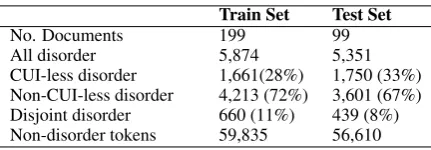
Table 2: The ShARe CLEF disorder concept recognition corpus statistics.
Train Set Test Set
No. Documents 199 99
All disorder 5,874 5,351
CUI-less disorder 1,661(28%) 1,750 (33%)
Non-CUI-less disorder 4,213 (72%) 3,601 (67%)
Disjoint disorder 660 (11%) 439 (8%)
Non-disorder tokens 59,835 56,610
corpus where annotators annotated them as disor-ders but no UMLS concept have been found for them were annotated with a “CUI-less” label. The ShARe CELF corpus comprises separate train and test sets that consist of 199 and 99 clinical docu-ments, respectively. Detailed statistics of this cor-pus are shown in Table 2. Disjointconcepts refer to concepts where their spans cover discontinuous tokens. Recognising such concepts is more chal-lenging than the regular concepts as the recogniser should be able to foresee possible tokens that can be assigned to a concept as a whole.
3.4 Evaluation Measures
The annotation systems were evaluated based on standard Information Extraction measures, namely, Precision, Recall, and F1-Score:
Precision (P):TP / (TP + FP); Recall (R):TP / (TP + FN);
F1-Score (F1): (2 * Recall * Precision) / (Re-call + Precision); i.e, Harmonic mean of Precision and Recall.
where true positive (TP) indicates that a system identified a disorder in the same span as that iden-tified by the expert assessors, false positive (FP) refers to the identification of an incorrect span, and false negative (FN) indicates that a system failed to identify a disorder-span that was identified by the expert assessors.
For the evaluation of the concept extraction component, The “exact span” and “overlapping span” evaluation settings refer to the case where
the automatically identified span is identical to the gold standard span boundaries, and that the iden-tified span overlaps with the gold standard span boundaries, respectively.
3.5 Experimental Setup
The ShARe/CLEF data set only contains disor-der concepts. Hence, the annotation systems were guided to look for disorder concepts only. Due to the annotation guideline of ShARe/CLEF data set (Suominen et al., 2013), a concept is in the disorder semantic group if it belonged to one of the following UMLS semantic types: Congeni-tal Abnormality, Acquired Abnormality, Injury or Poisoning, Pathologic Function, Disease or Syn-drome, Mental or Behavioral Dysfunction, Cell or Molecular Dysfunction, Experimental Model of Disease, Anatomical Abnormality, Neoplastic Process, and Signs and Symptoms. Occurrences of “CUI-less” spans and concepts in the gold stan-dard were removed from the data set as we cannot expect the annotation systems to find appropriate concepts for disorder text spans if appropriate con-cepts cannot be found by a human expert.
Table 3 shows the settings of the annotation sys-tems. These parameters can be used to reproduce the results that are reported in this paper. It can be observed that MetaMap, NCBO, and QuickUMLS systems were restricted to the above-mentioned UMLS semantic types. Since Ontoserver does not provide options for such restriction, we filter the output of this system to only those semantic types in a post-processing step. In addition, On-toserver’s annotations are based on SNOMED CT concept IDs. Since the annotations in the data set are UMLS concept IDs, the resulting SNOMED CT IDs were mapped to UMLS concept IDs using NLM’s Metathesaurus mapping table3.
The Stanford CoreNLP toolkit was applied to extract noun phrases from the clinical
docu-3Version 2015AB: https://www.ncbi.nlm.nih.
Table 3: Annotation System Settings.
System Parameters
Metamap -J acab,comd,anab,cgab,dsyn,emod,inpo,mobd,neop,patf,sosy, -R SNOMEDCT US, -q
NCBO include=prefLabel,cui, ontologies=SNOMEDCT, exclude numbers=true,
longest only=true, semantic types=T020,T049,T190,T019,T047,T050,T037,T048,T191,T046,T184
Ontoserver findConceptsByTermPrefixes, versionedId=http://snomed.info/sct/32506021000036107/version/20160731
QuickUMLS threshold=0.7, window=5, similarity name=jaccard,
accepted semtypes=’T020’,’T049’,’T190’,’T019’,’T047’,’T050’,’T037’,’T048’,’T191’,’T046’,’T184’
ments (Manning et al., 2014). In this approach, the resulting parse tree generated from each doc-ument was processed to extract the noun phrases (NPs) from the associated subtrees of clauses of sentences.
The MALLET implementation of CRF was used in this paper to train a concept recogniser model (McCallum, 2002). The text spans of disor-der concepts from the ShARe/CLEF training data set was used to train the CRF model. The data was converted into BIO format (Begin/Inside/Outside of spans) in order to have an appropriate formula-tion of concepts with multiple tokens.
4 Results
Table 4 presents the performance of the annotation systems. The first column of results shows system results when the whole document was used as in-put. The results here would reflect the end-to-end annotation system for both their built-in concept extraction and concept recognition components of the system. MetaMap achieved the highest re-sults with 0.5948 F1-score followed by Quick-UMLS and then NCBO. Despite NCBO having the lowest F1-score of the three systems, its pre-cision was considerably higher than MetaMap and QuickUMLS. Ontoserver currently only supports the annotation of short phrases and does not have a built-in concept extraction module to support an-notations at a document level.
To further investigate the effectiveness of an an-notation system’s concept recognition component, the input to the annotation systems were controlled by providing each system the same spans of text. The second column of results in Table 4 shows the results when spans from the gold standard dataset were used as input into the annotators. The re-maining columns show the performance of the an-notation systems when input spans were generated by the noun phrase parser and the CRF model were used as input.
As expected, system performance on the gold
standard chunks achieved the highest results com-pared to other concept extraction techniques. This simulated the upper bounds of these annotation systems as the human expert generated spans of text were used as input to the systems. The best performing concept recognition system in this set-ting was Ontoserver with 0.7426 F1-score. Quick-UMLS and MetaMap achieved comparable re-sults of 0.7409 and 0.7321 F1-score respectively. Noteworthy was Ontoserver’s ability to achieve a very high precision of 0.9058, while QuickUMLS achieved the best recall (i.e., 6893).
For the input spans generated by the noun phrase parser and the CRF model, a similar pattern could be observed in the performance of the sys-tems: MetaMap and QuickUMLS achieved higher F1-scores while NCBO and Ontoserver showed similar performance. Again, Ontoserver achieved the highest precision, particularly when applied to the span generated by the noun phrase parser (pre-cision = 0.6305).
Table 4: Concept recognition results. For whole documents as input, MetaMap and QuickUMLS achieved higher overall F1 scores, while NCBO showed higher precision. Over the various noun phrases, systems showed much superior results on the gold standard input spans with Ontoserver, in general, achieving the highest precision and QuickUMLS achieving the highest recall.
Document input Span input (via concept extraction)
(built-in concept extractor) Gold standard Noun phrase parser CRF
P R F1 P R F1 P R F1 P R F1
MetaMap 0.5650 0.6278 0.5948 0.8076 0.6695 0.7321 0.5027 0.4903 0.4964 0.3702 0.0401 0.0723
NCBO 0.6364 0.3742 0.4712 0.7679 0.3758 0.5047 0.5789 0.2982 0.3936 0.3767 0.0226 0.0426
Ontoserver - - - 0.9058 0.6292 0.7426 0.6305 0.3335 0.4363 0.3322 0.0267 0.0495
QuickUMLS 0.5140 0.6197 0.5619 0.8008 0.6893 0.7409 0.4622 0.5075 0.4838 0.3518 0.0406 0.0729
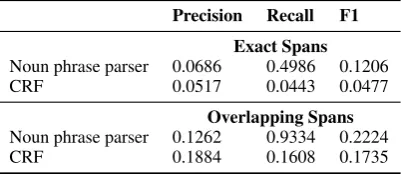
Table 5: Performance of concept extraction approaches in identifying the gold standard text spans. “Ex-act Spans” and “Overlapping Spans” refer to the case where the automatically identified span is identical to the gold standard span boundary, and that the identified span overlaps with the gold standard span boundaries, respectively. Results show that concept extraction performance is very poor but significant improvements can be achieved when the text span evaluation criteria was relaxed to overlapping spans.
Precision Recall F1
Exact Spans
Noun phrase parser 0.0686 0.4986 0.1206
CRF 0.0517 0.0443 0.0477
Overlapping Spans
Noun phrase parser 0.1262 0.9334 0.2224
CRF 0.1884 0.1608 0.1735
To assist in the analysis of the concept extrac-tion and concept recogniextrac-tion components of the systems, Table 6 was included to show the num-ber of input text spans and the numnum-ber of con-cept annotations output by each of the annotation systems. It can be observed that the noun phrase parser generates a large number of candidate spans (i.e., all noun phrases in a document), which leads to higher recall in both exact and overlapping text span scenarios (0.4986 and 0.9334, respectively) but low precision (0.0686 and 0.1262). On the other hand, the CRF model generated fewer can-didates and achieved poorer results, especially in the exact text span scenario.
5 Discussion
Annotation systems perform two primary steps: concept extraction and concept recognition. While most previous evaluations considered the end-to-end process (Jonquet et al., 2009a; Aronson and Lang, 2010; Groza et al., 2013c; Nunes et al., 2013; Mirhosseini et al., 2014), this papers at-tempts to consider the impact of these two com-ponents separately. The findings are that the con-cept extraction component significantly impacts the concept recognition phase. One reason for this was that the various concept extraction methods
(noun phrase parser, CRF and the built-in methods within each annotator) all produced widely vary-ing spans of text. There was a large difference in the performance between using the gold stan-dard span, which represent an upper bound, and the spans produced by concept extraction meth-ods. The built-in concept extraction methods all performed better than the naive noun phrase pars-ing and CRF methodology. Therefore we, conjec-ture that the noun phrase parser and CRF start to show promise when the text span evaluation crite-ria was relaxed to overlapping spans. Despite this, there was less variation in different concept recog-nition methods for the same spans of text. The les-son here is that efforts to improve annotation sys-tems are best directed toward improving concept extraction.
pa-Table 6: Number of output annotations by the systems over the test set. NCBO’s built-in concept ex-tractor found far less concepts compared to MetaMap and QuickUMLS. In addition, Noun phrase parser generated a large number of candidate input spans while the CRF model generated fewer candidates.
Built-in concept extractor Gold Standard Noun phrase parser CRF
# Input spans - 3,610 26,113 3,074
MetaMap 4,599 3,456 4,036 445
NCBO 2,246 1,874 1,963 231
Ontoserver - 2,499 1,900 289
QuickUMLS 4,331 3,103 3,944 415
tient records for rare diseases where clinicians are concerned with trying to get as high recall as pos-sible, and will tolerate lower precision results). To facilitate these different use cases it would be ad-vantageous to configure the annotation system to optimise for either precision or recall. This may involve adapting the system to use different con-cept extraction or concon-cept recognition methods. In general, it would be advantageous, both from a system design and system evaluation perspec-tive, to decouple the concept extraction and con-cept recognition component of such systems.
5.1 Future Work
The medical concept annotation systems studied were observed to comprise of concept extraction and concept recognition components with differ-ent levels of strengths (e.g., NCBO’s concept ex-traction module showed less success than its con-cept recognition module – resulting in low re-call but considerable precision). Investigating the effectiveness of the integration of these compo-nents across annotation systems should see gains in the overall performances. For example, using the QuickUMLS concept extractor (as it resulted in the best recall) as inputs to the Ontoserver con-cept recogniser (as it showed the highest preci-sion). Furthermore, an ensemble of these sys-tems working together may also show promising results (Kang et al., 2012). For example, a voting system can be designed to enrich the final annota-tions with the best outcomes of different systems.
A thorough investigation into the effectiveness and efficiency of annotation systems including evaluations of systems for recognising concepts beyond disorders is also warranted. Compari-son of other dimensions, such as execution time, robustness in terms of domain (e.g., radiology, pathology, emergency) and type of input clinical document (e.g., discharge letter vs progress notes),
and larger datasets (e.g., i2b2 (Uzuner et al., 2011) or CADEC (Karimi et al., 2015) corpora), and more detailed comparison of concept extraction and recognition components (e.g., effect of over-lapping spans on concept recognition) will all be the subject of ongoing work.
6 Conclusion
This paper investigated and evaluated four annota-tion systems (i.e., MetaMap, NCBO, Ontoserver, and QuickUMLS). The focus was on evaluat-ing and assessevaluat-ing the performances of annota-tion systems on annotating clinical free-text doc-uments. Concept extraction and concept recogni-tion, which are two main components of a con-cept annotation system, were independently eval-uated in order to provide an in-depth compari-son of their performances. The experimental re-sults showed that each annotator exhibited var-ied performance and that the text spans output by the concept extraction component of an annotation system significantly impacts on the performance of the concept recognition and overall end-to-end performance of the system.
References
Alan R Aronson and Franc¸ois-Michel Lang. 2010. An overview of metamap: historical perspective and re-cent advances.Journal of the American Medical In-formatics Association, 17(3):229–236.
Alan R Aronson. 2001. Effective mapping of biomed-ical text to the umls metathesaurus: the metamap program. InProceedings of the AMIA Symposium, page 17. American Medical Informatics Associa-tion.
[image:8.595.116.482.117.188.2]Berry de Bruijn, Colin Cherry, Svetlana Kiritchenko, Joel Martin, and Xiaodan Zhu. 2011. Machine-learned solutions for three stages of clinical infor-mation extraction: the state of the art at i2b2 2010.
Journal of the American Medical Informatics Asso-ciation, 18(5):557–562.
Christopher Funk, William Baumgartner, Benjamin Garcia, Christophe Roeder, Michael Bada, K Bre-tonnel Cohen, Lawrence E Hunter, and Karin Ver-spoor. 2014. Large-scale biomedical concept recog-nition: an evaluation of current automatic annotators and their parameters.BMC bioinformatics, 15(1):1.
Tudor Groza, Hamed Hassanzadeh, and Jane Hunter. 2013a. Recognizing scientific artifacts in biomedi-cal literature.Biomedical informatics insights, 6:15.
Tudor Groza, Jane Hunter, and Andreas Zankl. 2013b. Mining skeletal phenotype descriptions from scien-tific literature.PloS one, 8(2).
Tudor Groza, Anika Oellrich, and Nigel Collier. 2013c. Using silver and semi-gold standard corpora to compare open named entity recognisers. In Bioin-formatics and Biomedicine (BIBM), 2013 IEEE In-ternational Conference on, pages 481–485. IEEE.
Hamed Hassanzadeh and Mohammadreza Keyvanpour. 2013. A two-phase hybrid of semi-supervised and active learning approach for sequence labeling. In-telligent Data Analysis, 17(2):251–270.
Hamed Hassanzadeh, Tudor Groza, and Jane Hunter. 2014. Identifying scientific artefacts in biomedical literature: The evidence based medicine use case.
Journal of biomedical informatics, 49:159–170.
Clement Jonquet, Nigam Shah, and Mark Musen. 2009a. The open biomedical annotator. In AMIA summit on translational bioinformatics, pages 56– 60.
Clement Jonquet, Nigam Shah, Cherie Youn, Chris Callendar, Margaret-Anne Storey, and M Musen. 2009b. Ncbo annotator: semantic annotation of biomedical data. In International Semantic Web Conference, Poster and Demo session, volume 110.
Ning Kang, Zubair Afzal, Bharat Singh, Erik M Van Mulligen, and Jan A Kors. 2012. Using an en-semble system to improve concept extraction from clinical records. Journal of biomedical informatics, 45(3):423–428.
Sarvnaz Karimi, Alejandro Metke-Jimenez, Madonna Kemp, and Chen Wang. 2015. Cadec: A corpus of adverse drug event annotations. Journal of biomed-ical informatics, 55:73–81.
E Keith et al. 1998. The unified medical language system: Toward a collaborative approach for solving terminological problems. JAMIA, 5:12–16.
Mahnoosh Kholghi, Laurianne Sitbon, Guido Zuccon, and Anthony Nguyen. 2016. Active learning: a step towards automating medical concept extraction.
Journal of the American Medical Informatics Asso-ciation, 23(2):289–296.
Bevan Koopman. 2014. Semantic Search as Infer-ence: Applications in Health Informatics. Ph.D. thesis, Queensland University of Technology, Bris-bane, Australia.
John Lafferty, Andrew McCallum, and Fernando Pereira. 2001. Conditional random fields: Prob-abilistic models for segmenting and labeling se-quence data. In Proceedings of the eighteenth in-ternational conference on machine learning, ICML, volume 1, pages 282–289.
Christopher D Manning, Mihai Surdeanu, John Bauer, Jenny Rose Finkel, Steven Bethard, and David Mc-Closky. 2014. The stanford corenlp natural lan-guage processing toolkit. In ACL (System Demon-strations), pages 55–60.
Simon McBride, Michael Lawley, Hugo Leroux, and Simon Gibson. 2012. Using australian medicines terminology (amt) and snomed ct-au to better sup-port clinical research. InStudies in Health Technol-ogy and Informatics, pages 144–149.
Andrew Kachites McCallum. 2002. Mal-let: A machine learning for language toolkit. http://mallet.cs.umass.edu.
Shahin Mirhosseini, Guido Zuccon, Bevan Koopman, Anthony Nguyen, and Michael Lawley. 2014. Medical free-text to concept mapping as an infor-mation retrieval problem. In Proceedings of the 2014 Australasian Document Computing Sympo-sium, page 93. ACM.
Tiago Nunes, David Campos, S´ergio Matos, and Jos´e Lu´ıs Oliveira. 2013. Becas: biomedical con-cept recognition services and visualization. Bioin-formatics, 29(15):1915–1916.
Naoaki Okazaki and Jun’ichi Tsujii. 2010. Sim-ple and efficient algorithm for approximate dictio-nary matching. In Proceedings of the 23rd Inter-national Conference on Computational Linguistics, pages 851–859. Association for Computational Lin-guistics.
John P Pestian, Christopher Brew, Paweł Matykiewicz, Dj J Hovermale, Neil Johnson, K Bretonnel Cohen, and Włodzisław Duch. 2007. A shared task involv-ing multi-label classification of clinical free text. In
Proceedings of the Workshop on BioNLP 2007: Bio-logical, Translational, and Clinical Language Pro-cessing, pages 97–104. Association for Computa-tional Linguistics.
Guergana K Savova, James J Masanz, Philip V Ogren, Jiaping Zheng, Sunghwan Sohn, Karin C Kipper-Schuler, and Christopher G Chute. 2010. Mayo clinical text analysis and knowledge extraction sys-tem (ctakes): architecture, component evaluation and applications. Journal of the American Medical Informatics Association, 17(5):507–513.
Nigam H Shah, Nipun Bhatia, Clement Jonquet, Daniel Rubin, Annie P Chiang, and Mark A Musen. 2009. Comparison of concept recognizers for building the open biomedical annotator. BMC bioinformatics, 10(Suppl 9):S14.
Luca Soldaini and Nazli Goharian. 2016. Quickumls: a fast, unsupervised approach for medical concept extraction. InMedIR Workshop, SIGIR.
Hanna Suominen, Sanna Salanter¨a, Sumithra Velupil-lai, Wendy W Chapman, Guergana Savova, Noemie Elhadad, Sameer Pradhan, Brett R South, Danielle L Mowery, Gareth JF Jones, et al. 2013. Overview of the share/clef ehealth evaluation lab 2013. In Inter-national Conference of the Cross-Language Evalu-ation Forum for European Languages, pages 212– 231. Springer.
Michael A Tanenblatt, Anni Coden, and Igor L Somin-sky. 2010. The conceptmapper approach to named entity recognition. In Proceedings of Seventh In-ternational Conference on Language Resources and Evaluation (LREC?10).
¨
Ozlem Uzuner, Brett R South, Shuying Shen, and Scott L DuVall. 2011. 2010 i2b2/va challenge on concepts, assertions, and relations in clinical text.
Journal of the American Medical Informatics Asso-ciation, 18(5):552–556.
Guido Zuccon, Bevan Koopman, Anthony Nguyen, Deanne Vickers, and Luke Butt. 2012. Exploit-ing Medical Hierarchies for Concept-based Infor-mation Retrieval. In Proceedings of the Seven-teenth Australasian Document Computing Sympo-sium, Dunedin, New Zealand, December.
Guido Zuccon, Amol S Wagholikar, Anthony N Nguyen, Luke Butt, Kevin Chu, Shane Martin, and Jaimi Greenslade. 2013. Automatic classification of free-text radiology reports to identify limb fractures using machine learning and the snomed ct ontology.