!
!
Deriving Metonymic Coercions from WordNet
Sanda M. Harabagiu
Artificial Intelligence Center
SRI International
333 Ravenswood Ave, Menlo Park, CA 94025
A b s t r a c t
This paper presents a method for deriving metonymic coercions from the knowledge available in WordNet. Two different classes of metonymies are inferred by using (1) lexico-semantic connections be- tween concepts or (2) morphological cues and logical formulae defining lexical concepts. In both cases the derivation of metonymic paths is based on approx- imations of sortal constraints retrieved from Word- Net.
This novel method of inferring coercions validates the related knowledge through coreference links. As a result, metonymic coercions are potentially useful for the recognition of coreferring entities in informa- tion extraction systems.
1
Problem description
The pervasive phenomenon of metonymy raises a problem for the interpretation of real-world texts. Metonymies are figures of speech in which, according to the literature definition from (Lakoff and John- son, 1990), "one entity is used to refer to another, that is related to it". Characteristic of a metonymic reading of a textual expression is the fact that the satisfaction of sortal constraints guides the coercion to related knowledge.
The comprehensive account of the semantics of meaning transfers presented in (Nunberg, 1995) in- dicates that coercions need to be embedded in a conceptual and lexico-semantic space, ideally pro- vided by a linguistic knowledge base. Nunberg also notes that coercions are licensed by pragmatic cir- cumstances, specifically pertaining to the Gricean principles (Grice, 1975).
In this paper, we revisit the notion of metonymy and address the computational aspects of its res- olution in the context of the relational seman- tics provided by the recently released WordNet 1.6 lexical database (www.cogsci.princeton.edu/~wn
).
Following the lessons learned from the WordNet- based inference of Gricean implicatures, reported in (Harabagiu et al., 1996), a novel methodology of pro- ducing metonymic paths was devised.The coercions combine WordNet relations with st'-
142
mantic information derived from conceptual defini- tions. In WordNet (Miller, 1995) synony m words are structured in
synsets,
underlying a linguistic concept. Every synset is associated with agloss,
representing a textual definition, that can be trans- lated in alogical form
following the notation intro- duced in (Hobbs, 1986-1). This formalism, used in the implementation of TACITUS (Hobbs, 1986-2), ac- commodates a large variety of discourse inferences and, moreover, provides an elegant manner of local- izing ambiguities, as was shown in (Bear and Hobbs, 1988).Conceptual support from linguistic knowledge bases was already considered in the implementation of several metonymy resolution systems (e.g. (Mark- err and Hahn, 1997), (Fass, 1991) (Hobbs. 1986-2)), but none of these systems provided with more in- ferential flexibility than the typical coercion classes formulated by Lakoff (Lakoff and Johnson, 1990). We propose here a metonymy resolution approach that accounts for an open class of coercions. Simi- larly to Nunberg (Nunberg, 1995) and more recently to Markert and Hahn (Markert and Hahn, 1997), we find metonymy and nominal reference resolution to be two interacting processes; therefore, the proposed computational model validates metonymies through coreference links.
2
Classes of metonymic coercions
I
I
I
I
I
I
I
I
i
I
I
I
I
I
I
I
I
I
I
(QI) Vhich wide-body jets serve dinner? (Q2) Which airlines fly from Boston to Denver?
The ATIS domain is characterized by a pre- established formal system of categories and relations onto which the utterances must be mapped. In this domain it is known that only flights fly or serve meals; thus, both (Q1) and (Q2) can only be un- derstood metonymically. The interpretation of the ATT$ utterances is performed in the logical language imposed by the implementation in the DELPHI sys- tem (Bobrow et al., 1991). In this framework, a question is translated into a LISP-expression:
(wh x S (and (PI x) (P2 x ) )
interpreted as a query for all members of S (the se- mantic class of the wh-NP) that satisfy both PI (de- fined as the modifiers of the wh-NP) and P2 (the predicate of the clause). For exemplification, (qLFi) and (0LF2) represent the logical form translations of
(QI) and (Q2)t:
(QLFI) (whx flights
(and (exists y jets
(and (aircraft-of x y)
(.ide-bodyy))
(serve flight-ofx meal-of dinner)))
(QLF2) (wh x airlines
(exists y flights
(and (airline-of y x) (fly flight-of y orig-o~ Boston
d e s t - o f D e n v e r ) ) ) )
In the case of (QLFI), the coercion relation a i r c r a f t - o f maps between flights and the aircrafts they are on, whereas in the case of (QLF2), the co- ercion relation a i r l i n e - o f translates the connec- tion between airlines and flights. Although both (QLFI) and (qLF2) have an interpolated quantifier for flights, which is not specified in the utterance, the difference comes from the position of the variable: in the case of (QLF1), the interpolated variable x is the wh-variahle, whereas in the case of (QLF2), the in- terpolated variable y is part of the description that should be returned by the query. Stallard notes that this is the crux of the referential/predicative distinc- tion of metonymies.
In (0LFt), the NP-argument j e t s does not rep- resent the domain of the wh-variable, but f l i g h t ; does, thus indicating a metonymic reference and deriving a referential metonymy reading. In con- trast, in (QLF2) the domain of the wh-variable co- incides with the semantic type from the utterance (i.e.,
airlines),
but the subject-argument of thef l y
predicate is replaced by the coercion f l i g h t s . This prompts Stallard to state that "predicativeI (Or), (Q2), ({~LFt) and (qLF2) are borrowed from (StaJ- lard, 1993)
143
metonymy can be loosely thought of as coercion of a predicate place, rather than that of the argument NP itself".
We argue that this definition is dependent on two factors: (1) the specific logical transforma- tion imposed by the DELPHI implementation, which does not cover forms of utterances other than wh- questions, and (2) the availability of thematic role relations and coercions tailored specifically for the ATIS domain. This characterization of referen- tial/predicative metonymies is not applicable when processing different genres of text, operating in dif- ferent domains and, thus needing a different knowl- edge representation. An example o f a metonymy res- olution system using a more general representation is reported (Markert and Hahn, 1997).
In their model of metonymy inference, Markert and Hahn employ a two-tiered conceptual and se- mantic test: conceptual checks identify well-formed role chains between a pair of syntactically linked con- cepts, and then semantic checks distinguish whether these chains mirror literal or metonymic relation- ships. To perform these checks, they use (1) a concept hierarchy C with a taxonomic relation isac
and (2) a set of relation names 7~, containing la- bels of all conceptual roles of the elements from C, hierarchically organized by isa~. For the ATIS do- main, we can assume C = {AIRLINE, JET, MEAL, PASSENGER, PILOT .. . . } and 7~ -- {has-aircraft, has-flight, property-of' serves, fly-from, fly-to . . . . }.
To be able to parse texts, Markert and Hahn de- vised a system that grants a syntactic link between two concepts z and y if there is an acyclic path of relations ri E 7~ and concepts cj E C such that each
ri is a conceptual role of c i - t , with ra,lge(ri)= ci
and co = z A (c, isac. y V y i s a o ca).
Following established classifications (Lakoff and Johnson, 1990), Markert and Hahn predefine some of the relations from ~ as metonymic. These rela- tions are {has-part, part-of, produced-by, contained- in, made-of}. Thus, a metonymy is recognized whenever one of the relations ri from a path is metonymic.
In this framework, the interpretation of the re- lation between x = a i r l i n e and y = d i n n e r in (Q1) is rendered by the Path-l: c0--company (with z"=airline-isa-~company), rt-'has-part, ct=
employee (with flight-attendant-isa-+ employee and range (serve, SUBJECT) = flight-attendant),
r2=serve, c3=meal (with y--dinner-isa-+meal).
Similarly, the interpretation of the conceptual relat- edness between r - - a i r l i n e and y=Boston in (Q2) is rendered by the Path-2: co=airline, rt=has- flight, cl=scheduled-flight, r2=arrive-at, c3=city
(with y--Boston-isa-~city).
The presence of rl=has-part in Path-I and of
!
I
!
!
paths correspond to metonymic readings. Relation
has-flight
is not among the predefined metonymic relations considered by Markert and Hahn, but clearly would need to be so, to classify Path-2 as metonymic. Moreover, as a distinction on the predicate coercions, Path-1 contains the relation rz---serve, identical to the wh-predicate of (Ol), indicating that it is not a predicative metonymy. The referential metonymy from Path-1 is determined by the metonymic relationrl=has-part,
coercingairline to flight attendants. In contrast, Path- 2 has relation r2-arrive-at that coerces the wh- predicate fly-to from ({~2).
Markert and Hahn do not analyze the seman- tics of the metonymic paths, but instead distinguish referential and predicative metonyrnies only in the anaphoric cases. Considering that expression A is a metonymic coercion of the concept B, they assume that in the predicative case A should be available for reference resolution, whereas in the referential case, only B should be so. To be able to assess the availability for reference resolution, they search for the presence of A and B in the list of forward- looking centers of the previous sentences (thus using the functional centering framework defined in (Grosz
et al., 1995)).
A similar path-finding methodology for deriving metonymies was used by the
met*
system (Fass, 1991), in which connections between the sense frames of textual concepts are retrieved from a lex- icon of the size of 500 word senses. These paths are then classified against a small set of predefined metonymic inference rules, and form the grounds for the figurative interpretation of textual expressions. Inmet*
there is no support for distinctions between predicative and referential metonymies, since coer- cions are possible from any concept in a text. The appeal of this implementation stems from the fact that it uses word sense frames, inspired by the struc- ture of dictionary entries and shows that the paths retrieved from such a knowledge representation can be used to identify classical forms of metonymy. This indicates that metonymy resolution can be per- formed by processing knowledge from lexical dictio- naries, and therefore WordNet 1.6 is a suitable can- didate.A different methodology of deriving coercions was implemented in TACITUS (Hobbs et al., 1993). Whenever sortal constraints are violated, explicit ar- guments are replaced with coercion variables, related to the explicit arguments by generic relations. The coercion is devised when the generic relation sub- sumes some predicate that is brought forward by the abductive interpretation of the text. In the case of (Q1), argument
jets
is replaced with a coercion variable L- which is expected to satisfy the subject- constraints of the verb serve. The abductive inter-144
pretation of (Q1) brings forward a reasoning path showing that variable k may be coerced to any sub- sumer of concept
person.
Such a subsumer is synset{steward, flight attendant}, having the gloss (an attendant on an airplane). This gloss translates the generic relation between jets (a h y p o n y m of air- planes) and variable k to the predicate on, cued by the prepositional relation attendant-on-+airplane. The interpretation of this prepositional relation is produced when it is matched against WordNet- based classes of prepositional attachments collected from large treebanks, following the methodology de- scribed in (Harabagiu, 1996). For this case, the on- prepositional relation attaches the place of work to the worker, thus giving meaning to the coercion of jets into flight attendants.
Although the coercions derived in TACITUS do not
distinguish the predicative or referential cases, they present a different method of building metonymic paths. By incorporating this unification-based mechanism of producing coercions with a lexical path-finder working on WordNet, a novel way of deriving metonymies is made possible. It has the advantage that it relies only on approximations of sortal knowledge, as indirectly available from the WordNet database, and it does not need full-fledged abductions to be able to return metonymic paths.
3 M e t o n y m i c p a t h s
The process of deriving metonymic paths from WordNet consists of three distinct phases: (1) the identification of sortal constraints that need to be satisfied during the interpretation of nominal ex- pressions, (2) the retrieval of related knowledge that complies with the sortal restrictions, and (3) the val- idation of coercions against anaphoric expressions from the sentences following the processed sentence. The first two phases rely on access to semantic information available in (1) the relational seman- tic encoded in WordNet (e.g.,
hvpernyms, is_part,
is_member, is_stuff" entail
orpertaymym)
spanning synsets or words encoded in the database and (2) the semantic of the synset definitions (known as glosses). To be able to have computational access to the gloss semantic, synset definitions have been translated into logical formulae inspired by nota- tion proposed in (Hobbs, 1986-1) and implemented in TAClTUS.whereas irt the case of bitransitive verbs, y is as- sumed to range over both the direct and indirect object); (b) nouns are mapped into their lexicalized predicates and (c) modifiers have the same argument as the predicate they modify. Prepositional attach- ments are indicated by preposition-predicates rang- ing over the pair of arguments of the predicates they attach. For example, the gloss of synset { a i r l i n e , a i r l i n e b u s i n e s s , airway} is
(a commercial en-
terprise that provides scheduled flights for passen-
gers)
and has the following logical form transforma- tion (LFT):[ea~ e z p t i s e (x) ~:co~ereial (z) &provide (e, x, y) & ~:t li~cht (y) ~scheduled (y) ~ f or ( e, p) ~ p a s s e n g e : r (p) ]
Characteristic of LFTs is the fact that the gloss genus is always the first predicate, rendering the LFT a formula of the form [ g e n u s ( x ) g : d i f f e r e n t i a ( y ) ] . Gloss geni are accessed repeatedly during the deriva- tion of metonymic paths, and thus they need to be easily accessible.
T h e first two phases of the metonymic inference relies also upon lexico-semantic relations determined by derivational morphology, specifically the links be- tween verbs and their nominalizations. Relations be- tween verb and noun synsets that have elements with common morphological roots have been added to the database, classifying them as (a) the action nominal- ization; (b) the result (or object) of the action or (c) the agent (or subject) of the action, For example, verb p r o p o s e and noun p r o p o s a l refer to the same action. A
nominalization(act)
link was established between verb synset { p r o p o s e , p r o jet1:} and the sense of p r o p o s a l glossed as(the act o/making a
proposal).
A secondnominali=ation(result)
link was established between the same verb synset and the sense of p r o p o s a l glossed as(something proposed).
Phase h Approz~mation o/ the sortal constraints.
A nominal N is interpreted as literal or figurative depending on whether its sortal constraints to syn- tactically linked verb V are satisfied or not. Sortal information can be found in:
• (i) the LFT(g), where g stands for the gloss of any sense i of V (hence Vi) or any of its hypernyms; • (ii) LFT(e). where • represents an example from 8; • (iii) I, FT(c). where e represent those glosses where and V co-occur (and the sense of Y is unknown}. To access the sortal constraints of V implicitly en- coded in WordNet, we collect all expressions from LFT(g) or LFT(e) such that:
(1) they contain a predicate
verbi(e~, x[, x~),
representing either (a) V/ or (b) one of its hypernyms or (c) one of the geni from the LFTs of I,~ or its hypernyms;
(2} they also contain any predicate that is (a) a subject, (b) an object and/or {c) a prepositional attachment tO v e r b i in the s a m e /..FT.
When all predicates are conceptualized in the re- spective LFTs. such expressions have the form:
145
S i ~
verbi(el ,xz, x~) ~ subjecti{x~) ~ objecti(x~) &:
i i il'Iflprepj(e~,yj) ~ nou.j(y~))
T h e sortal information for subjects and objects of
Vi is:
S . b j e e t , ( V ) = U k
subjectk(zl.k ),
• i i wheresubjectik
is: (a) the subject from some Si (= S~) and(b) is the hypernym of any other subject (from another S~ ok) that belongs to the same WordNet hierarchy.
Objecti(V) = Uk, objeet~,(x~ ~, ),
whereobjectik,
is: ' k t(a) the object from some
Si
(= Si ) and(b) is the hypernym of any other object (from another
S~ 'ok')
that belongs to the same WordNet hierarchy. Similarly, for each prepositional a t t a c h m e n t de- termined by a preposition p r e p , we define the sortal information:Nouni(V
,prep) = [.Jk,,nounk,,(x t.~,,)
i i wherenounk,,
i is:(a) attached
to verbi
in some Si (S~") through prep and (b) is the hypernym of any other noun attached throughp r e p (in another
S~ ''gh''),
when both nouns belong to the same WordNet hierarchy.Expressions S " are
collected
from the r.xT(¢). T h e semantic sense k of V in S~ is selected as a result of the fact that the similarity measure between S " and thecollection
{5; } is maximal when i = k. T h e sim- ilarity measure between two expressions is defineda s :
Similarity(S'~,SO = Sim(subject, S~,Si) +
+ Sim(object.S~,,S~) + ~ j Sim(prepj, S'~, Si)))
where for
role E {subject, object,{prepj} }
we have: (i)Sire(role.
S~,, S~) = 1 if theconceptualizations
ofrole(S~,) and role(Si)
belong to the same hierarchy... q.r
(ii)
Sire(role. S~,. Si)
0
when eitherrole(~ ~)
role(Si) are
not defined oriii)
Sire(role. S'~, Si)
= - I otherwise. Finally, considering the set operator:St (~a $2 ={e
] e E St IJ $2 and there is no other e' E St LI $2 such that e' is ahyeprnym
of e} the sorrel constraint approximations are defined as:rl Subject_SortdV)=Subjeeti(V) ~ a [Jq subject~,
where
subject~
is the subject from some S'~ in which the sense of V isi;
r30bject.Sorti(V)=Objecti(V) ~ h Uq, °bjecti¢,
where
objectS,
is theobject
from some S~, in which the ~ense of V is i:[3 Prep.Sort,(V,prep)=Nouni(V,prepl ~ h U¢, n°uni4 ',
where
nouni¢, attaches
to the sense i of V throughp r e p in some S~.
Phase IL" Sorts satis[action and expansion o[ co-
ercions.
Sorts satisfaction amounts to (1) the recog- nition of the sense of V in the text and (2) a search for any element fromRole-Sorti(V)
across all con- cepts semantically related ro all WordNet senses of N (given that t / h a s the samerole
in the text).T h e recognition of sense i of V is based also on the maximal value of similarity between S,, the expression retrieved from the r~T of the text, and
I
I
I
I
I
I
!
I
I
!
I
I
I
!
!
!
!
Sorti(V) = Subject_Sort;(V) & Object_Sorti(V) &
& I-Ii Prep_Sorti(V,prepj)
The satisfaction of
Role_Sorti(V)
is a search for any element from this set along (1) allsynonyms, (2)
all
hypernyms
and (3) all ~geni
for each Word- Net sense of N. If this search is successful, we rule that N had a literal reading. Otherwise, we need to build metonymic paths to be able to access the related knowledge. Two distinct ways of deriving metonymic paths have been developed.Lezico-semantic paths.
The codification of meronymic relations in WordNet determines the consideration of lexico-semantic paths composed ofisa
and at least oneis_part, is_member,
oris_stuff
relations (or their reverses} as a means of deriv- ing coercions. Implementing
22.20%
of the semantic connections between noun concepts as meronyms, WordNet 1.6 sets an acceptable level of granular- ity for a knowledge representation needed to derive metonymic information.Lexico-semantic metonymies retrieve concepts
Cm E Role.Sorti(V)
that (1) are linked through a meronymic relation to any WordNet sense of N (or one of its hypernyms or geni); (2) morphologically or idiomatically indicate meronymic relations to N, or (3) represent predicates from the LFr of N (or its hypernyms) having thematic roles for the same verb that is the genus of the LFr. The general form of the lexico-semantic paths is determined to bePathLs
= (Co--N, rhChr2
.... ,Crn), with at least for onei,
riis a WordNet meronymic relation. The case when a triplet
(Cj_t,ri,Ci)
is part of an LFT extends the classical metonymiesobject-for-agent
andproduct-
for-producer.
The WordNet concepts that morphologically cue meronymic relations are those synsets containing collocations of such lexemes as u n i t (e.g., admin- istrative unit, army unit), system (e.g., exhaust system, file system), par~ (e.g. body part, aca- demic department), group (e.g., jazz group, pres- sure group), or other words that form the same hier- archies as p a r t to member. Similarly, concepts con- taining in their glosses idioms like ' ' a group o f ' ' or ' ' p a r t o f ' ' cue meronymic relations to thegloss genus.
Morpho-logical paths.
Frequently, N is a nominal- ization o f a VN, and thus LFI'(VN) brings forward re- lated semantic information. Moreover. the nominal- ization relations indicate the role of N in the r.Fr(E~): a n o m i n a l i z a t i o n ( r e s u l t ) link corresponds to anobject
role. whereas a n o m i n a l i z a t i o n ( a g e n t ) link relates to asubject
role of N in the LFT(rv~). This entails the interchangeability of the genus of r.yr(N) withverb(e, zt,z~)&noun(zi)
(with i = l if role=subject and i=2 if role=object) whenverb
is the predicate representing l,'h andnoun
is the predi- cate for N or any of its geni (in the hierarchies of the146
sense of N morphologically related to l/~v). The re- sulting logical form transformations are denoted as
L ~ ' (~).
In this case, we can compute the
Similar-
ity(Text,LFT' (N))
and pick theRole(s)
for which it is maximal and incorporate the corresponding LFTs in the most similar r.FT, (N), producing the final co- ercion. Morpho-logical paths are sequences of three kinds of steps: (1) relatedness based on morphologi- cal relations (i.e., N-nominalization-~VN), (2) ad- hoe weighted abduction based on similarity between text roles and the logical forms of the hypernyms of N (i.e. LFT' (N)-Similarity(text)~LFT(Roles)), and (3) unification of similar logical expression (i.e., LFT' (VN)-unification(LFT(text)-+Nc.Morpho-logic paths exploit morphological links and overlaps in the L ~ S and resolve predicative metonymies (by bringing into play additional ver- bal predicates). In contrast, lexico-semantic paths resolve referential metonyies.
Phase III: Anaphora validation.
Metonymic paths produce the expected coerced knowledge if they bring forward concepts that corefer with nom- inals from the successive sentences. There are three tests for the validation of coercions through anaphora. They determine whether there is a con- cept in a lexico-semantic path or a predicate in a morpho-logical path that (1) is identical, (2) is a hypernym, or (3) is a genus of one of the nonfinal expressions from the following sentences.4 A c a s e s t u d y
The processing associated with the derivation of metonymic paths is exemplified on a text presented in the manual defining the coreference task for the DARPA-sponsored MUC 7 competition (Hirshman and Chinchor, 1997):
(S1) The White House s e n t i t s h e a l t h care p r o p o - s a l t o t h e C o n g r e s s y e s t e r d a y .
($2) S e n a t o r Dole s a i d t h e a d m i n i s t r a t i o n ' s b i l l had little chance of passing.
The approximation of the sortal constraints of '¢=send from (St) determines:
o (a) the selection of sense
i=2
from the eight senses encoded for verb send in WordNet 1.6, due to greater similarity between its sorts and the roles from ($1). o (b)Subject~send)={{person,individual,someone}};
Object2(send)={ {communication}, {physical
object}};Prep_Sor t2 (send,
to)=Prep-Sor t~ (send,
from) = = { {person,individual,someone }. {address } }. The search space for the sortal constraints is de- termined by the LFT of ($1):LFT (S I) = [White~ouse( zt )~send(el. Xt, t2 )~
~:proposal( x~)~heal th_care( x2)~to( el, X3)&
I
I
I
I
I
I
I
across the synonyms, hypernyms and geni of both WordNet senses of White House, the three senses of noun p r o p o s a l and proper noun C o n g r e s s respec- tively.
T h e WordNet search' for the satisfaction of sortal constraint identifies c o m m u n i c a t i o n as the hyper- nym of sense 1 and 2 of proposal and person as the genus of {legislature,law_makers}, the hy- pernym of Congress, thus indicating that in (Sl), proposal and Congress have literal meaning. N o u n proposal as a nominalization is a candidate for morph-logic path derivations as well. The search for sortal constraints for the role of
subject
is not suc- cessful, requiring the inference of metonymic paths. A lexico-semantic path is derived, linking sense 1of White House to p e r s o n , the genus of synset
administrat ion:
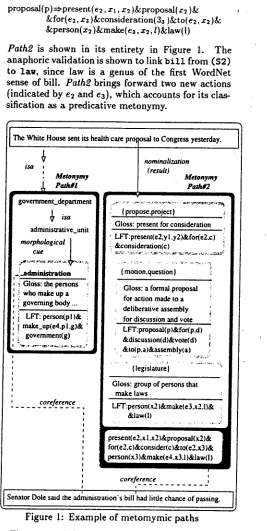
Pathl: l l h i t e . H o u s o - i s a - - ~ g o v e n m e n t A e p a r t a e n t - - - isa-+administrat i r e _ t r a i t - morphological.zue-~ -+admiaistration--genus-~person
The meronymic morphological cue from Pathl is consistent with the meronyms encoded in Word- Net 1.6, because we have:
(a)
govemment-department- is_part-+admirdstrationas an immediate inference from Path1
(b)
adminJstration-is_part--~governmentas a semantic relation encoded in WordNet 1.6 (c) govemment-department-is_part-.+government
as a semantic relation encoded in WordNet 1.6 Moreover, the anaphoric validation of Pathl is possible because nominal a d m i n i s t r a t i o n is present in
(S2).
In the case ofObject2(send) a morpho-logical path accounts for the coerced knowledge. Nominalization p r o p o s a l is the result of the action expressed by synset V'={ propose,project}. [ntegrating predicate
proposal as an object in the LFT(V') we obtain:
LFT' (proposal)=present (e2, Yt, Y~)&proposal(y~ )&
&for(e~, Ys )&consideration(ys )
When computing the similarity with (S1), we obtain Prep-Sort2(send,to) as the role candidate to be incorporated in LFT'(proposal). This is en- forced by the LFT of synset {motion,question}, a hyponym of sense I of proposal. The gloss of {motion,question} is (a proposal for action made to a deliberative assembly for discussion and vote),
producing the LFT:
LFT( motion)=proposal{p)&for(p,d)&discussion(x)& &vote(x)&to(p,a)&assembly(a)
in which present(e2,yt, y~)&proposal(y~) may sub- stitute proposal(p)whereas d i s c u s s i o n can be re- placed by its hypernym c o n s i d e r e d : i o n . Further- more, since Congress is a h y p o n y m of
assembly
and the filler of Prep_Sort2(send.to) in (S1). we can unify Lgr(motion), LFT'(proposal) and LgT(legislature) and obtain the final coercion as:
147
proposal(p)=~present (e2, z l , z~. )&proposal(x2 )& &for(e2, x~)&consideration(3s )&to{e2, x2)& &person(x~ )&make(e~, x~,/)&law(l)
Path2 is shown in its entirety in Figure 1. The anaphoric validation is shown to link b i l l from ($2) to la~, since law is a genus of the first WordNet sense of bill. Pathg brings forward two new actions (indicated by e2 and ea), which accounts for its clas- sification as a predicative metonymy.
['he White House sent its health care proposal to Congress yesterday.
t
= '
administrative_unit
morphological
J
: ~
.i..~dminiaration
i Gloss: the persons
i who make up a ; governing body ...
i LFT:person(pl)& ! make_up(e4,pl.g)&
i government(g)
.... ..... ... 1
{ propose.project I !
Gloss: present for consideration
LFT:present(e2,y I ,y2)&for(e2.c) &consideration(c)
{ moues.question }
Gloss: a formal proposal for action made to a
deliberative assembly
for discussion and vote
LFT:proposal(p)& forfp,d ) &discussion(d)&vom(d} &to(p,al&assemblyla)
{ legislamre }
Gloss: group of persons that make laws
LFT:person(x2 )&make(e3,x2.1)& !
&law(1) i
for(e2.c)&consideflc)&to(e2,x3 )& person(x3)&makefe4.x3.1 )&law(1)
co.e/ere.ce
I .. ... ... ... .. i
nator Dole said the administration's bill had little chance of passing.
Figure h Example of metomymic paths
The usage of the LFT of a hyponym of p r o p o s a l is a consequence of modeling Gricean principles via lexical chains from WordNet. The relevance maxim is enforced whenever as m a n y lexical chains as pos- sible can be retrieved between previously activated concepts and novel information. When we pro- cess the sort satisfaction of the object role, concept l e g i s l a t u r e is already activated and it satisfies the
[image:6.612.302.569.76.607.2]I
I
I
I
I
I
I
I
I
I
I
i
I
I
I
/!
I
I
I
and l e g i s l a t u r e and increasing the relevance of logis:l.atttre in the context of coercing knowledge for the object proposal. The final unification rein- forces the relevance of l o g i s l a ~ t t r e , congruent with the coreferential link between b i l l and 1am
5
C o n c l u s i o n sThis paper proposes a method of deriving metonymic coercions by using the information avail- able in WordNet 1.6. The method does not presup- pose the availability ofsortal constraints, but rather builds approximations ofsortai information from the knowledge implemented in WordNet. It uses two dis- tinct approaches for knowledge coercion: one that relies on lexico-semantic information, another based on morphological links and unifying logic formulae (LF'rs) inferred from conceptual definitions.
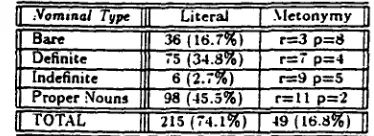
To evaluate this methodology of deriving metonymic coercions, a test set of 20 New York Times articles were parsed by FASTUS (Appelt et al., 1993) and used in conjunction with their coreference keys, as provided by the MUC test data. There were 1261 nominal expressions, distributed in four classes as il- lustrated in Table 1. A percentage of 23% nominals
w e r e anaphoric, out of which almost 74% had literal
meaning. In approximating the sortal constraints, sorts for 68.2% of nominals were returned. When the sorts were not satisfied by searches through Word- Net, metonymic paths were derived. As Table I in- dicates, 68.9% of these paths were lexico-semantic (denoted with r=-referential metonymies) and 31.1% were morpho-logical (denoted with p=predicative metonymies).
II ,Vo~,.~l r y ~ III "' Lito~, I Me~onymy II
,,Bare
:~ (16[r%i'
r=3p=s
Definite ~5 (34.8%) r=', p=4 Indefinite '6 (2.7%) r=9 p=5 ] ~:[.. Proper Nouns ~}8 (45.5%) r= 11 p=2
U-TOTAL [1[ 215 (74.1%) ] A9,(16.8%) H
Table h Distribution of metonymic anaphorae
The evaluation of path-validating anaphorae against coreference keys resulted in a precision rate of 76% and a recall of 83%. These results indicate that we need to experiment with different similar- ity measures. We also found that the metonymies have a significant contribution as knowledge sources for coreference resolution. 43% of the coreference keys were accounted by mere string matches. 3.1% by synonyms encoded in WordNet. 3.7% by hyper- nyms and 16.3% by links made possible through co- ercions.
R e f e r e n c e s
Douglas E. Appelt..Jerry R. Hobbs..John Bear. David Israel. Megumi Kameyama. aJad Mabry Tyson. The 148
SRI MUC-5 JV-FASTUS Information Ex:raction Sys- tem. In Proceedings of the Fifth Message Understand- ing
Conference
(MUC-5), 1993.John Bear and Jerry R. Robbs. Localizing Expressions of Ambiguity. In Proceedings of the Second Conference on Applied Natural Language Processing, Association for Computational Linguistics, pages 235-242, 1988. Richard Bobrow, Ran Ingria and David Stallard. The
Mapping Unit Approach to Subcategorization. In
Proceedings o[ the Speech and Natural Language Workshop, 1991.
Dan Fuss. met" : A Method of Discriminating Metonymy and Metaphor by Computer. In Compu- tational Linguistics, 17(1):49-90, 1991.
Paul J. Grice. Logic and Conversation. In P. Cole and J. Morgan, editors. Syntax and Semantics Val.3: Speech Acts, pages 41-58. Academic Press, New York, ~975.
Barbara J. Grosz, Aravind K. Joshi and Scott Weinstein. A Framework for Modeling the Local Coherence of Discourse. In Computational Linguistics, 12:(3), 1995. Sanda ttarabaglu, Dan Moldovan and Takashi Yukawa. Testing Gricean Constraints on a WordNet-Based Co- herence Evaluation System. In Working :Votes o/the AAAI.96 Spring Symposium on Computational Ap- proaches to Interpreting and Generating Conversa- tional [mplicature, pages 31-38. 1996.
Sanda Harabagiu. An Application of WordNet to Prepo- sitional Att_achment. In Proceedings o/the .'~st An- nual Meeting of the Association for Computational Linguistics. ACL-96, pages 361-362, 1996.
Lynette Hirshman and Nancy Chinchor. MUC-7 Coref- erence Task Definition, Version 3.0.. 1997.
Jerry R. Hobbs. Discourse and Inference. Unpublished manuscript. 1986- t.
Jerry R. Hobbs. Overview of the TACITUS Project. In
Computational Linguistics. 12:(3). 1986-2.
Jerry R. Hobbs. Mark E. Stickel. Douglas E. Appelt and Paul Martin. Interpretation as Abduction. in Artifi- cial Intelligence. 63:69-[42, 1993.
George Lakoff and Mark Johnson. Metaphors We Live By. Chicago University Press, Chicago. IL. 1990. MADCOW Committee {Hirshman. Lynette et all).
Multi-Site Data Collection for Spoken Language Cor- pus. In Proceedings o] the Speech and Natural Lan- guage Workshop. 1992.
Katya Markert and Udo Hahn. On the |ntcraction of Metonymies and Anaphora. In Proceedings of the 15th International Joint Con]erence on Artificial Intelli- gence (IJCAL97). Nagoya..Japan. t010-t015. George A. Miller. WordNet: a Lexical Database for
English. In Commumcatwns o[ the .4CM, Vol.38,
No. 11:39-41. 1995.
Geoffrey Ntmberg. Transfers of Meaning. In lournal o[ Semantics. 12:109-132. 1995.
[image:7.612.76.263.470.538.2]