DOI: 10.1534/genetics.110.124149
The
Activator
/
Dissociation
Transposable Elements Comprise
a Two-Component Gene Regulatory Switch That Controls
Endogenous Gene Expression in Maize
Ling Bai and Thomas P. Brutnell
1Boyce Thompson Institute, Cornell University, Ithaca, New York 14853 Manuscript received October 17, 2010
Accepted for publication December 23, 2010
ABSTRACT
The maizeActivator/Dissociation(Ac/Ds) elements are able to replicate and transpose throughout the maize genome. Both elements preferentially insert into gene-rich regions altering the maize genome by creating unstable insertion alleles, stable derivative or excision alleles, or by altering the spatial or temporal regulation of gene expression. Here, we characterize anAcinsertion in the 59-UTR of thePink Scutellum1 (Ps1) gene and five Ds derivatives generated through abortive transposition events. Char-acterization ofPs1transcription initiation sites in this allelic series revealed several that began within the terminus of theAcandDselements. Transcripts originating withinDsorAcaccumulated to lower levels than the wild-typePs1allele, but were often sufficient to rescue the seedling lethal phenotype associated with severe loss-of-function alleles. Transcription initiation sites were similar in Ac and Ds derivatives, suggesting thatAc transposase does not influence transcript initiation site selection. However, we show thatActransposase can negatively regulatePs1transcript accumulation in a subset ofDs-insertion alleles resulting in a severe mutant phenotype. The role of maize transposons in gene evolution is discussed.
T
HE maizehAT family membersActivator/Dissociation(Ac/Ds) are composed of the autonomousAcand nonautonomousDstransposable elements (Kunzeand
Weil2002).Acis 4565 bp and encodes a 3.5-kb open
reading frame (ORFa) that directs the synthesis of an 807-amino-acid-transposase (TPase) protein (Fedoroff
et al. 1983; Kunze et al. 1987). The TPase transcript
initiates at several sites within a 100-bp interval at the 59 end of the element and spans most ofAc(Kunzeet al.
1987). The lack of canonical CAAT and TATA boxes in the promoter region may account for the multiple transcriptional initiation sites within Ac and the low levels ofActranscript (Dynan1986; Fusswinkelet al.
1991; Fridlender et al. 1998). Ac contains 240 bp
subterminal repeats and 11 bp terminal inverted repeats at each end. The subterminal repeat regions at both Ac ends contain TPase binding sites that are essential for TPase recognition and subsequent trans-position of both Ac and Ds (Muller-Neumann et al.
1984; Pohlman et al. 1984a,b; Coupland et al. 1989;
Kunzeand Starlinger 1989).
Ds elements are structurally diverse but share the feature that they are capable of nonautonomous trans-position (reviewed in Doring and Starlinger 1986;
Kunze1996). Most Dselements arise fromAcinternal
deletions that ablate TPase activity. Some Dselements, such asDs9, are derived from simple internal deletions ofAcsequence (Pohlmanet al.1984b). More complex
structures can also be generated when oneDselement inserts into or near another Ds element (Courage
-Tebbeet al.1983; Kleinet al.1988; Doringet al.1989;
Ralston et al. 1989; Dooner and Belachew 1991).
These complex elements are capable of inducing chro-mosome breakage (Englishet al.1995), a phenomenon
first discovered by McClintock in 1946 (McClintock
1946; Doringet al.1989).AcandDsare also capable of
inducing large-scale structural rearrangements of the genome such as chromosome translocations, inversions, and deletions (Dooner and Belachew 1991; Zhang
et al.2009).
AcandDselement insertions can regulate and modify flanking gene expression in a variety of ways (reviewed in Wessler 1988; Feschotte et al. 2002). Ac/Ds
ele-ments can alter the RNA splicing patterns (Simonand
Starlinger 1987; Wessler et al. 1987; Grotewold
et al. 1991) or affect the timing and tissue-specific ac-cumulation of adjacent gene transcripts (Klein et al.
1988; Schiefelbeinet al. 1988a; Sullivanet al. 1989;
Doweet al.1990; Morenoet al.1992). Vollbrechtet al.
(2000) have also described a Ds-insertion allele of
knotted1that shows altered expressivity in the presence of Ac. The mutant phenotype is most enhanced (i.e., more knots on leaves) in the presence ofAc-st1, whereas in the absence ofAc, the mutant phenotype is relatively
Supporting information is available online athttp://www.genetics.org/ cgi/content/full/genetics.110.124149/DC1.
Sequences for theps1(Ds) alleles have been deposited in GenBank under identifiers HQ641289–HQ641293.
1Corresponding author:Boyce Thompson Institute, Cornell University, 1 Tower Road, Ithaca, NY 14853. E-mail: [email protected]
weak. Ac-st1 is an allele of Ac that accumulates higher levels of ORFa transcript (Brutnell1995) but is identical
in sequence toAc( J. Messing, unpublished data).
Al-though the precise mechanism by whichAc-st1mediates the effect onknottedTDsis unknown, the interaction
be-tweenDsandAcresults in ectopic accumulation ofKn1
transcripts in leaves (Vollbrechtet al.2000).
To explore the mechanisms by which Ac/Ds may control adjacent gene expression, we characterized an
Ac insertion in the ps1 gene, ps1-m8TAc [hereafter
referred to asps1(Ac)]. ThePs1gene encodes lycopene
b-cyclase (LCYB), an essential enzyme in b-carotene biosynthesis (Singh et al. 2003). In previous studies,
a series of Ac-induced alleles of ps1 were generated through a large-scaleAc regional mutagenesis (Singh
et al.2003; Baiet al. 2007). Among a collection of 24
independentps1alleles, all but 1 allele conditioned a seedling lethal phenotype when homozygous due to insufficient accumulation of xanthophylls in seedling tissues (Bai et al. 2007). The one viable insertion
al-lele, ps1(Ac), carries a single Ac insertion in the 59 -untranslated region (UTR) 16 bp upstream of the predicted Ps1 start codon in a 39 to 59 orientation relative toPs1transcription (Baiet al.2007). This single
insertion allele and the nonautonomous Ds deletion derivatives generated from this allele (Conrad et al.
2007) are the focus of this report.
Quantitative real-time PCR and 59rapid amplification of cDNA ends (RACE) techniques were utilized to exam-inePs1 transcript pools in mutant and wild-type indi-viduals and to mapPs1transcription start sites (TSS), respectively. A series of Ds derivatives was generated fromps1(Ac) to examine the contribution ofAc trans-posase on ps1 expression. The Ps1 TSS in these Ds
derivatives were also mapped by 59RACE analysis and the ps1 transcript pools among the Ds derivatives quantified. We found that in some Ds alleles, the presence ofAc results in a significantly reduced accu-mulation ofPs1product leading to seedling lethality. We discuss the implications of these results in elucidating the molecular mechanisms of transposon-mediated control of endogenous gene expression.
MATERIALS AND METHODS
Plant stocks: All materials were maintained in the color-converted W22 inbred genetic background (Dooner and Kermicle 1971). Line ps1(Ac), originally defined as
ps1-m8TAc, was discovered through an Acregional mutagenesis of theps1 locus from donor site bti97156TAc as previously described (Bai et al. 2007). Ds insertional alleles ps1(Ds1),
ps1(Ds2),ps1(Ds3),ps1(Ds4), andps1(Ds5) were derived from ps1(Ac) through a two-step genetic selection scheme as pre-viously described (Conradet al.2007).
To monitorAccopy number in the maize genome, we used aDstester line,r-sc:m3as previously reported (Brutnelland Dellaporta1994). This line contains aDsinsertion at the
r1locus that is responsible for anthocyanin production in the aleurone and scutellum tissues. In the absence ofAc,Ds
insertions at r1 are stable, which results in a colorless aleurone. In the presence of Ac, Ds excises from r1 and restores gene function producing purple sectors in the aleurone. The timing ofDsexcision is delayed with increasing Ac copy number in the genome, resulting in a ‘‘negative dosage effect’’ (McClintock1951). TheAc-immobilized (
Ac-im) element encodes the Ac transposase protein but is in-capable of autonomous transposition (Conradand Brutnell 2005). TheAc-stablized1(Ac-st1) allele is a derivativeAcline that does not display a negative dosage effect (Chomet1988).
Phenotypic screens: Seeds were surface sterilized and placed in a seed germination pouch as described in Baiet al. (2007) or sown directly in pots without treatments. Seedlings were grown in growth chambers under the following con-ditions: 31°day/22°night, 50% humidity, 12 hr night and 12 hr light of intensity at 500mmol/m2/sec. Photos were taken 7 days after planting.
Nucleotide sequences: Sequences for the ps1(Ds) alleles have been deposited in GenBank under identifiers HQ641289– HQ641293.
RACE: Total RNA was extracted from seedlings harvested at the three-leaf stage using TRIzol reagent following the manufacturer’s recommendations (Invitrogen, Carlsbad, CA). Approximately 200mg total RNA was used to isolate mRNA with the Oligotex mRNA mini kit (Qiagen, Valencia, CA). Approximately 200 ng mRNA was treated using the GeneRacer kit according to the manufacturer’s recommendations (Invi-trogen). Only capped full-length mRNA pools were captured and used to construct RACE libraries. The first-strand cDNA synthesis was performed using SuperScript III (Invitrogen) with GeneRacer Oligo dT primer (Invitrogen). An RNase H treatment was performed (Invitrogen) followed by two rounds of nested PCR to amplify the cDNA product. The first-round PCR reaction was performed using 0.6 mm GeneRacer 59Primer (Invitrogen) and 0.2mmPs1 gene-specific primer PS1-38 (59-GACCTTGGCCTGGTGGAAGACGA-39) from 1ml first-strand cDNA template. The nested PCR reaction was performed using 0.2mmGeneRacer 59Nested Primer (Invi-trogen) and 0.2 mm Ps1 gene-specific primer PS1-36 (59-AACTCGTCCACCCACACGCCGTA-39) with 1 ml first-round PCR product. The PCR reactions consisted of 2.5 units Platinum Taq DNA Polymerase High Fidelity (Invitrogen), 13PlatinumTaqbuffer, 0.2 mmdNTP’s, 0.5mbetaine, 4% DMSO and 2 mm magnesium sulfate. A touchdown PCR program was used under the following conditions: denaturing at 94°for 2 min, 5 cycles at 94°for 30 sec and 72°for 2 min, 5 cycles of 94°for 30 sec and 70°for 2 min, 25 cycles of 94°for 30 sec, 65°for 30 sec, and 68°for 2 min, with a final extension at 68° for 10 min. RACE products were visualized by gel electrophoresis, subcloned into pCR4-TOPO cloning vector (Invitrogen) and sequenced.
Real-time PCR:Total RNA was extracted as described above, purified using an RNeasy mini kit, and treated with RNase-free DNase (Qiagen). cDNA libaries were reverse transcribed from purified total RNA using a High-Capacity cDNA Reverse Transcription kit (Applied Biosystems, Foster City, CA). Taq-Man gene primers and a 39minor groove binder (MGB) probe specific to ps1 were used in real-time PCR as previously described (Baiet al.2009). For each allele, three biological replicates and for each replicate three technical replicates were performed. The relativeps1gene expression was calcu-lated as previously described (Baiet al.2009).
RESULTS
Acinsertion in the 59-UTR directs transcription at the
gene expression, we performed a detailed characteriza-tion of theps1(Ac) allele. Unlike all otherAc-induced
ps1alleles described (Singhet al.2003; Baiet al.2007),
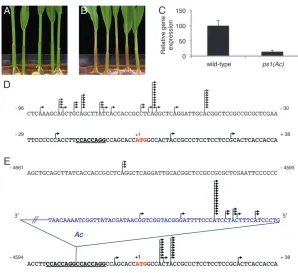
seedlings homozygous for theps1(Ac) grew to maturity and set seed. When seeds are planted and grown in seed germination pouches as shown in Figure 1, homozygous
ps1(Ac) seedlings display a slightly pale green and pink leaf sheath, due to the accumulation of lycopene in seedling tissues (our unpublished data). When grown in a field nursery, plants homozygous forps1(Ac) display a weak mutant phenotype including thinner stalks, slower growth, and delayed flowering time, indicating that the
Ac insertion at the 59-UTR disrupts but does not completely abolish PS1 function.
To characterizePs1transcript profiles inps1(Ac) homo-zygous mutant plants,ps1mRNA pools were quantified using real-time PCR (see materials and methods).
Relative gene expression levels ofps1alleles were calcu-lated and are shown in Figure 1C. Transcripts encoded by ps1(Ac) were reduced to 14% of wild-type levels, suggesting that theAcinsertion interfered withPs1 tran-scription initiation or transcript stability. Despite the greatly reduced transcript pools, these results indicate that sufficient PS1 protein is able to accumulate to produce viable offspring in self-pollinated homozygous
ps1(Ac) mutants.
Rare transcripts initiate within terminus of Ac
element: To further characterize the transcriptional regulation of theps1(Ac) allele, we performed 59rapid amplification of cDNA ends (RACE) (see materials and methods) to map theps1TSS. The 59RACE
prod-ucts were amplified from both wild-type and homozy-gousps1(Ac) mutant tissues. A pool of PCR products was amplified, and 47 independent clones for both the wild-type and mutant allele were sequenced to define the TSS. It should be noted that the same primer sets were used to map the TSS for bothPs1andps1(Ac) alleles and were designed to sequence 321 bp downstream of the ATG start codon. Furthermore, 59RACE was performed on capped full-length mRNA templates as described in
materials and methods. Thus, it is likely that all the
TSS mapped reflect genuine TSS and the relative abundance of the products is directly comparable betweenPs1andps1(Ac) alleles. Transcription initiation sites are shown in Figure 1, D and E.
The majority of wild-type Ps1 transcripts initiate within a window of 49 to 93 bp upstream of the start codon ATG (Figure 1D). The lack of a strong consensus TSS is consistent with the absence of a strong consensus TATA motif as seen in mammalian systems (Carninci
et al.2006) and suggests that other promoter elements are utilized to drive Ps1 transcription. Inps1(Ac), the predominant ps1 transcripts initiate within the Ac
terminus 18 nt from the 59end ofAcand read out into the flankingps1sequence (Figure 1E). These initiation sequences are300 bp from the predominantAc trans-posase TSS (ORFa; Kunzeet al.1987), andAcandps1
transcription is directed in opposite orientation. Such 59Acread-out promoter activity has not been previously reported in maize, though a similar activity has been described for aDsinsertion in transgenic tomato plants (Rudenkoet al.1994). In addition to the TSS initiating
withinAc, several TSS were mapped within the coding regions of ps1(Ac). However, these transcripts are un-likely to encode functional protein products, since they would lack 31 amino acids of the mature protein, in-cluding plastid targeting sequences (Singhet al.2003).
In summary, multiple TSS are utilized in both the wild-type andAcinsertion allele, suggesting plasticity in the control ofPs1expression.
Dsderivatives atps1-m8:TheAc-encoded TPase binds to subterminal repeats withinAcandDselements to cat-alyze the transposition reaction (Kunzeand Starlinger
1989). Thus, we examined the possibility that the Ps1
promoter activity associated with ps1(Ac) is mediated through Ac binding at end sequences. To test this hy-pothesis, we examined promoter activity in the absence of TPase expression and in the presence of low and high levels of TPase expression.
To eliminate TPase expression from ps1(Ac), a ge-netic scheme was used to recover five Ds derivatives from the Acinsertion atps1(Ac) (Conradet al.2007).
Four of the five ps1(Ds) alleles were identified as internal deletion derivatives that do not produce functional TPase protein but retain the element at the original genomic location as the donorAc. A schematic of theDsallelic structures at theps1(Ac) locus is shown in supporting information, Figure S1. The ps1(Ds1),
ps1(Ds3), ps1(Ds4), and ps1(Ds5) alleles each suffered an internal deletion of varying length: 1177 bp, 775 bp, 455 bp, and 1805 bp, respectively, from a 4565-bp intact
Ac. In each of these fourps1(Ds) alleles, theDselement has intact terminal and subterminal repeats. The
ps1(Ds1) allele contains 39 bp, andps1(Ds3) contains 77 bp of ‘‘filler’’ DNA, respectively, inserted at the deletion junction as shown in Figure S1. The fifth
ps1(Ds) allele,ps1(Ds2), is unique in that sequences at the 59end of theAcelement including the subterminal and terminal inverted repeats were deleted together with the internal sequence. One base pair of the target site duplication adjacent to this Ds insertion was also deleted. In addition to the 3563-bp deletion inps1(Ds2), filler DNA was also present at the deletion junction, which originated from bothAcandps159-UTR sequen-ces that flanked the insertion site (Conradet al.2007).
To dissect the function ofAcTPase in regulatingps1
expression,ps1transcription initiation sites were map-ped by 59 RACE in ps1(Ds) derivatives. The ps1(Ds1) allele was not selected for this assay because it has a similar structure to ps1(Ds3), ps1(Ds4), and ps1(Ds5). Homozygousps1(Ds2),ps1(Ds3),ps1(Ds4), andps1(Ds5) seedlings were harvested and mRNA used in 59RACE experiments (see materials and methods). The 59
and a minimum of 12 PCR products were cloned and sequenced for each genotype to map TSS. As shown in Figure 2, multiple TSS were identified for each allele and the profile of each was similar among all Ds de-rivatives characterized. In particular, the predominant
ps1 transcription initiation site in ps1(Ds3), ps1(Ds4), andps1(Ds5) was within theActerminus 18 nt from the 59end. Additional TSS were also detected downstream of the ATG in plants carrying theseps1(Ds) alleles as was observed withps1(Ac). However, it is unlikely that any of these downstream TSS restore functionality as the predicted encoded protein would lack a plastid transit peptide. The finding that the predominant TSS are conserved between these Ds alleles and the Ac allele indicates thatAc transposase is not necessary for TSS selection.
Theps1(Ds2) allele is unique in that it carries1 kb of 39Acend sequences and completely lacks the 59Acend sequences that immediately flank the ps1 gene in
ps1(Ac). As the derivative is missing the end of the element it is most similar to fAc elements described previously by Dooner (Ralstonet al.1989). However,
we refer to it here as aDselement as it was derived from
Ac and is no longer capable of autonomous trans-position. Interestingly, ps1 transcription still initiates within the Ds element in ps1(Ds2) but no consensus sequences were identified and TSS initiated further upstream at sites47–115 bp from thePs1start codon. Thus, it appears that 59 terminal sequences of Ac do influence the TSS selection but are not absolutely required for transcription initiation.
A comparison of the mutant phenotypes conditioned by the variousDsalleles (Figure 3) is consistent with the
results of TSS site selection. The ps1(Ds1), ps1(Ds3),
ps1(Ds4), andps1(Ds5) alleles condition similar mutant seedling phenotypes that are not appreciably different from the parental ps1(Ac) allele. Seedlings are very slightly pale green, but grow to maturity in the field and set seed. However, ps1(Ds2) shows a severe mutant phenotype; seedlings are albescent and die soon after germination. In summary, these results suggest thatAc/Ds
sequences at the 59end of the element promoteps1gene expression independently ofAcTPase.
High levels of TPase expression in ps1(Ds) alleles:
Although Ac TPase did not noticeably influence the mutant seedling phenotype, plants that carried theDs
insertion alleles [with the exception of ps1(Ds2)] dis-played weaker mutant phenotypes in the field than the original ps1(Ac) allele (data not shown). This finding suggests that Ac transposase may negatively regulate gene expression fromPs1through interactions withAc
or Ds sequences upstream of Ps1. Thus, we reasoned that very high levels of Ac TPase could negatively influence the phenotype of theDsinsertion alleles. To dissect the role that TPase may play in regulatingPs1
gene expression, we examined the influence ofAcon
ps1(Ds) allelic expression using the Ac derivatives Ac-immobilized(Ac-im) (Conradand Brutnell2005) and
Ac-stabilized1 (Ac-st1) (Chomet 1988). The Ac-im
ele-ment encodes a functional TPase but is incapable of autonomous transposition due to a 10-bp deletion of 59end sequences (Conradand Brutnell2005).Ac-st1
shows a dosage insensitive Ds-mediated variegation pattern (B. McClintock, unpublished data) that is
59sequences of the element (Brutnell 1995). The
Ac-st1allele likely produces high levels of TPase protein that delays the developmental timing of the transposi-tion (Heinlein1996). Thus, we compared the seedling
phenotypes and expression of the Ps1 gene in the absence of TPase [ps1(Ds), 1/1], with low levels of TPase [ps1(Ds), Ac-im/1] and with high levels of TPase [ps1(Ds),Ac-st1/1].
To introduce TPase into ps1(Ds) derivatives, a two-step genetic strategy was developed. Pollen collected from plants homozygous for ps1(Ds1), ps1(Ds3),
ps1(Ds4), and ps1(Ds5) was used to pollinate plants homozygous for Ac-im or Ac-st1in the field. To create stocks with the ps1(Ds2) allele, crosses could only be performed with heterozygous individuals because ho-mozygous ps1(Ds2) are seedling lethal. Heterozygous progeny carrying theps1(Ds) mutant alleles andAcwere then backcrossed to plants homozygous for their re-spectiveps1(Ds) mutant alleles. Using this two-step ge-netic scheme, testcross ears were harvested and kernels homozygous forps1(Ds1),ps1(Ds3),ps1(Ds4), orps1(Ds5) alleles were phenotypically identified in approximately one-half of the kernels as they conditioned slightly pink endosperm tissue. Of these kernels, half carried one copy of Ac-im or Ac-st1 (spotted) and half lacked Ac
(nonspotted). For the ps1(Ds2) allele, heterozygous plants were used to generate mutant progeny and similar kernel selections were made [e.g., ps1(Ds2)
mutant kernels were selected with or without Ac-im
andAc-st1].
To visualize the effects of TPase on ps1(Ds) alleles, homozygous ps1(Ds) mutant kernels exhibiting three different levels ofAcexpression (1/1,Ac-im/1, or Ac-st1/1) were grown in growth chambers (seematerials and methods). Plants homozygous forps1(Ds2) display
a seedling lethal albescent phenotype (Figure 3A). The introduction of one copy ofAc-im(Figure 3B) orAc-st1
(Figure 3C) did not noticeably affect the expressivity of the mutant phenotype in the homozygous ps1(Ds2) individuals.
The ps1(Ac) derivative alleles ps1(Ds1), ps1(Ds3),
ps1(Ds4), andps1(Ds5) are very weak mutants and con-dition similar phenotypes. Homozygous ps1(Ds3) and
ps1(Ds5) seedlings were selected as representatives of these four derivative mutants (Figure 3, D and G, re-spectively). Introduction of a low level of TPase expres-sion through the addition of a single copy ofAc-imdid not noticeably influence the mutant seedling pheno-types in eitherps1(Ds3) orps1(Ds5) plants as shown in Figure 3, E and H, respectively. Interestingly, the in-troduction of high levels of TPase expression by adding a single copy of Ac-st1resulted in a virescent seedling lethal phenotype [Figure 3, F and I for ps1(Ds3) and
ps1(Ds5), respectively] that is similar to the seedling phenotype of lines homozygous for theps1(Ds2) allele, with the exception that occasional revertant sectors are
observed in the presence ofAc-st1(Figure 3, F and I), which was confirmed by DNA blot analysis (data not shown).
ps1 transcript levels in ps1(Ds) derivatives: To un-derstand the phenotypic variation found in theps1(Ds) derivatives, real-time PCR was performed to examine the relativeps1transcript levels inps1(Ds2) andps1(Ds5) genotypes containing differentAcdoses (Figure 4). The
ps1(Ds5) allele was selected for this assay to represent the four weak ps1(Ds) derivatives. TaqMan real-time PCR primers and probe were used to compare ps1
transcript abundance in seedling tissues (seematerials and methods). Relative to the transcript of theps1(Ac)
allele, theps1(Ds2)1/1,ps1(Ds2)Ac-im/1, andps1(Ds2)
Ac-st1/1 genotypes all showedps1transcript levels that were approximately fivefold lower in abundance. The
ps1(Ds5) 1/1 and ps1(Ds5) Ac-im/1 genotypes accu-mulated ps1 transcripts at a level similar to that of
ps1(Ac). However,ps1transcript accumulation was
sub-stantially lower in ps1(Ds5) Ac-st1/1 mutant tissues relative tops1(Ds5)1/1,ps1(Ds5)Ac-im/1, orps1(Ac)
seedlings. These results suggest that the presence of Ac-st1 negatively affects the accumulation of the ps1
transcripts.
TSS in ps1(Ds) alleles containing Tpase: To under-stand whether or not additional TPase expression regulatesps1transcription, ps1TSS were examined by 59 RACE in ps1(Ds2) and ps1(Ds5) derivatives in the presence of TPase. Homozygous mutant seedlings of
ps1(Ds2) 1/1, ps1(Ds2) Ac-im/1, ps1(Ds2) Ac-st1/1,
ps1(Ds5)1/1,ps1(Ds5)Ac-im/1, andps1(Ds5)Ac-st1/1 were harvested and mRNA used in 59 RACE experi-ments. TSS were mapped by cloning and sequencing a minimum of 30 PCR products from each genotype. As shown in Figure 5, multiple TSS were detected among all genotypes characterized. Importantly, transcription initiation sites were similar in the presence of TPase expressed from eitherAc-imorAc-st1. Interestingly, sev-eral TSS were mapped upstream of theDsinsertions in
ps1(Ds5) lines carrying Ac-im and Ac-st1. These minor products representDsexcision alleles and show that the preferred TSS in revertant alleles are similar to those in the original Ps1 allele, indicating the Ds element dis-places but does not eliminate endogenous promoter sequences. Taken together, these findings strongly sug-gest that Ac-st1inhibits the expression of the ps1(Ds5) allele by reducing the rates of transcription initiation rather than affecting transcript site selection.
DISCUSSION
Plant transposable elements are capable of regulating flanking gene expression through numerous mecha-nisms including providing novel TSS (Masson et al. Figure3.—Seedling phenotypes of homozygousps1(Ds)
al-leles. (A)ps1(Ds2), (B)ps1(Ds2)1Ac-im, (C)ps1(Ds2)1 Ac-st1, (D)ps1(Ds3), (E)ps1(Ds3)1Ac-im, (F)ps1(Ds3)1Ac-st1, (G)ps1(Ds5), (H)ps1(Ds5)1Ac-im, and (I)ps1(Ds5)1Ac-st1.
1987; Schiefelbeinet al.1988a; Barkanand Martienssen
1991; Rudenkoet al.1994; Kigeret al.1999),
introduc-ing novel enhancer elements (Naito et al. 2009),
altering the splicing of the genes in which the trans-poson resides (Wessleret al.1987; Menssenet al.1990;
Weil and Wessler 1990), and subjecting flanking
genes to epigenetic regulation (Chomet et al. 1987;
Slotkinand Martienssen2007).
Here we describe a two-component gene regulatory switch wherebyDsinsertions in the promoter of thePs1
gene bring the gene under the control of Ac. In the presence of an Ac-overexpression allele (i.e., Ac-st1) transcript pools from Ps1 are reduced significantly,
resulting in a seedling lethal phenotype. In the absence ofAcor in the presence of a single standardAcelement, expression of the Ps1 gene is sufficient to result in a green seedling that reaches maturity and sets viable seeds. A model describing this interaction is presented in Figure 6. In a wild-type seedling, transcription is initiated from several sites in a window50–90 bp up-stream of the ATG (represented by a single arrow in Figure 6A). AnAcinsertion in the 59-UTR displaces the endogenous TSS 4.5 kb upstream of the translation start site. Nevertheless,ps1transcripts accumulate to14% of wild-type levels and are initiated from sequences within the ends of Ac [relative levels represented by
poly(A) transcripts in Figure 6]. Transposase is not required to drive transcription from within the Ds
element as insertion alleles can also provide TSS in the absence of Ac (Figure 6C). We propose that a transcription factor complex is recruited to the sub-terminal repeat region at theAc/Dsterminus (Figure 6, B and C). The weak promoter activity results in a low abundance ofps1transcript pools. However, these pools are sufficient for plant survival. In the presence ofAc-st1, excessive Ac transposase binds to the Ds subterminal repeat regions and inhibits recruitment of a transcrip-tion factor complex (Figure 6D). Thus,ps1transcripts are greatly reduced resulting in a severe mutant pheno-type. The absence ofAcbinding sites at the 59end of the element inps1(Ds2) renders this allele insensitive to this effect. Importantly, the ps1(Ac) and ps1(Ds) alleles represent new regulatory circuits that are controlled through both novelcis(i.e.,Ac/Dsend sequence) and
trans(i.e., transposase) regulatory components. Our findings suggest thatActransposase is capable of suppressing gene expression whenAcorDsinserts in 59 -UTR sequences of target genes. Similar ‘‘suppressible’’ gene expression systems have been described for the maizeMu andSpm families. For instance, aMu trans-poson inserted in 59-UTR of thehcf106 gene provides transcription initiation sites when Mu is inactive (Barkanand Martienssen1991). However,
transcrip-tion from thehcf106gene is suppressed when an active source of Mu transposase is present elsewhere in the genome (Barkan and Martienssen 1991). A similar
phenomenon has been described forSpm(McClintock
1954, 1965). InSpm-suppressible alleles,dSpminsertions reduce but do not completely eliminate the expression of the target gene in the absence ofSpm. In the presence of
Spm, gene expression is inhibited but dSpm excisions restore gene function (McClintock1954). The
molec-ular characterization ofSpm-suppressible alleles ata2-m1
(Menssen et al. 1990), a1-m1(Schwarz-Sommer et al.
1985), andbz-m13(Schiefelbeinet al.1988b) revealed
that these insertions were in coding regions of the gene and likely involved the misprocessing of transcripts in the presence ofSpm(Gierlet al.1988). McClintock(1962)
also characterizedSpm-dependent alleles in which flank-ing gene expression was dependent on the presence of a functionalSpmelement. InSpm-dependent alleles ofa1, an insertion of thedSpmelement in the promoter region drives flanking gene expression in the presence but not in the absence ofSpm(Massonet al.1987). TheKn1-2F11
allele described by Vollbrecht et al.(2000) could be
considered anAc-dependent allele; only in this instance
Acenhances ectopic accumulation ofKn1, resulting in a dominant mutant phenotype.
TheAc-suppressible alleles ofps1are most similar to theMu-suppressible alleles athcf106, in which insertions in the 59-UTR result in decreased transcript accumula-tion in the presence of high levels of transposase. In addition, our observations that transcripts are initiated
from both within the 59end of theAc/Dselements and in the flanking regions of the ps1(Ac/Ds) alleles are consistent with the finding that TSS also initiate in the ends of Mutator in the hcf106 allele (Barkan and
Martienssen 1991). In both instances flanking gene
expression is inhibited in the presence, but not in the absence of the autonomous element. However, Spm -suppressible alleles characterized to date are associated with the insertion of elements in transcribed regions of the gene. Thus, the mechanism of suppression shared by Ac/Ds/Mu appears to differ from the mechanism used by theSpmsystem.
An interesting contrast between the Muand Ac/Ds
systems is thatMuactive lines generally contain a high copy number of Mu insertions. Germinal insertions increase rapidly with each generation (Mayet al.2003)
and global silencing of all endogenous copies occurs rapidly and frequently (Martienssenand Baron1994;
May et al. 2003). InAc active lines, copy numbers are
generally maintained at low levels and silenced at a relatively low frequency (Brutnell and Dellaporta
provide a mechanism to negatively regulate both Ds
copy number and Ac copy number. As Ac dosage in-creases (i.e., copy number), expression of genes flank-ingDspromoter insertions would be subject to negative regulation. In the case ofPs1, this results in a seedling lethal phenotype and the selection for lines that carry reduced copy numbers ofAc and Ds promoter inser-tions. To examine this potential for Ac suppression more globally, we mapped knownDsinsertions relative to the 59-UTR of annotated genes in the maize genome (Vollbrecht et al. 2010). As shown in Table S1, we
identified 114Dsinsertions that are likely to act asAc -suppressible alleles (39to 59orientation) and another 161Dsinsertion alleles that may serve as potentialAc -suppressible alleles (59to 39orientation). Thus, while
Muactivity may be targeted directly through gene si-lencing mechanisms (Slotkin et al. 2005), more
in-direct regulation of Ac/Ds copy number may occur through the detrimental effect of insertion into or near essential maize genes.
The identification of additional Ac-suppressible al-leles could be exploited for functional genomics stud-ies. A program is currently under development to distribute thousands of Ds insertions throughout the maize genome as platforms for regional mutagenesis (Ahern et al. 2009; Vollbrecht et al. 2010). These
insertions will be used to generate multipleDs-insertion alleles at defined target genes. Those that insert in promoter regions could be potential targets for the ‘‘fine-tuning’’ of flanking gene expression by the mod-ulation ofAcexpression levels. We are currently testing this concept using the ps1(Ds5) allele to monitor expression ofPs1in the presence of several derivatives ofAc-st1that have altered transposase expression levels. The ability to influence flanking gene expression throughAc/Dsalso has potential to regulate gene ex-pression in transgenic systems. Several thousand Ds
elements have been distributed throughout the rice and
Arabidopsis thalianagenomes (Sundaresanet al.1995;
Kolesniket al.2004) and those that insert into 59-UTR
sequences in a 39to 59orientation relative to target gene transcription are good candidates for Ac-suppressible insertion alleles.
Although transcription is initiated from within the end sequences of both Ac/Ds (this study) and Mu
(Barkan and Martienssen 1991), it is unlikely that
Ac/DsorMuend sequences are sufficient to drive high level expression of flanking gene transcription. As noted by Barkan and Martienssen, the ends of Mu do not harbor a canonical TATA motif, but do have sequences similar to Initiator (Inr) elements described in mamma-lian genes (Smaleand Baltimore1989). TATA motifs
are also absent from the ends ofAc/Dsand although a read-out promoter activity has been described for a Ds
insertion in tomato (Rudenkoet al.1994), the TSS was 300 bp from the 59end compared to18 bp from the 59end of theAc/Dselement in this study. This suggests
that sequences within the end of the elements function as transcription initiation sites if they are inserted in a suitable context (e.g., near an endogenous gene pro-moter). A more detailed characterization of additional 59-UTR insertions should help further delimit the promoter activity of Ac/Ds in driving flanking gene expression.
To examine additional regulatory motifs in the ps1
gene, we scanned the regions surrounding the TSS for signatures of transcription initiation. The multiple transcriptional initiation sites associated with wild-type and mutant ps1alleles are consistent with the absence of consensus CAAT and TATA boxes in the promoter region (Smale and Kadonaga 2003). In many
pro-moters lacking a TATA element, the Inr functions at the site of transcription initiation (Smale and Baltimore
1989). The Inr motif is contained within the transcrip-tion start site and is a strong core promoter element that is functionally analogous to the TATA box (O’Shea
-Greenfieldand Smale1992). In yeast, the Inr extends
from nucleotides 6 to 111 and has the consensus sequence of Py Py A(11) N T/A Py Py (Smale1997).
Within the consensus sequence, an A at 11, a T or A at 13, and a C or T at 1 are most critical for de-termining the strength of an Inr (Smale 1997). In
maize, an Inr element has been identified as directing transcription from the TATA-less geneAbp1(Elrouby
and Bureau2000). In our study, most of the transcripts
identified initiated with an A at 11. The predominant transcripts have sequences similar to Inr element, but with mismatch(es).
The wild-typePs1TSS lie in a window of 22 to 93 bp upstream of the start codon ATG. The predominant transcript initiation sites within Ac and most Ds inser-tions are located from 34 bp to110 relative to the ATG. Inps1(Ds2), the TSS fall in a window from 47 to 115 bp upstream of the ATG. These findings suggest that the proximity of TSS to the ATG is relatively conserved among theps1transcripts detected, within a window of 115 to110 bp relative to the ATG. This may reflect the ability of sequences surrounding the start codon to aid in the recruitment of RNA polymerase II. Previous studies in Drosophila have suggested that sequences downstream of the Inr help direct transcrip-tion initiatranscrip-tion sites. One such element, the downstream promoter element (DPE), is highly conserved (A/G G A/T C/T G/A/C) among Drosophila TATA-less pro-moters and is located at128 to132 relative to the start of transcription (Burkeand Kadonaga1996; Kutach
and Kadonaga2000). The DPE is also found in human
core promoters and is conserved but not identical to the one described in Drosophila (Burke and Kadonaga
contains a sequence from137 to141 that matches the Drosophila DPE at all but 1 bp. The sequence at133 to137 of the transcript with TSS at 105 bp upstream of ATG inps1(Ds2) is identical to the DPE and sequence at 138 to 142 has all but 1 bp, same as the DPE. Collectively, these results suggest that an Inr-DPE core promoter functions to direct transcription in maizeps1
alleles. It appears that inps1(Ac/Ds) alleles, the physical distance separating the Inr from the downstream DPE element is variable but similar to the spacing observed between the Inr and DPE elements in both Drosophila and human promoters. Thus, gene regulation in maize may involve similar Inr-DPE modules. Studies to in-vestigate this possibility are now possible with the se-quencing of the maize genome (Schnableet al.2009).
We thank Amanda Romag for DNA blot hybridization. We also thank Erik Vollbrecht for helpful discussions and suggestions to the text and Kevin Ahern, Amanda Romag, Jon Duvick, and Kazuhiro Kikuchi for critical readings of the manuscript. This work is supported by funding from the National Science Foundation to T.P.B. (IOS-0501713 and IOS-0922701).
LITERATURE CITED
Ahern, K. R., P. Deewatthanawong, J. Schares, M. Muszynski, R. Weekset al., 2009 Regional mutagenesis usingDissociation in maize. Methods49:248–254.
Bai, L., M. Singh, L. Pitt, M. Sweeney and T. P. Brutnell, 2007 Generating novel allelic variation throughActivator inser-tional mutagenesis in maize. Genetics175:981–992.
Bai, L., E. H. Kim, D. DellaPennaand T. P. Brutnell, 2009 Novel lycopene epsilon cyclase activities in maize revealed through per-turbation of carotenoid biosynthesis. Plant J.59:588–599. Barkan, A., and R. A. Martienssen, 1991 Inactivation of maize
transposon Mu suppresses a mutant phenotype by activating an outward-reading promoter near the end ofMu1.Proc. Natl. Acad. Sci. USA88:3502–3506.
Brutnell, T. P., 1995 Epigenetic regulation of Activator(Ac) in maize, Ph.D. Thesis, Yale University, New Haven, CT.
Brutnell, T. P., and S. L. Dellaporta, 1994 Somatic inactivation and reactivation ofAcassociated with changes in cytosine meth-ylation and transposase expression. Genetics138:213–225. Burke, T. W., and J. T. Kadonaga, 1996 DrosophilaTFIID binds to
a conserved downstream basal promoter element that is present in many TATA-box-deficient promoters. Genes Dev. 10: 711–724.
Burke, T. W., and J. T. Kadonaga, 1997 The downstream core pro-moter element, DPE, is conserved fromDrosophilato humans and is recognized by TAFII60 of Drosophila. Genes Dev. 11: 3020–3031.
Carninci, P., A. Sandelin, B. Lenhard, S. Katayama, K. Shimokawa et al., 2006 Genome-wide analysis of mammalian promoter ar-chitecture and evolution. Nat. Genet.38:626–635.
Chomet, P., 1988 Characterization of stable and metastable changes of the maize transposable element,Activator.Ph.D. Thesis, State University of New York, Stony Brook, NY.
Chomet, P. S., S. Wesslerand S. L. Dellaporta, 1987 Inactivation of the maize transposable element Activator(Ac) is associated with its DNA modification. EMBO J.6:295–302.
Conrad, L. J., L. Bai, K. Ahern, K. Dusinberre, D. P. Kaneet al., 2007 State IIDissociationelement formation followingActivator excision in maize. Genetics177:737–747.
Conrad, L. J., and T. P. Brutnell, 2005 Ac-immobilized, a stable source ofActivatortransposase that mediates sporophytic and ga-metophytic excision ofDissociationelements in maize. Genetics 171:1999–2012.
Coupland, G., C. Plum, S. Chatterjee, A. Postand P. Starlinger, 1989 Sequences near the termini are required for transposition
of the maize transposonAcin transgenic tobacco plants. Proc. Natl. Acad. Sci. USA86:9385–9388.
Courage-Tebbe, U., H. P. Doring, N. Fedoroffand P. Starlinger, 1983 The controlling elementDsat theShrunkenlocus inZea mays: structure of the unstablesh-m5933allele and several rever-tants. Cell34:383–393.
Dooner, H. K., and J. L. Kermicle, 1971 Structure of theR r tan-dem duplication in maize. Genetics67:427–436.
Dooner, H. K., and A. Belachew, 1991 Chromosome breakage by pairs of closely linked transposable elements of theAc-Dsfamily in maize. Genetics129:855–862.
Doring, H. P., and P. Starlinger, 1986 Molecular genetics of trans-posable elements in plants. Annu. Rev. Genet.20:175–200. Doring, H. P., B. Nelsen-Salz, R. Garber and E. Tillmann,
1989 DoubleDselements are involved in specific chromosome breakage. Mol. Gen. Genet.219:299–305.
Dowe, Jr., M. F., G. W. Romanand A. S. Klein, 1990 Excision and transposition of twoDstransposons from thebronze mutable 4 derivative 6856 allele of Zea mays L. Mol. Gen. Genet. 221: 475–485.
Dynan, W. S., 1986 Promoters for housekeeping genes. Trends Genet.2:196–197.
Elrouby, N., and T. E. Bureau, 2000 Molecular characterization of theAbp159-flanking region in maize and the teosintes. Plant Physiol.124:369–377.
English, J. J., K. Harrisonand J. Jones, 1995 Aberrant transposi-tions of maize doubleDs-like elements usually involveDsends on sister chromatids. Plant Cell7:1235–1247.
Fedoroff, N., S. Wessler and M. Shure, 1983 Isolation of the transposable maize controlling elements Ac and Ds. Cell 35: 235–242.
Feschotte, C., N. Jiangand S. R. Wessler, 2002 Plant transposable elements: where genetics meets genomics. Nat. Rev. Genet.3: 329–341.
Fridlender, M., Y. Sitrit, O. Shaul, O. Gileadiand A. A. Levy, 1998 Analysis of the Acpromoter: structure and regulation. Mol. Gen. Genet.258:306–314.
Fusswinkel, H., S. Schein, U. Courage, P. Starlinger and R. Kunze, 1991 Detection and abundance of mRNA and protein encoded by transposable elementactivator(Ac) in maize. Mol. Gen. Genet.225:186–192.
Gierl, A., S. Luttickeand H. Saedler, 1988 TnpAproduct en-coded by the transposable element En-1 ofZea maysis a DNA binding protein. EMBO J.7:4045–4053.
Grotewold, E., P. Athma and T. Peterson, 1991 Alternatively spliced products of the maizePgene encode proteins with ho-mology to the DNA-binding domain ofmyb-like transcription fac-tors. Proc. Natl. Acad. Sci. USA88:4587–4591.
Heinlein, M., 1996 Excision patterns ofActivator(Ac) and Dissocia-tion(Ds) elements inZea maysL.: implications for the regulation of transposition. Genetics144:1851–1869.
Kiger, A. A., S. Gigliottiand M. T. Fuller, 1999 Developmental genetics of the essentialDrosophilanucleoporinnup154: allelic differences due to an outward-directed promoter in the P-element 39end. Genetics153:799–812.
Klein, A. S., M. Clancy, L. Paje-Manalo, D. B. Furtek, L. C. Hannahet al., 1988 The mutation bronze-mutable 4 derivative 6856in maize is caused by the insertion of a novel 6.7-kilobase pair transposon in the untranslated leader region of thebronze-1 gene. Genetics120:779–790.
Kolesnik, T., I. Szeverenyi, D. Bachmann, C. S. Kumar, S. Jiang et al., 2004 Establishing an efficient Ac/Dstagging system in rice: large-scale analysis ofDsflanking sequences. Plant J. 37: 301–314.
Kunze, R., 1996 The maize transposable elementActivator (Ac). Curr. Top. Microbiol. Immunol.204:161–194.
Kunze, R., and P. Starlinger, 1989 The putative transposase of transposable elementAcfromZea maysL. interacts with subtermi-nal sequences ofAc.EMBO J.8:3177–3185.
Kunze, R., and C. F. Weil, 2002 ThehATand CACTA superfamily of plant transposons. Mobile DNAII:565–610.
Kutach, A. K., and J. T. Kadonaga, 2000 The downstream pro-moter element DPE appears to be as widely used as the TATA box in Drosophila core promoters. Mol. Cell. Biol. 20: 4754–4764.
Martienssen, R., and A. Baron, 1994 Coordinate suppression of mutations caused by Robertson’sMutatortransposons in maize. Genetics136:1157–1170.
Masson, P., R. Surosky, J. A. Kingsbury and N. V. Fedoroff, 1987 Genetic and molecular analysis of the Spm-dependent a-m2alleles of the maizealocus. Genetics117:117–137. May, B. P., H. Liu, E. Vollbrecht, L. Senior, P. D. Rabinowiczet al.,
2003 Maize-targeted mutagenesis: A knockout resource for maize. Proc. Natl. Acad. Sci. USA100:11541–11546.
McClintock, B., 1946 Maize genetics. Carnegie Inst. Wash. Year Book45:176–186.
McClintock, B., 1951 Chromosome organization and gene expres-sion. Cold Spring Harb Symp. Quant. Biol.16:13–47. McClintock, B., 1954 Mutations in maize and chromosomal
aber-rations inNeurospora.Carnegie Inst. Wash. Year Book 53:254– 260.
McClintock, B., 1962 Topographical relations between elements of control systems in maize. Carnegie Inst. Wash. Year Book61: 448–461.
McClintock, B., 1965 Components of action of the regulatorsSpm andAc.Carnegie Inst. Wash. Year Book64:527–534.
Menssen, A., S. Hohmann, W. Martin, P. S. Schnable, P. A. Peterson et al., 1990 The En/Spm transposable element ofZea mays con-tains splice sites at the termini generating a novel intron from a dSpm element in theA2gene. EMBO J.9:3051–3057.
Moreno, M. A., J. Chen, I. Greenblatt and S. L. Dellaporta, 1992 Reconstitutional mutagenesis of the maize P gene by short-rangeActranspositions. Genetics131:939–956.
Muller-Neumann, M., J. I. Yoder and P. Starlinger, 1984 The DNA sequence of the transposable elementAcofZea maysL. Mol. Gen. Genet.198:9–24.
Naito, K., F. Zhang, T. Tsukiyama, H. Saito, C. N. Hancocket al., 2009 Unexpected consequences of a sudden and massive trans-poson amplification on rice gene expression. Nature461:1130– 1134.
O’Shea-Greenfield, A., and S. T. Smale, 1992 Roles of TATA and initiator elements in determining the start site location and di-rection of RNA polymerase II transcription. J. Biol. Chem.267: 1391–1402.
Pohlman, R. F., N. V. Fedoroffand J. Messing, 1984a Correction: nucleotide sequence ofAc.Cell39:417.
Pohlman, R. F., N. V. Fedoroffand J. Messing, 1984b The nucle-otide sequence of the maize controlling elementActivator.Cell 37:635–643.
Ralston, E., J. Englishand H. K. Dooner, 1989 Chromosome-breaking structure in maize involving a fracturedAcelement. Proc. Natl. Acad. Sci. USA86:9451–9455.
Rudenko, G. N., H. J. Nijkampand J. Hille, 1994 Dsread-out tran-scription in transgenic tomato plants. Mol. Gen. Genet. 243: 426–433.
Schiefelbein, J. W., D. B. Furtek, H. K. Doonerand O. E. Nelson, Jr., 1988a Two mutations in a maizebronze-1allele caused by transposable elements of the Ac-Ds family alter the quantity and quality of the gene product. Genetics120:767–777.
Schiefelbein, J. W., V. Raboy, H. Y. Kim and O. E. Nelson, 1988b Molecular characterization of suppressor-mutator (Spm)-induced mutations at the bronze-1 locus in maize: the bz-m13 alleles. Basic Life Sci.47:261–278.
Schnable, P. S., D. Ware, R. S. Fulton, J. C. Stein, F. Weiet al., 2009 The B73 maize genome: complexity, diversity, and dynam-ics. Science326:1112–1115.
Schwarz-Sommer, Z., A. Gierl, R. Berndtgen and H. Saedler, 1985 Sequence comparison of ‘states’ of a1-m1 suggests a model of Spm (En) action. EMBO J.4:2439–2443.
Simon, R., and P. Starlinger, 1987 Transposable elementDs2of Zea mays influences polyadenylation and splice site selection. Mol. Gen. Genet.209:198–199.
Singh, M., P. E. Lewis, K. Hardeman, L. Bai, J. K. Rose et al., 2003 Activator mutagenesis of the pink scutellum1/viviparous7 locus of maize. Plant Cell15:874–884.
Slotkin, R. K., M. Freelingand D. Lisch, 2005 Heritable transpo-son silencing initiated by a naturally occurring transpotranspo-son in-verted duplication. Nat. Genet.37:641–644.
Slotkin, R. K., and R. Martienssen, 2007 Transposable elements and the epigenetic regulation of the genome. Nat. Rev. Genet. 8:272–285.
Smale, S. T., 1997 Transcription initiation from TATA-less promoters within eukaryotic protein-coding genes. Biochim. Biophys. Acta 1351:73–88.
Smale, S. T., and D. Baltimore, 1989 The ‘‘initiator’’ as a transcrip-tion control element. Cell57:103–113.
Smale, S. T., and J. T. Kadonaga, 2003 The RNA polymerase II core promoter. Annu. Rev. Biochem.72:449–479.
Sullivan, T. D., J. W. Schiefelbein, Jr. and O. E. Nelson, Jr., 1989 Tissue-specific effects of maizebronzegene promoter mu-tations induced byDs1insertion and excision. Dev. Genet.10: 412–424.
Sundaresan, V., P. Springer, T. Volpe, S. Haward, J. D. Joneset al., 1995 Patterns of gene action in plant development revealed by enhancer trap and gene trap transposable elements. Genes Dev. 9:1797–1810.
Vollbrecht, E., L. Reiserand S. Hake, 2000 Shoot meristem size is dependent on inbred background and presence of the maize ho-meobox gene,knotted1.Development127:3161–3172. Vollbrecht, E., J. Duvick, J. P. Schares, K. R. Ahern, P.
Deewatthanawonget al., 2010 Genome-wide distribution of transposedDissociationelements in maize. Plant Cell22:1667– 1685.
Weil, C. F., and S. R. Wessler, 1990 The effects of plant transpos-able element insertion on transcription initiation and RNA pro-cessing. Annu. Rev. Plant Physiol. Plant Mol. Biol.41:527–552. Wessler, S. R., 1988 Phenotypic diversity mediated by the maize
transposable elementsAcandSpm.Science242:399–405. Wessler, S. R., G. Baranand M. Varagona, 1987 The maize
trans-posable elementDsis spliced from RNA. Science237:916–918. Zhang, J., C. Yu, V. Pulletikurti, J. Lamb, T. Danilova et al., 2009 AlternativeAc/Ds transposition induces major chromo-somal rearrangements in maize. Genes Dev.23:755–765.
GENETICS
Supporting Information
http://www.genetics.org/cgi/content/full/genetics.110.124149/DC1
The
Activator
/
Dissociation
Transposable Elements Comprise
a Two-Component Gene Regulatory Switch That Controls
Endogenous Gene Expression in Maize
Ling Bai and Thomas P. Brutnell
L. Bai and T. P. Brutnell 2 SI
FIGURE S1.—Schematic structures of ps1(Ac/Ds) alleles. The light grey boxes represent Ps1 coding regions. Solid black lines represent non-coding sequences of ps1. Dark grey box represents the Ac or Ds elements inserted in the ps1 5’UTR. Deletions within Ds are shown as gaps. Open box shows filler DNA at the Ds internal deletion junction. Dark triangles represent the terminal inverted repeats at the end of Ac/Ds termini.
L. Bai and T. P. Brutnell 3 SI
TABLE S1
Putative Ac-suppressible Ds insertion alleles
Table S1 is available for download as an Excel file at http://www.genetics.org/cgi/content/full/genetics.110.124149/DC1.