A New Algorithmic Approach to Improve
MCDS Based Routing Using Articulation
Point in MANAT
K.K Joshi1, Nimmi Gupta2Assistant Professor, Dept. of CS, MPCT College, Gwalior, M.P, India1 PG Student, Dept. of CS, MPCT College, Gwalior, M.P, India2
ABSTRACT: An ad hoc wireless network is a special type of wireless network in which a collection of mobile hosts
with wireless network interfaces may from a temporary network, without the aid of any established infrastructure or centralized administration. A connected dominating set (CDS) is used to reduce broadcast overhead. A common source of overhead in a wireless ad hoc network comes from blind broadcasts. It is possible to significant reduction of overhead by using the minimal connected dominating set (MCDS) to reduce redundancy due to these blind broadcasts. Dynamic Source Routing (DSR) is a routing protocol designed specifically for use in mobile ad hoc networks. The protocol allows nodes to dynamically discover a source route across multiple network hops to any destination in the ad hoc network. When using source routing, each packet to be routed carries in its header the complete, ordered list of nodes through which the packet must pass.
KEYWORDS: Adhoc Network, MCDS, Routing Protocol.
I.INTRODUCTION
A Mobile Ad-hoc network [1] is a collection of wireless nodes communicating with each other in the absence of any fixed infrastructure. An ad-hoc network is totally temporary arrangement without any Centralized Administration. Topology changes from time to time, due to change in situation of each node. Since all nodes are mobile, each node works as a Host as well as a Router. So, Mobile Ad-Hoc Network is self creating, self organizing and self administering. A Mobile Ad hoc network is a special type of wireless network in which a collection of wireless hosts with wireless network interfaces encompasses of a temporary network, without the aid of any established infrastructure or centralized administration. If two hosts that want to communicate are outside their Wireless Transmission Ranges, they could communicate only if other hosts between them in the Ad hoc network are willing to forward packets for them.
II.MCDS SET APPROACH
Fig. 1: An example of CDS
MCDS in Mobile Ad - hoc network is treated as a Virtual Backbone for the whole network. A Virtual Backbone [16, 17] Structure in the Ad-hoc network is useful, in order to support Unicast, Multicast, and Fault-Tolerant Routing within the Ad-hoc network. This virtual backbone differs from the wired backbone of cellular network. The hosts in the MCDS maintain local copies of the Global Topology of the network, along with shortest paths between all pairs of nodes. Finding a minimal CDS for a connected graph is an NP-hard problem [18]. For a small graph, we can enumerate all possible cases to find a minimal solution. However, this approach is not feasible for larger graphs.
Routing
To determine routes with MCDS, global knowledge of G (taking to the Link-State approach restricted to MCDS Nodes) In general, the routes determined by the MCDS nodes do not pass through the MCDS. However, the MCDS can handle routes in two situations:
(a) When a non- MCDS Edge or Node fails [14], the MCDS provides an Immediate Backup Route to use while another shortest path is found, and
(b) The MCDS can be used for Multicast and Broadcast Routing [12].
At a High Level of Abstraction, the MCDS based routing algorithms consists of the following step to Computation of Routes [14]:
1. Compute the MCDS.
2. Gather Topology information from Non-MCDS nodes to MCDS nodes.
3. Broadcast Topology to all MCDS nodes.
4. Determine Routes. Each node runs an All - Pairs Shortest Path Algorithm on its Local Copy of
Graph.
5. Propagate Information
III.PREVIOUS WORK
GUHA AND KHULLER’S ALGORITHM (CDS BASED)
The idea behind the algorithm is as follows: Grow a tree T, Starting from the Vertex of Maximum Degree. At each step a vertex v in T is picked and scans it. Scanning a vertex, add edges to T from v to all its neighbors not in T. In the end, it obtains a Spanning Tree T, and will pick the Non - Leaf Nodes as the Connected Dominating Set.
DRAWBACK:
Algorithm starts by selecting a Node which has Maximum Degree. Since it is a heuristic approach for selection of a Node, it can increase the size of MCDS.
PROOF:
Here, the Size of obtained MCDS is 9. But optimal solution is 8 only as shown in Figure 3. Hence, Heuristic like Maximum Degree for Starting Node can lead to increased size of MCDS.
Fig. 3: MCDS generated by Optimal Solution
IV.PROPOSED WORK
Two Algorithms that utilize the Articulation Points have been proposed and evaluated. These two algorithms are variations of [13]. Proposed approach to compute the MCDS is based on implementation of articulation points [21]. The algorithm starts by selecting a Node which has Maximum Degree. Since it is a heuristic approach for selection of a node, it can increase the size of CDS. It is observed that selection of node with maximum degree may not be the right choice to start. Proposed algorithm starts with computation of articulation points in a connected graph. The two algorithms assume the existence of articulation points. The assumption is largely valid in view of the Dynamic Topology of wireless ad hoc network. The computation of CDS starts with articulation points. The set of articulation points, as provide in Theorem I in next section, is always a subset of MCDS once the articulation points are determined. Resource can be taken to grow this subset in a connected manner or to connect the elements of subset using some Algorithms.
4.1 ARTICULATION POINTS
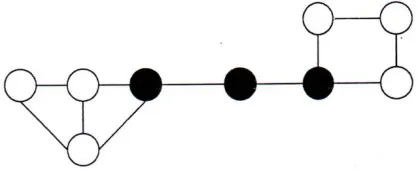
A vertex S in a connected graph G (V, E) is an Articulation Point [21] if and only if the deletion of vertex S Together with all edges incident to S disconnects the graph into two or more non-empty components. Where V is set of nodes and E is set of edges.
Fig 4: Articulation Points in a Graph
In Fig. 4, all Black nodes are Articulation Points for this Graph. Removal of Black node creates disconnected components of graph. The presence of articulation points in a connected graph is undeniable feature for Communication Network. The failure of a node that is an articulation point implies that they will always be a part of the MCDS. With the inclusion of Articulation Points concept, the heuristic starts with Right choice. In our proposed algorithms, the CDS Formation always starts with articulation points. This approach is based on next theorem.
4.1.1 Algorithm I
A. First Phase :
This Phase proceeds as follows. All the articulation points available in a graph G are computed. Further, randomly one Articulation Point is selected and colored Black. All the adjacent White nodes of Black node are colored Gray.
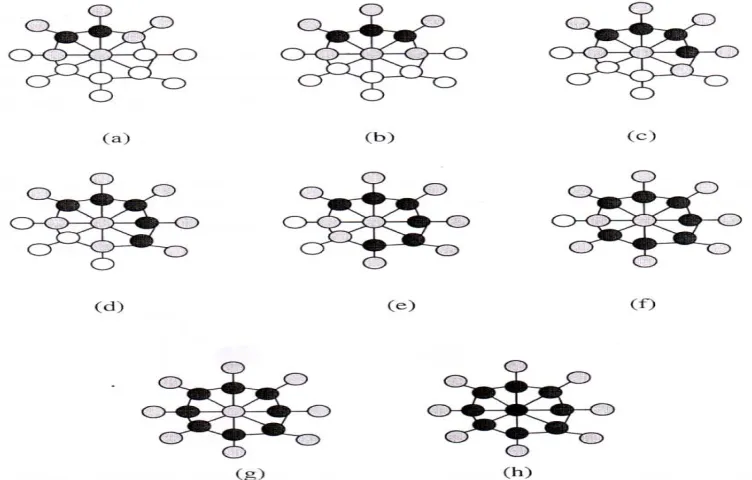
Fig.5 (a – c): Phase I of Algorithm I
For example, Figure 5(a) is the given Graph to be computed. Figure 5 (b) shows all articulation points available in the given graph. Next in Figure 5 (c), a randomly articulation points is selected as Starting Node.
Second Phase:
The size of Dominating Set grows in connected manner. If any Gray node is an Articulation Point, then color it Black else a Gray node with largest number of White adjacent node is selected and colored Black. Second phase is repeated till no node left in graph. Finally a series of Black nodes is generated as CDS.
Fig 6 (a – h): Second Phase of Algorithm I and (h): Equivalent Output generated by Algorithm in [13] and [14].
nodes left i.e. UN is Null at this stage. Hence, CDS consists of all Black nodes. Obtained CDS is less in size as compared to CDS obtained from algorithms in [13] [14] as shown in Figure 6 (h).
4.1.2 Algorithm II
Algorithm II is similar to Algorithm I unlike the method to connect Articulation Points. Shortest Path algorithm is used to connect articulation points. The algorithm works in two phases. Initially all nodes are colored White.
A. First Phase :
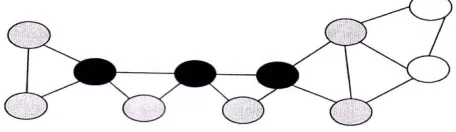
Initially all articulation points are computed and if articulation points are not connected then connect them by using Shortest Path algorithms. Series of nodes are generated this way. Further, Generated Nodes (including Articulation Points) are colored Black and all adjacent nodes are colored Gray.
Fig. 7: First Phase of Algorithm II
In the above Figure 7, Black nodes are the only articulation points. Since articulation points are not connected. Using shortest path algorithms a gray node is discovered to connect articulation points. This gray node is declared as part of DS and colored Black as shown in Figure 7. Gray nodes shown in figure 7 represent the Covered Nodes (CN) of Dominating Set (DS) like in Algorithm I.
Fig. 8: CDS induced by Algorithm II
Second Phase:
Flow chart of Algorithm-I
(Phase-1)
(Phase-2)
Flow chart of Algorithm-II
(Phase-1)
(Phase-2)
Step1: All Articulation Points of Graph are computed
Step2: Now, randomly select any one Articulation Point and colour it black
Step: 3 now, all the Adjacent White Nodes of Black Node are colored Gray
Step:4 If any Gray colour Node is an Articulation Point, then color it Black.
Step: 5 A Gray Nodes with Largest Number of White Adjacent Nodes is selected and color it Black.
Step: 6 Now, Repeat Step (3) of Phase I.
Step1: All Articulation Points of Graph are computed. In the above Graph, Articulation
Step2: If Articulation Points are not connected, then
connect them by means of Shortest Path Algorithms.
Step: 3 Generated Nodes (including Articulation Points)
are colored Black and all adjacent nodes are colored
Step: 4 If any Gray colored Node is an Articulation Point,
then color it Black.
Step: 5 Else, a Gray Node with Largest number of White
Adjacent Nodes is selected and color it Black.
V. SIMULATION RESULT
Parameters Value
Number of Nodes Variable (10,15,20………. 50)
Topography 750m ×7500m
Traffic Type CBR
Signal Propagation Two Ray Ground Model
MAC Type 802.11 Mac Layer
Packet Size 512 Bytes
Mobility Model Random Way Point
Antenna Type Omni Directional
Mobile Ad Hoc Routing AODV
Interface Queue Drop Tail/Priority Queue
Maximum Packet in Interface Queue 100
Channel Wireless Channel
Link Layer Type LL
Network Interface Type Wireless
Fig: 9. Scenarios of 15 nodes
Fig: 11 Packet Delivery Ratio Graph for 15 nodes
Fig: 12 End to End Delay Graph for 15 nodes
VI.CONCLUSION & FUTURE WORK
6.1 Conclusion
This paper proposed different algorithms for calculating Connected Dominating Set in the Mobile Ad - hoc Networks. Here we introduced the implementation of Articulation Point concept into MCDS problem and discussed how to find the MCDS problem using Articulation Points. Analysis shows that inclusion of articulation point concept gives a better solution compared to Heuristic Approach by Guha and Khullers. In Average Case and Best Case proposed approaches have less time complexities and simulation result for 15 nodes.
6.2 Future Work
REFERENCES
[1] A Distributed approach for computing the minimum connected dominating set in ad hoc networks by Kais Mnif , Bo Rond and Michel Kadoch
Ram Soni, Navneet Kour, Alka Kushwaha, Satyendra Singh, Abhishek Vaish Live Computer Forensics on Windows and Linux platform IJSDIA International Journal of Secure Digital Information Age, Volume 2, No.1, 2010
[2] C David B. Johnson, David A. Maltz, and Josh Broch. DSR The Dynamic Source Routing Protocol for Multihop Wireless Ad Hoc Networks. In
Ad Hoc Networking, edited by Charles E. Perkins, chapter 5, pages 139–172. Addison-Wesley, 2001.
[3] K David B. Johnson, David A.Maltz, Yih-Chun Hu, and Jorjeta Jetcheva. The Dynamic Source Routing Protocol for Mobile Ad Hoc Networks. Internet-Draft, draft-ietf-manet-dsr-04.txt, November 2000. Work in progress.
[4] David A.Maltz. Resource Management in Multi-hop Ad Hoc Networks. Technical Report CMU CS TR00-150, School of Computer Science, Carnegie Mellon University, November 1999. Available from http://www.monarch.cs.cmu.edu/papers.html
[5] K M. Scott Corson and Anthony Ephremides. A Distributed Routing Algorithm for Mobile Wireless Networks. Wireless Networks, 1(1):61–81, February 1995.
[6] National Science Foundation. Research Priorities in Wireless and Mobile Communications and Networking: Report of a Workshop Held March
24–26, 1997, Airlie House,Virginia J.P. Anderson, Computer Security Threat Monitoring and Surveillance,
http://csrc.nist.gov/publications/history/ande80.pdf, 2010
[7] RajendraV. Boppana and Satyadeva P. Konduru. An Adaptive DistanceVector Routing Algorithm for Mobile, Ad Hoc Networks. In Proceedings of IEEE INFOCOM 2001, pages 1753–1762, Anchorage, Alaska, April 2001
[8] IEEE Computer Society LAN MAN Standards Committee. Wireless LAN Medium Access Control (MAC) and Physical Layer (PHY) Specifications, IEEE Std 802.11-1999. The Institute of Electrical and Electronics Engineers, New York, New York, 1999.
[9] John Jubin and Janet D. Tornow. The DARPA Packet Radio Network Protocols. Proceedings of the IEEE, 75(1):21–32, January 1987.N.B. Amor, S. Benferhat, and Z. Elouedi, “Naive Bayes vs. Decision Trees in Intrusion Detection Systems,” Proc. ACM Symp. Applied Computing (SAC ’04), pp. 420-424, 2004.
[10] Stephen E. Deering and Robert M. Hinden. Internet Protocol, Version 6 (IPv6) Specification. RFC 2460, December 1998..
[11] Charles E. Perkins and Pravin Bhagwat. Highly Dynamic Destination-Sequenced Distance-Vector Routing (DSDV) for Mobile Computers. In
Proceedings of the SIGCOMM ’94 Conference on Communications Architectures, Protocols and Applications, pages 234–244, August 1994W. Fan, M. Miller, S. Stolfo. “Using Artificial Anomalies to Detect Unknown and Known Network Intrusions”. Proc. First IEEE Int’l Conf. Data Mining, Nov. 2001
[12] Charles E. Perkins and Elizabeth M. Royer. Ad Hoc On Demand Distance Vector (AODV) Routing. Internet-Draft, draft-ietf-manet-aodv-02.txt, November 1998. Work in progress.Qingqing Zhang, Hongbian Yang, Kai Li “Research on the Intrusion Detection Technology with Hybrid Model”,2010 2nd Conference on Environmental Science and Information Application Technology,978-1-4244-7388-5/10 ,ESIAT,pp. 646-649,2010 [13] Vincent D. Park and M. Scott Corson. A Highly Adaptive Distributed Routing Algorithm for Mobile Wireless Networks. In Proceedings of INFOCOM’97, pages 1405–1413, April 1997.
[14] Vincent D. Park and M. Scott Corson. Temporally-Ordered Routing Algorithm (TORA) Version 1: Functional Specification. Internet-Draft, draft-ietf-manet-tora-spec-01.txt, August 1998. Work in progress.
[15] M. S. Corson, S. Papademetriou, P. Papadopoulos, V. Park, and A. Qayyum. An Internet MANET Encapsulation Protocol (IMEP) Specification. Internet-Draft, draft-ietf-manet-imep-spec-01.txt, August 1998. Work in progress.
[16]B. Das, E. Shivakumar, and V. Bhargavan, “ Routing in ad-hoc networks using a virtual backbone, “ Proceedings of the 6th International Conference on Computer Communication and Networks (IC3N’97), pages 1-20, Sept. 1997.
[17]R. Sivakumar, B. Das, and V. Bharghavan, “ An improved spines-based infrastructure for routing in ad hoc networks, ‘ Proceedings of the International Symposium on Computers and Communications (ISCC’98), 1998.
[18]D.B. West, ‘ Introduction to Graph theory,. “ 2nd ed., Prentice Hall, Upper Saddle River, NJ 2001, pp. 116-118.
[19] C. E. Perkins, E. M. Belding-Royer, and S. R. Das, “Ad hoc On-Demand Distance Vector (AODV) Routing,” Internet Engineering Task Force (IETF) draft, November 2002. Available at http://www.ietf.org/internet-drafts/draft-ietf-manet-aodv-12.txt.
[20] A. Boukerche, “Performance comparison and analysis of ad hoc routing algorithms,” in Proc. of IEEE International Conference on Performance, Computing, and Communications, pp. 171-178, 2001.
[21] I. D. Aron and S. K. S. Gupta, “On the scalability of on-demand routing protocols for mobile ad hoc networks: an analytical study,” in Journal of Interconnection Networks, vol. 2, no. 1, pp. 5-29, 2001.
[22] D. Johnson, "The Dynamic Source Routing Protocol for Mobile Ad Hoc Networks (DSR)", IETF Internet Draft, draft-ietf-manet-dsr-09.txt, April 2003.
[23] D.B. Johnson, D.A. Maltz, and J. Broch, "DSR: The Dynamic Source Routing Protocol for Multi-Hop Wireless Ad Hoc Networks", Ad Hoc Networking, pp. 139-172, 2001.