501
Anitha.V2
PG Student [EST], Dept. of EEE, R.V.S College of Engg & Tech , Coimbatore, Tamil Nadu, India 1 PG Student [EST], Dept. of EEE, R.V.S College of Engg & Tech , Coimbatore, Tamil Nadu, India 2
ABSTRACT: Due to the rapid increase in the number of vehicles, traffic congestions and traffic jams are happening very often during peak hours. Hence managing the traffic issues is necessary in rapidly growing cities. The poor traffic management often creates traffic jams which results in many other critical issues like life loss and also affects the human routine lives. One of the methods to overcome the traffic problem is to develop a traffic control system by measuring the traffic density on a road using video capturing and Real time image processing techniques. The Existing image processing systems work well in free-flowing traffic, but not with the traffic congestion. The suggested algorithm will determine the number of vehicles on the road and to control the traffic by calculating the traffic density only on the targeted area. The Optical Flow algorithm works by comparing the reference image (real time frame of live video) with the vehicles captured only in the region of interest (i.e., road area). In order to intelligently control the traffic signal the measured vehicle density can be compared with other direction of the traffic.
KEYWORDS: Traffic density, image processing, density count
I. INTRODUCTION
A steady increase in metro-city population, the number of automobiles and cars increases rapidly and metro traffic is growing crowded which leads to the traffic jam problem.Thus the number of vehicles on roads is increasing in our day today life therefore it is important to efficiently manage the traffic flow. Traffic system plays a vital role in this civilized world and many aspects of life that relies on it. The reason of traffic is an inefficient controlling of traffic signals that affects the traffic flow. Consider for example if one side of the road has less traffic and the other side with huge traffic but the duration of green light for both sides is same then this will create the current resources to go inefficient. But when the higher traffic density side switches on the green signal light for a longer period than lesser density side. Traffic congestion has become a serious issue in big cities. The main reason is the increase in the population that subsequently raises vehicular travel, which creates congestion problem [1-5]. These further results in an expensive transportation due to the extra fuel and time consumption [2]. This problem can be controlled by the proper analysis of traffic, proper adjustment in the controlling of traffic management. The proposed system consists of cameras that are fixed in lanes which are prone to traffic jam. The camera continuously monitors the traffic by capturing videos. The system will extract frames at particular time intervals. The consecutive frames are compared and based on some parameters we determine whether there is a traffic jam. The system is flexible, reliable and cost-effective. For example if there is an emergency vehicle like ambulance on the road. In that situation if an ambulance get caught in a heavy traffic jam then there are high chances that the patient cannot reach the hospital on time. So it is very important to design an intelligent traffic system which controls traffic intelligently to avoid accidents, collisions and traffic jams [7-8]. Increasing number of traffic and poor controls of this traffic also reason for traffic jams [13].
II. SYSTEM MODEL
Sri Krishna College of Engineering & Technology, Kuniamuthur, Coimbatore-641008, Tamilnadu, India
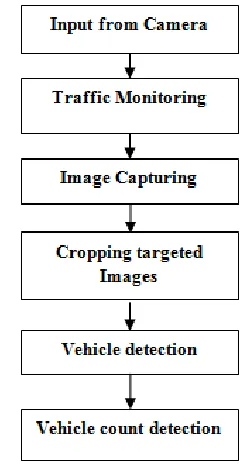
502 Fig 1: System Flow for the Proposed Model
III. STEPS INVOLVED FOR VEHICLE COUNT
A. Traffic Monitoring and Image Capturing
503
B. Image Cropping
Fig 2: (a) Reference Image taken from the Live Video from [12]
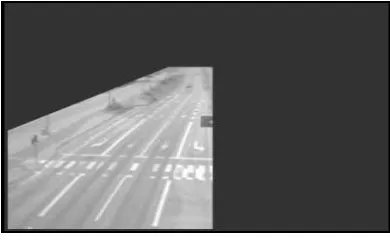
The second stage is to crop the region of interest with the reference image by designing image cropping algorithms using MATLAB. The need for this cropping is to focus the road where the vehicles are present and exclude the unnecessary background information that are captured in the camera. This unnecessary information is fixed in every frame of the live video because the camera is kept fixed. Thus with the help of reference image, the targeted region is cropped by eliminating the unwanted regions Fig. 2(a), which has no road traffic. Firstly, a binary image of having the same dimensions are created with the reference image, then the road area has been shaded white, and the leftover region as black, as shown in Fig. 2(b). Finally, the multiplication of the reference image with the cropping black and white image results in the final desired target area which is illustrated in Fig 2 (c).
Sri Krishna College of Engineering & Technology, Kuniamuthur, Coimbatore-641008, Tamilnadu, India
504 Fig 2: (c) Selection of the target area
C. Vehicle
Detection
The third stage is the vehicle detection in order to identify the vehicles which are present in the targeted area shown in Fig.2(c) which is used to count the vehicle in the specified area. To perform this, first the frame from the real time video sequence is extracted as illustrated in Fig 3(a).
Fig 3: (a) Real-time image extracted from the live video taken from [12]
Fig 3: (b) Difference of reference and real time image
The next step is to convert both the reference image and the real time image into grayscale and then the difference of these two images will be found. Since the dimensions of the road are fixed therefore the difference image only highlights the presence of vehicles in the desired area. The difference image is illustrated in Fig. 3(b).
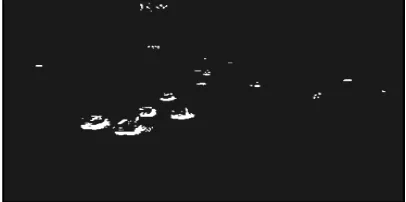
505 Fig 4: (a) Binarization of the difference Image Fig 4: (b) Image highlighting the presence of vehicles in
the targeted area
D. Traffic Density
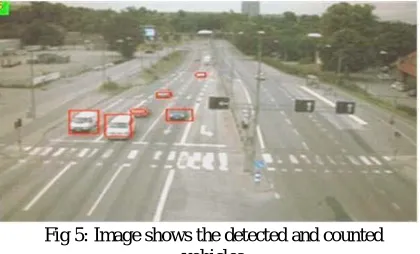
The next stage is to find the number of vehicles present in the desired target area. In order to determine the vehicle count, the vehicles are marked first [here rectangular shape with red colour] and then their numbers are counted. The algorithm search for a set of connecting pixels to detect a vehicle.
In order to consider a connected region as a vehicle, a minimum threshold has been found. However, it is possible that more than one region of a vehicle is detected using the above algorithm. This problem could be overcome by finding the overlapping bounding boxes of the selected regions and from that only smaller and highly overlapping regions are filtered out.
IV. RESULT AND DISCUSSION
The system starts with an image capturing process in which the live video is processed by the fixed camera, mounted on any pole for capturing the required traffic direction. Captured video is divided into one frame per second which continuously extracted from the live video and each frame is processed by converting it into gray scale. For the reference image an empty road image was selected with the absence of vehicles, that is when there is no traffic on the road.
The second stage is the image cropping in which, the targeted area is selected, the area where the vehicles are present and filtered out unnecessary surrounding background information. Next stage, determines the presence of objects in live video by taking the absolute difference of each extracted frame with the reference image.
Sri Krishna College of Engineering & Technology, Kuniamuthur, Coimbatore-641008, Tamilnadu, India
506 Fig 5: Image shows the detected and counted
vehicles
V. CONCLUSION
This paper discusses a method for estimating the traffic density on the lane by using image processing through optical flow algorithm. The advantages of this proposed technique is that there is no need to use complex sensor or aerial imagery based systems.
Our proposed system is very cost effective as it does not require any installation of additional devices, such as RFIDs. This work can be enhanced further by proposing a system by using pressure sensor on roads to count the vehicles. Secondly, the system which identifies the presence of emergency vehicles (like an ambulance) and by giving preference to those emergency vehicles.
REFERENCES
[1] Madhavi Arora, V. K. Banga, “Real Time Traffic Light Control System”, 2nd International Conference on Electrical, Electronics and Civil Engineering (ICEECE'2012), pp. 172-176, Singapore, April 28-29, 2012.
[2] Sabya sanchi kanojia, “Real –time Traffic light control and Congestion avoidance system”, International Journal of Engineering Research andApplications (IJERA), pp.925-929, Vol. 2, Issue 2,Mar-Apr 2012.
[3] Muhammad Tayyab, “Implementation of Restoration Path Using AODV in VANETs” Master’s Dissertation at Brunel University London, UK. [4]Anthony J. Venables, “Evaluating Urban Transport Improvements”, Journal of Transport Economics and Policy, Vol. 41, No.2 , pp. 173-188, May,2007.
[5] Tommy Gärling, Geertje Schuitema, “Travel Demand Management Targeting Reduced Private Car Use”, Journal of Social Issues, Vol. 63, Issue 1, pp. 139–153, March 2007.
[6] Papageorgiou M., Diakaki C., Dinopoulou V., Kotsialos, A.,“Review of road traffic control strategies”, Proceedings of IEEE, Vol. 91, Issue 12, pp. 2043-2067, November 2004.
[7] Georgios Vigos, Markos Papageorgioua, Yibing Wangb, “Real-time estimation of vehicle-count within signalized links”, Journal of Transportation Research Part C: Emerging Technologies, Volume 16, Issue 1, pp.18–35, February 2008.
[8] Michael W. Szeto and Denos C. Gazis, “Application of Kalman Filtering to the Surveillance and Control of Traffic Systems”, Journal of Transportation Science, vol. 6 pp.. 4419-439 , November 1972.
[9] Vikramaditya Dangi, Amol Parab, Kshitij Pawar & S.S Rathod, “Image Processing Based Intelligent Traffic Controller”, Undergraduate Academic Research Journal (UARJ), Vol.1, Issue 1, 2012
[10]Celil Ozkurt and Fatih Camci,“ Automatic Traffic Density Estimation and Vehicle Classification For Traffic Survillance Systems Using Neural Networks”, Journal of Mathematical and Computational Applications, Vol. 14, No. 3, pp. 187-196, 2009.
[11] Pratishtha Gupta, G.N Purohit, Sweta Pandey, “Traffic Load Computation for Real Time Traffic Signal Control”, International Journal of Engineering and Advanced Technology, Vol. 2, Issue 4, April 2013.
[12]Live Video of CCTV Camera for Traffic Monitoring in Stockholm, available at
http://www.trafiken.nu/sv/Stockholm/trafiklaget/Kameror/Roslagsvagen/Albano/
![Fig 2: (a) Reference Image taken from the Live Video from [12]](https://thumb-us.123doks.com/thumbv2/123dok_us/1534714.1188184/3.612.212.411.472.591/fig-reference-image-taken-live-video.webp)