ISSN(Online): 2320-9801
ISSN (Print): 2320-9798
I
nternational
J
ournal of
I
nnovative
R
esearch in
C
omputer
and
C
ommunication
E
ngineering
(An ISO 3297: 2007 Certified Organization)
Vol. 3, Issue 9, September 2015
An Efficient Approach for 3D Face
Recognition Using ANN Based Classifiers
Vaibhav M. Pathak
1, Suhas S.Satonkar
2, Dr.Prakash B.Khanale
3Assistant Professor, Dept. of C.S., Shri Shivaji College, Parbhani, M.S, India1
Assistant Professor, Dept. of C.S., Arts, Commerce and Science College, Gangakhed, M.S, India2
Associate Professor, Dept. of C.S., Dnyanopasak College Parbhani, M.S, India3
ABSTRACT: The area of Face recognition is largely being encompassed by the application of soft computing tools. In
this paper, neural network based three different classification algorithms have been used for a comparative evaluation purpose of randomly taken 3D facial images as a local dataset. The recognition rates have been calculated using LDA technique and compared using SOM, SVM, and Backpropagation algorithm. All the three classification methods differ based on their learning paradigms, as the first one is an unsupervised learning approach and the latter two are supervised learning based classifiers. Through this paper, results have been calculated to serve the purpose of determining a most prominent of the ANN based main classifiers used for efficient 3D Face recognition system.
KEYWORDS:3D Face recognition, ANN, Backpropagation, SVM, SOM
I. INTRODUCTION
The main advantage of the 3D based approaches [7] is that the 3D model retains all the information about the face geometry. The 3D facial representation seems to be a promising tool coping many of the human face variations [2]. There has been increasing interest in using artificial neural networks (ANN) [5] for pattern recognition. A classifier is considered to be good or not according to its ability to generalize. The investigation of sample size problem for neural network classifiers leads the conclusion that the generalization error decreases as the training sample size increases. However, in contrast to statistical pattern recognition, neural networks have a good behaviour regarding small size problem. In this paper, a comparative study has been represented for 3D Face recognition. Following three classifiers have been used to bring out the recognition rates. Self-Organizing Map (SOM) (also called Kohonen network) [11] is an artificial unsupervised neural network characterized by the fact that the neurons become specifically tuned to various classes of patterns through a competitive, unsupervised or self-organizing learning. The spatial location of a neuron in the network (given by its co-ordinates) corresponds to a particular input vector pattern. Similar input vectors correspond to the same neuron or to neighbour neurons. Second classification tool used in this paper and present in ANN theory is, Support Vector Machine (SVM) [13]. It is the supervised learning based approach. The standard SVM takes a set of input data and predicts, for each given input, which of two possible classes the input is a member of, which makes the SVM non-probabilistic binary linear classifiers. Since an SVM is a classifier, then given a set of training examples, each marked as belonging to one of two categories, an SVM training algorithm builds a model that predicts whether a new example falls into one category or the other. The third classifier used is Back propagation[4]. It is also a supervised learning method, and is a generalization of the delta rule. The term is an abbreviation for "backward propagation of errors". Backpropagation requires that the activation function used by the artificial neurons (or "nodes") be differentiable.
ISSN(Online): 2320-9801
ISSN (Print): 2320-9798
I
nternational
J
ournal of
I
nnovative
R
esearch in
C
omputer
and
C
ommunication
E
ngineering
(An ISO 3297: 2007 Certified Organization)
Vol. 3, Issue 9, September 2015
II. RELATEDWORK
This section summarizes related work on face recognition – geometrical feature based approaches, template matching, neural network approaches, and the popular eigenfacestechnique [2][3][8] . A lot of algorithms have been proposed for solving face recognition problem. Based on the use of the Karhunen-Loeve transform, PCA is used to represent a face in terms of an optimal coordinate system which contains the most significant eigenfaces and the mean square error is minimal. Kumar et al. [12] integrated the two techniques for dimensionality reduction and feature extraction and to see the performance when the two are combined. Simulation results show that, though, the individual techniques SOM and PCA itself give excellent performance but the combination of these two can also be utilized for face recognition. The advantage in combining the two techniques is that the reduction in data is higher but at the cost of recognition rate. SOM has been proposed by Kohonen in the early eighties [14]. Since that time, it has been used most widely for data analysis in some areas such as economics physics, chemistry or medical applications. As a general purpose clustering tool with topology preserved from input data, Self-Organizing Map (SOM) has been widely utilized in various areas now [15].
III. EXPERIMENTAL WORK
2.1
BASIC ARCHITECTUREThe input images are taken with varying expressions, background conditions, age, illumination and partial occlusion. The images have been captured into different time periods of the year. People differ based on gender, age, hair style, culture and complexion. The devices used for capturing the images are differing, such that, the different camera models used for the collection purpose are: COOLPIX L550 and COOLPIX L21 few have been taken using the standard cameras of Motorola L6 and Karbon K500 cellular handsets. The figure 1 shows the basic experimental architecture.
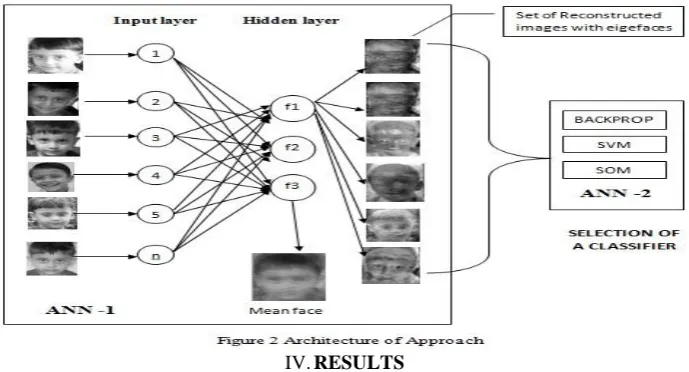
The input 3D colour image has been converted to its head model, for the more precise facial detail extraction, the cone model of the image has been derived. The 3D image is then transformed into 256 grey levels, this 8 bit image is then pre-processed by applying the crop function, histogram equalization and eye coordinate setting Etc. This final image is treated as the input to the network.
2.2 GENERALIZED NEURAL NETWORK ARCHITECTURE
ISSN(Online): 2320-9801
ISSN (Print): 2320-9798
I
nternational
J
ournal of
I
nnovative
R
esearch in
C
omputer
and
C
ommunication
E
ngineering
(An ISO 3297: 2007 Certified Organization)
Vol. 3, Issue 9, September 2015
at the hidden layer, the functions of the hidden layer calculate the mean image, reconstructed images and eigenfaces, at last the output layer generates the set of recognized images.
IV.RESULTS
For the experimentation purpose randomly chosen 100 images have been taken from a collection of own images, the sample images are shown in the figure 2.All the experiments have been performed in MATLAB
(R2010a)
computing environment. The set of reconstructed images obtained from the first neural network is then fed to the next network. For derivation of the comparison of recognition rates, all the three classifiers have been tested. These rates have been estimated based on the percentages of recognized images for all the three techniques. The standard Linear Discriminant Analysis (LDA) method is closely related to linear regression analysis and hence has been used for facial feature extraction and recognition. The following Table I show the summary of results obtained through the experimental work.TABLE I
DATA DISTRIBUTION AND RESULTS OBTAINED FOR EACH CLASSIFIER
DATA DISTRIBUTION RATES OBTAINED BY
CLASSIFIERS (%)
LDA SUBSPACE
NO. OF CLASSES
PURELY SEPERATED
CLUSTERS
BACKPROP SVM SOM
20 1 2 77.5 82.7 87
40 2 4 78 76.4 78.3
60 3 6 77.8 73 84.6
80 4 8 69.7 78.2 80.5
100 5 10 58.3 72.9 74.2
ISSN(Online): 2320-9801
ISSN (Print): 2320-9798
I
nternational
J
ournal of
I
nnovative
R
esearch in
C
omputer
and
C
ommunication
E
ngineering
(An ISO 3297: 2007 Certified Organization)
Vol. 3, Issue 9, September 2015
TABLE II
AVERAGE RECOGNITION RATES
CLASSIFIER METHOD RECOGNITION
RATES%
FALSE RATES %
BACKPROPOGATION LDA 72.26 27.74
SUPPORT VECTOR
MACHINE LDA 76.64 23.36
SELF ORGANISING
MAP LDA 80.92 19.08
V. CONCLUSIONS
The set of results obtained by the experiments carried out using Linear Discriminant Analysis (LDA) method encourages to draw two conclusions: First is that Backpropagation algorithm did not perform well along with the LDA technique. The supervised learning method expects us to already know the output to be produced, this may be the reason because of which regressive analysis approach of LDA does not perform well with supervised learning based classification tools, which are Backpropagation and Support Vector Machine (SVM).
According to the numeric results obtained in the process second conclusion can be made that, Self-Organizing Map (SOM) performed well in the entire experiment, nevertheless, as with rest of the two classifiers the recognition rate for SOM decreases as the size of LDA subspace is increased in the test.
VI. SUMMARY & DISCUSSION
Through this paper, an attempt of comparative analysis of the neural network based classification algorithms has been put forward. Two of which are belonging to supervised learning paradigm and one is the unsupervised learning based method. Results have shown that, supervised learning based classification tools did not perform well with the standard linear regression subspace analysis method of Face recognition i.e. LDA. Unsupervised learning based classifier performed relatively well but the false rate associated with it started to increase along with the size of LDA subspace. Therefore, the question of whether all the three classification methods give the same results if used along with other two subspace analysis methods (PCA & ICA) is left to the future research work and is not in the coverage of the topic of this paper.
REFERENCES
1. A.K.Jain, B.Chandrasekaran. Dimension and Sample Size Consideration in Pattern Recognition Practice. In Handbook of Statistic. Amsterdam, North Holland. 1982.
2. H. Bourlard and Y. Kamp, “Auto-association by multilayer perceptrons and singular value decomposition,” Biological Cybern., vol. 59, pp. 291–294, 1988.
3. Turk M, Pentland A. Eigen faces for recognition. Journal of Cognitive Neuroscience[J], 1991, 3(1): 71-86.
4. G. W. Cottrell and M. Fleming, “Face recognition using unsupervised feature extraction,” in Proc. Int. Neural Network Conf., vol. 1, Paris, France, July 9–13, 1990, pp. 322–325.
5. Swets D L, Weng J. Using Discriminant Eigen features for Image Retrieval. IEEE Trans on Pattern Analysis and Machine Intelligence[J], 1996, 18(8): 831-836.
6. Belhumeur V, Hespanha J, Kriegman D. Eigen faces vs Fisher faces: Recognition Using Class Specific Linear Projection. IEEE Trans on Pattern Analysis and Machine Intelligence[J]. 1997, 19(7):711-720.
7. J. Yang, J.Y.Yang. Why can LDA be performed in PCA transformed space?. Pattern Recognition. 2003,36(2):563-566.
8. J.Yang, A.F.Frangi, J-Y.yang, D.Zhang, Z.Jin. KPCA Plus LDA: A complete kernel fisher discriminant framework for feature extraction and recognition. IEEE Trans. On PAMI. 2005,27(2):230-244.
9. S. Y. Kung, M. Fang, S. P. Liou, M. Y. Chiu, and J. S. Taur, “Decision-based neural network for face recognition system,” in Proc. ICIP’96, vol. I, Washington, D.C., Oct. 1995, pp. 430–437.
ISSN(Online): 2320-9801
ISSN (Print): 2320-9798
I
nternational
J
ournal of
I
nnovative
R
esearch in
C
omputer
and
C
ommunication
E
ngineering
(An ISO 3297: 2007 Certified Organization)
Vol. 3, Issue 9, September 2015
11. Hummel, J. (1995), Object recognition, in M. A. Arbib, ed., „The Handbook of Brain Theory and Neural Networks‟, MIT Press, Cambridge, Massachusetts, pp. 658–660.
12. Kumar, D.; Rai, C.S. & Kumar, S. (2005). Face Recognition Using Self-Organizing Map and Principal Component Analysis, 13. International Conference on Neural Networks and Brain 2005 (ICNN&B '05), Vol. 3, pp. 1469-1473
14. Chellappa, R. ; Wilson, C. L. & Sirohey, S. (1995). Human and Machine Recognition of Faces: A Survey, Proc. IEEE, Vol. 83, No. 5, pp. 705-740
15. Kohonen, T. (1985). Self-Organizing Maps, Springer-Verlag, Berlin
16. Kohonen, T. (1996). Engineering Applications of the Self-Organizing Map, Proceedings of the IEEE, Vol. 84, No. 10, pp. 1358-1384
BIOGRAPHY
Vaibhav M. Pathak – He is a M.Sc. in Computer Science, Currently working as Assistant Professor,
Department of Computer Science, Shri Shivaji College, Parbhani, and Maharashtra, India. He received Master of Philosophy Degree in Computer Science in 2010. His research interest are Soft Computing, Artificial Intelligence, Machine Learning He is Ph.D. Scholar student. His topic of research is 3D Face Recognition Using Soft Computing Techniques.
Suhas S. Satonkar - He is M.Sc.in Computer Science, currently working as Assistant Professor and
Head, Department of Computer Science, Shri Sant Janabai Education Society‟s Arts, Commerce and Science College, Gangakhed District Parbhani, Maharashtra, India, from last 16 years. His area of research is 2D Face Recognition Using soft computing, AI, Machine Learning. He has 8 Research papers published in Journals and 3 Research papers published in conferences. He is Ph.D. Scholar Student.
Dr. Prakash B. Khanale - He has an experience of 14+ years of research work in areas of computer