Design and Modification in Bulk Loading of
Cement at ERP-II Using Air Slide
P.Godson Felix1, S.Hari Hara Krishnan1, M.Goutham Raj1, A.Ganesh1, K.S.Maheswari2
U.G. Student, Department of Mechanical Engineering, Francis Xavier Engineering College, Vannarpettai,,
Tirunelveli, Tamil Nadu, India1
Associate Professor, Department of Mechanical Engineering, Francis Xavier Engineering College, Vannarpettai,
Tirunelveli, Tamilnadu, India2
ABSTRACT: In India Cement packing department has four ERP, it means ELECTRONIC ROTO PACKER (ERP). Our
project done at ERP-II. Here, we construct bulk loading system using air slide in ERP-II. The hopper is placed above the packer and the air slide is taken from the bottom of the hopper which is mainly used to transmit cement from hopper to load truck
.
I. INTRODUCTION
The India Cements Limited - Sankar Nagar Plant is a complete cement manufacturing unit with the present capacity of 1.825 million tonnes per annum. They covers the overall southern marketing for cements; most of their production here is transported to kerala. The cement is manufactured by dry process. The manufacturing process involves various stages from mining of limestone from mines to the packing unit. There are two varieties of cement being manufactured here
1. OPC-Ordinary Portland Cement 2. PPC-Portland Pozzilana Cement
Ordinary Portland Cement is used in housings and our regular day to day purposes. Portland Pozzilano Cement is used in constructing bridges and heavy budget projects. Fly ash is added for making Portland Pozzolona Cement. The fly ash has binding property.
II LITERATURE REVIEW
Bunsri M. Sivakumar & D. Hagare et al (2007)
inferred that A tracer transport numerical model was developed according to the advective – dispersive contaminants transport equation in unsaturated porous media. The govering equation was solved numerically & coded in mat lab program.
B.T.D.Praveen Varma & K.P.Sirisha, et al (2013)
Nahla Fawzy Ahmed, et al (2016)
explain that Research aims to produce fabrics suitable for using an air slide fabrics in cement plant. Technical textiles are defined as textile materials and products manufactured primarily for their technical and performance properties according to the end use. High tensile strength air slide fabric is one of the technical textile which named as air slide belt, conveyor belt or air slide canvas. The air slide belt is placed between material and air -flow box . Air flow cross the material and make the powder or particle Fluidized under gas pressure to achieve the purpose of conveying. This is research aims to produce Fabrics suitable for using as an air slide fabrics in cement plant.
P.G. Mukunda, R.A. Shailesh, A.S. Kiran, & S.R. Shrikantha, et al (2009)
explained that attempt has been made to investigate the various parameters affecting the fluid behaviour, partially filled in a rotating cylinder. An attempt has been made to investigate the various parameters affecting the fluid behaviour, partially filled in a rotating cylinder. When the cylinder is rotating at ‘high’ speed, a liquid forms a hollow cylinder. Different patterns are observed in the fluids for the rotatioal speeds below a critical speed. This study should give us some insight into molten metal behaviour
during centrifugal casting.
S.N. Sridhara & B.N. Raghunandan, et al (2009)
inferred that Photographs &in addition in new concept of shear formation of smaller droplets from the surface of liquid jet by co-flowing air stream in an air blast atomizer has been proposed Still photographs of sprays from an air blast atomizer and a swirl atomizer are taken under backlighting, slit lighting, incident lighting (front flash) and a new method of capturing scattered light image at 1200 to the incident light is introduced in the useful observations such as jet break up phenomenon, the internal details and the external appearance of the spray.
III. EXISTING MODEL
In the India Cement Limited, packing department has four ERP. Our project is carried out at ERP-II. Before starting the project there is no bulk loading in ERP-II.
In packing department, the main process in ERP-II (Electro Roto Packer) is packing of cement into bags. The cement coming to the ERP through the hopper. Hopper is consist of combination of cylinder and frustrum that hold the cement for temporary purpose. The finished material of cement is stored in silo. Here, silo means permanent storage and from the help of bucket elevator is used to transfer cement from silo to hopper and vibrating screen also used in the process. This are the working process of ERP-II in packing department.
IV. PROPOSED MODEL
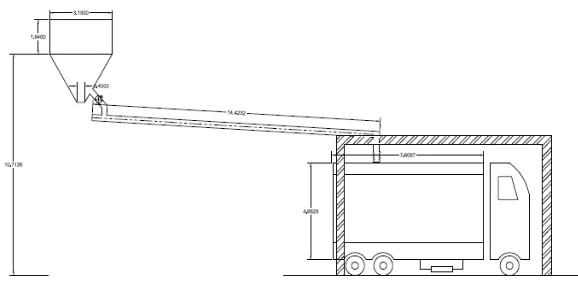
A system for transfer cement from hopper to the truck for the purpose of bulk loading for that various process are carried out air slide and centrifugal blower play major role and brief explanation about it. In the ERP-II packing department, we just introduce the bulk loading system using air-slide. Because bulk loading is a predominantly running area. In the ERP I there has bulk loading but they use angle blow method. So we proposed the air-slide mechanism. In the angle there has various draw backs and also in which the ERP-II is not suitable for the angle blow method. So we proposed this method for transferring powder material with low degree of tapered rectangle box.
Fig (2.2) Final Model
Air-slide is mainly consist of rectangle box and polyster fabric material is placed in between air-slide. Air is blows lower side of the fabric using centrifugal blower. Powder material is flow over the fabric. So, that it easily transferring cement from hopper to the loading truck.
V. OBJECTIVES OF PROPOSED MODEL
1. It increases the production supply lead time
2. To form bulk loading as a more convenient process
3. To minimize the bottlenecks during packing
4. Load out from bulk silos to trucks & railcars
6. Feed to process
VI. AIR – SLIDE MODEL
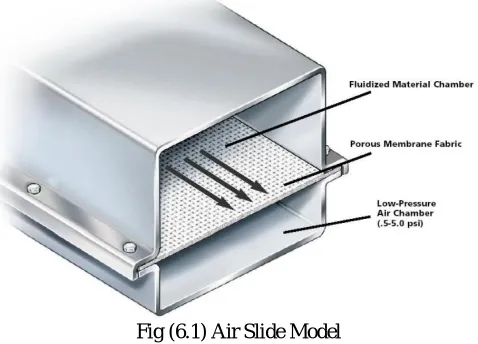
Air-Slide is the metal box divided into two parts .The upper part where the fluidized powder material is located. The lower part where the air passed between 250 to 500mm.
A Pneumatic fluidizing conveyor or air slide or air activated gravity conveyor consist of a fixed inclined duct of the rectangular cross sectional shape which is divided longitudinally in to parts by a partition consisting of a material permeable to air.
Air Slide provide some most efficient and practical method of conveying bulk powder material. All we need is some low pressure air an aeration bed and a small incline (gravity) and we convey hundreds of tons of products over long distances.
Fig (6.1) Air Slide Model
Air slides are used extensively in conveying homogenous dry powder in many industries including minerals and mining where it is used in cement, lime and fly ash. The Cement industry use air slide on flour and many powders in the chemical industry are ideally suited to air slider.
VII. CONCLUSION
We done the project on bulk loading in the use of air slide. Our project ease the bulk loading when compare to other model it mainly reduces the loading time. The major advantage of using bulk loading is in the significant improvement of performance. Especially in the large volume table, bulk loading speeds up the process. To reduce the demand rate of loading system. To construct the bulk loading in the effective manner. So, Air slide efficiency is high. Air slide has low maintenance.
REFERENCES
[1] B.T.D. Praveen Varma & K.P. Sirisha (2013)–“study of processing and machinery in cement industry” –International Journal Of Engineering And Innovative Technology(IRJIT)
[2] Nahla Fawzy Ahmed (2016)”optimizing the functional properties of air- C.Bartholomew (2014)” air-slide activated gravity conveyor”-International Journal Of Engineering Science.
[3] Slide fabrics used in cement industry” – journal of basic and applied science.
[5] T. Bunsri M. Sivakumar & D. Hagare (2007) “ numerical modelling of tracer transport in unsaturated porous media “- journal of applied fluidmechanics.VOL.1,NO.1,PP.62-70,2008.
[6] P.G. Mukunda, R.A. Shailesh, A.S. Kiran & S.R. Shrikantha (2009) “experimental studies of flow patterns of different fluids in a partially filled rotating cylinder “-journal of applied fluid mechanics.VOL.2,NO.1,PP.39-43,2009.
[7] S.N.Sridhara & B.N.Raghunandan (2009)” photographic investigations of jet disintegration in air blast sprays”-journal of applied fluid mechanics VOL.3,NO.2,PP.111-123,2010.
[8] E. Shirani, F. Ghadiri &A.Ahmadi (2011)” modeling and simulation of interfacial turbulent flows”-journal of applied fluid mechanics.VOL.5,NO.4,PP.1-12,2012
[9] B.Tripathi & S.G.Moulic (2011)”investigation of air drafting pattern obtained from the variation in outlet positions inside a closed area“-journal of applied science.VOL.2,NO.23,PP.43-48,2009.