ABSTRACT
LYNCH, CAMERON EDWARD. Implementation and Sensitivity Analysis of a Task-Capability Interface Model for Automobile Driver Safety. (Under the direction of Dr. Mo-Yuen Chow.)
As technologies like GPS navigation systems, smart phones, and advanced on-board
computers increase their presence in the automotive world, it is natural to want to utilize
these resources to aid in improving automobile driver safety. Many current methods for
modeling drivers and driver safety are computationally expensive or inappropriate for
real-time use. To solve the problems of complexity, we wish to create a model that is
simple, understandable, and heuristically sound. In this study we design and implement
a version of the Task-Capability Interface(TCI) Model to accomplish these stated goals.
The TCI designed in this study uses three inputs, sleepiness, rainfall, and relative speed,
to determine task capability, task demand, and uses the difference to signal driver safety.
To compensate for the inexact nature of the problem, the TCI was implemented as a fuzzy
logic rules-based system. Further insight into the models behavior is obtained through
local sensitivity analysis with respect to sixteen of the membership function parameters.
This local sensitivity analysis reveals that four of the sixteen parameters have a significant
impact on the models behavior and should receive extra consideration when tuning the
model. Additionally, we consider the set of inputs that cause capability and demand to
be close in value. We find that these “borderline” inputs occupy a significant portion of
c
Copyright 2011 by Cameron Edward Lynch
Implementation and Sensitivity Analysis of a Task-Capability Interface Model for Automobile Driver Safety
by
Cameron Edward Lynch
A thesis submitted to the Graduate Faculty of North Carolina State University
in partial fulfillment of the requirements for the Degree of
Master of Science
Electrical Engineering
Raleigh, North Carolina
2011
APPROVED BY:
Dr. Cranos Williams Dr. Ralph Smith
DEDICATION
This work is dedicated to my parents Eddie and Rhonda Lynch, as well as my fianc´e
BIOGRAPHY
Cameron Lynch was born in Wilmington, North Carolina on May 27th, 1985. He
re-ceived his Bachelors of Science in Electrical Engineering, Computer Engineering, and
Applied Mathematics at North Carolina State University in May of 2008. After entering
the Graduate School at North Carolina State University in the Fall of 2008 in pursuit
of a Master’s of Science in Electrical Engineering, he joined the Advanced Diagnosis,
Automation and Control Laboratory (ADAC Lab) under the direction of Dr. Mo-Yuen
Chow in the Fall of 2009 and has been working there ever since. Cameron’s research
interests include control systems, modeling, digital signal processing, and embedded
sys-tems. The defense of this thesis will complete the requirements to receive a Master’s of
ACKNOWLEDGEMENTS
I would like to take this time to thank my advisor, Dr. Mo-Yuen Chow for his time and
commitment to me throughout this process of conceiving and finishing my thesis project.
His knowledge and guidance proved to valuable resources and this work would not have
been possible without him. Additionally, I would like to thank the other members of my
committee, Dr. Ralph Smith and Dr. Cranos Williams, both of whom have impacted
me greatly as a student. My time here at North Carolina State University has been very
special to me, not only from an academic standpoint, but also on a personal level. I know
I will never forget my experiences here and I will try to stay engaged with the university
community.
This research was supported under NSF-ECS-0823952 Impaired Driver Electronic
Assis-tant (IDEA) project and DOT Massive Sensor Based Congestion Management System
TABLE OF CONTENTS
List of Tables . . . vii
List of Figures . . . viii
Chapter 1 Introduction . . . 1
Chapter 2 Fuzzy Sets, Fuzzy Logic, and Modeling . . . 3
2.1 Set Theories . . . 3
2.1.1 Zermelo-Fraenkel Set Theory . . . 4
2.1.2 Fuzzy Set Theory . . . 4
2.2 Fuzzy Logic . . . 6
2.3 Modeling with Fuzzy Sets and Fuzzy Logic . . . 7
2.3.1 Rule-Based Systems . . . 7
2.3.2 Step 1: Fuzzification of Inputs . . . 8
2.3.3 Step 2: Application of Fuzzy Operator . . . 9
2.3.4 Step 3: Application of Implication Method . . . 9
2.3.5 Step 4: Aggregation of Rules . . . 9
2.3.6 Step 5: Defuzzification . . . 10
Chapter 3 Modeling Driver Capability and Task Demand . . . 11
3.1 Task-Capability Interface Model . . . 11
3.1.1 Philosophy of the TCI . . . 12
3.1.2 Comparison of Driver Models . . . 15
3.2 Implementing the Task-Capability Interface Model . . . 15
3.2.1 Capability Model . . . 16
3.2.2 Demand Model . . . 20
Chapter 4 Sensitivity Analysis . . . 26
4.1 Analysis of the TCI . . . 27
4.1.1 Choosing Inputs . . . 27
4.1.2 Computing Model Output . . . 28
4.1.3 Calculating Local Sensitivity . . . 29
4.2 Sensitivity Data . . . 30
4.2.1 Capability Model Sensitivity Data . . . 30
Chapter 5 Results of Model Analysis . . . 55
5.1 Capability Model . . . 56
5.1.1 Sleepiness . . . 56
5.1.2 Capability . . . 59
5.1.3 Analysis Summary . . . 62
5.2 Demand Model . . . 62
5.2.1 Rainfall . . . 62
5.2.2 Speed . . . 64
5.2.3 Demand . . . 67
5.2.4 Analysis Summary . . . 69
5.3 Borderline Inputs . . . 69
Chapter 6 Conclusion . . . 74
LIST OF TABLES
Table 3.1 Capability Input Membership Function Parameters . . . 17
Table 3.2 Capability Output Membership Function Parameters . . . 18
Table 3.3 Demand Rainfall Membership Function Parameters . . . 21
Table 3.4 Demand Speed Membership Function Parameters . . . 22
Table 3.5 Demand Output Membership Function Parameters . . . 23
Table 4.1 Sleepiness Membership Function Parameter Sensitivity . . . 36
Table 4.2 Capability Output Membership Function Parameter Sensitivity . . 40
Table 4.3 Rainfall Membership Function Parameter Sensitivity . . . 46
Table 4.4 Speed Membership Function Parameter Sensitivity . . . 50
Table 4.5 Demand Output Membership Function Parameter Sensitivity . . . 54
Table 5.1 SL1 Analysis Results . . . 57
Table 5.2 SL2 Analysis Results . . . 58
Table 5.3 SL3 Analysis Results . . . 58
Table 5.4 SL4 Analysis Results . . . 59
Table 5.5 C1 Analysis Results . . . 60
Table 5.6 C2 Analysis Results . . . 61
Table 5.7 C3 Analysis Results . . . 61
Table 5.8 R1 Analysis Results . . . 63
Table 5.9 R2 Analysis Results . . . 63
Table 5.10 R3 Analysis Results . . . 64
Table 5.11 S1 Analysis Results . . . 65
Table 5.12 S2 Analysis Results . . . 66
Table 5.13 S3 Analysis Results . . . 66
Table 5.14 D1 Analysis Results . . . 67
Table 5.15 D2 Analysis Results . . . 68
LIST OF FIGURES
Figure 2.1 An example of a membership function u with input x. . . 5
Figure 3.1 Task-capability interface model. . . 13
Figure 3.2 Task difficulty homeostasis. . . 14
Figure 3.3 Capability Input Membership Functions. . . 17
Figure 3.4 Capability Output Membership Functions. . . 18
Figure 3.5 Capability Model Input-Output Mapping . . . 19
Figure 3.6 Demand Rainfall Membership Functions. . . 20
Figure 3.7 Demand Speed Membership Functions. . . 21
Figure 3.8 Demand Output Membership Functions. . . 23
Figure 3.9 Demand Input-Output Mapping . . . 24
Figure 3.10 Simplified Task-Capability Interface. . . 25
Figure 4.1 The input x = 1.2 generates no new information after the param-eter increases in value. . . 28
Figure 4.2 Capability Model Membership Functions. . . 31
Figure 4.3 Sensitivity plots for parameter SL1. . . 32
Figure 4.4 Sensitivity plots for parameter SL2. . . 33
Figure 4.5 Sensitivity plots for parameter SL3. . . 34
Figure 4.6 Sensitivity plots for parameter SL4. . . 35
Figure 4.7 Sensitivity plots for parameter C1. . . 37
Figure 4.8 Sensitivity plots for parameter C2. . . 38
Figure 4.9 Sensitivity plots for parameter C3. . . 39
Figure 4.10 Demand Model Input Membership Functions. . . 41
Figure 4.11 Demand Model Output Membership Functions. . . 42
Figure 4.12 Sensitivity plots for parameter R1. . . 43
Figure 4.13 Sensitivity plots for parameter R2. . . 44
Figure 4.14 Sensitivity plots for parameter R3. . . 45
Figure 4.15 Sensitivity plots for parameter S1. . . 47
Figure 4.16 Sensitivity plots for parameter S2. . . 48
Figure 4.17 Sensitivity plots for parameter S3. . . 49
Figure 4.18 Sensitivity plots for parameter D1. . . 51
Figure 4.19 Sensitivity plots for parameter D2. . . 52
Figure 4.20 Sensitivity plots for parameter D3. . . 53
Figure 5.1 Borderline Region Inputs, View 1 . . . 71
Figure 5.2 Borderline Region Inputs, View 2 . . . 72
Chapter 1
Introduction
How can we model human behavior? If this question seems exceptionally broad, that is
because it is. Instead of considering how all human decisions are made, we can restrict
our domain to specific activities. One such activity that engineers and psychologists have
been concerned with for some time now is decision-making while driving an automobile
[1].
While psychologists have primarily studied what factors affect drivers and their ability
to make decisions, engineers have been concerned with modeling the driving process and
how to use these models to design systems that monitor driver behavior and driver status.
Researchers have created and tested many models that attempt to describe and predict
specific driving actions that a person will take, such as turning, stopping, and changing
lanes[2]. These models often become so complex that their creators no longer have the
ability to analyze or utilize them for the intended purpose: creating safer cars and roads.
This thesis attempts to create a model of human driver behavior that is both
il-lustrative and understandable. The genesis of this thesis comes from the psychologist
Task-Capability Interface Model (TCI)[3]. At its core, this model attempts to describe how a
driver attempts to maintain a balance of their driving capability with the level of
diffi-culty corresponding to the present task. What this model does not do is predict tactical
decisions such as maneuvering, speed, and stopping.
Given the variability in human behavior and the nebulous nature of a concept like
task-capability and demand, fuzzy logic and fuzzy set theory are natural choices to model
such concepts. A fuzzy set, as defined by Ross, can be viewed as “a set containing
elements that have varying degrees of membership in the set”, where the “membership
of an element from the universe in this set is measured by a function that attempts to
describe vagueness and ambiguity [4].” The flexibility of fuzzy logic allows for models to
be designed, tuned, and understood easily.
In addition to creating theTask-Capability Interface Model, local sensitivity analysis
is performed using the discrete derivative. This local sensitivity analysis is primarily
used to determine what effects the membership function parameters of the input sets
and output sets have on the output of the individual capability model and demand
model.
Chapter 2 will be primarily focused on fuzzy set theory and how fuzzy models works
from an input-output perspective. Chapter 3 will discuss what the task-capability
inter-face is and how it was heuristically developed and implemented using MATLAB’sRFuzzy
Logic Toolbox. Chapter 4 will be focused on sensitivity analysis and how it is performed
on this fuzzy model, as well the data gathered from the local sensitivity analysis. Chapter
5 will contain the results of the sensitivity analysis and what implications these results
have for using the model. Chapter 6 will contain any remaining remarks about the model
Chapter 2
Fuzzy Sets, Fuzzy Logic, and
Modeling
2.1
Set Theories
Voltaire once said, “If you wish to converse with me, define your terms.” This simple
statement cuts to the heart of the ambiguity present in language that is not found in
mathematics. However, when using mathematics to describe the world around us our
inspirations are typically formed from statements conceived with spoken language, or at
the very least formed in our minds with the language with which we are most familiar.
Fuzzy set theory is an attempt to bridge the gap between ambiguity in language and
the precision in logic and mathematics. In his paper, Fuzzy Sets, Zadeh says
Clearly, the “class of all real numbers which are greater than 1,” or “the class
of beautiful women,” or “the class of tall men,” do not constitute classes or
sets in the usual mathematical sense of these terms. Yet the fact remains that
particularly in the domains of pattern recognition, communication of
infor-mation, and abstraction. [5]
Clearly, a less restrictive set theory is required to adequately classify our observations in
more human-friendly terms.
2.1.1
Zermelo-Fraenkel Set Theory
To better understand fuzzy set theory and why it is useful, we will start by exploring
Zermelo-Fraenkel set theory or ZFC set theory. Zermelo-Fraenkel set theory requires two
things: a universe of discourse, and a crisp boundary that defines the set in the universe
of discourse [4, p. 17]. There are four operations that can be performed with sets to
produce new sets, they are the union, intersection, complement, and difference.
In ZFC set theory, elements of a set A are either members of set A or they are not
members of set A. This membership can be described mathematically by what is called
a characteristic (or indicator) function χA(x), where χA(x) is defined as
χA(x) =
1, x∈A
0, x /∈A
where “χAexpresses “membership” in setAfor the elementxin the universe of discourse[4,
p. 25].” This “crisp” membership is the reason for ZFC set theory’s strength in logical
domains and its weakness in less precise domains.
2.1.2
Fuzzy Set Theory
In 1965 a paper entitled Fuzzy Sets was published by Lotfi Zadeh in which he proposed
membership in the set. More specifically, a function µA(x) associates an elementx∈X,
where X is the universe, with a number in the interval [0,1]. The value of the function
µA(x) is the degree of membership of x in A [5]. With fuzzy set theory relying on a
membership function, fuzzy set theory can be regarded as a generalization of
Zermelo-Fraenkel set theory. This relaxed membership criteria provides a rigorous method with
which to classify ambiguous concepts mathematically. Figure 2.1 is an example that
includes triangular and trapezoidal membership functions.
Figure 2.1: An example of a membership function u with input x.
Fuzzy sets possess their own notation distinct from that of ZFC sets. For a fuzzy set
A with a discrete and finite universe of discourse, we denote the contents of the set as
follows:
A=
µA(x1)
x1
+µA(x2)
x2 +· · · = ( X i
µA(xi)
xi
If the universe of discourse is continuous and infinite, A is denoted as
A=
Z
µA(x)
x
Note that the “fractions” shown in the discrete and finite case are just representations of
the membership value of each xi over the literal value of eachxi; no division is actually
taking place. Also, the plus sign between each element of the set does not denote addition,
rather it is a statement of function-theoretic union; the integral in the continuous and
infinite case is a similar union notation [4, p. 26-27].
Like ZFC sets, fuzzy sets have the operations of union, intersection, and complement.
For fuzzy sets these operations are performed similarly to their binary counterparts, but
there are some important differences. The union of two fuzzy setsA and B is written as
µA∪B(x) = µA(x)WµB(x) = max(µA(x), µB(x)), wheremax(µA(x), µB(x)) is the
mem-bership function corresponding to the maximum value of either µA(x) or µB(x) for some
fixed x. The intersection is denoted as µA∪B(x) = µA(x)
V
µB(x) =min(µA(x), µB(x)),
where min(µA(x), µB(x)) corresponds to the minimum of the membership values. The
complement of a fuzzy set is µA¯(x) = 1−µA(x).
2.2
Fuzzy Logic
Now that basic set-theoretic operations have been established, we can consider the topic
of fuzzy logic and how it compares with classical predicate logic. In classical predicate
logic, a propositionP is a collection of elements in a universe of discourse, where the truth
values of the elements of the proposition are all true or all false [4, p. 184]. In predicate
logic, there are five logical connectives and they are the disjunction (W
(V
), negation (-), implication (→), and equivalence (↔). These connectives allow for the combination of logical propositions so as to create new logical statements where we
can be sure of the truth of the statement.
Predicate logic allows us to make deductions from axioms and theorems in a formal
system where our rules are precisely defined, but as we have seen describing uncertain
phenomenon is not precise, thus we must use fuzzy logic to obtain the desired results.
“Fuzzy propositions are assigned to fuzzy sets. Suppose propositionP is assigned to fuzzy
set A; then the truth value of a proposition, denoted T(P), is given by T(P) = µA(x),
where 0≤µA≤1 [4, p. 198].”
Similar to predicate logic, fuzzy logic contains the logical connectives of negation,
disjunction, conjunction, and implication; Ross provides definitions for these operations
in his book [4]. These logical connectives allow for the building of what are called
rule-based systems; these systems will be described in the next section.
2.3
Modeling with Fuzzy Sets and Fuzzy Logic
After describing the structure of a rule-based system, we will examine the five steps
involved in computing an output from a given input. Note that the inputs and outputs
of a fuzzy system are crisp numbers.
2.3.1
Rule-Based Systems
In order to use fuzzy sets and fuzzy logic to model a process, we must create a
rule-based system. Fuzzy rules are written in terms of natural language and natural language
contains what Zadeh calls atomic terms. Atomic terms are fundamental terms used for
etc. [6].
There are three canonical rule forms used in rule-based systems: assignment
state-ments, conditional statestate-ments, and unconditional statements. Assignment statements
assign a linguistic variable an atomic value; an example would be “x is big”. The
sec-ond canonical rule form is the csec-onditional statement; a typical csec-onditional statement is
written as “IF (antecedent) THEN (consequent).” The third canonical form is the
un-conditional statement, which contains a statement akin to a command, such as “Multiply
by 10” or “Stop execution.” By combining basic properties and operations defined for
fuzzy sets, any compound rule structure can be reduced to a number of canonical rules
[4, p. 241].
Since the MATLAB Fuzzy Logic Toolbox was used for the construction and
applica-tion of the model in this thesis, the input-output process will be described in the steps
that MATLAB uses to compute outputs from inputs; further details are available in the
MATLAB Fuzzy Logic Toolbox documentation [7].
2.3.2
Step 1: Fuzzification of Inputs
The first step in using a fuzzy system is fuzzifying the input. Fuzzification is accomplished
by the membership functions corresponding to the input of the system discussed in section
2.1.2. Each input of the system will have a set of membership functions associated with
it. The result of fuzzification is a number between 0 and 1 that corresponds with the
2.3.3
Step 2: Application of Fuzzy Operator
If the rule associated with an input has more than one part in its antecedent, a fuzzy
operator must be applied. These fuzzy operators are the “and (min)” and “or (max)”
operations. By applying these operators, the antecedent of the rule is evaluated and a
fuzzy truth value is generated.
2.3.4
Step 3: Application of Implication Method
The third step takes the fuzzy truth value generated by the antecedent as an input
and reshapes the membership functions associated with the output, or consequent, set
according to “and” and “or” functions.
2.3.5
Step 4: Aggregation of Rules
In order to map the system’s input to an output, the rules must be aggregated according
to two cases: conjunctive system of rules and disjunctive system of rules [4, p. 245].
Since the model constructed herein uses the disjunctive system of rules, only it will be
considered.
A disjunctive system of rules is one where at least one rule must be satisfied; that
is, the rules are connected logically by the “or” operation. This means that the
ag-gregated output of the rules is the fuzzy union of the respective consequents. Written
mathematically,
r=r1∪r2∪ · · · ∪rn
and the membership function of r is
The output of this aggregation process is a fuzzy set; each output variable has its own
fuzzy set.
2.3.6
Step 5: Defuzzification
The finals step in the input-output mapping is defuzzification. Defuzzification is the
process that maps the fuzzy set generated for each output variable to a crisp number.
There are many methods for defuzzifying a fuzzy set: the max-membership
princi-ple, weighted average, mean-max membership, and the centroid method. According to
Ross, the centroid, or center of gravity, method is most prevalent and since it used in
the implementation of the Task-Capability Interface it is the only method that will be
discussed [4, p. 136].
The centroid of the output set is computed as the integral of the membership function
of the output multiplied by the input, divided by the integral of the membership function,
or
y= R
µoutput(x)·xdx
R
µoutput(x)dx
Chapter 3
Modeling Driver Capability and
Task Demand
The goal of this thesis is to design, implement, and test something called the
Task-Capability Interface(TCI) Model. The Task-Capability Interface Model is a model
de-signed to show when a driver is in a dangerous situation. Fuller says “In this model, task
difficulty arises out of the dynamic interface between the demands of the driving task and
the capability of the driver [3].” To understand how these goals will be accomplished, we
will examine the motivation and justifications behind the TCI, the architecture of the
model, and the data used to create the fuzzy membership functions.
3.1
Task-Capability Interface Model
Before delving into the details of how the model was designed and implemented, it is
important to understand the philosophy behind the model and how it differs from other
implemented heuristically using fuzzy logic and the MATLAB Fuzzy Logic Toolbox.
3.1.1
Philosophy of the TCI
As was previously stated, the TCI is an attempt to determine the demand of the driving
task at hand and the capability that a driver possesses. The first question that arises is
where do these notions of task demand and driver capability come from and are they well
grounded? Briefly, task demand is the amount of attention that a driver must dedicate to
select relevant information from available inputs to make control decisions that result in
safe movement. Task demand is determined by environmental factors such as position on
the road, speed, other cars, etc.. Driver capability, the second determining factor in the
TCI, is a measure of the driver’s ability to execute the necessary control decisions that
ensure safety. The examples of the determinants of driver capability are constitutional
characteristics, reaction time, training, and experience. For a more complete discussion
of task demand and capability, consult Fuller and Santos [8].
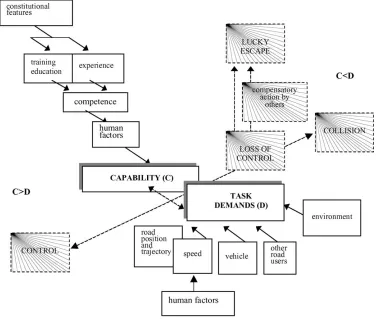
After determining the task demand and driver capability, the task-capability interface
provides a way to determine if the driver is in control or in danger by the computing
the difference between capability and demand. There are two possible scenarios: if
capability is greater than demand, then the driver is in control, and if demand is greater
than capability, then the driver is in danger [8]. Figure 3.1, taken from [3], is a graphical
R. Fuller / Accident Analysis and Prevention 37 (2005) 461–472 465
speed, like driver competence, is subject to the influence of human factor variables.
2.2. Hierarchical nature of driver decision making
Some authors (such asAllen et al., 1971; Michon, 1985; van der Molen and Botticher, 1988; Hollnagel et al., 2004) have emphasized the hierarchical nature of driver decision-making, pointing out the distinctions between strategic de-cisions (route and timing of journey), tactical dede-cisions (manouvering) and operational decisions (executive acts). More recently, Laapotti et al. (2001) have added an even higher level, which pertains to ‘goals for life and skills for liv-ing’. These distinctions are retained in the TCI model where drivers can influence task demand by making choices in rela-tion to each of the factors, which influence it as well as their own speed. Thus, they can make purchase or hire decisions so as to drive a vehicle with particular features (such as ABS), they can select a particular route to a destination (avoiding high density or high speed motorways, for example) and a par-ticular time-of-day (avoiding periods of congestion or driv-ing in darkness—see, for example, Rimmo and Hakamies-Blomqvist, 2002). They can shift towards serial as opposed to parallel use of vehicle controls (Hakamies-Blomqvist et al., 1999) and they can also influence task demand by using di-rectional indicators (and other signals) to affect the behaviour
of other road users. Drivers also have some control over their capability, and decisions here also have a hierarchical struc-ture. Remotest from real-time decisions on the roadway are decisions regarding type, amount and level of training and about the kinds of driving experienced. Closer to real-time driving are decisions about exposure to a range of human fac-tor variables such as fatigue, stress and the effects of alcohol and of other drugs. And on an ongoing basis, drivers can vary their level of effort.
Putting all of these general features of the determinants of driver capability and task demand together, we arrive at the model presented inFig. 2. The elements of the model interact to determine task difficulty and the outcome for the driver in terms of whether or not control is maintained or lost.
2.3. The interaction between task demand and capability
The TCI model as presented inFig. 2gives the impression that task demand and capability are independent elements. However, it must be recognized that this is not necessarily, or even usually, the case. Capability is determined by many variables and one of these is the driver’s level of arousal or activation. The relationship between these two is tradition-ally described by an inverted U curve, with relatively lower levels of capability associated with both very low and very high levels of arousal. Arousal is partly determined by
en-Fig. 2. The task–capability interface model.
Figure 3.1: Task-capability interface model.
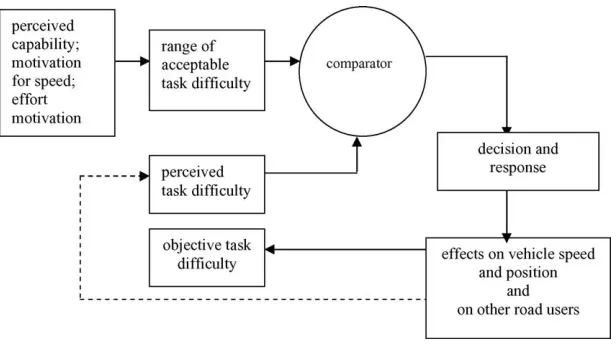
To complete the model, Fuller proposes the notion of task difficulty homeostasis. The
motivation behind task difficulty homeostasis is described by Fuller thusly:
The proposition I want to suggest is that at the outset of a journey, and
sometimes also during it, a driver will determine a range of task difficulty
that she/he is prepared to accept, a kind of target margin or envelope of task
difficulty. A key element of this is the upper boundary of difficulty beyond
place both choice of route and time of journey and, on an ongoing basis, will
influence speed choice. In fact, once the more strategic decisions have been
made, it will be speed choice, which the driver will predominantly use to
control the level of task difficulty experienced [3].
This idea of homeostasis is rooted in previous work of Wickens and Hollands [9] that
finds workers who have low workloads will tend of add jobs or overworked workers will
shed jobs to reach a more acceptable level of workload. Figure 3.2 from [3] demonstrates
the task difficulty homeostasis process.
R. Fuller / Accident Analysis and Prevention 37 (2005) 461–472 467
3. Task difficulty homeostasis
How might the perception of task difficulty determine driver behaviour? The proposition I want to suggest is that at the outset of a journey, and sometimes also during it, a driver will determine a range of task difficulty that she/he is prepared to accept, a kind of target margin or envelope of task difficulty. A key element of this is the upper bound-ary of difficulty beyond which the driver prefers not to go. That preference may influence in the first place both choice of route and time of journey and, on an ongoing basis, will influence speed choice. In fact, once the more strategic de-cisions have been made, it will be speed choice, which the driver will predominantly use to control the level of task dif-ficulty experienced (seeFig. 4), although as suggested by
Hakamies-Blomqvist et al. (1999), drivers may also change the ‘architecture’ of their performance. What determines the preferred level will be motivation for speed, perceived capa-bility and effort motivation. Motivation for speed arises from variables such as available time for a journey, possible social forces relating to passengers (e.g., desire to ‘show-off’ to peers or to provide a comfortable ride for an elderly person). Perceived capability will be a function of estimates of compe-tence and sensitivity to the effects of human factor variables. It is as if the driver asks herself/himself: what do I have to do here and what am I able to do? The result of this will be an acceptable, preferred range of task difficulty. This concept of task difficulty or workload homeostasis has been alluded to elsewhere in the context of industrial work. As stated by
Wickens and Hollands (2000): “Given some flexibility, op-erators usually work homeostatically to achieve an ‘optimal level’ of workload by seeking tasks when workload is low and shedding them when workload is excessive” (p. 470). In a self-paced task like driving, modifications of speed provide a very flexible and fairly rapid means of control of workload level (see also next section).
Task difficulty is an expression of the separation between task demand and driver capability. From a safety perspective, a key issue is their degree of separation. The closer
capabil-ity is to task demand, the more difficult will be the task and the less reserve capability there will be to accommodate a sudden increase in task demand (such as a child dashing out from behind a parked vehicle). This problem may be partic-ularly salient where journey time is limited, forcing a driver to drive faster than would otherwise be preferred (such as a truck driver attempting to make a just-in-time delivery). In such situations safety may be further challenged by the fact that capability may be simultaneously lowered by the stress of anticipated ‘mission failure’ and a state of height-ened anxiety. But the general principle proposed here is that drivers are motivated to maintain a preferred level of task dif-ficulty. Speed choice is the primary solution to the problem of keeping task difficulty within selected boundaries and, as de-scribed above, those boundaries are subject to motivational influences. This principle explains not only the continuous adjustment of speed to perceived hazards on the roadway (such as approaching a small radius bend) and the general phenomenon of behavioural adaptation (OECD, 1990) but also the effects on driver speed of traffic calming measures (such as throats, chicanes, lane narrowing and gateways).
Hoyos (1986), in discussing a study that measured driver estimates of task demand and their speed, reported that drivers used compensatory speed reductions as demand increased. In a study of the behaviour of older drivers, de Raedt and Ponjaert-Kristoffersen (2000)found that this kind of ‘tacti-cal’ compensation was associated with better drivers, as rated by driving instructors and by number of accidents. They con-cluded that it would be advisable to evaluate compensatory abilities in fitness-to-drive assessments of older drivers and recommended that older drivers should learn such strategies, as well as more ‘strategic’ decisions, such as avoiding high demand situations (driving in dark, fog, etc.). They also sug-gested, in line withHakamies-Blomqvist (1994)and the fun-damental postulate of the TCI model, that “it is probable that the immediate goal of compensation behaviour of older drivers is to reduce mental load, with increased safety a by-productrather than the main goal of the behaviour” (italics mine). In an interesting technical development from this line
Fig. 4. Task difficulty homeostasis.
Figure 3.2: Task difficulty homeostasis.
In summary, the Task-Capability Interface model attempts to describe the level of
danger that a driver is experiencing by considering human factors and the current driving
3.1.2
Comparison of Driver Models
Now that the TCI has been described, it can be compared with other models used to
study and predict driver behavior. From this comparison we can discover the TCI’s
strengths and weaknesses.
Researchers have employed many tools in their attempts to model driver behavior.
Some of the most notable modeling tools are neural networks, fuzzy logic, hybrid
dy-namical systems, etc. [10] [11] [2]. Each of these modeling strategies are used to achieve
the same goal of improving the safety of the driver, but their results are not universally
applicable. Many of these models are designed to predict specific tactical decisions like
collision avoidance and evaluation of driver skill, while some models take an entirely
different approach and attempt to model the driver’s cognitive process [1].
In summary, theTask-Capability Interface Model’s contribution to driver modeling is
its abdication of predicting tactical driver decisions. The TCI provides the researcher with
a metric to describe the situation that a driver is in and provides a way of determining
if a new tactical decision must be made. When the TCI is viewed in this manner, it can
be used to create a more complete safety-conscious model.
3.2
Implementing the Task-Capability Interface Model
Now that the TCI has been explained and justified, we can consider the heart of this
thesis: the implementation of the TCI. As was stated earlier, the model needs to be
understandable and accurate. In order to satisfy the criteria of understandability, a
fuzzy logic rules-based system was chosen and the membership functions were designed
heuristically. As for accuracy, data regarding driver behavior was found in journals [12]
In keeping with the research behind the Task-Capability Interface, three important
factors were identified from [8] and data collected from [12] and [13] was used to construct
the membership functions in the rule-based system. Sleepiness, rainfall, and speed were
the three factors chosen because of their ubiquitous nature and the availability of data
with respect to drivers.
For the purposes of implementation, the model was broken up into two smaller models:
the capability model and the demand model. The design of the two models will be
discussed herein.
3.2.1
Capability Model
In keeping with the research behind the TCI, it was decided that the Capability model
would be a single input single output system that depends on the sleepiness of the driver.
In order to simplify the creation of this model, key assumptions had to be made. In order
to make the model manageable, it is assumed that the driver is in good health and has
average training and experience. These assumptions allow the driver’s capability to be
determined solely by the “human factors” element shown in Figure 3.1. Sleepiness was
chosen because of the availability of data and the practicality of measurement.
In [13], researchers had car drivers rate their level of sleepiness on the Stanford
Sleepi-ness Scale, a scale ranging from 1 to 7, and found that drivers who had five or fewer hours
of sleep in the previous 24 hours had a significant increase in risk while driving. The first
step in creating the Capability model is transforming this data into fuzzy membership
functions.
The input membership functions were chosen to partition the level of sleepiness into
three categories: low, medium, and high. Figure 3.3 shows the three trapezoidal
membership functions were chosen in such a way as to err on the side of caution by
increasing the sleepiness of the driver.
Figure 3.3: Capability Input Membership Functions.
Table 3.1: Capability Input Membership Function Parameters
Name Point 1 Point 2 Point 3 Point 4
Low 0 0 1.452 3.23
Medium 2.01 2.9 3.341 4.65
High 3.786 4.86 7 7
The output membership functions were chosen to partition the driver’s capability into
three categories: low, medium, and high. Unlike the input membership functions, only
was chosen to be a triangle. Figure 3.4 shows the three membership functions and table
3.2 shows the membership function parameters. These shapes were chosen to reflect the
quick decline in driver capability.
Figure 3.4: Capability Output Membership Functions.
Table 3.2: Capability Output Membership Function Parameters
Name Point 1 Point 2 Point 3 Point 4
Low 0 0 0.03833 0.36
Medium 0.3241 0.48 0.578 NA
High 0.444 0.6045 1 1
Three rules were created to map the input to the output and they are listed
functions and the rules that tie them together.
1. If sleepiness is low then capability is high.
2. If sleepiness is medium then capability is medium.
3. If sleepiness is high then capability is low.
Figure 3.5: Capability Model Input-Output Mapping
The input-output mapping reflects the results of [13], where drivers exhibit increased
3.2.2
Demand Model
The Demand model was made to account for the effects that the driver experiences due to
the environment. In order to give the demand model greater flexibility, it was constructed
as a two-input single-output system. The two inputs are rainfall in hundredths of an inch
per hour and the car’s speed (as a percentage) relative to the speed limit.
Data for constructing the membership functions was taken from [12]. Researchers
partitioned the amount of rainfall into three different categories: no rain, light, and
heavy. Correspondingly, the input rainfall membership functions were chosen to be zero
(triangle), light (trapezoid), and heavy (trapezoid). Figure 3.6 shows the membership
functions and Table 3.3 contains the parameters for the rainfall membership functions.
Figure 3.6: Demand Rainfall Membership Functions.
In [12], it was found that drivers would slow down 5%-6.5% in light and heavy rain,
Table 3.3: Demand Rainfall Membership Function Parameters
Name Point 1 Point 2 Point 3 Point 4
Zero 0 0 6.071 NA
Light 4.2 6.06 11.07 16.26
Heavy 13.45 15 30 30
rain; this decision was supported by the Risk Homeostasis phenomenon discussed in [3].
The data for speed was used to create three membership functions: low (trapezoid),
normal (triangle), and high (trapezoid). Figure 3.7 contains the membership functions
associated with speed and Table 3.4 contains the membership function parameters.
Table 3.4: Demand Speed Membership Function Parameters
Name Point 1 Point 2 Point 3 Point 4
Low -6.41% -6.41% -4.663% -1.79%
Normal -3% 0% 2% NA
High 1% 3.04% 6.41% 6.41%
The output component of the Demand model was designed heuristically to couple no
rainfall and low speed with low demand, and to couple heavy rainfall and high speed
with high demand. Ultimately, the membership functions for the output were chosen
to partition the demand into three categories: low (triangle), medium (triangle), and
high (trapezoid). Figure 3.8 shows the membership functions and Table 3.5 contains the
Figure 3.8: Demand Output Membership Functions.
Table 3.5: Demand Output Membership Function Parameters
Name Point 1 Point 2 Point 3 Point 4
Low 0 0 0.4 NA
Medium 0.1 0.5 0.9 NA
High 0.64 0.8426 1 1
The rules that form the input-output mapping are as follows:
1. If rainfall is zero and speed is low then demand is low.
3. If rainfall is zero and speed is high then demand is medium.
4. If rainfall is light and speed is low then demand is medium.
5. If rainfall is light and speed is normal then demand is medium.
6. If rainfall is light and speed is high then demand is high.
7. If rainfall is heavy and speed is low then demand is medium.
8. If rainfall is heavy and speed is medium then demand is high.
9. If rainfall is heavy and speed is high then demand is high.
The input-output mapping that results from these rules is shown in Figure 3.9.
In total, this implementation of theTask-Capability Interfacedecreases the complexity
of Figure 3.1. Instead of considering eleven inputs, three were chosen. Figure 3.10
represents the new simplified TCI that is implemented herein.
Figure 3.10: Simplified Task-Capability Interface.
When implemented in Simulink, the model can provide “snapshots” of a situation
given all three inputs, or it can provide a “real-time” output if the inputs are described
as functions with respect to time. This allows the TCI to used as a component in a larger
Chapter 4
Sensitivity Analysis
After designing a model, we require a certain amount of analysis before its predictions
can be trusted. Sensitivity analysis provides the modeler with several tools to gain insight
into the model’s performance with respect to its parameters. Sensitivity analysis can be
broken down into three classes: screening methods, local SA methods, and global SA
methods [14, p. 10]; since local sensitivity analysis is the only method used in this thesis,
we will not discuss other methods. Local sensitivity analysis is used to determine the
local impact that parameters have on the output of a model and how variations of said
parameters affect the output [14, p. 10]. This method of analysis is used by modelers for
many different systems, including oil spills [15], fault analysis [16], etc.. Local SA can be
calculated several ways, but in this case we will use the Finite-Difference Approximation
4.1
Analysis of the TCI
Since local sensitivity analysis is computed as a finite difference, a way of accessing
and changing membership function parameters was needed. MATLAB’s Fuzzy Logic
Toolbox provides a data structure, called the Fuzzy Inference System, that allows the
user to change the desired membership function parameters and thus provides a method
of implementing the finite-difference approximation. It should be noted that since the
TCI is the linear combination of the output of two independent fuzzy systems, it was
decided that the two systems would be analyzed independently. This decoupling of
models has no impact on the overall results.
4.1.1
Choosing Inputs
Before the outputs can be calculated, we must choose an appropriate input with which
the model can be tested. The nature of the Fuzzy Inference System requires that several
different inputs be tested for each input set so that a more complete data set can be
generated. If, for instance, a trapezoidal membership function’s third parameter is being
analyzed and the parameter reshapes the membership function in such a way that the
fuzzy value corresponding to the input no longer changes, the output will no longer change
and no useful data will be generated. In other words, the output becomes constant and
the derivative will become zero, resulting in a sensitivity of zero. Therefore we must
choose inputs that have values close to that of the membership function parameters that
Figure 4.1: The inputx= 1.2 generates no new information after the parameter increases
in value.
It was ultimately decided that three different inputs would be chosen for each
mem-bership function and the values of these inputs were chosen based on the value of the
membership function parameter in question.
4.1.2
Computing Model Output
In order to compute the finite-difference approximation, we must choose the parameter
that we wish to vary, how much we will vary the parameter at each iteration, and what
input we will use. It was decided that when performing sensitivity analysis on a fuzzy
be chosen and those parameters would be perturbed around their original value, i.e.
±5%. After the output is stored, the sensitivity is calculated using the finite-difference
approximation. While two different functions are used to analyze the parameters in input
sets and output sets, the algorithm remains the same. Shown below is the algorithm in
MATLAB to analyze the ith membership function parameter.
Algorithm 1Parameter perturbation algorithm
max←1.05∗pi
min←0.95∗pi
paramDistance←max−min
for k = 0 : ∆p:paramDistance do if mf(i) + ∆p < max then
mf(i)←mf(i) + ∆p
else
mf(i)←max
end if
output(k)←evalf is(f isInput)
end for
4.1.3
Calculating Local Sensitivity
Once the data gathered by the parameter perturbation algorithm is ready, the local
sensitivity analysis can be performed by computing the value of the derivative using
the finite-difference approximation. The Finite-Difference Approximation is computed
thusly,
∂y
∂kj
≈ y(kj + ∆kj)−kj
∆kj
, j = 1, . . . , m.
whereyis the output,kj is thejthmembership function parameter of thekthmembership
4.2
Sensitivity Data
The sensitivity analysis of the Task-Capability Interface is broken down in two ways;
first, the analysis of the capability model and the demand model are separated, and
secondly the input membership function parameter analysis and output membership
function parameter analysis are separated from one another. Herein the data will be
presented in accordance with the previous breakdown.
4.2.1
Capability Model Sensitivity Data
The capability model consists of three input membership functions and three output
membership functions. In total, there are seven membership function parameters. The
four input membership function parameters tested are SL1, SL2, SL3, SL4. The
remain-ing parameters correspond to the model’s output and they are C1, C2, and C3. All
Figure 4.2: Capability Model Membership Functions.
The figures 4.3 through 4.9 and tables 4.1 and 4.2 contain all of the data gathered for
the driver Capability model. Included in the data is the parameter name, system input
Table 4.1: Sleepiness Membership Function Parameter Sensitivity
Parameter Input Maximum Value Minimum Value
SL1 1.45 0.0198 0
2.5 0.0405 0
3.2 0.0102 0
SL2 2.6 0.0434 3.8284×10⁻¹⁵
2.9 0.0157 0
3 0.0042 0
SL3 3.34 0.0015 0
4.3 0.0479 1.6615×10⁻¹⁵
4.6 0.0140 8.3076×10⁻¹⁶
SL4 4.4 0.0644 0
4.86 0.260 0
Table 4.2: Capability Output Membership Function Parameter Sensitivity
Parameter Input Maximum Value Minimum Value
C1 4.3 0.0113 0
4.6 0.0823 0
5.5 0.0707 0
C2 2.3 0.0687 0
4.1 0.1055 0.0660
4.5 0.0232 0.0088
C3 1 0.2291 0.2137
2 0.1651 0.1544
2.5 0 0
4.2.2
Demand Model Sensitivity Data
The demand model consists of nine membership functions, six dedicated to the input and
three dedicated to the output. The sensitivity analysis is performed on nine membership
function parameters. The rainfall parameters are R1, R2, and R3. The speed parameters
are S1, S2, and S3. Lastly, the demand parameters are D1, D2, and D3. Figure 4.10
shows the input membership functions with labeled parameters and Figure 4.11 shows
Figure 4.11: Demand Model Output Membership Functions.
The figures 4.12 through 4.20 and tables 4.3, 4.4, and 4.5 contain the sensitivity data
for the driver Demand model. The information is presented in the same fashion as the
Table 4.3: Rainfall Membership Function Parameter Sensitivity
Parameter Input Maximum Value Minimum Value
R1 (5.5,3) 0.0464 0
(6.1,3) 0.0172 0
(6.5,3) 0 0
R2 (10.5,0) 0 0
(11.07,0) 2.0058×10⁻¹⁵ 0
(12,0) 4.0116×10⁻¹⁵ 0
R3 (14,0) 0.0921 0
(15,0) 0.0542 0
Table 4.4: Speed Membership Function Parameter Sensitivity
Parameter Input Maximum Value Minimum Value
S1 (0,-4.66) 0.0052 0
(0,-3.2) 0.0145 0
(0,-3.7) 0.0145 0
S2 (0,-1) 5.5511×10⁻¹⁵ 0
(0,1) 6.6613×10⁻¹⁵ 0
(0,1.5) 7.7716×10⁻¹⁵ 0
S3 (0,2.5) 2.1912×10⁻¹⁴ 0
(0,3) 7.3041×10⁻¹⁵ 0
Table 4.5: Demand Output Membership Function Parameter Sensitivity
Parameter Input Maximum Value Minimum Value
D1 (3,-1) 0 0
(5,4) 0 0
(12.5,4) 0 0
D2 (10,-1) 0.2819 0
(15,-2) 0.0590 0
(20,6) 0 0
D3 (7,-3) 0 0
(12.5,2) 0.1130 0
Chapter 5
Results of Model Analysis
To aid in the interpretation of the model’s behavior, it was decided that a new metric
was needed to examine the magnitude of the change in output as a percentage. This
new metric was inspired from the percent error calculation commonly used in physics
and chemistry to quantify error present in experiments.
% error = |Theoretical value - Experimental value|
Theoretical value ∗100%
In order to quantify the changes in output over the range of parameter values used in
the sensitivity calculations, we change the percent error calculation thusly, wherepmin is
the model’s output calculated with the minimum parameter value, pmax is the model’s
output calculated with the maximum parameter value, and poriginal is the output value
Pmax =
|pmax−poriginal|
poriginal
∗100% (5.1)
Pmin =
|pmin−poriginal|
poriginal
∗100% (5.2)
Ptotal =
|pmax−pmin|
poriginal
∗100% (5.3)
Lastly, we will consider the case of capability and demand having values close to one
another. In particular, we will examine the inputs that lead to this situation and what
implications these inputs have for the model and driver safety.
5.1
Capability Model
5.1.1
Sleepiness
There are four membership function parameters in the sleepiness input under
consid-eration when analyzing the sensitivity of the capability model. The following sections
contain the data found for each of the four parameters along with conclusions that can
be drawn from the gathered data.
SL1
Parameter SL1 of the “low” membership function was tested with the inputs I1 = 1.45,
I2 = 2.5, and I3 = 3.2. Table 5.1 contains the data found with the previously listed
inputs.
From examination of the data below, we can see that the capability model is most
percentage change, the output does not vary appreciably for any of the inputs used in
sensitivity calculations. Note that Savg is the average sensitivity calculated for a fixed
input.
Table 5.1: SL1 Analysis Results
I1 = 1.45 I2 = 2.5 I3 = 3.2
Savg 0.0190 0.0416 0.0108
Pmax 0% 0.3804% 0.1495%
Pmin 0.1447% 0.4545% 0.1743%
Ptotal 0.1447% 0.8349% 0.3237%
SL2
Parameter SL2 of the “medium” membership function was tested with the inputs I1 =
2.6,I2 = 2.9, and I3 = 3.
When changing the parameter SL2, it was found that the model was most sensitive
when the input is in the neighborhood of 2.6. Perturbing SL2 resulted in relatively small
changes according to the Pmax and Pmin metrics. Ultimately it can be concluded that
Table 5.2: SL2 Analysis Results
I1 = 2.6 I2 = 2.9 I3 = 3
Savg 0.0546 0.0147 0.0039
Pmax 1.0615% 0.4144% 0.0636%
Pmin 1.1997% 0.0402% 0%
Ptotal 2.2611% 0.4547% 0.0636%
SL3
Parameter SL3 of the “medium” membership function was tested with the inputs I1 =
3.34, I2 = 4.3, and I3 = 4.6.
The capability model is most sensitive, with respect to SL3, when the input is in the
neighborhood of 4.3. The change in output found while perturbing SL3 is significant.
Table 5.3: SL3 Analysis Results
I1 = 3.34 I2 = 4.3 I3 = 4.6
Savg -0.0046 0.0340 0.0098
Pmax 0% 2.3319% 1.1492%
Pmin 0.1486% 2.5870% 1.1510%
SL4
Parameter SL4 of the “high” membership function was tested with the inputs I1 = 4.4,
I2 = 4.86, and I3 = 5.
The maximum sensitivity resulting from changes in SL4 is found when the input is
in the neighborhood of 4.4. Additionally, it is found that perturbations of SL4 result in
the largest changes in model output. It can be concluded that changes in the value of
SL4 can have a significant impact in the capability model.
Table 5.4: SL4 Analysis Results
I1 = 4.4 I2 = 4.86 I3 = 5
Savg 0.0560 0.0205 0.0142
Pmax 4.8824% 4.1294% 1.7569%
Pmin 7.0562% 0.8855% 0%
Ptotal 11.9386% 5.0150% 1.7569%
5.1.2
Capability
The following sections contain the results found while analyzing the sensitivity of the
capability model with respect to three of the output membership function parameters.
As with the previous section concerning the sleepiness parameters, we attempt to draw
C1
Parameter C1 of the “low” membership function was tested with the inputs I1 = 4.3,
I2 = 4.6, and I3 = 5.5.
The capability model is found to be most sensitive, with respect to output parameter
C1, when the input is in the neighborhood of 4.6. Analysis of the output shows that
perturbations of C1 do not result in a significant change in model output.
Table 5.5: C1 Analysis Results
I1 = 4.3 I2 = 4.6 I3 = 5.5
Savg 0.0127 0.0821 0.0637
Pmax 0.0085% 0.0892% 0.0841%
Pmin 0.0105% 0.1109% 0.1018%
Ptotal 0.0190% 0.2000% 0.1018%
C2
Parameter C2 of the “medium” membership function was tested with the inputsI1 = 2.3,
I2 = 4.1, and I3 = 4.5.
The capability model is found to be most sensitive, with respect to C2, when the input
is in the neighborhood of 4.1. Given the value ofSavg and the percentage deviations, the
Table 5.6: C2 Analysis Results
I1 = 2.3 I2 = 4.1 I3 = 4.5
Savg 0.0891 0.0900 0.0099
Pmax 0.1713% 0.5760% 0.1056%
Pmin 0.1416% 0.4100% 0.0737%
Ptotal 0.3129% 0.9859% 0.1793%
C3
Parameter C3 of the “high” membership functions was tested with the inputs I1 = 1,
I2 = 2, and I3 = 2.5.
Sensitivity analysis shows that the model is most sensitive with respect to C3 when
the input is in the neighborhood of 1. The percentage change found is small, but not
negligible; this suggests that small changes to C3 do affect model output to a small
degree.
Table 5.7: C3 Analysis Results
I1 = 1 I2 = 2 I3 = 2.5
Savg 0.2196 0.1597 0.0133
Pmax 0.8570% 0.6358% 0.0631%
Pmin 0.7100% 0.5204% 0.0481%
5.1.3
Analysis Summary
In summary, changes to the values of membership function parameters SL3 and SL4
resulted in the largest deviations in model output. Since driver capability should drop
significantly as the driver becomes more sleepy, this result makes heuristic sense.
Addi-tionally, it can be seen in Table 5.3 and Table 5.4 that the largest changes occur when the
parameter values become smaller. In the case of SL3, the capability will decrease for an
input value equal to or greater than the original parameter value as the value decreases.
The large change in output that results from decreasing the value of SL4 comes from the
increased membership values that nearby inputs assume.
5.2
Demand Model
5.2.1
Rainfall
The sensitivity analysis data and the respective conclusions concerning three of the
rain-fall membership function parameters are contained in the following section.
R1
Parameter R1 from the “light” membership function was tested with the inputs I1 =
(5.5,3), I2 = (6.1,3), and I3 = (6.5,3).
The demand model is found to be most sensitive to changes in R1 when the rainfall
input is in the neighborhood of 5.5. The change in model output is small when perturbing
Table 5.8: R1 Analysis Results
I1 = (5.5,3) I2 = (6.1,3) I3 = (6.5,3)
Savg -0.0424 -0.0154 0
Pmax 1.2785% 0.4337% 0%
Pmin 1.7650% 0% 0%
Ptotal 3.0435% 0.4337% 0%
R2
Parameter R2 from the “light” membership function was tested with the inputs I1 =
(10.5,0), I2 = (11.07,0), and I3 = (12,0).
Given the magnitude of the results found while testing the sensitivity of the demand
model with respect to R2, it can be concluded that small changes to this parameter have
no effect on the model.
Table 5.9: R2 Analysis Results
I1 = (10.5,0) I2 = (11.07,0) I3 = (12,0)
Savg 0 -5.0146×10⁻¹⁴ 0
Pmax 0% 0% 0%
Pmin 0% 2.2204×10⁻¹⁴% 0%
R3
Parameter R3 from the “heavy” membership function was tested with the inputs I1 =
(14,0), I2 = (15,0), and I3 = (15.5,0).
The demand model is found to be most sensitive to a rainfall input of 14 while
perturbing R3. Changes in R3 can have significant effect on the model’s output when
the rainfall input is not a full member of the “heavy” membership function.
Table 5.10: R3 Analysis Results
I1 = (14,0) I2 = (15,0) I3 = (15.5,0)
Savg -0.0524 -0.0410 -0.0310
Pmax 3.3984% 4.0432% 1.2234%
Pmin 9.0251% 1.1446% 0%
Ptotal 12.423% 5.1878% 1.2234%
5.2.2
Speed
Data and conclusions regarding the effects of the three Speed membership function
pa-rameters are contained in the following section.
S1
Parameter S1 from the “low” membership function was tested with the inputs I1 =
(0,−4.66), I2 = (0,−3.2), I3 = (0,−3.7).
the range of -3.7. As evidenced by the percentage change, the model output does not
strongly depend on the value of S1.
Table 5.11: S1 Analysis Results
I1 = (0,−4.66) I2 = (0,−3.2) I3 = (0,−3.7)
Savg -0.0029 -0.0130 -0.0138
Pmax 0% 1.6906% 1.8766%
Pmin 0.5206% 1.8829% 2.2252%
Ptotal 0.5206% 3.5735% 4.1018%
S2
Parameter S2 from the “normal” membership function was tested with the inputs I1 =
(0,−1), I2 = (0,1), andI3 = (0,1.5).
As can be seen in Table 5.12, the model is essentially insensitive to small changes in
Table 5.12: S2 Analysis Results
I1 = (0,−1) I2 = (0,1) I3 = (0,1.5)
Savg -3.4694×10⁻¹⁶ 6.1679×10⁻¹⁷ -1.5543×10−15
Pmax 1.3323×10−13% 3.3307×10⁻¹⁴% 9.992×10⁻¹⁴%
Pmin 7.7716×10⁻¹⁴% 2.2204×10⁻¹⁴% 2.5535×10⁻¹⁴%
Ptotal 5.5511×10⁻¹⁴% 1.1102×10⁻¹⁴% 1.5543×10⁻¹³%
S3
Parameter S3 of the “high” membership function was tested with the inputsI1 = (0,2.5),
I2 = (0,3), andI3 = (0,3.1).
The sensitivity of the model, with respect to S3, is similar to the sensitivity of the
model with respect to S2 in that changes to the value of S3 exhibit little to no sensitivity
in the model and little to no change in model output.
Table 5.13: S3 Analysis Results
I1 = (0,2.5) I2 = (0,3) I3 = (0,3.1)
Savg -3.9443×10⁻³¹ 0 0
Pmax 0% 2.2204×10⁻¹⁴% 0%
Pmin 0% 2.2204×10⁻¹⁴% 0%
5.2.3
Demand
The following section contains the data and conclusions gathered from the analysis of
three membership function parameters in the demand model output.
D1
Parameter D1 of the “low” membership function was tested with the inputsI1 = (3,−1),
I2 = (5,4), andI3 = (12.5,4).
Table 5.14 shows that the demand model is insensitive to small changes in the value
of D1 and that changes to D1 do not affect the output.
Table 5.14: D1 Analysis Results
I1 = (3,−1) I2 = (5,4) I3 = (12.5,4)
Savg 0 0 0
Pmax 0% 0% 0%
Pmin 0% 0% 0%
Ptotal 0% 0% 0%
D2
Parameter D2 of the “medium” membership function was tested with the inputs I1 =
(10,0), I2 = (15,−2), and I3 = (20,6).
The demand model is most sensitive to changes in the value of D2 when the input is
a small change in the output.
Table 5.15: D2 Analysis Results
I1 = (10,0) I2 = (15,−2) I3 = (20,6)
Savg 0.2777 0.0556 0
Pmax 1.112% 0.1843% 0%
Pmin 1.381% 0.2265% 0%
Ptotal 2.493% 0.4107% 0%
D3
Parameter D3 of the “high” membership function was tested with the inputsI1 = (7,−3),
I2 = (12.5,2), and I3 = (20,6).
The model is most sensitive to changes in the value of D3 when the input is in the
neighborhood of (20,6), however, the output does not change significantly with small
Table 5.16: D3 Analysis Results
I1 = (7,−3) I2 = (12.5,2) I3 = (20,6)
Savg 0 0.1077 0.1702
Pmax 0% 0.4195% 0.6093%
Pmin 0% 0.5448% 0.8772%
Ptotal 0% 0.9642% 1.4865%
5.2.4
Analysis Summary
After performing sensitivity analysis, the data shows that the demand model is most
affected by changes in the parameters R3 and S1. The most significant change in model
output occurs when the “heavy” rainfall membership function’s core is widened. Since a
heavy rainfall should have a significant negative impact in a driving scenario, this result
is heuristically sound. Changes to R2, S2, S3, and D1 were found to have no impact on
model output.
5.3
Borderline Inputs
Referring back to Section 3.1.1, there is a discussion concerning the two cases ofC > D
andD > C. In addition to these two cases, there is a third case of interest: C ≈D. When capability is significantly greater than demand, it is clear that no corrective action must be
taken, and when demand is significantly greater than capability, it is clear that corrective
action must be taken; what is not clear is if any action is necessary when capability and
expect drivers to spend a significant portion of their time in this ambiguous region. To
aide in the discussion of this region of ambiguity, we will name it the “borderline region.”
Since the driver’s actions in this borderline region are beyond the scope of this thesis,
we will investigate the inputs that map into the borderline region. It was decided that
the borderline region would be defined as the set of outputs generated by the TCI where
the Demand model’s output value is within ten percent of the Capability model’s output
value. It was decided that the borderline region would be defined by a ten percent buffer,
as opposed to a strict equality between capability and demand, due to computational
and safety concerns; by relaxing the equality requirement we allow for a safety margin of
sorts.
To find the set of inputs that map to the borderline region, each input component,
rainfall, speed, and sleepiness, is divided into 100 uniformly partitioned values,
result-ing in 1,000,000 different input combinations tested; of the inputs tested, 72,184 inputs
mapped into the borderline region. Figure 5.1, Figure 5.2, and Figure 5.3 all show the
inputs that map into the borderline region.
Inspection of the inputs reveals that a significant portion of the input space maps
to the borderline region. We find that the majority of borderline inputs exist when the
sleepiness component has a value between three and four. Rainfall inputs near 0.05”
rain/hour define a wall between the “safe” region and the “dangerous” region.
Examina-tion of the affects of the speed input reveals a box-like region where inputs arounds 0%
are still safe, but more positive speeds result in a quick transition to “dangerous” inputs.
In essence, we can see that these inputs occur in situations tend to occur in scenarios
where a driver appears to be moving into a dangerous region of operation and the driver
must be vigilant, as their margin for error is likely to be diminishing. When viewed
the intentions with which the model was designed.
Chapter 6
Conclusion
The purpose of this thesis was to design, implement, and analyze a model intended to
be used as a metric for automobile driver safety. In order to avoid the complexities
associated with approaches that make use of tactical driver simulators, we chose to go in
a direction that considered the driver and their environment from a holistic viewpoint.
The model chosen to satisfy these requirements was the Task-Capability Interface. The
TCI is a model based on the concepts of task demand, task capability, and task difficult
homeostasis written about by Ray Fuller in [3]. In this thesis the TCI’s complexity
was reduced by considering a reduced set of input factors; additionally, the model was
implemented as a fuzzy logic rules-based system to maintain a simple model architecture.
After surveying the available data, it was decided that the three input factors for
the TCI would be driver sleepiness, rainfall, and automobile speed relative to the posted
speed limit. Sleepiness was chosen to determine driver capability, rainfall was chosen
as a demand input to represent a significant factor outside of the driver’s control, and
relative speed was chosen as a demand input to give the driver an element of control.