ISSN(Online): 2320-9801
ISSN (Print): 2320-9798
I
nternational
J
ournal of
I
nnovative
R
esearch in
C
omputer
and
C
ommunication
E
ngineering
(An ISO 3297: 2007 Certified Organization)
Vol. 3, Issue 6, June 2015
Detecting Guilty Party using Fake Object
Testing and Block while Sending Original data
Y I Jinesh Melvin, K S Charumathi
Assistant Professor, Dept. of Computer Engineering, I.T., PIIT, New Panvel, New Mumbai, India
ABSTRACT: In Today’s real business world more number of sensitive data has been leaked by an untrusted agentfora
third party. For example Company’s agreement projects, Hospital patient reports, Government Sensitive data, Military secret data, etc. These types of sensitive data are very secure by an authorized person. Water Marking is the technique to secure the sensitive data, but it has some disadvantage, Perturbation also to modify the sensitive data while sending to an agent and another technique is a fake object with original data,it makes the file size as large also the data are made less sense. It is not a proper secure because original data also transfer by distributor without any trust with an agent. In this proposed scheme to overcome these type of faults using two methods. (1) Test the agent with only fake objects. (2) Block the agent who sends the original data from the distributor.
KEYWORDS: Data Leakage, Data Leakage Model, Fake Objects, Guilty Agent, Blocking
I. INTRODUCTION
A Distributor has sent the sensitive data to his agent with proper secured, but some unauthorized person trying to leak the data, hackers also include in-between distributor and agent to attack sensitive data and to make illegal business. Data leakage in the sense of information leakage. The scope of data leakage is very wide many techniques has followed to reduce the leakage and find the guilty party. It is very useful for the distributor, but day-by-day hackers and guilty party were using loopholes from previous technique.
Watermarking is a useful technique to detect the leakage, from these the unique code is injected into all distributor copies, but it modifies the original data also it destroy and the agent doesn’t get the actual data from distributor [4]. When compared with allocation strategy, the watermark is less sensitive [3]. Hackers can easily attack. In allocation strategy method distributor inject “realistic but fake” data record to improve the detecting leakage and find a guilty agent, but in “realistic but fake” method distributor add fake objects with real-data. Some intelligent hackers will fragment the original data from fake, also by using these method file size also be increased.
Today’s economic world an enterprise on a daily basis sends large number of data and received through email, downloads, server and various channels. They hold only the sensitive it has been controlled from leakage [3].In this paper our goal is to find a more accurate guilty agent, who has leaked the sensitive data from the distributor using agent testing with only fake object and block while sending original data.
II. METHODOLOGY
ISSN(Online): 2320-9801
ISSN (Print): 2320-9798
I
nternational
J
ournal of
I
nnovative
R
esearch in
C
omputer
and
C
ommunication
E
ngineering
(An ISO 3297: 2007 Certified Organization)
Vol. 3, Issue 6, June 2015
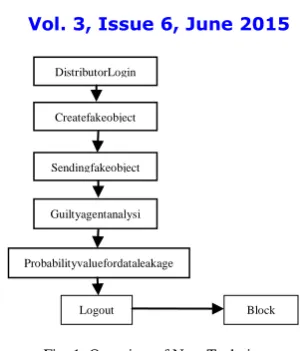
Fig. 1. Overview of New Technique
III.PROPOSED SCHEME
Distributor wants to send an original data to agent by using a fake object testing algorithm. While sending data if distributor finds any guilty party, then unauthorized party will block by distributor. Our main focus is that how the distributor intelligently give data to an agent, and how distributor choose an agent is trusted or not. In this proposed scheme two techniques to improve the chance of detecting Guilty agent.
1. Test the agent with only fake object.
2. Block the agent who send the original data from distributor circle.
In Distributor circle number of agents can allow to make relation witha distributor. Consider an agent as A and the number of agents as A= {A1, A2, A3, A4, ……. An}, agents wants to register and get an agent ID from the distributor. Before sending the data to agent, distributor will randomly choose agents to test where they are trusted or guilty. From [3] distributor creates some fake objects F = {f1, f2, f3, f4,...fn} for agent Aiis a function CREATEFAKEOBJECT (Ai, Fi, condi), it takes the input object for all objects Ai, the subset of fake object Fi that has been received to agents and condi returns a new fake object. The Distributor can also use CREATEFAKEOBJECT() function when he wants to send some fake object to a set of agents. Distributor chooses agent random order using e-optimal method [3]. This method is to improve the chance of detecting a guilty agent. Evaluating an algorithm relative to a random allocation. Distributor randomly chooses agents and send the fake object to test, so each agent’s value will increase as 1. Suppose anyone agent forward those fake objects to a third party without the permission of distributors, again the value will increase in the database, it’s controlled by the distributor. In this technique distributor can send number of fake objects to the agent. The total probability value for each agent is calculated as the total number of fake objects which has received or forward by a particular agent divided by the total number of fake object send by distributor.
Agent PA1 =
F
FA
1PA1 Probability of Agent A1
FA1 Total number of fake object receive or forward by agent A1 F Total number of fake object
Suppose any intelligent agents identifies the received object as a fake object, then they will act as a trusted agent for their distributor, then original data has been sent from the distributor, at that situation any agent is trying to leak the sensitive data then the system will ask distributor permission. Distributor noted those agents, give black-mark and block from distributor circle.
DistributorLogin
Createfakeobject
Sendingfakeobject
Guiltyagentanalysi s
Probabilityvaluefordataleakage
ISSN(Online): 2320-9801
ISSN (Print): 2320-9798
I
nternational
J
ournal of
I
nnovative
R
esearch in
C
omputer
and
C
ommunication
E
ngineering
(An ISO 3297: 2007 Certified Organization)
Vol. 3, Issue 6, June 2015
IV.DESIGN ARCHITECTURE
Consider D as Distributor and A as Agent, the database is common for both distributor and agent, but the database is controlled by distributor. In distributor circle number of trusted agents were allowed. The distributor sends some fake object to the agent which stores in the database. If any agent forward the fake object to any third party, then the probability value will increase for those agents. The probability value is calculated from the database shown in Fig (2).
Fig. 2. Testing Guilty Agent using Fake objects
From Fig (3), suppose the intelligent guilty agent can identify that the objects are fake, then they will act as trusted. For these types of guilty agents only distributor allows the blocking system.
Fig.3. Blocking Guilty Agent while trying to send original data
V. ALGORITHM EXPLANITION
A. Description of the Proposed Algorithm:
Distributor randomly select multiple agent to send data.
Distributor creates fake objects to test selected agent.
Consider fake objects as (f1, f2, f3, f4,……,.fn) and send to agent in random order.
After receiving the fake objects by all the agents, there probability value will increased as 1.
If any agents try to send those fake objects to a third party without the permission of distributor then again Distributor Data
Base Agent
Fake Agent Probability
Values Calculation
Illegal Transfer Fake Objects
Sending Fake Objects
Distributor Data Base
Agent
Distributor Permission
Fake Objects Probability
Value
Sending Original Data
Trying to transfer
ISSN(Online): 2320-9801
ISSN (Print): 2320-9798
I
nternational
J
ournal of
I
nnovative
R
esearch in
C
omputer
and
C
ommunication
E
ngineering
(An ISO 3297: 2007 Certified Organization)
Vol. 3, Issue 6, June 2015
Guilty agent.
After testing distributor again sends the original data to trusted agents as randomly. Unfortunately, anyonetries to send the original data to a third party, then this system will ask the distributor permission.
Distributor got the alert messages to block guilty agent from distributor circle.
B. Algorithm Steps
Step 1: Allocation for fake object request to Agent [6] Input A1… An cond1…., condn, f1… fn, F
Output A1,….. An F1… Fn 1. A θ
2. For i = 1,………n do 3. if fi > 0 then 4. A A Ʋ {i} 5. Fi θ
6. while F > 0 do
7. i select agent (A, A1, …….., An) 8. f create fake object (Ai, Fi, condi) 9. Ai Ai Ʋ {f}
10. Fi Fi Ʋ {f} 11. Fi fi 1 12. if fi = 0 then 13. A A \ {Ai} 14. F F 1
Step 2: Agent Selection Algorithm for e-random
1. Function SELECTAGENT (A, A1,.. , An) 2. i select at random an agent from A 3. return i
VI.SIMULATION RESULTS
ISSN(Online): 2320-9801
ISSN (Print): 2320-9798
I
nternational
J
ournal of
I
nnovative
R
esearch in
C
omputer
and
C
ommunication
E
ngineering
(An ISO 3297: 2007 Certified Organization)
Vol. 3, Issue 6, June 2015
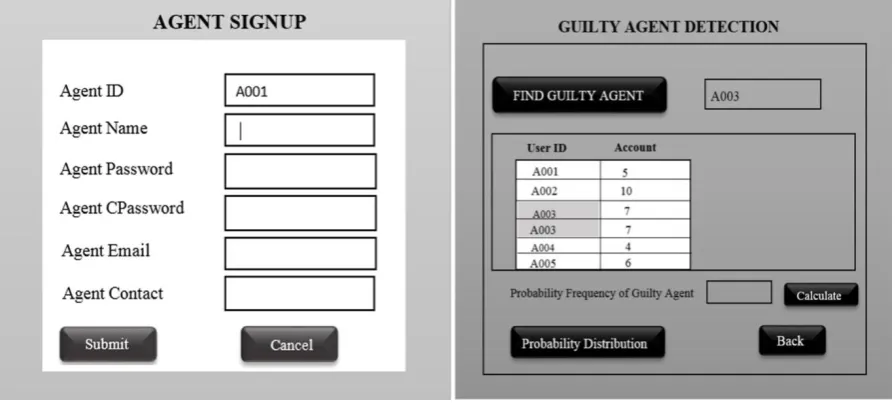
From fig (6) Consider that the distributor sends total number of fake data is 20. In distributor circle five agents available. Third agent’s account is increased than other four agent account, so the distributor calculate the probability of agent 003.This module is easy to identify the probability value of each agent. It can be controlled by the distributor.
A data distributor has given a sensitive data to trusted agents. Some of the data are leaked and found in the unauthorized place. The distributor can access the leaked data any agent, as opposed to having been independently gathered by other means admin can able to view the leakage files from the agent explained in fig(7)
Fig. 4. Registration Fig. 5. Guilty AgentDetection Module
ISSN(Online): 2320-9801
ISSN (Print): 2320-9798
I
nternational
J
ournal of
I
nnovative
R
esearch in
C
omputer
and
C
ommunication
E
ngineering
(An ISO 3297: 2007 Certified Organization)
Vol. 3, Issue 6, June 2015
VII. CONCLUSION AND FUTURE WORK
Surviving of existing system, we find out some loopholes from previous techniques. Watermarking is the technique to hide the sensitive data, but it fails to make the data as sensitive and sometime it will destroy the data, also a perturbation technique in watermarking which modified the original data, but it acts as less sensitive. In “realistic but fake” technique the fake object is attached with the original, and the file size also high.Where the proposed scheme is to invisible these techniques and test the agent using fake objects and block the guilty party. Future works include the extension of blocking the guilty party and the distributor gets high priority with trusted agents and to transfer the high sensitive data between distributor and trusted agent with proper security.
REFERENCES
[1] Sandip A. Kale, S.V.Kulkarni,” Data Leakage Detection”, International Journal of Advanced Research in Computer and Communication Engineering, Vol. 1, pp.668 - 678, Nov 2
[2] Chandni Bhatt, Richa Sharma,” Data Leakage Detection”, International Journal of Computer Science and Information Technologies, Vol. 5, pp. 2556 - 2558, 2014
[3] Lipi George, Mr.S.Vinoth Kumar, Dr.S.Karthik, “Detecting Guilty Party Using Dynamic Agents In Data Leakage”, International Journal of Scientific & Engineering Research, Volume 3, Issue 7 July - 2012
[4] R. Agrawal and J. Kiernan.,”Watermarking relational databases”, International conference on Very Large Data Bases , pp. 155 – 166, 2 [5] Amol O. Gharpande ,V. M. Deshmukh, “Data Leakage Detection”, International Journal of Computer Science and Applications Vol. 6, pp.216
- 219, Apr 2013.
[6] Karthik.R, Ramkumar.S, Sundaram.K, “Data Leakage Identification and Blocking Fake Agents Using Pattern Discovery Algorithm”, International Journal of Innovative Research in Computer and Communication Engineering Vol. 2 Issue 9, September 2014
[7] P. Papadimitriou and H. Garcia - Molina, “Data Leakage Detection”, technical report, Stanford Univ., 2008
[8] S.U. Nabar, B. Marthi, K. Kenthapadi, N. Mishra, and R. Motwani, “Towards Robustness in Query Auditing,” Proc. 32nd Int’l Conference Very Large Data Bases (VLDB ’06), VLDB Endowment, pp. 151 -162, 2006
[9] F. Guo, J. Wang, Z. Zhang, X. Ye, and D. Li, “Information Security Applications”, An Improved Algorithm to Watermark Numeric Relational Data, pp.138 – 149, 2006
[10] F. Hartung and B. Girod, “Watermarking of uncompressed and compressed video”, . Journal of Signal Processing”, , Vol.66, pp.283 – 301, 1998
BIOGRAPHY
Y I Jinesh Melvin is Assistant Professor in Computer Engineering Department, Pillai Institute of Information
Technology Engineering Media studies and Research, Mumbai University, New Panvel, Navi Mumbai, India. He received Master of Engineering degree in 2014, Dept. of Computer Engineering in Anna University Chennai. His research interests are Data Mining, Computer Networks, Image Processing etc.
K S Charumathi is Assistant Professor in IT Department, Pillai Institute of Information Technology Engineering