ISSN(Online): 2320-9801
ISSN (Print): 2320-9798
International Journal of Innovative Research in Computer
and Communication Engineering
(An ISO 3297: 2007 Certified Organization)
Vol. 3, Issue 7, July 2015
Standalone USB Flash to USB Flash Data
Transfer
Rahul.R.Menon
1, Hardik.Sukhadiya
2, Jainish.Patel
3Research Scholar, Dept. of ECE., Govt. Engineering College, Modasa, Gujarat, India1,2,3
ABSTRACT:In the modern era, computers and laptops has became an inseparable part of our busy life. And so are the accessories associated with these devices. One of the commonly used device for data transfers is USB flash drives. There are plenteous types of data transactions that are being delivered out through these devices daily. Due to emerging technology, these USB devices are shrinking in size day by day, but not the equipments which is required to access them. This paper explains the methodology of a portable battery driven device which one can easily carry for quick and safe data transactions and operations between two USB flash drives which otherwise would require bulk equipments like PC or laptop.
KEYWORDS: USB to USB data Transfer; Flash Drive; UART; FTDI; VNC1L
I. INTRODUCTION
The idea of this methodology and mechanism of data transfer has been taken looking at the problems faced by daily life USB disk users to transfer the data between two USB Disks. Carrying a computer or a laptop just for the sake of data transfer is not affordable these days in the age when people want all devices to be portable and quickly accessible as possible. Transferring data via a laptop involves a lot of power wastage and moreover wastage of precious time, because to use a computer for data transfers, it needs to boot up the system first.
The USB disks are slave devices which means they cannot initiate data transfers and operation on data on their own. These slave devices needs a master controller(PC or Laptop) which commands them to do appropriate operations on the data. So we cannot eliminate the master controller, only thing which can be done is to reduce the size of master controller and make it portable, quick and user-friendly for access. This paper demonstrates a way of data transfer between two USB flash drives using an Host controller chip called VNC1L and a microcontroller for user interface and commands.
The standalone device will display the files inside the USB in the LCD screen. There will be a small keypad provided for browsing through files and selecting required operations on files like cut, copy, paste or delete files. The whole module once fabricated through VLSI technology will be a portable device which one can easily carry around in pocket.
II. RELATED WORK
Several works has been done in this field. In [1] authors have used raspberry pi module to implement the USB to USB data transfer. Raspberry Pi is a small module which comes with a inbuilt RAM, VGA HDMI ports, and a microprocessor CPU which makes this module work like a mini computer. In [3] authors have used VDIP 2 module incorporating VNC1L IC chip which is a USB Host controller development module for VNC1L. In [2] authors have provided methodology to transfer data from one USB to another using a ARM processor having capability for entire transfer and selective file transfer.
III.HARDWAREDESCRIPTION
ISSN(Online): 2320-9801
ISSN (Print): 2320-9798
International Journal of Innovative Research in Computer
and Communication Engineering
(An ISO 3297: 2007 Certified Organization)
Vol. 3, Issue 7, July 2015
The VNC1L chip features an integrated 8/32-bit MCU and 64k embedded Flash memory. The chip handle data transfer functions on two USB Host/Client interfaces. One doesn't have to worry about writing firmware to implement those functions. When interfacing to mass storage devices such as USB Flash drives, the VNC1L transparently handles the FAT file structure communicating via UART, SPI or parallel FIFO interfaces via a simple-to-implement command set.
Fig.1. Block Diagram of USB to USB transfer module
The PIC 16F877A microcontroller is used for peripheral interface and for sending commands to VNC1L host controller via UART serial mode. The PIC 16F877A has 4 I/O ports which can be used for interfacing USB slave disks and VNC1L. The microcontroller acts as a bridge between the host controller and slave disk by sending the commands to VNC1L and also displaying the results of the operation on LCD screen.
A Keypad is used for user inputs. Arrow keys and function keys are assigned for browsing through disk and for disk operations. Figure 1 shows the block diagram of the proposed module.
IV.PROPOSED ALGORITHM
The VNC1L chip is shipped as a blank device. The programmer needs to upload proper firmware into this chip according to the application. The firmware can be downloaded from the FTDI website and can be used to program the VNC1L chip via UART interface or by using a VPROG1 VNC1L standalone programmer. Once the chip is programmed, its connected to PC via serial port to check the command sets and response of VNC1L using hyper terminal program which is usually used to troubleshoot serial communication between PC and external devices like modem. The VNC1L has two command sets viz. ECS( Extended Command Set) and SCS ( Shortened Command Set). In our programming code, we are using SCS set. The commands can be sent in form of ASCII or hex codes. The documentation of the host controller shows all the commands and corresponding Hex codes and the responses made by VNC1L in form of hex codes.
The microcontroller has to send proper hex code to the VNC1L based on the user input in order to execute an operation and wait for a response from VNC1L. The hex code response received after execution is decoded by the microcontroller and proper output is displayed in LCD screen for user understandable form.
Proposed Algorithm is as follows:
1. Switch On the power supply.
2. Default Display will appear on the LCD Screen
3. Wait for the USB Disk 1 and Disk 2
4. As soon as the two disk are detected, screen show two drive letters A:/ and B:/ 5. Select the drive and press enter to view the content of disk
6. Select files or folders by up or down key.
ISSN(Online): 2320-9801
ISSN (Print): 2320-9798
International Journal of Innovative Research in Computer
and Communication Engineering
(An ISO 3297: 2007 Certified Organization)
Vol. 3, Issue 7, July 2015
9. Once the process is completed, screen will refresh the display contents of the disk. 10.Repeat step 6-10 for more operations
11.End.
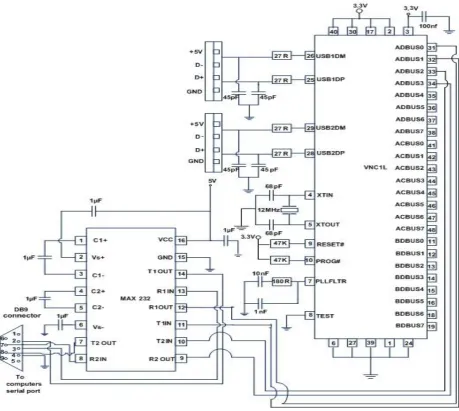
Fig.2. Interfacing Schematic of VNC1L chip to Max 232 for serial connection
Figure 2 shows interfacing schematic of VNC1L chip to Max 232 IC in order to convert voltages to RS232 logic level. The serial DB9 connector from MAX 232 goes to computers' serial COM port. Once hardware connection is made, commands can be given to VNC1L in SCS or ECS mode via hyper terminal program in Computer.
Code Snippet
for(k=0;k<6;k++)
{ str1[k]=receive();
if(str1[k]==0x0D) {
ISSN(Online): 2320-9801
ISSN (Print): 2320-9798
International Journal of Innovative Research in Computer
and Communication Engineering
(An ISO 3297: 2007 Certified Organization)
Vol. 3, Issue 7, July 2015
} }
if(strcmp(str1,pdi1)==0)
{ LED1=1;
P1=1; r=receive(); r=receive(); }
else if(strcmp(str1,pdr1)==0)
{ LED1=0;
P1=0; r=receive(); r=receive(); r=receive(); }
else if(strcmp(str1,pdi2)==0)
{ LED2=1;
P2=1; r=receive(); r=receive(); }
else if(strcmp(str1,pdr2)==0)
{ LED2=0;
P2=0; r=receive(); r=receive(); r=receive(); }
V. RESULT ANALYSIS
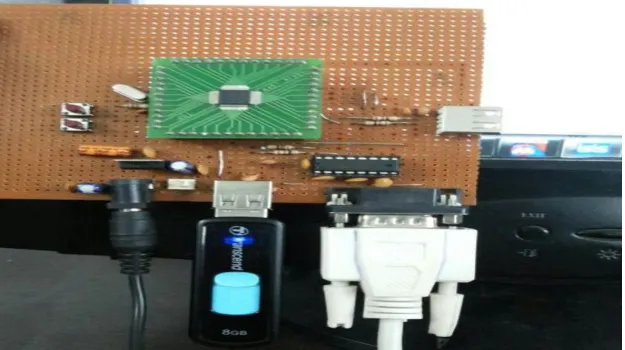
The Prototype design is assembled in two modules viz. USB interface module having the USB devices interfaced to the host controller. And the second module will contain the general purpose microcontroller used for serial communication and commanding to the host. The USB module is showed in figure 3 which is been interfaced to PC for command check and debug. The module is connected to serial COM port of PC via DB9 connector.
ISSN(Online): 2320-9801
ISSN (Print): 2320-9798
International Journal of Innovative Research in Computer
and Communication Engineering
(An ISO 3297: 2007 Certified Organization)
Vol. 3, Issue 7, July 2015
Both modules are assembled together in the assembly stage. The main advantage of dividing into modules will be that the device can be upgraded when needed, by changing the general purpose microcontroller and interfacing circuits without affecting the USB module section.
Fig.4. USB to USB data transfer Prototype design
Figure 4 shows the prototype design of the device incorporated with host controller which will serve as a host and a platform for data transfer between USB Flash drive to another without depending on PC. The device will allow the user to select various data transfer operations like copy, cut, paste, delete, format drive etc. LCD screen will monitor the data transfers and operation continuously. The device can be operated on a battery, so no external power supply will be needed by this device.
Main features of the device are as follows: Quick and easy access to USB drives Easy to carry/ Portable
Low power consumption
Plug and Go functionality Very low boot up time
ISSN(Online): 2320-9801
ISSN (Print): 2320-9798
International Journal of Innovative Research in Computer
and Communication Engineering
(An ISO 3297: 2007 Certified Organization)
Vol. 3, Issue 7, July 2015
2. Selected file is copied from source pen drive to another pen drive. 3. Delete selected file from the USB flash disk.
VI.CONCLUSION AND FUTURE SCOPE
To sum up “STANDALONE USB TO USB DATA TRANSFER” is expected to be a fully functional device with two USB ports which is capable of copying entire Flash disk to another (Memory Mapping), selectively copy or deletes files from one USB Flash disk to another. The final unit will contain a small PCB with all surface mounted packages and a battery / DC Adapter in small casing. The Device is expected to support flash disk size up to 4GB formatted with FAT32 File System.
LCD Screen will be provided on the PCB for indication of ongoing data transfer process and for completion of data transfer and user interface.
Enhancements that can be made to the system are dependent on future technologies and innovations. However some of the future enhancements expected are as follows:
Touch screen based GUI to encapsulate LCD Screen and Keypad to single unit and thus reducing size of the
module further.
Wireless connectivity of disks.
USB to printer interface so as to directly print the selected file from USB flash drive without need of a PC.
Digital camera backup interface.
REFERENCES
1. Rupali C. Bachalkar, Shrutika D. Durge, Purvaja V. Pote, Sapana V. Ajmire, Prof. Reetesh V. Golhar, Data Transfer between Two Pendrives without PC’, International Journal of Advanced Research in Computer Science and Software Engineering, Vol.5, Issue 1.
2. Omprakash Gawali, Ketan Pandurang Kale, Mahesh Sanjay Gund, Ganesh Balasaheb Gaware, Communication In USB’S For Data Transfer, International Journal of Engineering and Advanced Technology (IJEAT) ISSN: 2249 – 8958, Volume-2, Issue-4, April 2013 3. Mukesh Tiwari, Siddhartha Motghare, Jimit Gada, Unmesh Barhate , Flash Drive To Flash Drive Data Transfer’, International Refereed
Journal of Engineering and Science (IRJES),Vol. 2, Issue. 3, pp. 17-23, 2013.
4. J. Axelson, USB Complete 2nd Edition, Madison, WI: Lakeview Research LLC.
5. www.vinculum.com/documents/datasheet/DS_VNC1L_V2.01(FT_00 030).pdf
BIOGRAPHY
Rahul Ravindran Menonis a Research Scholar. He received his Bachelor of Engineering Degree in Electronics & Communication Engineering from, E&C Department, Government Engineering College, Modasa, Gujarat Technological University, India. His research interests are control engineering, communication and embedded systems.
Sukhadiya Hardik Harshadkumaris an Engineering Graduate. He received his Bachelor of Engineering Degree in Electronics & Communication Engineering from, E&C Department, Government Engineering College, Modasa, Gujarat Technological University, India. His research interests are communication engineering and electromagnetic theory.