ISSN(Online): 2320-9801
ISSN (Print): 2320-9798
I
nternational
J
ournal of
I
nnovative
R
esearch in
C
omputer
and
C
ommunication
E
ngineering
(An ISO 3297: 2007 Certified Organization)
Vol. 3, Issue 6, June 2015
Wireless Sensor Network for Heart Disease
Detection Using Data Mining Technique
Prachi W. Jambhulkar, Vaidehi Baporikar
M.E Student, Department of Embedded System &Computing, Nagpur Institute of Technology, Nagpur, India Asst. Professor, Department of Computer Science, Nagpur Institute of Technology, Nagpur, India
ABSTRACT: According to World Health cardiovascular diseases occur almost equally in men and women, it is the
first leading cause of death in high and low income countries.According to a recent study by the Indian Council of Medical Research (ICMR) and the Registrar General of India (RGI), about 25% of deaths between age group of 25-69 years occur because of different heart related problems.so that we try developing a module which can predict the possibilities of risk of having heart diseases with minimum number of attributes.Hence, we used the combination of data mining technique with wireless sensor network for the same.
KEYWORDS: Data Mining;WSN;KNN,Sensors.
I. INTRODUCTION
Heart is the important part of our body and its efficient working is necessary to regulates the other parts of human body such as kidney, brain etc. Hence for living long and healthy life proper care and alertness about these diseases is essential. The first question usually arise in mind is which is the easiest and fastest technique for this?.so, the answer is regular check-up and proper health diet. But this is not sufficient for care and alertness.
In the modern world, as the cardiovascular diseases are the highest flying diseases, so we should also have jump on some techniques and methods used for alertness and care. For this purpose we develop a decision support (computer based) based information system which will facilitate the correct diagnosis with reduced cost. This integration of existing medical decision support system with different data mining techniques requires the comparison of several mining techniques for extracting the suitable data for said job.
Here we developed a module which predicts the possibility of risk of having heart diseases using Data Mining technique with Wireless Sensor Network (WSN).first of all we can collect different data records of patients from Cleveland database and extracts the essential arrtibutes required for prediction [1].
II. RELATED WORK
[2]Author proposed various data mining techniques for heart disease diagnosis using single data mining techniques. The thoroughly investigation in disease diagnosis showing the highest level of accuracy and for getting enhanced result, will hybridize more than one techniques. After comparing both the techniques on the Cleveland heart disease database, hybrid shows the better accuracy than single technique.[3]Author presents a naïve bayes classification approach for heart disease prediction .the proposed system will categorized the medical data into different categories like no,low,accurate,high& very high and predicts the class label of unknown sample. For result analysis, two basic functions namely training and testing will be performed. Accurate prediction will depend on algorithm applied on databases.[4]Author has been done a research work on data mining techniques, provides a survey on current knowledge discovery based data mining technique which helps the medical practitioners for taking effective decision. Prediction will base on minimum number of attributes with three classifier like naïve bayes, J48 decision tree bagging algorithm.
ISSN(Online): 2320-9801
ISSN (Print): 2320-9798
I
nternational
J
ournal of
I
nnovative
R
esearch in
C
omputer
and
C
ommunication
E
ngineering
(An ISO 3297: 2007 Certified Organization)
Vol. 3, Issue 6, June 2015
monitoring and identifying the diseases in a cardiac patients at remote areas. [5]Author provides research article which shows a real-time WSN system for prediction of upcoming cardiovascular disease. The system has capability to monitor multiple patients at a time and diagonize the patient with prescription; also provides warning signals to doctors and relatives too. We can use the above model with application of data mining technique for getting more real-time data sets and accuracy in detection of risk of having various cardiovascular diseases.
III.HEART DISEASE DATA
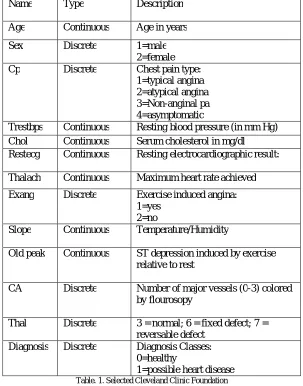
There are some attributes which are essential for predictions are listed below:
Name Type Description
Age Continuous Age in years
Sex Discrete 1=male
2=female Cp Discrete Chest pain type:
1=typical angina 2=atypical angina 3=Non-anginal pa 4=asymptomatic
Trestbps Continuous Resting blood pressure (in mm Hg) Chol Continuous Serum cholesterol in mg/dl
Restecg Continuous Resting electrocardiographic result:
Thalach Continuous Maximum heart rate achieved Exang Discrete Exercise induced angina:
1=yes 2=no
Slope Continuous Temperature/Humidity
Old peak Continuous ST depression induced by exercise relative to rest
CA Discrete Number of major vessels (0-3) colored by flourosopy
Thal Discrete 3 = normal; 6 = fixed defect; 7 = reversable defect
Diagnosis Discrete Diagnosis Classes: 0=healthy
1=possible heart disease
Table. 1. Selected Cleveland Clinic Foundation
ISSN(Online): 2320-9801
ISSN (Print): 2320-9798
I
nternational
J
ournal of
I
nnovative
R
esearch in
C
omputer
and
C
ommunication
E
ngineering
(An ISO 3297: 2007 Certified Organization)
Vol. 3, Issue 6, June 2015
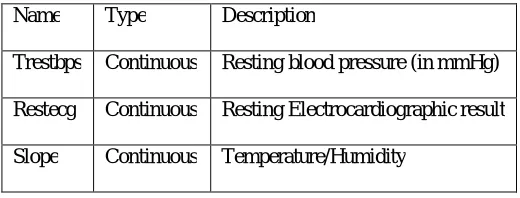
Name Type Description
Trestbps Continuous Resting blood pressure (in mmHg)
Restecg Continuous Resting Electrocardiographic result
Slope Continuous Temperature/Humidity
Table. 2. Attributes Provides Through Sensor
The above parameters value can be changes suddenly and abruptly in a cardiac patient. Hence, by providing the above parameters real-time, we can achieve the level of accuracy in predictionIn Heart Disease Detection System, first of all we used 3 types of sensors viz. temperature and humidity sensor, blood pressure sensor and heart beat sensor which are able to sense the real-time values of the above parameters from our body and sends the data to system via wireless module, this will provide the mobility and flexibility. While the system receives the data, apply the classification technique on the combination of received real-time data and recorded remaining extracted attributes data with the processed Cleveland Datasets ,thus identify the class code according to code labels system provides the result i.e. probability(possibility) of risk of having heart disease or not.
IV.HEART DISEASE DETECTION SYSTEM
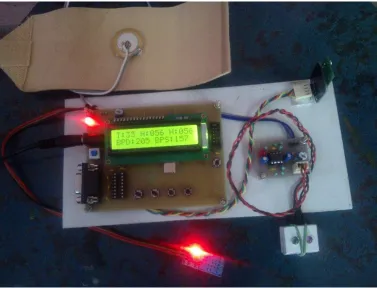
Heart disease detection system consists of hardware and software module as shown in bellow fig.now we will describe each part one by one.
A. Hardware module(Wireless sensor network):
We can also call hardware module as a wireless sensor network because it will sense the data using different sensors and transmit data wirelessly to the system. In this way we can form WSN using combination of sensor system with wireless module.
This module consist of sensors which are able to collect the real-time value of our body and send these bundle of data to microcontroller, afterreceiving these data microcontroller will transmit this to heart disease detection system via wireless module.
Now let us describe the WSN in detail.it consist of three sensors such as:
1. Temperature and Humidity sensor
The DHT11 Temperature and Humidity sensor feature a temperature & humidity sensor complex with a calibrated digital signal output. This sensor includes an NTC temperature measurement component and resistive-type humidity measurement component and connects to a high performance 8-bit microcontroller. This both value can be shown on prediction system as a ratio of temperature to humidity values called slope.
2. Blood pressure sensor
It is a non-invasive sensor designed to measure human blood pressure. For measurement we used piezoelectric pressure sensor, made up of high sensitivity, ceramic element glued with a metal diaphragm with rigid bonding agent.
3. Heart beat sensor
This sensor measures the heartbeat of a person with micro-controller through fingertip. While heart is beating, means actually pumping blood throughout body, resulting blood volume inside finger artery to change. This fluctuation can be detected by optical sensing mechanism placed near the fingertip.
ISSN(Online): 2320-9801
ISSN (Print): 2320-9798
I
nternational
J
ournal of
I
nnovative
R
esearch in
C
omputer
and
C
ommunication
E
ngineering
(An ISO 3297: 2007 Certified Organization)
Vol. 3, Issue 6, June 2015
for providing real-time values we will achieve accuracy in disease prediction and real –time observation also helpful for doctors to know about the patient’s current condition. Hence in our module we can take these attributes value using sensor and provide these data to disease prediction system using wireless module.
Fig. 1. Hardware Module Consist of Sensors
B. Software Module:
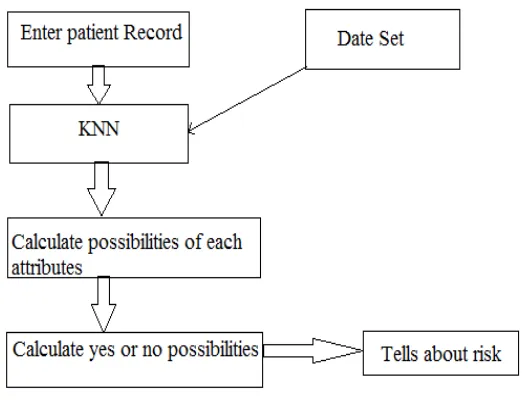
This module relates to Data Mining techniques. Possibilities of having heart diseases can be detected using sophisticated data mining technique. For this, firstly we collect the large quantities of significant datasets from selected Processed Cleveland Heart Disease Databases and extract the 14 essential attributes first and maintain the record. Then apply the data mining technique on extracted attributes and 3 real-time receiving attributes with the large database record using classification technique. We use KNN classification technique which is based on the combination of classes of the k records most likely it to in a historical datasets and classifies each record in dataset. KNN theory will find out the most likely significant possible classification, identify class labels and provide the result of prediction.
Implementation of K Nearest Neighbour Classification:
KNN is a sophisticated classification method well suited when the dimensionality of the input is very high and it shows the probability of each input attributes for predictable state, identify the characteristics of cardiac diseases. In our module we used KNN implementation because:
1. When the datasets is high
2. When the attributes are separate and not connected to each other. 3. When we want more efficient output with good accuracy
ISSN(Online): 2320-9801
ISSN (Print): 2320-9798
I
nternational
J
ournal of
I
nnovative
R
esearch in
C
omputer
and
C
ommunication
E
ngineering
(An ISO 3297: 2007 Certified Organization)
Vol. 3, Issue 6, June 2015
Implementation on patient data
Fig. 2.Implementation of KNN algorithm on the patient data.
After calculating the correlation between dependent and independent variables provides the possibility about risk of having cardiac diseases. We can use continuous real-time data rather than just categorical data for prediction using wireless sensor networks.
After receiving the real-time data from hardware module and applying the data mining technique on 3 real-time and remaining recorded datasets of extracted attributes, we are able to get the class code of possibility of risk of having heart disease or not in terms of different class labels as: Normal,Low,Moderate and high. Following figures shows the output in GUI (Graphical User Interface).
V. EXPERIMENTAL RESULT
Hence, we can successfully able to identify the possibility of risk of having heart diseases in a cardiac patient in terms of different class labels.From this analysis patient comes to know their cardiac condition in the absence of doctor also or at a home. And according to result shown on GUI may generate any alarm signal;if we want for doctor alertness.so that he will able to pay attention towards diagnosis of patient and start the treatment.
While running code in matlab data reading and processing will be done and use the real valued data with data records in excel sheet for prediction.
Here, some steps show the result:
ISSN(Online): 2320-9801
ISSN (Print): 2320-9798
I
nternational
J
ournal of
I
nnovative
R
esearch in
C
omputer
and
C
ommunication
E
ngineering
(An ISO 3297: 2007 Certified Organization)
Vol. 3, Issue 6, June 2015
Fig. 3.Output at GUI (Enter Age)
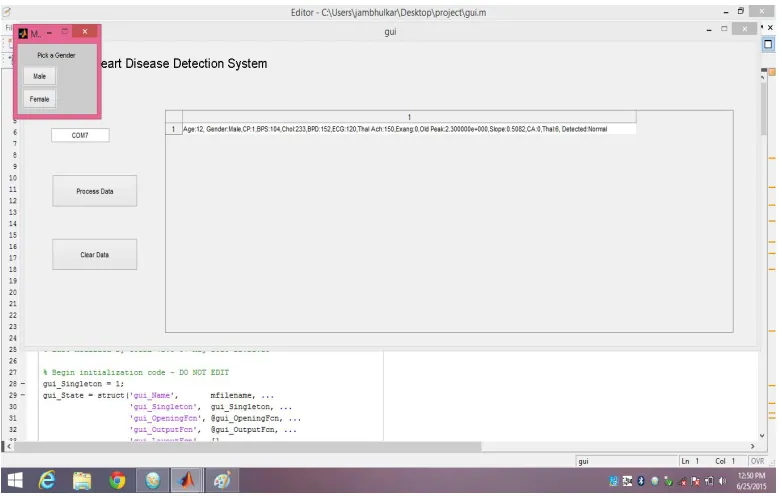
2. Pick a Gender, after entering age then in next step to choose a gender i.e.Male or Female ,as shown in fig.
ISSN(Online): 2320-9801
ISSN (Print): 2320-9798
I
nternational
J
ournal of
I
nnovative
R
esearch in
C
omputer
and
C
ommunication
E
ngineering
(An ISO 3297: 2007 Certified Organization)
Vol. 3, Issue 6, June 2015
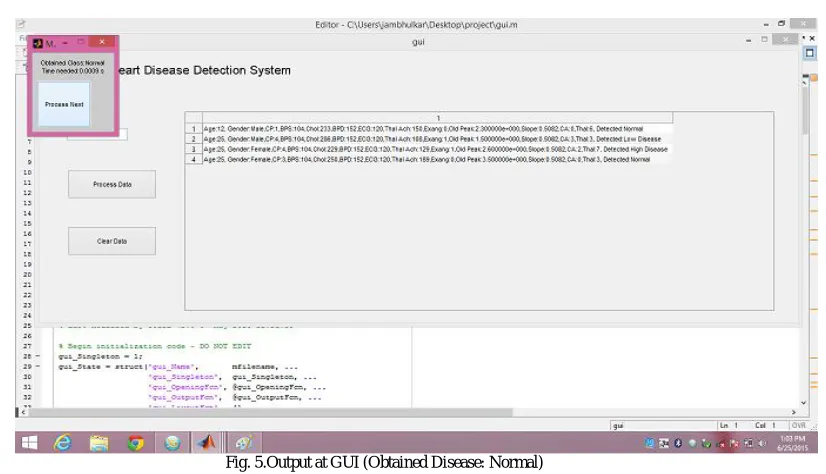
3. Result, after selection of gender and press enter automatically result of prediction will generate which consist of predicted class and time needed for prediction and on the GUI all the parameters value will be shown consist of detected class code label also, as shown in bellow fig.
Fig. 5.Output at GUI (Obtained Disease: Normal)
VI.CONCLUSION AND FUTURE WORK
The system can be used for providing enhance healthcare services and early diagnosis of disease detection may reduce the chances of death in a cardiac patients.
In future it is possible that we will provide all extracted attributes value in a real-time via different sensor system and identify the class labels by applying data mining.in that case no need to maintain separate records for extracted attributes.
If the number of nodes increases with one prediction system, doctors will able to monitor several patients cardiac condition in minimum time with good accuracy.
REFERENCES.
1. PrachiJambhulkar and VaidehiBaporikar,”Review on Prediction of Heart Disease Using Data Mining Technique with Wireless Sensor
Network”,Intenational Journal of Computer Science and Application,Vol8,ISSN:0974-1011,no.1,pp.55-59,jan-mar 2015.
2. Mai Shouman, Tim Turner, and Rob Stocker “Using Data Mining Technique in Heart Disease Diagnosis and Treatment”, 2012
Japan-Egypt Conference on Electronics, Communications and Computers ISSN:978-1-4673-0484-9/ IEEE,pp.173-177,2012.
3. Dhanashree S. Medhekar, Mayur P. Bote,Shruti D. Deshmukh “HeartDisease Prediction System using Naïve Bayes”, International
Journal of Enhanced Research In ScienceTechnology&Engineering,Vol.2,ISSN:2319-7463,pp.1-5,2013.
4. VikasChaurasia and Saurabh Pal “Data Mining Approach to Detect Heart Dieses”, International Journal of Advanced Computer Science
and Information Technology (IJACSIT) Vol. 2, No. 4,ISSN: 2296-1739,pp.56-66,2013.
5. Kala John Kappiarukudil and ManeeshaVinodini Ramesh “Real-Time Monitoring and Detection of ‘‘Heart Attack’’ Using Wireless
Sensor Networks”, 2010 Fourth International Conference on Sensor Technologies and Applications ISSN:978-0-7695-4096-2/10IEEE,2010.