ISSN(Online): 2320-9801
ISSN (Print): 2320-9798
I
nternational
J
ournal of
I
nnovative
R
esearch in
C
omputer
and
C
ommunication
E
ngineering
(An ISO 3297:2007 Certified Organization)
Vol. 3, Issue 2, February 2015
An Efficient Resource Allocation Strategies
in Cloud Computing
B.Rajasekar
1,S.K.Manigandan
2Final Year MCA Student, VelTech HighTech Engineering College, Chennai, India1
Assistant Professor, VelTech HighTech Engineering College, Chennai, India2
ABSTRACT: Recently cloud computing booming area and emerging trends in information communication technology domain. Resource allocation is to allocate the resource based on infrastructure as a service (IaaS) is one of the keys for large-scale Cloud applications. Therefore, performance evaluation of workload models and Cloud resource allocation and algorithms in a repeatable manner under different configurations and requirements is difficult. There is still lack of tools that enable developers to compare different resource allocation strategies in IaaS regarding both computing servers and user workloads. To fill this gap in tools for evaluation and modeling of Cloud environments and applications, we propose Cloud computing environment can help developers identify and explore appropriate solutions considering different resource allocation stratigies. we proposed for resource allocation strategies in cloud computing environment such as Cloud data centers, and results by applying the proposed system are analyzed and discussed.
KEYWORDS: Cloud computing,Deployment model.RAS,Service Model.
I. INTRODUCTION
ISSN(Online): 2320-9801
ISSN (Print): 2320-9798
I
nternational
J
ournal of
I
nnovative
R
esearch in
C
omputer
and
C
ommunication
E
ngineering
(An ISO 3297:2007 Certified Organization)
Vol. 3, Issue 2, February 2015
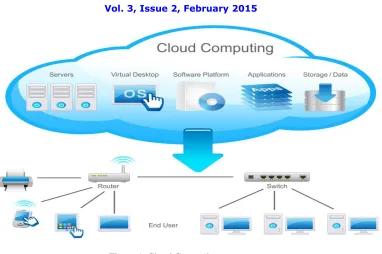
Figure 1. Cloud Computing
Cloud computing service models: There are three fundamental Service models in Cloud computing. Three service
models are presented below.
1 Software as a Service:Cloud Applications or Software as a Service (SaaS) refers to software delivered over a browser. SaaS eliminates the need to install and run applications on the customer's own computers/servers and simplifies maintenance, upgrades and support. Examples of SaaS are Facebook, SalesForce, etc. The Cloud Computing service model is given in figure 2.
Figure .2 Cloud Computing Service model
ISSN(Online): 2320-9801
ISSN (Print): 2320-9798
I
nternational
J
ournal of
I
nnovative
R
esearch in
C
omputer
and
C
ommunication
E
ngineering
(An ISO 3297:2007 Certified Organization)
Vol. 3, Issue 2, February 2015
3. Infrastructure as a Service: Cloud infrastructure services or Infrastructure as a Service (IaaS) delivers a computing infrastructure, typically a virtualization environment, as-a-service. Examples of IaaS are virtual servers leased by Amazon, Rackspace, GoGrid, etc.
Deployment model
Cloud Computing Deployment model is given in figure 3..
Figure3.Cloud Computing Deployment model
Each company chooses a deployment model for a cloud computing solution based on their specific business, operational, and technical requirements. Four primary cloud deployment models are private cloud, community cloud, public cloud, and hybrid cloud.
Public Cloud: Public cloud refers to Cloud Computing in the traditional mainstream sense, whereby resources are
dynamically provisioned on a fine-grained, self-service basis over the Internet. These resources are provisioned via web applications/web services, from an off-site third-party provider who shares resources and bills the customer on a fine-grained utility computing basis.
Community Cloud: A community cloud is established among several organizations that have similar requirements and
seek to share their computing infrastructure in order to realize some of the benefits of the Public Cloud.
Private Cloud: A term that is similar to, and derived from, the concept of Virtual Private Network (VPN), is applied to Cloud Computing. The Private Cloud delivers the benefits of Cloud Computing with the option to optimize on data security, corporate governance and reliability.
Hybrid cloud: The cloud infrastructure is shared by several organizations with common concerns (eg, mission, security requirements, policy, and compliance considerations).
II.EXISTING SYSTEM
ISSN(Online): 2320-9801
ISSN (Print): 2320-9798
I
nternational
J
ournal of
I
nnovative
R
esearch in
C
omputer
and
C
ommunication
E
ngineering
(An ISO 3297:2007 Certified Organization)
Vol. 3, Issue 2, February 2015
Second, it is highly recommended that any member in a group should be able to fully enjoy the data storing and sharing services provided by the cloud, which is defined as the multiple-owner manner. Compared with the single-owner manner, where only the group manager can store and modify data in the cloud, the multiple-single-owner manner is more flexible in practical applications. More concretely, each user in the group is able to not only read data, but also modify his/ her part of data in the entire data file shared by the company.
ISSUES IN EXISTING SYSTEM: The cloud servers managed by cloud providers are not fully trusted by users
while the data files stored in the cloud may be sensitive and confidential, such as business plans. To preserve data privacy, a basic solution is to encrypt data files, and then upload the encrypted data into the cloud. Unfortunately, designing an efficient and secure data sharing scheme for groups in the cloud is not an easy task.
III. RESOURCE ALLOCATION STRATEGIES
Resource allocation is process of assigning the available resources in an economic way and efficient and effective way Resource allocation is the scheduling of the available resources and available activities required by those activities while taking into consideration both the resource availability and the project time. Resource provisioning and allocation solves that problem by allowing the service providers to manage the resources for each individual request of resource. Resource Allocation Strategy (RAS) is all about the number of activities for allocating and utilizing inadequate resources within the limit of cloud environment so as to meet the needs of the cloud application. It requires the type and amount of resources needed by each application in order to complete a user job
From the perspective of a cloud provider, predicting the dynamic nature of users, user demands, and application demands are impractical. For the cloud users, the number of tasks of job needs to be completed on time with minimal cost. Hence due to limited resources, resource heterogeneity, environmental necessities, locality restrictions and dynamic nature of resource demand, we need an efficient resource allocation system that suits cloud environments. Cloud resources consist of virtual resources. The physical resources are shared across multiple computer quests through virtualization and provisioning. The virtualized resources are described through a set of parameters detailing the processing, memory and disk needs. Provisioning of cloud can be done by mapping virtualized resources to physical ones. The software and hardware resources are allocated to the cloud applications on-demand basis [1].
IV.ADVANTAGES AND LIMITATIONS OF RESOURCE ALLOCATION STRATEGIES
Advantages:
The first major benefit of resource allocation is that user neither has to install software nor hardware to access the applications, to develop the application and to host the application over the internet.
The next major benefit is that there is no limitation of place and medium. We can reach our applications and data anywhere in the world, on any system.
The user does not need to expend on hardware and software systems.
Cloud providers can share their resources over the internet during resource scarcity.
Limitations:
ISSN(Online): 2320-9801
ISSN (Print): 2320-9798
I
nternational
J
ournal of
I
nnovative
R
esearch in
C
omputer
and
C
ommunication
E
ngineering
(An ISO 3297:2007 Certified Organization)
Vol. 3, Issue 2, February 2015
Migration problem occurs, when the users wants to switch to some other provider for the better storage of their data. It’s not easy to transfer huge data from one provider to the other.
In public cloud, the clients’ data can be susceptible to hacking or phishing attacks. Since the servers on cloud are interconnected, it is easy for malware to spread.
Peripheral devices like printers or scanners might not work with cloud. Many of them require software to be installed locally. Networked peripherals have lesser problems.
More and deeper knowledge is required for allocating and managing resources in cloud, since all knowledge about the working of the cloud mainly depends upon the cloud service provider.
V. SUMMARY OF RESOURCE ALLOCATION STRATEGIS
A.Meera and S.Swamynathan proposed an approach for allocating resources based on the analyzed data that is being analyzed by a monitoring agent. The monitoring agent will collect the resources usage information that is currently being used by a virtual machine and will display it in a dashboard. Statistical report that is being displayed on a dashboard provides an information for cloud administrator for better optimization of resources. At this point this approach suffers from the centralized coordination because agents are not autonomous so future work can be focused on autonomous agents.Kyle Chard, Simon Caton, Kris Bubendorfer, Omer Rana proposed an approach of a social cloud for sharing the resources on the base of relationship, trust and risk, and policies with the coordination of social market. A Social cloud is resource and service sharing framework utilizing relationships established between members of a social network. Social market is being used in order to regulate the resource sharing within the group. K C Gouda, Radhika T V, and Akshatha M proposed a priority based resource allocation approach with minimum wastage and a maximum profit. Priority is being considered in terms of different parameters like time, cost, number of processor requests etc. priority can be used for better resource allocation in cloud environment.
Diptangshu Pandit, Matangini Chattopadhyay, and Nabendu Chaki proposed an efficient resource allocation algorithm with the use of simulated annealing. In this approach authors had introduced the concept of bin, soft computing and simulated annealing. In this approach, problem of resource allocation is being solved with the help of bin packing problem. In this approach temperature is being considered as a control parameter but no formal procedure of selecting the temperature has been described in this approach.
VI. CONCLUSION
Cloud computing technology is increasingly being used in enterprises and business global markets. A evaluate shows that dynamic resource allocation is growing need of cloud providers for more number of users and with the less response time. In cloud paradigm, an effective resource allocation strategy is required for achieving user satisfaction and maximizing the profit for cloud service providers. This paper summarizes the main resource allocation strategies and its impacts in cloud system. Some of the strategies discussed above mainly focus on memory resources but are lacking in other factors. Hence this survey paper will hopefully motivate future researchers to come up with smarter and secured optimal resource allocation algorithms and framework to strengthen the cloud computing paradigm.
REFERENCES
ISSN(Online): 2320-9801
ISSN (Print): 2320-9798
I
nternational
J
ournal of
I
nnovative
R
esearch in
C
omputer
and
C
ommunication
E
ngineering
(An ISO 3297:2007 Certified Organization)
Vol. 3, Issue 2, February 2015
[2] Gunho Lee, Niraj Tolia, Parthasarathy Ranganathan, and Randy H. Katz, Topology aware resorce allocation for data-intensive workloads, ACM SIGCOMM Computer Communication Review, 41(1):120--124, 2011.
[3] Abirami S.P. and Shalini Ramanathan, Linear scheduling strategy for resource allocation in cloud environment, International Journal on Cloud Computing: Services and Architecture(IJCCSA), 2(1):9--17, 2012.
[4].Chandrashekhar S. Pawar and R.B. Wagh, A review of resource allocation policies in cloud computing, World Journal of Science and Technology, 2(3):165-167, 2012.
[5]. A.Meera, S.Swamynathan, “Agent based Resource Monitoring system in IaaS Cloud Environment”, International Conference on Computational Intelligence: Modeling Techniques and Applications (CIMTA), 2013
[6].Weiwei Lin, James Z. Wang, Chen Liang, and Deyu Qi, “A Threshold-based Dynamic Resource Allocation Scheme for Cloud Computing”, Procedia Engineering volume 23, 2011, Pages 695–703
[7] K C Gouda, Radhika T V, Akshatha M, “Priority based resource allocation model for cloud computing”, International Journal of Science, Engineering and Technology Research (IJSETR) Volume 2, Issue 1, January 2013
[8] Ewnetu Bayuh Lakew, Francisco Hernandez-Rodriguez, Lei Xu and Erik Elmroth, “Management of Distributed Resource Allocations in Multi-cluster Environments”, Performance Computing and Communications Conference (IPCCC), IEEE 31st International, 2012