How to Misuse AODV: A Case Study of Insider Attacks against
Mobile Ad-hoc Routing Protocols
Peng Ning and Kun Sun
Computer Science Department, North Carolina State University Raleigh, NC 27695-7534
Emails: [email protected], [email protected]
February 23, 2003
Abstract
This paper presents a systematic analysis of insider attacks against mobile ad-hoc routing protocols, using the Ad hoc On-Demand Distance Vector (AODV) protocol as an example. It identifies a number of attack goals and then study how to achieve these goals through misuses of the routing messages. To facilitate the analysis, this paper classifies the insider attacks into two categories: atomic misusesandcompound misuses. Atomic misuses are performed by ma-nipulating a single routing message, which cannot be further divided; compound misuses are composed of combinations of atomic misuses and possibly normal uses of the routing proto-col. The analysis results in this paper reveal several classes of insider attacks, includingroute disruption, route invasion, node isolation, andresource consumption. This paper also includes simulation results that demonstrate the impact of these attacks.
1
Introduction
Mobile Ad-hoc Networks (MANET) have attracted substantial research efforts recently, partially due to their attractive applications in infrastructureless situations such as battle fields and disaster recovery. Among all the research issues, security in MANET is particularly challenging due to the nature of wireless communication and the lack of infrastructure supports. Several efforts (e.g., Security-aware AODV [1], Ariadne [2], SEAD [3], CONFIDANT [4], watchdog and pathrater [5]) are under way to provide security services in ad-hoc routing protocols.
Most of the current security mechanisms (e.g., Ariadne [2], SEAD [3]) are preventive approaches that depend on cryptography to ensure the security of the network. However, in a typical mobile ad-hoc network such as a battle field, mobile nodes are extremely vulnerable to capture or key compromise. Even if critical keying materials are protected by tamper proof hardware, it is still difficult to ensure that the same hardware will not be misused by an attacker. Thus, to ensure the overall security of the network, it is important to develop security mechanisms that can survive malicious attacks from “insiders” who have full control of some nodes. In order to protect against insider attacks, it is necessary to understand how an insider can attack a wireless ad-hoc network. Several attacks (e.g., routing disruption attacks and resource consumption attacks [2, 3]) have been discussed in the literature. However, these attacks have not been seriously studied and verified.
achieve, and then enumerate all possible actions that an attacker may apply to a routing message. Our analysis is then to examine whether the attack goals may be achieved through these misuse actions. To facilitate the analysis, we further classify misuses of the AODV protocol into two categories: atomic misuses and compound misuses. Intuitively, atomic misuses are performed by manipulating a single routing message, which cannot be further divided. In contrast, compound misuses are composed of multiple atomic misuses, and possibly normal uses of the routing protocol. Since atomic misuses are potentially building blocks of compound misuses, in this paper, we start with analyzing atomic misuses. In addition, we also study compound misuses that can achieve more powerful effects than simple compositions of atomic misuses when carefully composed together. We do not discuss simple compositions of atomic misuses, though we do perform simulation experiments to study their impacts. We pick the AODV protocol [6] as a target, performing our analysis from an attacker’s perspective. It is easy to see that our analysis scheme is also applicable to other ad-hoc routing protocols, possibly with slight changes. To validate the analysis results, we have implemented the misuses based on the AODV extension in ns2, and evaluated the effectiveness of the misuses through simulations.
The rest of this paper is organized as follows. The next section briefly describes the AODV protocol. Section 3 describes our analysis scheme. Section 4 focuses on analyzing the atomic misuses of AODV routing message. Section 5 discusses compound misuses. Section 6 presents the experimental results. Section 7 discusses the related work in security of wireless ad-hoc networks. Section 8 concludes this paper and points out future research directions. Appendices give the details of the misuses as well as the simulation results.
2
An Overview of AODV Protocol
The Ad-hoc On-Demand Distance Vector (AODV) [6] protocol is an on-demand routing protocol, which initiates a route discovery process only when desired by a source node. When a source node wants to send data packets to a destination node but cannot find a route in its routing table, it broadcasts a Route Request (RREQ) message to its neighbors. Its neighbors then rebroadcast the RREQ message to their neighbors if they do not have afresh enough route to the destination node. (A fresh enough route is a valid route entry for the destination node whose associated sequence number is equal to or greater than that contained in the RREQ message.) This process continues until the RREQ message reaches the destination node or an intermediate node that has a fresh enough route.
Every node has its own sequence number and RREQ ID1
. AODV uses sequence numbers to guarantee that all routes are loop-free and contain the most recent routing information. RREQ ID in conjunction with source IP address uniquely identify a particular RREQ message. The destination node or an intermediate node only accepts the first copy of a RREQ message, and drops the duplicated copies of the same RREQ message.
After accepting a RREQ message, the destination or intermediate node updates its reverse
route to the source node using the neighbor from which it receives the RREQ message. The
reverse route will be used to send the corresponding Route Reply (RREP) message to the source node. Meanwhile, it updates the sequence number of the source node in its routing table to the maximum of the one in its routing table and the one in the RREQ message. When the source or an intermediate node receives a RREP message, it updates its forward route to the destination node using the neighbor from which it receives the RREP message. It also updates the sequence number
1
of the destination node in its routing table to the maximum of the one in its routing table and the one in the RREP message. A Route Reply Acknowledgement (RREP-ACK) message is used to acknowledge receipt of a RREP message. Though not required, AODV may utilize the HELLO message to maintain the local connectivity of a node.
Route maintenance is done with Route Error (RERR) messages. If a node detects a link break in an active route, it sends out a RERR message to its upstream neighbors that use it as the next hop in the broken route. When a node receives a RERR message from its neighbor, it further forwards the RERR message to its upstream neighbors.
AODV is a stateless protocol; the source node or an intermediate node updates its routing table if it receives a RREP message, regardless of whether it has sent or forwarded a corresponding RREQ message before. If it cannot find the next hop in the reverse routing table, it simply drops the RREP message. Otherwise, it unicasts the RREP message to the next hop in the reverse route. In general, a node may update the sequence numbers in its routing table whenever it receives RREQ, RREP, RERR, or RREP-ACK messages from its neighbors.
3
Analysis Scheme
We adopt a systemic way to analyze the insider attacks against the AODV protocol. We first identify a number of misuse goals that an inside attacker may want to achieve, and then study how these goals may be achieved through misuses of the routing messages. These misuse goals are listed as follows.
• Route Disruption (RD). Route Disruption means either breaking down an existing route or
preventing a new route from being established.
• Route Invasion (RI). Route invasion means that an inside attacker adds itself into a route
between two endpoints of a communication channel.
• Node Isolation (NI). Node isolation refers to preventing a given node from communicating
with any other node in the network. It differs from Route Disruption in that Route Disruption is targeting at a route with two given endpoints, while node isolation is aiming at all possible routes.
• Resource Consumption (RC). Resource consumption refers to consuming the communication
bandwidth in the network or storage space at individual nodes. For example, an inside attacker may consume the network bandwidth by either forming a loop in the network.
There may be other attack goals (e.g., denial of service); however, we do not consider them in our current work.
To facilitate the analysis, we further classify misuses of the AODV protocol into two categories:
atomic misusesandcompound misuses. Intuitively, atomic misuses are performed by manipulating
a single routing message, which cannot be further divided. In contrast, compound misuses are composed of multiple atomic misuses, and possibly normal uses of the routing protocol. It is easy to see that atomic misuses may be used as building blocks of compound misuses.
We perform our analysis of atomic misuses through understanding the effects of possibleatomic
misuse actions. Each atomic misuse action is an indivisible manipulation of one routing message.
• Drop (DR). The attacker simply drops the received routing message.
• Modify and Forward (MF). After receiving a routing message, the attacker modifies one or
several fields in the message and then forwards the message to its neighbor(s) (via unicast or broadcast).
• Forge Reply (FR). The attacker sends a faked message in response to the received routing
message. Forge Reply is mainly related to the misuse of RREP messages, which are in response of RREQ messages.
• Active Forge (AF). The attacker sends a faked routing message without receiving any related
message.
At first glance, compound misuses seem to be simple compositions of atomic uses. However, when carefully aggregated together, some compositions of atomic misuses become more powerful attacks due to the changes in the number of messages. For example, if an attacker regularly broadcasts RREQ messages with false information in the neighborhood of a victim node, the attacker can successfully prevent the victim node from receiving any messages. In our analysis of compound misuses, we focus on the aforementioned, “powerful” compound misuses; simple compositions of atomic misuses (and possibly the normal routing messages as well as the above compound misuses) can be analyzed via automatic vulnerability analysis tools (e.g., attack graphs [8]).
It is easy to see that our analysis scheme is also applicable to other mobile ad hoc routing protocols, possibly with slight modification. However, in this paper, we only focus on the AODV protocol, while considering the analysis of the other protocols as possible future work.
Since atomic misuses form the foundation of compound misuses, in the following, we first perform a systematic analysis of atomic misuses of the AODV protocol, and then study how atomic misuses and normal routing messages may be combined to launch compound misuses.
4
Atomic Misuses of AODV
In this section, we present our analysis results about atomic misuses of the AODV protocol. Due to the space limit, we only summarize the results and discuss a few atomic misuses in details. For the complete set of atomic misuses, please refer to the appendix of our technical report [7].
In our analysis, we use a simple naming scheme to identify atomic misuses, which combines routing message type and atomic misuse action. Specifically, each atomic misuse is named in the form ofMessageType Action, which means that an inside attacker applies the “Action” to a routing message of type “MessageType.” For brevity, we use the abbreviations introduced in the previous section to represent atomic misuse actions. For example,RREP DRrepresents that an attacker drops (DR) a RREP message. We also use names in the form ofMessageType Action Goalto represent that an inside attacker attempts to achieve the “Goal” by applying the “Action” to a routing message of type “MessageType.” For example,RREP DR RDrepresents that an attacker attempts to disrupt (RD) a route by dropping (DR) a RREP message.
4.1 Atomic Misuses of RREQ Messages
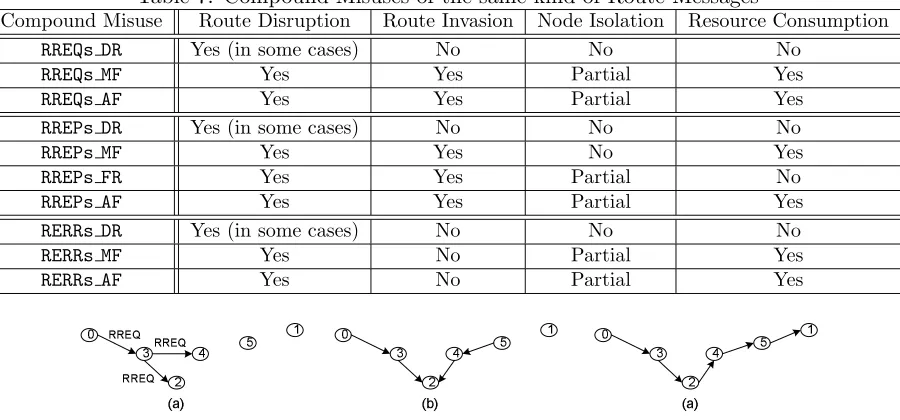
Table 1 summarizes the atomic misuses of a RREQ message. The atomic misuse action Forge
Reply is not applicable to RREQ messages, since RREQ messages are not used to reply to any
Table 1: Atomic Misuses of A RREQ Message and Achievable Misuse Goals.
Atomic Misuse Route Disruption Route Invasion Node Isolation Resource Consumption
RREQ DR Yes (in some cases) No No No
RREQ MF Yes Yes Partial2 No
RREQ AF Yes Yes Partial No
Atomic misuse RREQ DR refers to simply dropping the received RREQ message. If an attacker applies such attacks to all the RREQ messages it receives, this kind of misuses is equivalent to not having the attacking node in the network. An inside attacker may also selectively drop RREQ messages. Attackers that launch such misuses are in nature similar to the selfish nodes mentioned in [5].
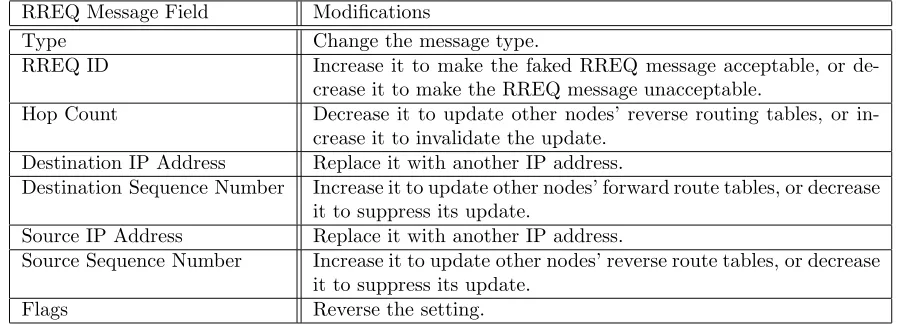
Atomic misuseRREQ MFrefers to the atomic misuses with which an inside attacker modifies one or several fields in a RREQ message that it just receives, and then broadcasts the modified RREQ message. Table 2 lists the RREQ message fields that an attacker may modify as well as the possible modifications.
Table 2: Possible Modifications of Fields in A RREQ Message.
RREQ Message Field Modifications
Type Change the message type.
RREQ ID Increase it to make the faked RREQ message acceptable, or de-crease it to make the RREQ message unacceptable.
Hop Count Decrease it to update other nodes’ reverse routing tables, or in-crease it to invalidate the update.
Destination IP Address Replace it with another IP address.
Destination Sequence Number Increase it to update other nodes’ forward route tables, or decrease it to suppress its update.
Source IP Address Replace it with another IP address.
Source Sequence Number Increase it to update other nodes’ reverse route tables, or decrease it to suppress its update.
Flags Reverse the setting.
Several fields have immediate security implications when modified. RREQ ID along with the source IP address uniquely identifies a RREQ message; they indicate the freshness of a RREQ message. Since a node only accepts the first copy of a RREQ message, an increased RREQ ID along with the source IP address can guarantee that the faked RREQ message is accepted by other nodes.
To ensure loop freedom in AODV, after receiving a RREQ message, a node updates its reverse routing table only if the source sequence number field in the RREQ message is greater than that in its routing table, or the source sequence numbers are equal, but the hop count field in the RREQ message is smaller than that in the routing table. An inside attacker may also change these fields to affect other nodes’ routing table.
When a node updates its routing table, the next hop in the route entry is assigned as the node from which it receives the RREQ message. An inside attacker may manipulate the source IP address in the IP header to change the reverse route.
Both RREQ DR and RREQ MF must be triggered by an incoming RREQ message. In contrast,
an inside attacker may perform a RREQ AF misuse to forge a RREQ message without receiving a RREQ message. An inside attacker may need to collect some necessary information to forge RREQ messages (e.g., by listening to the traffic). Theoretically, the attacker may forge any field in a RREQ message, generating the effects we just discussed.
Now let us look at an atomic misuse of a RREQ message, RREQ MF NI, with which an inside attacker prevents a victim node from receiving data packets from other nodes for a short period of time. The attacker may make the following modifications after it receives a RREQ message from the victim node: (1) Increase the RREQ ID by a small number; (2) Replace the destination IP address with a non-existent IP address; (3) Increase the source sequence number by at least one; (4) Set the source IP address in IP header to a non-existent IP address. The attacker then broadcasts the forged message. When the neighbors of the attacker receive the faked RREQ message, they will update the next hop to the source node to the non-existent node, since the faked RREQ message has a greater source sequence number. Due to the non-existent destination IP address, the faked message can be broadcasted to the farthest nodes in the ad-hoc network. When other nodes want to send data packets to the source node, they will use the routes established by the faked RREQ message, and the data packets will be dropped due to the non-existent node.
This atomic misuse can prevent a victim node from receiving data packets for a short period of time; however, it cannot fully isolate the victim node, due to the local repair mechanism in the AODV protocol [6]. The other nodes will initiate another round of route discovery if they note that the data packets cannot be delivered successfully. In addition, the victim node may still be able to send data packets to other nodes.
Several of the atomic misuses of RREQ messages use RREQ messages to add entries the routing table of other nodes. These entries are different from those established through normal exchange of RREQ and RREP messages. In particular, the lifetime of these entries is set to a default value (e.g., 3 seconds as in our experiments). Thus, to make such entries effective, an attacker needs to launch the atomic misuses periodically.
4.2 Atomic Misuses of RREP Messages
Table 3 summarizes the atomic misuses of a RREP message and whether they can achieve the misuse goals. The premise of atomic misuses of RREP messages is that the inside attacker must
Table 3: Atomic Misuses of A RREP Message and Achievable Misuse Goals.
Atomic Misuse Route Disruption Route Invasion Node Isolation Resource Consumption
RREP DR Yes (in some cases) No No No
RREP MF Yes Yes No No
RREP FR Yes Yes No No
RREP AF Yes Yes No Yes
already be in a reverse route involving a victim node, so that it can receive a RREQ or RREP message, or send a forged RREP through some other nodes. Due to this restriction, most of the atomic misuses of RREP messages, includingRREP DR RREP MF, have limited impact.
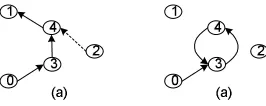
Figure 1: An Attacker Invades A Route by Sending A Faked RREP Actively.
attacker forges a RREP message in response to a RREQ message. For example, after receiving a RREQ message, an inside attacker may forge a RREP message as if it had a fresh enough route to the destination node. In order to suppress other legitimate RREP messages that the source node may receive from other nodes, the attacker may forge a faked RREP message by increasing the destination sequence number. An attacker may disrupt the route between the victim node to a given destination, or invade in the route between by suppressing other alternative routes.
An interesting atomic misuse is RREP AF RI. If an inside attacker has routes to both the source
and the destination nodes of an existing route (as shown in Figure 1(a)), it can invade the route by sending a faked RREP message to the source node. In Figure 1, assume node A is the attacking node, which already has a route to nodes 0 and 3, respectively. Node A can forge a RREP message as follows: (1) Set the source IP to node 0; (2) Set the destination IP to node 3; (3) Set the destination sequence number to node 3’s sequence number plus at least one; (4) Set the source IP in the IP header to node 2; (5) Set the destination IP in the IP header to node 1. Node A then sends the faked RREP message to node 1, which forwards the faked RREP message to node 0 (Figure 1(b)). When nodes 0 and 1 receive the faked RREP message, they will update the sequence number of node 3 in their routing tables to the destination sequence number in the faked RREP message. Node 0 will still use node 1 as the next hop to node 3, but node 1 will update node A as the next hop to node 3. Note that node A already has a route to node 3. As a result, node A successfully becomes a part of the route from node 0 to node 3 (Figure 1(c)).
4.3 Atomic Misuses of RERR Messages
Table 4 summarizes the three types of atomic misuses of RERR messages and the misuse goals that they can achieve. The misuse action Forge Reply is not applicable to RERR messages, since RERR messages are not used to reply to any routing messages.
Table 4: Atomic Misuses of A RERR Message and Achievable Misuse Goals.
Atomic Misuse Route Disruption Route Invasion Node Isolation Resource Consumption
RERR DR Yes (in some case) No No No
RERR MF Yes No Partial Yes
RERR AF Yes No Partial Yes
RERR DRhas limited impact on the network except for causing delays in the identification of route
errors, since the upstream nodes will eventually discover the problematic routes and establish new routes.
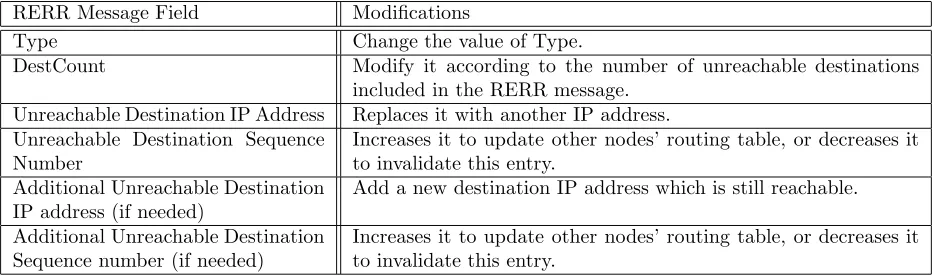
that the attacker may manipulate. Sometimes, the attacker may modify the IP addresses in the IP header as well.
Table 5: Possible Modifications of Fields in A RERR message.
RERR Message Field Modifications
Type Change the value of Type.
DestCount Modify it according to the number of unreachable destinations included in the RERR message.
Unreachable Destination IP Address Replaces it with another IP address. Unreachable Destination Sequence
Number
Increases it to update other nodes’ routing table, or decreases it to invalidate this entry.
Additional Unreachable Destination IP address (if needed)
Add a new destination IP address which is still reachable. Additional Unreachable Destination
Sequence number (if needed)
Increases it to update other nodes’ routing table, or decreases it to invalidate this entry.
5
Compound Misuses
One or several inside attackers may combine atomic misuses, and possibly normal uses of routing messages, in any order to launch compound misuses. For example, an attacker may repeatedly launch the same type of atomic misuses to make the impact persistent. As another example, an attacker may launch some early atomic or compound misuses to prepare for some later ones. A crucial issue here is to understand the compound misuses that can be used as “building blocks” of more complex attacks. Once we understand “building blocks,” we may analyze the complex atomic scenarios through automatic vulnerability analysis tools such as the attack groups [8].
For convenience, we extend the naming scheme for atomic misuses to denote compound misuses of the same type of atomic misuses. Specifically, we put an “s” after the type of routing message that is being misused in the corresponding atomic misuse. For example, RREQs AF represent that
an attacker actively forges multiple RREQ messages.
In our analysis, we observe that most of atomic misuses targeted at disrupting services can only generate temporary impact due to the local repair mechanism that is commonly seen in mobile ad hoc routing protocols. Thus, to make the impact of these misuses persistent, an attacker needs to repeat the atomic misuses regularly. We do not discuss such misuses in detail; however, our experimental results will show that an attacker can indeed achieve its goals through such compound misuses.
Another class of compound misuses is more interesting than simply repeating the same type of atomic misuses. We discovered that an attacker may achieve some misuse goals through well planned combination of atomic misuses. Let’s see an example as follows.
Figure 2: Route Invasion by Two Faked RREQ Messages.
To further establish the route from node A to node 5, the attacker may generate the second RREQ message as follows: (1) Set the source IP address as node A; (2) Set the destination IP address as node 5; (3) Set the destination sequence number to a number greater than node 5’s current sequence number; (4) Set the source IP address in the IP header as node A. Node A can then broadcast this RREQ message. This message will help node A establish a route to node 5, as in Figure 2(c).
As discussed earlier, one or several inside attackers may compose attacks by arbitrarily combin-ing atomic and/or compound misuses. In particular, the attackers may use different misuses to complement each other. For example,RREQs AFis effective in preventing a victim node from receiv-ing messages from other nodes, and RREP AF is effective in preventing other nodes from receiving from the victim node. By combining them together, the attacker(s) may successfully isolate a node. In addition, one or several inside attackers may use some misuses or normal routing messages to prepare for later misuses. For example, all RREP related misuses require a route involving both the attacker and the victim node. To prepare for such misuses, an attacker may use a normal RREQ message or an atomic misuse (e.g.,RREQ AF) to establish the required route. These misuses are interesting; however, we do not consider them in this paper. Indeed, manually analyzing such attacks is not the best option due to the potentially large search space for possible complex attack scenarios. A better solution is to model the individual misuses and then construct attack strategies through automatic tools. Our work in this paper provides the foundation required by such tools.
6
Experimental Results
In order to validate our analysis results, we have implemented all the misuses and performed a series of experiments through simulation. The simulation is based on ns2 version 93
with the CMU Monarch extension for the AODV protocol4
. To take advantage of the existing AODV code, we implemented the atomic misuses by simply overriding the AODV agent’s receive and send functions. Compound misuses are performed by repeating/combining the atomic misuses.
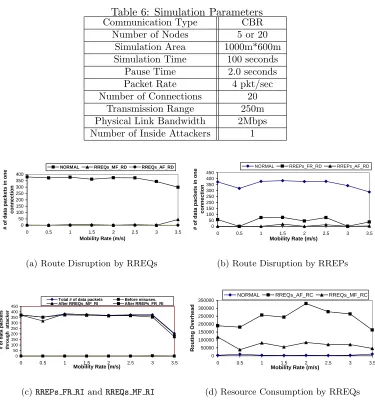
Table 6 shows the parameters used in our experiments. We used continuous bit rate (CBR) in all our experiments. In each simulation scenario, there are 5 mobile nodes if it is for atomic misuses, and 20 nodes if it is for compound misuses. In all the experiments, there is only one inside attacker in the ad hoc network. The field configuration is 1000 m × 600 m. The simulation runs for 100
simulated seconds. After arriving at a location, a node stays there for 2.0 seconds before moving to the next location. A source node sends 4 data packets per simulated seconds. There are at most 20 connections during each simulation run. In a node’s transmission range (250m), other nodes can receive signals from this node directly. The physical link bandwidth is 2 Mbps.
We have verified all the atomic misuses through analyzing the trace files generated by the
sim-3
http://www.isi.edu/nsnam/ns/.
4
Table 6: Simulation Parameters
Communication Type CBR
Number of Nodes 5 or 20 Simulation Area 1000m*600m Simulation Time 100 seconds
Pause Time 2.0 seconds Packet Rate 4 pkt/sec Number of Connections 20
Transmission Range 250m Physical Link Bandwidth 2Mbps Number of Inside Attackers 1
0 50 100 150 200 250 300 350 400
0 0.5 1 1.5 2 2.5 3 3.5
Mobility Rate (m/s)
# o f d a ta p a c k e ts i n o n e c o n n e c ti o n
NORMAL RREQs_MF_RD RREQs_AF_RD
(a) Route Disruption by RREQs
0 50 100 150 200 250 300 350 400 450
0 0.5 1 1.5 2 2.5 3 3.5 Mobility Rate (m/s)
# o f d a ta p a c k e ts i n o n e c o n n e c ti o n
NORMAL RREPs_FR_RD RREPs_AF_RD
(b) Route Disruption by RREPs
0 50 100 150 200 250 300 350 400 450
0 0.5 1 1.5 2 2.5 3 3.5
Mobility Rate (m/s)
# o f d a ta p a c k e ts th ro u g h a tt a c k e r
Total # of data packets Before misuses.
After RREQs_MF_RI After RREPs_FR_RI
(c)RREPs FR RIandRREQs MF RI
0 50000 100000 150000 200000 250000 300000 350000
0 0.5 1 1.5 2 2.5 3 3.5 Mobility Rate (m/s)
R o u ti n g O v e rh e a d
NORMAL RREQs_AF_RC RREQs_MF_RC
(d) Resource Consumption by RREQs
Figure 3: Experimental Results about Compound Misuses
ulations. We found that all the atomic misuses intended for Route Disruption and Node Isolation
succeeded; however, the effect can last for a short period of time due to the local repair mechanism in the AODV protocol. This is due to two reasons. First, the impact caused by such atomic misuses are detectable by the normal nodes, which then attempt to recover from the failures by establishing new routes. Second, all the atomic misuses are performed with a single routing message. They do not have further impact once the affected nodes perform local repair successfully.
In contrast, the atomic misuses intended for Route Invasion are much more subtle. Unless the routes established via atomic misuses are disrupted, the victim nodes will continue to use the routes involving the inside attacker to transmit data packets. Details of the experiments about atomic misuses can be found in the appendix.
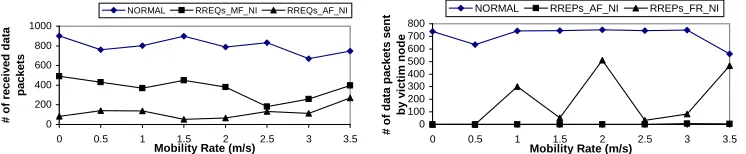
Figure 3 shows the experimental results for compound misuses for Route Disruption, Route
Invasion, andResource Consumption. Figure 3(a) displays the numbers of data packets transmitted
between two victim nodes when using compound misuses of RREQ messages. It clearly shows that
whenRREQs MF RDand RREQs AF RDare used against these two nodes, the number of data packets
drops almost to zero. Figure 3(b) shows the same measure when compound misuses of RREP messages are used. The number of data packets transmitted between the two victim nodes is slightly better than in Figure 3(a); however, it is still much lower than the number of packets transmitted in normal situations. Figure 3(c) shows the number of data packets transmitted through an inside attacker with or without Route Invasion misuses. It is easy to see that the misuses effectively make the attacker a part of the route between the two victim nodes. Finally, Figure 3(d) shows that the routing overhead withRREQs MF RCis higher than the overhead in normal situations, and
RREQs AF RCmisuse is much higher than the RREQs MF RC.
7
Related Work
Research in MANET has been rather active. Several routing protocols have been proposed to discover and maintain routes in MANET environments, including secure routing protocols. Early proposals for secure ad hoc routing (e.g., [9], [1], [10], and [11]) use public key cryptography to protect ad hoc routing messages. However, due to the heavy computation involved in public key cryptography, these proposals are too expensive for nodes in mobile ad hoc networks, which are usually powered by batteries.
Recent results usually use symmetric cryptography to authenticate the routing messages. Pa-padimitratos and Haas proposed to authenticate the route discovery process with a secret key shared between the source and the destination nodes [12]. Basagni et al. use a network-wide secret key to secure the routing messages [13]. Yi et al. modified AODV to include security metrics for route discovery, using different trust levels with a shared symmetric key for each level [1]. Hu, Perrig, and Johnson have proposed a sequence of secure mobile ad hoc routing protocols, including Ariadne [2] and SEAD [3], as well as security mechanisms for routing protocols [14]. Their techniques include authenticating routing messages through a one-way key chain with delayed disclosures of keys, and authentication code with secret keys shared by mobile nodes.
Intrusion detection can provide another layer of protection to mobile ad hoc networks. Zhang and Lee proposed a distributed and cooperative IDS architecture in mobile ad-hoc networks [15]. They use data on the node’s physical movements and the corresponding change in its routing table as the trace data to build the anomaly detection model. In Marti et al.’s proposal [5], each node uses a component calledwatchdog to detect misbehaving nodes, and another component calledpathrater
to choose a reliable route based on the information collected by the watchdog. In Buchegger and Boudec’s proposal [4], each node not only monitors the bad behaviors of neighbors, but collects the list of malicious nodes from warnings sent from other trusted nodes.
8
Conclusions
The results in this paper represent our initial attempt in understanding insider attacks against mobile ad hoc routing protocols. As a part of our future work, we plan to investigate insider attacks against secure mobile ad hoc routing protocols such as Ariadne [2].
References
[1] S. Yi, P. Naldurg, and R. Kravets, “Security-aware routing protocol for wireless ad hoc net-works,” inProc. of ACM MobiHoc 2001, Oct 2001.
[2] Y. Hu, A. Perrig, and D. B. Johnson, “Ariadne: A secure on-demand routing protocol for ad hoc networks,” inProc. of (MobiCom 2002), Sept. 2002.
[3] Y.-C. Hu, D. B. Johnson, and A. Perrig, “SEAD: Secure efficient distance vector routing for mobile wireless ad hoc networks,” in 4th IEEE Workshop on Mobile Computing Systems and
Applications, June 2002.
[4] S. Buchegger and J. L. Boudec, “Performance analysis of the CONFIDANT protocol (coop-eration of nodes: Fairness in dynamic ad-hoc networks),” in Proc. of ACM MobiHoc 2002, pp. 226–236, June 2002.
[5] S. Marti, T. J. Giuli, K. Lai, and M. Baker, “Mitigating routing misbehavior in mobile ad hoc networks,” inProc. MobiCom 2000, pp. 255–265, 2000.
[6] C. Perkins, E. Belding-Royer, and S. Das. Internet Draft, June 2002. draft-ietf-manet-aodv-11.txt.
[7] P. Ning and K. Sun, “How to misuse AODV: A case study of insider attacks against mobile ad-hoc routing protocols,” Tech. Rep. TR-2003-07, CS Department, NC State University, 2003.
[8] O. Sheyner, J. Haines, S. Jha, R. Lippmann, and J. Wing, “Automated generation and analysis of attack graphs,” inProc. of IEEE Symposium on Security and Privacy, May 2002.
[9] L. Zhou and Z. J. Haas, “Securing ad hoc networks,”IEEE Network, vol. 13, no. 6, pp. 24–30, 1999.
[10] J. Hubaux, L. Buttyan, and S. Capkun, “The quest for security in mobile ad hoc networks,”
inProc. ACM MobiHoc 2001, 2001.
[11] K.Sanzgiri, B.Dahill, B.N.Levine, C.Shields, and E.M.Belding-Royer, “A secure routing pro-tocol for ad hoc networks,” in Proc. of the Tenth IEEE Int’l Conf. on Network Protocols, 2002.
[12] P. Papadimitratos and Z. J. Haas, “Secure routing for mobile ad hoc networks,” inProc. of the
SCS Communication Networks and Distributed Systems Modeling and Simulation Conference,
pp. 27 – 31, Jan 2002.
[13] S. Basagni, K. Herrin, D. Bruschi, and E. Rosti, “Secure pebblenets,” inProc. of ACM
Mobi-Hoc 2001, pp. 156–163, 2001.
[14] Y. Hu, A. Perrig, and D. V. Johnson, “Efficient security mechanisms for routing protocols,”
[15] Y. Zhang and W. Lee, “Intrusion detection in wireless ad hoc networks,” in Proc. of ACM
MobiCom 2000), pp. 275–283, 2000.
A
Description of Atomic Misuses and the Simulation Results
This appendix provides descriptions of the atomic misuses and the simulation results about these atomic misuses. In all the simulations, there are 5 nodes in the network, and node 2 is the malicious node launching the misuses.
A.1 Atomic Misuses of RREQ Messages
A.1.1 Atomic Misuses RREQ DR
Atomic misusesRREQ DRrefer to simply dropping the received RREQ message. If an attacker applies such attacks to all the RREQ messages it receives, this kind of misuses is equivalent to not having the attacking node in the network. An inside attacker may also selectively drop RREQ messages. Such misuses are in nature similar to selfish nodes mentioned in [5]. If the attacking node is the only node between two parts of an ad-hoc network, it may selectively separate the nodes in these two parts, and partially achieve the goal of route disruption. RREQ DR cannot achieve the other three misuse goals. Due to the simplicity ofRREQ DR misuses, we do not include the experimental results here.
A.1.2 Atomic Misuses RREQ MF
RREQ MF RD: If an attacking node is the only node connecting two parts of an ad-hoc network,
the attacker can prevent a new route from being established by utilizing one of the following modifications on a RREQ message it receives:
• Change the Type field;
• Replace the destination IP address with another IP address;
• Replace the source IP address with another IP address;
• Replace the source IP address in IP header with another IP address.
Even if there exists other routes between two given nodes, the attacker still has a chance to disrupt the new route from being established. Suppose node S broadcasts a RREQ message to establish a route to node D. After receiving the RREQ message, the attacker modifies the following fields of the RREQ message:
1. Replace the RREQ ID of node S with the RREQ ID of node D, and increases it by a small number;
2. Interchange the source IP address5
(node S) with the destination IP address (node D) in the RREQ message;
5
3. Increment the destination sequence number by at least one, and then interchanges the source sequence number with the destination sequence number;
4. Fill source IP address in IP header with a non-existent IP address.
By doing these modifications, the attacker pretends to forward a RREQ message initiated from node D to node S, whereas the original RREQ message is initiated from node S to node D. Neighbors of the attacker accept the faked RREQ message since they have not received a RREQ message with such a RREQ ID from node D before. Because the faked RREQ message has a greater source sequence number, these neighbors updates their next hop to the node D as the non-existent node, which is indicated by the source IP address in the IP header. These neighbors rebroadcast the faked RREQ message to their neighbors. When node D receives the faked RREQ message, it just drops the message since it notices that this message is originated from itself. When node S receives the faked RREQ message, it updates its reverse route table since the source sequence number (of node D) in the faked RREQ message is greater than that in its route table. Node S then updates the next hop to node D as the neighbor from which it receives the faked RREQ message, and unicasts a RREP message to this neighbor. When the RREP message is unicasted along the reverse route, it is lost due to the non-existent node in the reverse route.
Due to the broadcast of the legitimate RREQ message, node S may receive normal RREP messages, but the route established by the faked RREQ message suppresses the routes established by RREP messages since node D’s sequence number in the faked RREQ message is greater than those in the RREP messages. After that, node S begins to send data packets along the route established by the faked RREQ message, but all data packets are dropped when they reach the non-existent node. When the upstream neighbor of the attacker discovers the link failure, it either sends a RERR message back to node S, or starts ”local repair,” which broadcasts a RREQ message to discover a route from itself to the destination node if the destination is no farther than maximum repair hops away.
Note that the reverse route table (established by RREQ messages) and the forward route (es-tablished by RREP messages) are in indeed one route table. The route entries added by RREQ messages can be updated by RREP message, and vice versa.
In the simulation, node 0 is the source node, and node 1 is the destination node. Malicious node 2 sends a faked RREQ message to disrupt the route from node 0 to node 1. From the trace file, we can see clearly that the route is disrupted when node 3 attempts to forward data packets to node 88, which is a non-existent node. The fragment of the trace file is as follows:
...
s 0.200000000 0 RTR — 0 AODV 48 [0 0 0 0] ——- [0:255 -1:255 30 0] [0x2 1 1 [1 0] [0 4]] (REQUEST) r 0.200900287 3 RTR — 0 AODV 48 [0 ffffffff 0 800] ——- [0:255 -1:255 30 0] [0x2 1 1 [1 0] [0 4]] (REQUEST) s 0.201042333 3 RTR — 0 AODV 48 [0 ffffffff 0 800] ——- [3:255 -1:255 29 0] [0x2 2 1 [1 0] [0 4]] (REQUEST) r 0.201942620 0 RTR — 0 AODV 48 [0 ffffffff 3 800] ——- [3:255 -1:255 29 0] [0x2 2 1 [1 0] [0 4]] (REQUEST) s 0.201942934 2 RTR — 0 AODV 48 [0 ffffffff 3 800] ——- [88:255 -1:255 28 0] [0x2 3 101 [0 12] [1 10]] (REQUEST) r 0.201943000 4 RTR — 0 AODV 48 [0 ffffffff 3 800] ——- [3:255 -1:255 29 0] [0x2 2 1 [1 0] [0 4]] (REQUEST) r 0.202843535 4 RTR — 0 AODV 48 [0 ffffffff 2 800] ——- [88:255 -1:255 28 0] [0x2 3 101 [0 12] [1 10]] (REQUEST) r 0.202843535 3 RTR — 0 AODV 48 [0 ffffffff 2 800] ——- [88:255 -1:255 28 0] [0x2 3 101 [0 12] [1 10]] (REQUEST) ...
f 0.780535995 3 RTR — 3 cbr 68 [13a 3 0 800] ——- [0:0 1:0 29 88] [3] 1 0 D 0.780535995 3 RTR CBK 2 cbr 68 [13a 3 3 800] ——- [0:0 1:0 29 88] [2] 1 0 D 0.780535995 3 RTR CBK 3 cbr 68 [13a 3 3 800] ——- [0:0 1:0 29 88] [3] 1 0
s 0.780535995 3 RTR — 0 AODV 32 [0 0 0 0] ——- [3:255 -1:255 1 0] [0x8 1 [1 0] 0.000000] (ERROR) r 0.781932282 0 RTR — 0 AODV 32 [0 ffffffff 3 800] ——- [3:255 -1:255 1 0] [0x8 1 [1 0] 0.000000] (ERROR) r 0.781932596 2 RTR — 0 AODV 32 [0 ffffffff 3 800] ——- [3:255 -1:255 1 0] [0x8 1 [1 0] 0.000000] (ERROR) r 0.781932662 4 RTR — 0 AODV 32 [0 ffffffff 3 800] ——- [3:255 -1:255 1 0] [0x8 1 [1 0] 0.000000] (ERROR) ...
RREQ MF RI: Let’s first consider a scenario in which an inside attacker is in the transmission
range of a source node that initiates a RREQ message. After receiving the RREQ message from the source node, the attacker may modify the RREQ message as follows:
1. Increase the source node’s RREQ ID by at least one;
2. Increase the source sequence number by at least one;
3. Increase the destination sequence number by at least one.
After generating this faked RREQ message, the attacker broadcasts it to its neighbors. The neighbors of the attacker accept the faked RREQ message due to the new pair of the RREQ ID and the source IP address. They then update their next hop to the source node as the attacking node, because the faked RREQ message has a greater source sequence number than those in their route tables. They also rebroadcast the faked RREQ message to their neighbors. When the source node receives the faked RREQ message, it drops the message, since this message appears to originate from itself. When the destination node receives the faked RREQ message, it updates its next hop to the source node as the neighbor from which it receives the faked RREQ message, and then updates its own sequence number to the maximum of its current sequence number and the destination sequence number in the RREQ message. After that, it fills the updated sequence number into the destination sequence number in the RREP message. The destination node then unicasts the RREP message to the source node along the reverse route, which includes the attacker. Because this RREP message contains a greater destination sequence number than that in the source node’s route table which may have been updated by other legitimated RREP messages, the source node updates the destination sequence number to that in the RREP message, and sets the attacker as the next hop to the destination node. Now the attacker succeeds in invading the route from the source node to the destination node.
When the attacker is not in the transmission range of a source node, i.e., there exists at least one intermediate node between the attacker and the source node, the attacker cannot invade the route by modifying a RREQ message in the above way. When the attacker broadcasts the faked RREQ message, all the neighbors will accept it and update the attacker as the next hop to the source node. When the attacker forwards the RREP message to a neighbor along the reverse route, this neighbor will just send the RREP message back to the attacker. As a result, there will be a loop involving the attacker and one of its neighbors. However, the attacker still can invade the route by sending two faked RREQ messages, which is a compound misuse by RREQs MF RI.
In the simulation, node 0 is the source node, and node 1 is the destination node. In normal situations, the route is 0⇒ 3⇒ 1; with atomic misuse RREQ MF RI, the route is 0 ⇒ 3⇒ 2 ⇒1.
The fragment of the trace file is as follows:
...
r 5.668618722 0 RTR — 0 cbr 48 [0 0 0 0] ——- [0:0 1:0 32 0] [0] 0 0
s 5.668618722 0 RTR — 0 AODV 48 [0 0 0 0] ——- [0:255 -1:255 30 0] [0x2 1 1 [1 0] [0 4]] (REQUEST) r 5.669519249 2 RTR — 0 AODV 48 [0 ffffffff 0 800] ——- [0:255 -1:255 30 0] [0x2 1 1 [1 0] [0 4]] (REQUEST) s 5.670400475 2 RTR — 0 AODV 48 [0 ffffffff 0 800] ——- [2:255 -1:255 29 0] [0x2 2 3 [1 5] [0 9]] (REQUEST) r 5.678305682 3 RTR — 0 AODV 48 [0 ffffffff 2 800] ——- [2:255 -1:255 29 0] [0x2 2 3 [1 5] [0 9]] (REQUEST) r 5.678306029 1 RTR — 0 AODV 48 [0 ffffffff 2 800] ——- [2:255 -1:255 29 0] [0x2 2 3 [1 5] [0 9]] (REQUEST) s 5.678306029 1 RTR — 0 AODV 44 [0 0 0 0] ——- [1:255 0:255 30 2] [0x4 1 [1 6] 10.000000] (REPLY) r 5.678306076 0 RTR — 0 AODV 48 [0 ffffffff 2 800] ——- [2:255 -1:255 29 0] [0x2 2 3 [1 5] [0 9]] (REQUEST) s 5.679947136 3 RTR — 0 AODV 48 [0 ffffffff 2 800] ——- [3:255 -1:255 28 0] [0x2 3 3 [1 5] [0 9]] (REQUEST) r 5.682433791 0 RTR — 0 AODV 44 [13a 0 3 800] ——- [1:255 0:255 29 0] [0x4 2 [1 2] 10.000000] (REPLY) s 5.682433791 0 RTR — 0 cbr 68 [0 0 0 0] ——- [0:0 1:0 30 3] [0] 0 0
r 5.694526421 2 RTR — 0 AODV 44 [13a 2 1 800] ——- [1:255 0:255 30 2] [0x4 1 [1 12] 10.000000] (REPLY) f 5.694526421 2 RTR — 0 AODV 44 [13a 2 1 800] ——- [1:255 0:255 29 3] [0x4 2 [1 12] 10.000000] (REPLY) r 5.696474821 3 RTR — 0 AODV 44 [13a 3 2 800] ——- [1:255 0:255 29 3] [0x4 2 [1 12] 10.000000] (REPLY) f 5.696474821 3 RTR — 0 AODV 44 [13a 3 2 800] ——- [1:255 0:255 28 2] [0x4 3 [1 12] 10.000000] (REPLY) D 5.696474821 3 IFQ ARP 0 AODV 44 [13a 3 3 800] ——- [1:255 0:255 28 2] [0x4 3 [1 6] 10.000000] (REPLY) ...
r 5.700809487 2 RTR — 0 AODV 48 [0 ffffffff 3 800] ——- [3:255 -1:255 26 0] [0x2 5 5 [1 10] [0 14]] (REQUEST) s 5.700809487 2 RTR — 0 AODV 44 [0 0 0 0] ——- [2:255 0:255 30 3] [0x4 2 [1 12] 9.000000] (REPLY)
r 5.700809778 0 RTR — 0 AODV 48 [0 ffffffff 3 800] ——- [3:255 -1:255 26 0] [0x2 5 5 [1 10] [0 14]] (REQUEST) r 5.700809920 1 RTR — 0 AODV 48 [0 ffffffff 3 800] ——- [3:255 -1:255 26 0] [0x2 5 5 [1 10] [0 14]] (REQUEST) r 5.702343754 2 RTR — 0 AODV 44 [13a 2 3 800] ——- [1:255 0:255 28 2] [0x4 3 [1 12] 10.000000] (REPLY) r 5.705962421 3 RTR — 0 AODV 44 [13a 3 2 800] ——- [2:255 0:255 30 3] [0x4 2 [1 12] 9.000000] (REPLY) s 5.793703616 0 AGT — 1 cbr 48 [0 0 0 0] ——- [0:0 1:0 32 0] [1] 0 0
r 5.793703616 0 RTR — 1 cbr 48 [0 0 0 0] ——- [0:0 1:0 32 0] [1] 0 0 s 5.793703616 0 RTR — 1 cbr 68 [0 0 0 0] ——- [0:0 1:0 30 3] [1] 0 0 r 5.795440889 3 RTR — 1 cbr 68 [13a 3 0 800] ——- [0:0 1:0 30 3] [1] 1 0 f 5.795440889 3 RTR — 1 cbr 68 [13a 3 0 800] ——- [0:0 1:0 29 2] [1] 1 0 r 5.797541289 2 RTR — 1 cbr 68 [13a 2 3 800] ——- [0:0 1:0 29 2] [1] 2 0 f 5.797541289 2 RTR — 1 cbr 68 [13a 2 3 800] ——- [0:0 1:0 28 1] [1] 2 0 r 5.799762731 1 AGT — 1 cbr 68 [13a 1 2 800] ——- [0:0 1:0 28 1] [1] 3 0 ...
RREQ MF NI: In general, an inside attacker cannot completely isolate a node by modifying one
RREQ message, but it can prevent the source node from receiving data packets from other nodes for a short period of time. After receiving a RREQ message from the source node, the attacker applies the following modifications:
1. Increase the RREQ ID by a small number;
2. Replace the destination IP address with a non-existent IP address;
3. Increase the source sequence number by at least one;
4. Set the source IP address in IP header to a non-existent IP address.
Because the faked RREQ message has a non-existent destination IP address, it can be broadcasted to the farthest nodes in the ad-hoc network, and no RREP message is generated. When other nodes want to send data packets to the source node, they just use the routes established by the faked RREQ message. The data packets are dropped due to the non-existent node in the routes. The attacker may isolate a victim node from receiving from other nodes for a short period of time until new routes are estalished. Alternatively, the attacker can set its own IP address as the source IP address in the IP header, so it can receive and drop the data packets from other nodes to the victim node.
In the simulation, node 0 is the victim node. In normal situations, node 1 can send data packets to node 0 without sending a RREQ message, because it can use the reverse route added by the RREQ message originated from node 0. With the atomic misuse RREQs MF NI, node 1 fails when sending data packets to a non-existent node, and then generates a RERR message. At the same time, all nodes receiving the faked RREQ message cannot send data packets to node 0. The related fragment of the trace file is as follows:
...
s 5.668618722 0 AGT — 0 cbr 48 [0 0 0 0] ——- [0:0 1:0 32 0] [0] 0 0 r 5.668618722 0 RTR — 0 cbr 48 [0 0 0 0] ——- [0:0 1:0 32 0] [0] 0 0
s 5.668618722 0 RTR — 0 AODV 48 [0 0 0 0] ——- [0:255 -1:255 30 0] [0x2 1 1 [1 0] [0 4]] (REQUEST) r 5.669518888 2 RTR — 0 AODV 48 [0 ffffffff 0 800] ——- [0:255 -1:255 30 0] [0x2 1 1 [1 0] [0 4]] (REQUEST) r 5.669519456 3 RTR — 0 AODV 48 [0 ffffffff 0 800] ——- [0:255 -1:255 30 0] [0x2 1 1 [1 0] [0 4]] (REQUEST) r 5.669519512 1 RTR — 0 AODV 48 [0 ffffffff 0 800] ——- [0:255 -1:255 30 0] [0x2 1 1 [1 0] [0 4]] (REQUEST) s 5.669519512 1 RTR — 0 AODV 44 [0 0 0 0] ——- [1:255 0:255 30 0] [0x4 1 [1 2] 10.000000] (REPLY) f 5.669660935 2 RTR — 0 AODV 48 [0 ffffffff 0 800] ——- [88:255 -1:255 29 0] [0x2 2 2 [1 0] [0 6]] (REQUEST) s 5.670400683 3 RTR — 0 AODV 48 [0 ffffffff 0 800] ——- [3:255 -1:255 29 0] [0x2 2 1 [1 0] [0 4]] (REQUEST) r 5.673439043 0 RTR — 0 AODV 44 [13a 0 1 800] ——- [1:255 0:255 30 0] [0x4 1 [1 2] 10.000000] (REPLY) s 5.673439043 0 RTR — 0 cbr 68 [0 0 0 0] ——- [0:0 1:0 30 1] [0] 0 0
r 5.674763944 1 RTR — 0 AODV 48 [0 ffffffff 3 800] ——- [3:255 -1:255 29 0] [0x2 2 1 [1 0] [0 4]] (REQUEST) r 5.674764345 2 RTR — 0 AODV 48 [0 ffffffff 3 800] ——- [3:255 -1:255 29 0] [0x2 2 1 [1 0] [0 4]] (REQUEST) r 5.674764512 0 RTR — 0 AODV 48 [0 ffffffff 3 800] ——- [3:255 -1:255 29 0] [0x2 2 1 [1 0] [0 4]] (REQUEST) r 5.676492882 1 AGT — 0 cbr 68 [13a 1 0 800] ——- [0:0 1:0 30 1] [0] 1 0
r 5.677757675 0 RTR — 0 AODV 48 [0 ffffffff 2 800] ——- [88:255 -1:255 29 0] [0x2 2 2 [1 0] [0 6]] (REQUEST) r 5.677758076 3 RTR — 0 AODV 48 [0 ffffffff 2 800] ——- [88:255 -1:255 29 0] [0x2 2 2 [1 0] [0 6]] (REQUEST) r 5.677758135 1 RTR — 0 AODV 48 [0 ffffffff 2 800] ——- [88:255 -1:255 29 0] [0x2 2 2 [1 0] [0 6]] (REQUEST) s 5.677758135 1 RTR — 0 AODV 44 [0 0 0 0] ——- [1:255 0:255 30 88] [0x4 1 [1 2] 10.000000] (REPLY) ...
s 6.068618722 1 RTR — 3 cbr 68 [0 0 0 0] ——- [1:1 0:1 30 88] [0] 0 0
D 6.068618722 1 IFQ ARP 0 AODV 44 [0 0 1 800] ——- [1:255 0:255 30 88] [0x4 1 [1 2] 10.000000] (REPLY) D 6.068618722 1 RTR CBK 3 cbr 68 [0 0 1 800] ——- [1:1 0:1 30 88] [0] 0 0
s 6.068618722 1 RTR — 0 AODV 32 [0 0 0 0] ——- [1:255 -1:255 1 0] [0x8 1 [0 0] 0.000000] (ERROR) r 6.069390888 3 RTR — 0 AODV 32 [0 ffffffff 1 800] ——- [1:255 -1:255 1 0] [0x8 1 [0 0] 0.000000] (ERROR) r 6.069391348 2 RTR — 0 AODV 32 [0 ffffffff 1 800] ——- [1:255 -1:255 1 0] [0x8 1 [0 0] 0.000000] (ERROR) r 6.069391512 0 RTR — 0 AODV 32 [0 ffffffff 1 800] ——- [1:255 -1:255 1 0] [0x8 1 [0 0] 0.000000] (ERROR) ...
RREQ MF RC: It is difficult for an attacker to consume too much resource with one faked RREQ
incoming RREQ message to make it appear to be fresh (by increasing the RREQ ID) so that it will be rebroadcasted by the attacker’s neighbors. To generate real impact on the network, the attacker needs to repeatedly applyRREQ MF RC misuses, and generate a broadcast message loop in the network. We will discuss such misuses in the context of compound misuses.
A.1.3 Atomic misuses RREQ AF
RREQ AF RD: If there exists a route from a source node to a destination node, an inside attacker can
break down the route by broadcasting a faked RREQ. In the faked RREQ message, the attacker pretends to rebroadcast a RREQ message initiated from the destination node to the source node with a non-existent node as the source IP address in the IP header, just as described inRREQ MF RD. Due to the same reason described in RREQ MF RD, the source node will update its route to the
destination node through a non-existent node, so the route is broken down.
In the simulation, node 0 is the victim node, and it already has a route to node 1. After node 2 sends a faked RREQ message actively, the route from node 0 to node 1 is disrupted. The fragment of the trace file is as follows:
...
s 6.133635540 0 AGT — 2 cbr 48 [0 0 0 0] ——- [0:0 1:0 32 0] [2] 0 0 r 6.133635540 0 RTR — 2 cbr 48 [0 0 0 0] ——- [0:0 1:0 32 0] [2] 0 0 s 6.133635540 0 RTR — 2 cbr 68 [0 0 0 0] ——- [0:0 1:0 30 3] [2] 0 0 r 6.135372813 3 RTR — 2 cbr 68 [13a 3 0 800] ——- [0:0 1:0 30 3] [2] 1 0 f 6.135372813 3 RTR — 2 cbr 68 [13a 3 0 800] ——- [0:0 1:0 29 1] [2] 1 0 r 6.137574510 1 AGT — 2 cbr 68 [13a 1 3 800] ——- [0:0 1:0 29 1] [2] 2 0 s 6.460392679 0 AGT — 3 cbr 48 [0 0 0 0] ——- [0:0 1:0 32 0] [3] 0 0 r 6.460392679 0 RTR — 3 cbr 48 [0 0 0 0] ——- [0:0 1:0 32 0] [3] 0 0 s 6.460392679 0 RTR — 3 cbr 68 [0 0 0 0] ——- [0:0 1:0 30 3] [3] 0 0 r 6.462129952 3 RTR — 3 cbr 68 [13a 3 0 800] ——- [0:0 1:0 30 3] [3] 1 0 f 6.462129952 3 RTR — 3 cbr 68 [13a 3 0 800] ——- [0:0 1:0 29 1] [3] 1 0 r 6.464571649 1 AGT — 3 cbr 68 [13a 1 3 800] ——- [0:0 1:0 29 1] [3] 2 0 s 6.668618722 2 AGT — 4 cbr 48 [0 0 0 0] ——- [2:0 0:1 32 0] [0] 0 0 r 6.668618722 2 RTR — 4 cbr 48 [0 0 0 0] ——- [2:0 0:1 32 0] [0] 0 0
s 6.668618722 2 RTR — 0 AODV 48 [0 0 0 0] ——- [88:255 -1:255 0 0] [0x2 1 11 [0 4] [1 6]] (REQUEST) r 6.669518855 3 RTR — 0 AODV 48 [0 ffffffff 2 800] ——- [88:255 -1:255 0 0] [0x2 1 11 [0 4] [1 6]] (REQUEST) s 6.669518855 3 RTR — 0 AODV 44 [0 0 0 0] ——- [3:255 1:255 30 88] [0x4 2 [0 4] 9.000000] (REPLY) r 6.669519202 1 RTR — 0 AODV 48 [0 ffffffff 2 800] ——- [88:255 -1:255 0 0] [0x2 1 11 [0 4] [1 6]] (REQUEST) r 6.669519249 0 RTR — 0 AODV 48 [0 ffffffff 2 800] ——- [88:255 -1:255 0 0] [0x2 1 11 [0 4] [1 6]] (REQUEST) s 6.669519249 0 RTR — 0 AODV 44 [0 0 0 0] ——- [0:255 1:255 30 88] [0x4 1 [0 6] 10.000000] (REPLY) s 6.715054878 0 AGT — 5 cbr 48 [0 0 0 0] ——- [0:0 1:0 32 0] [4] 0 0
r 6.715054878 0 RTR — 5 cbr 48 [0 0 0 0] ——- [0:0 1:0 32 0] [4] 0 0 s 6.715054878 0 RTR — 5 cbr 68 [0 0 0 0] ——- [0:0 1:0 30 88] [4] 0 0
D 6.715054878 0 IFQ ARP 0 AODV 44 [0 0 0 800] ——- [0:255 1:255 30 88] [0x4 1 [0 6] 10.000000] (REPLY) ...
RREQ AF RI: An attacker can invade a route if the attacker is in the transmission range of the source node of the route. The attacker pretends to forwards a RREQ message initiated from the source node to the destination node as described inRREQ MF RI. Due to the same reason described
inRREQ MF RI, after the source node receives the the RREP message forwarded by the attacker, it
updates the attacker as the next hop to the destination node. The attacker needs to have a route to forward the RREP message to the source node. As a result, the attacker succeeds in invading the route from the source node to the destination node.
In the simulation, malicious node 2 succeeds in invading the route from node 0 to node 1 after applying RREQ AF RI. The fragment of the trace file is as follows:
...
s 0.200000000 0 AGT — 0 cbr 48 [0 0 0 0] ——- [0:0 1:0 32 0] [0] 0 0 r 0.200000000 0 RTR — 0 cbr 48 [0 0 0 0] ——- [0:0 1:0 32 0] [0] 0 0
s 0.200000000 0 RTR — 0 AODV 48 [0 0 0 0] ——- [0:255 -1:255 30 0] [0x2 1 1 [1 0] [0 4]] (REQUEST) r 0.200900547 3 RTR — 0 AODV 48 [0 ffffffff 0 800] ——- [0:255 -1:255 30 0] [0x2 1 1 [1 0] [0 4]] (REQUEST) r 0.200900567 1 RTR — 0 AODV 48 [0 ffffffff 0 800] ——- [0:255 -1:255 30 0] [0x2 1 1 [1 0] [0 4]] (REQUEST) s 0.200900567 1 RTR — 0 AODV 44 [0 0 0 0] ——- [1:255 0:255 30 0] [0x4 1 [1 2] 10.000000] (REPLY) s 0.201042593 3 RTR — 0 AODV 48 [0 ffffffff 0 800] ——- [3:255 -1:255 29 0] [0x2 2 1 [1 0] [0 4]] (REQUEST) r 0.204453551 1 RTR — 0 AODV 48 [0 ffffffff 3 800] ——- [3:255 -1:255 29 0] [0x2 2 1 [1 0] [0 4]] (REQUEST) r 0.204453739 0 RTR — 0 AODV 48 [0 ffffffff 3 800] ——- [3:255 -1:255 29 0] [0x2 2 1 [1 0] [0 4]] (REQUEST) r 0.205969251 0 RTR — 0 AODV 44 [13a 0 1 800] ——- [1:255 0:255 30 0] [0x4 1 [1 2] 10.000000] (REPLY) ...
s 0.693391010 0 AGT — 3 cbr 48 [0 0 0 0] ——- [0:0 1:0 32 0] [3] 0 0 r 0.693391010 0 RTR — 3 cbr 48 [0 0 0 0] ——- [0:0 1:0 32 0] [3] 0 0 s 0.693391010 0 RTR — 3 cbr 68 [0 0 0 0] ——- [0:0 1:0 30 1] [3] 0 0 r 0.695128710 1 AGT — 3 cbr 68 [13a 1 0 800] ——- [0:0 1:0 30 1] [3] 1 0 ...
s 30.668618722 2 RTR — 0 AODV 48 [0 0 0 0] ——- [2:255 -1:255 30 0] [0x2 1 1 [1 12] [0 12]] (REQUEST) r 30.669518976 0 RTR — 0 AODV 48 [0 ffffffff 2 800] ——- [2:255 -1:255 30 0] [0x2 1 1 [1 12] [0 12]] (REQUEST) r 30.669519070 3 RTR — 0 AODV 48 [0 ffffffff 2 800] ——- [2:255 -1:255 30 0] [0x2 1 1 [1 12] [0 12]] (REQUEST) r 30.669519243 1 RTR — 0 AODV 48 [0 ffffffff 2 800] ——- [2:255 -1:255 30 0] [0x2 1 1 [1 12] [0 12]] (REQUEST) s 30.669519243 1 RTR — 0 AODV 44 [0 0 0 0] ——- [1:255 0:255 30 2] [0x4 1 [1 14] 10.000000] (REPLY)
s 30.672031970 3 RTR — 0 AODV 48 [0 ffffffff 2 800] ——- [3:255 -1:255 29 0] [0x2 2 1 [1 12] [0 12]] (REQUEST) r 30.673676896 2 RTR — 0 AODV 44 [13a 2 1 800] ——- [1:255 0:255 30 2] [0x4 1 [1 14] 10.000000] (REPLY) D 30.673676896 2 RTR NRTE 0 AODV 44 [13a 2 1 800] ——- [1:255 0:255 29 2] [0x4 1 [1 14] 10.000000] (REPLY) s 30.673676896 2 RTR — 128 cbr 68 [0 0 0 0] ——- [2:1 1:1 30 1] [0] 0 0
r 30.674981592 2 RTR — 0 AODV 48 [0 ffffffff 3 800] ——- [3:255 -1:255 29 0] [0x2 2 1 [1 12] [0 12]] (REQUEST) r 30.674981603 1 RTR — 0 AODV 48 [0 ffffffff 3 800] ——- [3:255 -1:255 29 0] [0x2 2 1 [1 12] [0 12]] (REQUEST) r 30.674981790 0 RTR — 0 AODV 48 [0 ffffffff 3 800] ——- [3:255 -1:255 29 0] [0x2 2 1 [1 12] [0 12]] (REQUEST) r 30.676749157 1 AGT — 128 cbr 68 [13a 1 2 800] ——- [2:1 1:1 30 1] [0] 1 0
s 30.768618722 2 AGT — 129 cbr 48 [0 0 0 0] ——- [2:0 0:1 32 0] [0] 0 0 r 30.768618722 2 RTR — 129 cbr 48 [0 0 0 0] ——- [2:0 0:1 32 0] [0] 0 0
s 30.768618722 2 RTR — 0 AODV 48 [0 0 0 0] ——- [2:255 -1:255 30 0] [0x2 1 2 [0 10] [1 14]] (REQUEST) r 30.769518976 0 RTR — 0 AODV 48 [0 ffffffff 2 800] ——- [2:255 -1:255 30 0] [0x2 1 2 [0 10] [1 14]] (REQUEST) s 30.769518976 0 RTR — 0 AODV 44 [0 0 0 0] ——- [0:255 1:255 30 2] [0x4 1 [0 12] 10.000000] (REPLY)
r 30.769519243 1 RTR — 0 AODV 48 [0 ffffffff 2 800] ——- [2:255 -1:255 30 0] [0x2 1 2 [0 10] [1 14]] (REQUEST) ...
s 31.198477777 0 AGT — 132 cbr 48 [0 0 0 0] ——- [0:0 1:0 32 0] [129] 0 0 r 31.198477777 0 RTR — 132 cbr 48 [0 0 0 0] ——- [0:0 1:0 32 0] [129] 0 0 s 31.198477777 0 RTR — 132 cbr 68 [0 0 0 0] ——- [0:0 1:0 30 2] [129] 0 0 r 31.200214539 2 RTR — 132 cbr 68 [13a 2 0 800] ——- [0:0 1:0 30 2] [129] 1 0 f 31.200214539 2 RTR — 132 cbr 68 [13a 2 0 800] ——- [0:0 1:0 29 1] [129] 1 0 r 31.202716104 1 AGT — 132 cbr 68 [13a 1 2 800] ——- [0:0 1:0 29 1] [129] 2 0 ...
RREQ AF NI: By broadcasting one faked RREQ message, an inside attacker can prevent any
vic-tim node from receiving data packets from other nodes for a short period of vic-time, just as described
inRREQ MF NI. But the attacker cannot completely isolate a victim node from sending data packets
to other nodes unless other misuses are also used. In the simulation, node 3 cannot send data packets to node 0 using the route established by the faked RREQ message and generates a RERR message. The fragment of trace file is as follows:
s 5.668618722 0 AGT — 0 cbr 48 [0 0 0 0] ——- [0:0 1:0 32 0] [0] 0 0 r 5.668618722 0 RTR — 0 cbr 48 [0 0 0 0] ——- [0:0 1:0 32 0] [0] 0 0
s 5.668618722 0 RTR — 0 AODV 48 [0 0 0 0] ——- [0:255 -1:255 30 0] [0x2 1 1 [1 0] [0 4]] (REQUEST) r 5.669518888 2 RTR — 0 AODV 48 [0 ffffffff 0 800] ——- [0:255 -1:255 30 0] [0x2 1 1 [1 0] [0 4]] (REQUEST) r 5.669519065 3 RTR — 0 AODV 48 [0 ffffffff 0 800] ——- [0:255 -1:255 30 0] [0x2 1 1 [1 0] [0 4]] (REQUEST) r 5.669519139 1 RTR — 0 AODV 48 [0 ffffffff 0 800] ——- [0:255 -1:255 30 0] [0x2 1 1 [1 0] [0 4]] (REQUEST) s 5.669519139 1 RTR — 0 AODV 44 [0 0 0 0] ——- [1:255 0:255 30 0] [0x4 1 [1 2] 10.000000] (REPLY) s 5.669660935 2 RTR — 0 AODV 48 [0 ffffffff 0 800] ——- [2:255 -1:255 29 0] [0x2 2 1 [1 0] [0 4]] (REQUEST) s 5.670400292 3 RTR — 0 AODV 48 [0 ffffffff 0 800] ——- [3:255 -1:255 29 0] [0x2 2 1 [1 0] [0 4]] (REQUEST) r 5.673436063 0 RTR — 0 AODV 44 [13a 0 1 800] ——- [1:255 0:255 30 0] [0x4 1 [1 2] 10.000000] (REPLY) ...
s 5.793703616 0 AGT — 1 cbr 48 [0 0 0 0] ——- [0:0 1:0 32 0] [1] 0 0 r 5.793703616 0 RTR — 1 cbr 48 [0 0 0 0] ——- [0:0 1:0 32 0] [1] 0 0 s 5.793703616 0 RTR — 1 cbr 68 [0 0 0 0] ——- [0:0 1:0 30 1] [1] 0 0 r 5.795440869 1 AGT — 1 cbr 68 [13a 1 0 800] ——- [0:0 1:0 30 1] [1] 1 0 ...
s 6.268618722 3 AGT — 4 cbr 48 [0 0 0 0] ——- [3:0 0:2 32 0] [0] 0 0 r 6.268618722 3 RTR — 4 cbr 48 [0 0 0 0] ——- [3:0 0:2 32 0] [0] 0 0 s 6.268618722 3 RTR — 4 cbr 68 [0 0 0 0] ——- [3:0 0:2 30 0] [0] 0 0 r 6.273052124 0 AGT — 4 cbr 68 [13a 0 3 800] ——- [3:0 0:2 30 0] [0] 1 0 ...
s 6.668618722 2 RTR — 0 AODV 48 [0 0 0 0] ——- [88:255 -1:255 30 0] [0x2 1 101 [66 4] [0 16]] (REQUEST) r 6.669518888 0 RTR — 0 AODV 48 [0 ffffffff 2 800] ——- [88:255 -1:255 30 0] [0x2 1 101 [66 4] [0 16]] (REQUEST) r 6.669518924 3 RTR — 0 AODV 48 [0 ffffffff 2 800] ——- [88:255 -1:255 30 0] [0x2 1 101 [66 4] [0 16]] (REQUEST) r 6.669518976 1 RTR — 0 AODV 48 [0 ffffffff 2 800] ——- [88:255 -1:255 30 0] [0x2 1 101 [66 4] [0 16]] (REQUEST) s 6.671931181 3 RTR — 0 AODV 48 [0 ffffffff 2 800] ——- [3:255 -1:255 29 0] [0x2 2 101 [66 4] [0 16]] (REQUEST) ...
...
s 7.377469954 3 AGT — 15 cbr 48 [0 0 0 0] ——- [3:0 0:2 32 0] [6] 0 0 r 7.377469954 3 RTR — 15 cbr 48 [0 0 0 0] ——- [3:0 0:2 32 0] [6] 0 0 s 7.377469954 3 RTR — 15 cbr 68 [0 0 0 0] ——- [3:0 0:2 30 88] [6] 0 0 D 7.377469954 3 RTR CBK 13 cbr 68 [0 0 3 800] ——- [3:0 0:2 30 88] [5] 0 0 D 7.377469954 3 RTR CBK 15 cbr 68 [0 0 3 800] ——- [3:0 0:2 30 88] [6] 0 0
s 7.377469954 3 RTR — 0 AODV 32 [0 0 0 0] ——- [3:255 -1:255 1 0] [0x8 1 [0 0] 0.000000] (ERROR) r 7.378242157 2 RTR — 0 AODV 32 [0 ffffffff 3 800] ——- [3:255 -1:255 1 0] [0x8 1 [0 0] 0.000000] (ERROR) r 7.378242178 1 RTR — 0 AODV 32 [0 ffffffff 3 800] ——- [3:255 -1:255 1 0] [0x8 1 [0 0] 0.000000] (ERROR) r 7.378242298 0 RTR — 0 AODV 32 [0 ffffffff 3 800] ——- [3:255 -1:255 1 0] [0x8 1 [0 0] 0.000000] (ERROR) ...
RREQ AF RC: An inside attacker can only introduce limited broadcast messages into the network
by a single RREQ AF RC.
A.2 Atomic Misuses of RREP Messages
A.2.1 Atomic Misuses RREP DR
RREP DR RD: If during a route discovery process, only one node generates a RREP message and an
attacker drops the RREP message when the only RREP message passes through the attacker, so the source node cannot receive the RREP message and the route cannot be established. The source node has to initiate another round of route discovery process. However, when the source node has multiple neighbors and not all of them are malicious, this misuse has very limited impact.
RREP DR RI: Obviously, an attacker cannot invade a route by dropping a RREP message, which
is used to establish a route.
RREP DR NI: Because a node may communicate with several nodes in an ad-hoc network, and
the RREP messages from different destination nodes may reach the source node through different neighbors, an inside attacker cannot isolate a node by dropping only one RREP message. However, if an attacker is the only neighbor of a victim node, it can partially isolate the victim node by dropping all the RREP messages sent to or from the victim node. This is essentially a compound misuse due to the multiple dropping actions.
RREP DR RC:RREP DRmisuses cannot consume noticeable resource of other nodes.
A.2.2 Atomic Misuses RREP MF
RREP MF RD: In a route discovery process, if the only RREP message passes through an inside
attacker, the attacker can prevent the route from being established by applying one of the following modifications:
• Change the value of type;
• Replace the destination IP address with another IP address;
• Replace the source IP address with another IP address;
• Decrease the TTL in IP header to 1;
• Replace the source IP address in the IP header with a non-existent IP address.
Because of the modifications of the RREP message, the source node will receive an invalid RREP message or no RREP message at all. As a result, the source node cannot establish a route to the destination node in this round of route discovery process. However, note that the victim node may receive RREP messages from other nodes. Thus, this misuse doesn’t always work.
In the simulation, node 0 is the source node, and node 1 is the destination node. Before node 2 forwards the RREP message, it modifies the source IP address in IP header to a non-existent node ( node 88). After node 0 receives the faked RREP message, it attempts to send data packets to the non-existent node, and generates a RERR message. The fragment of the trace file is as follows:
...
s 5.668618722 0 AGT — 0 cbr 48 [0 0 0 0] ——- [0:0 1:0 32 0] [0] 0 0 r 5.668618722 0 RTR — 0 cbr 48 [0 0 0 0] ——- [0:0 1:0 32 0] [0] 0 0
s 5.668618722 0 RTR — 0 AODV 48 [0 0 0 0] ——- [0:255 -1:255 30 0] [0x2 1 1 [1 0] [0 4]] (REQUEST) r 5.669518916 2 RTR — 0 AODV 48 [0 ffffffff 0 800] ——- [0:255 -1:255 30 0] [0x2 1 1 [1 0] [0 4]] (REQUEST) r 5.669519259 3 RTR — 0 AODV 48 [0 ffffffff 0 800] ——- [0:255 -1:255 30 0] [0x2 1 1 [1 0] [0 4]] (REQUEST) s 5.669660963 2 RTR — 0 AODV 48 [0 ffffffff 0 800] ——- [2:255 -1:255 29 0] [0x2 2 1 [1 0] [0 4]] (REQUEST) s 5.670400486 3 RTR — 0 AODV 48 [0 ffffffff 0 800] ——- [3:255 -1:255 29 0] [0x2 2 1 [1 0] [0 4]] (REQUEST) r 5.670561157 0 RTR — 0 AODV 48 [0 ffffffff 2 800] ——- [2:255 -1:255 29 0] [0x2 2 1 [1 0] [0 4]] (REQUEST) r 5.670561343 3 RTR — 0 AODV 48 [0 ffffffff 2 800] ——- [2:255 -1:255 29 0] [0x2 2 1 [1 0] [0 4]] (REQUEST) r 5.670561765 1 RTR — 0 AODV 48 [0 ffffffff 2 800] ——- [2:255 -1:255 29 0] [0x2 2 1 [1 0] [0 4]] (REQUEST) s 5.670561765 1 RTR — 0 AODV 44 [0 0 0 0] ——- [1:255 0:255 30 2] [0x4 1 [1 2] 10.000000] (REPLY) r 5.674626385 2 RTR — 0 AODV 44 [13a 2 1 800] ——- [1:255 0:255 30 2] [0x4 1 [1 2] 10.000000] (REPLY) f 5.674626385 2 RTR — 0 AODV 44 [13a 2 1 800] ——- [1:255 0:255 29 0] [0x4 2 [1 6] 10.000000] (REPLY) r 5.678306922 2 RTR — 0 AODV 48 [0 ffffffff 3 800] ——- [3:255 -1:255 29 0] [0x2 2 1 [1 0] [0 4]] (REQUEST) r 5.678307035 1 RTR — 0 AODV 48 [0 ffffffff 3 800] ——- [3:255 -1:255 29 0] [0x2 2 1 [1 0] [0 4]] (REQUEST) r 5.678307080 0 RTR — 0 AODV 48 [0 ffffffff 3 800] ——- [3:255 -1:255 29 0] [0x2 2 1 [1 0] [0 4]] (REQUEST) r 5.680061506 0 RTR — 0 AODV 44 [13a 0 2 800] ——- [1:255 0:255 29 0] [0x4 2 [1 6] 10.000000] (REPLY) s 5.680061506 0 RTR — 0 cbr 68 [0 0 0 0] ——- [0:0 1:0 30 88] [0] 0 0
s 5.793703616 0 AGT — 1 cbr 48 [0 0 0 0] ——- [0:0 1:0 32 0] [1] 0 0 r 5.793703616 0 RTR — 1 cbr 48 [0 0 0 0] ——- [0:0 1:0 32 0] [1] 0 0 s 5.793703616 0 RTR — 1 cbr 68 [0 0 0 0] ——- [0:0 1:0 30 88] [1] 0 0 D 5.793703616 0 IFQ ARP 0 cbr 68 [0 0 0 800] ——- [0:0 1:0 30 88] [0] 0 0 s 5.947155678 0 AGT — 2 cbr 48 [0 0 0 0] ——- [0:0 1:0 32 0] [2] 0 0 r 5.947155678 0 RTR — 2 cbr 48 [0 0 0 0] ——- [0:0 1:0 32 0] [2] 0 0 s 5.947155678 0 RTR — 2 cbr 68 [0 0 0 0] ——- [0:0 1:0 30 88] [2] 0 0 D 5.947155678 0 IFQ ARP 1 cbr 68 [0 0 0 800] ——- [0:0 1:0 30 88] [1] 0 0 s 6.178069862 0 AGT — 3 cbr 48 [0 0 0 0] ——- [0:0 1:0 32 0] [3] 0 0 r 6.178069862 0 RTR — 3 cbr 48 [0 0 0 0] ——- [0:0 1:0 32 0] [3] 0 0 s 6.178069862 0 RTR — 3 cbr 68 [0 0 0 0] ——- [0:0 1:0 30 88] [3] 0 0 D 6.178069862 0 RTR CBK 2 cbr 68 [0 0 0 800] ——- [0:0 1:0 30 88] [2] 0 0 D 6.178069862 0 RTR CBK 3 cbr 68 [0 0 0 800] ——- [0:0 1:0 30 88] [3] 0 0
s 6.178069862 0 RTR — 0 AODV 32 [0 0 0 0] ——- [0:255 -1:255 1 0] [0x8 1 [1 0] 0.000000] (ERROR) r 6.178842057 2 RTR — 0 AODV 32 [0 ffffffff 0 800] ——- [0:255 -1:255 1 0] [0x8 1 [1 0] 0.000000] (ERROR) r 6.178842400 3 RTR — 0 AODV 32 [0 ffffffff 0 800] ——- [0:255 -1:255 1 0] [0x8 1 [1 0] 0.000000] (ERROR) s 6.326604576 0 AGT — 4 cbr 48 [0 0 0 0] ——- [0:0 1:0 32 0] [4] 0 0
r 6.326604576 0 RTR — 4 cbr 48 [0 0 0 0] ——- [0:0 1:0 32 0] [4] 0 0
...
RREP MF RI: If the RREP message is the only one responding to a RREQ message, an inside
attacker doesn’t have to do anything to invade the route when the RREP message passes through it, since it is already in the route. However, if there are other RREP messages reaching the source node, to guarantee that the RREP message through the attacker suppresses other RREP messages, the attacker may increase the destination sequence number of the RREP message by a small number. The source node will update its route table by the faked RREP message that has the greatest destination sequence number, and thus choose the route involving the attacker.
RREP MF NI: An inside attacker cannot isolate a node by manipulating only one RREP message.
If the attacker is the only neighbor of a victim node, it can partially isolate the victim node by manipulating all the RREP messages sent to or from the victim node, which is essentially a compound misuse.
RREP MF RC:RREP MFconsumes little resource of the network and the other nodes.
A.2.3 Atomic Misuses RREP FR
RREP FR RD: After receiving a RREQ messsage, an inside attacker may forge a RREP message as
if it had a fresh enough route to the destination node. In order to suppress other legitimate RREP messages that the source node may receive from the other nodes, the attacker may forge a faked RREP message in the following way:
1. Set the destination IP address to the destination node’s IP address;
2. Set the source IP address to the source node’s IP address;
3. Set the source IP address in the IP header to a non-existent IP address;
4. Set the destination IP address in the IP header to the node from which the attacker receives the RREQ message;
5. Increase the destination sequence number by at least one, or decrease the hop count to 0.
The attacker unicasts the faked RREP message to the source node along the reverse route which is established by the RREQ message. After receiving the faked RREP message, the neighbor of the attacker will update the next hop to the destination node to the non-existent IP address in the IP header. Before the faked RREP message reaches the source node, the source node may have already received other legitimate RREP messages. Even in this case, the source node will update its next hop to the destination node as the neighbor from which it receives the faked RREP message, since the faked RREP has a greater destination sequence number or a smaller hop count than that in the source node’s route table. As a result, the data packets from the source node will be lost, since they will eventually sent to a non-existent node.
In the simulation, node 0 is the source node, and node 1 is the destination node. After malicious node 2 receives the RREQ message, it responds a faked RREP message, which disrupts the route. The fragment of the trace file is as follows:
s 5.668618722 0 AGT — 0 cbr 48 [0 0 0 0] ——- [0:0 1:0 32 0] [0] 0 0 r 5.668618722 0 RTR — 0 cbr 48 [0 0 0 0] ——- [0:0 1:0 32 0] [0] 0 0



![Figure 4: An Attacker Invades A Route by Sending A Faked RREP Actively."RTR — 0 AODV 44 [0 0 0 0] ——- [88:255 0:255 30 0] [0x4 1 [1 10] 10.000000] (REPLY)](https://thumb-us.123doks.com/thumbv2/123dok_us/1493404.1182793/26.612.73.521.160.535/figure-attacker-invades-route-sending-faked-actively-reply.webp)