ISSN(Online): 2320-9801
ISSN (Print): 2320-9798
International Journal of Innovative Research in Computer
and Communication Engineering
(An ISO 3297: 2007 Certified Organization)
Vol. 3, Issue 2, February 2015
Vampire Attack Detection in Wireless Sensor
Networks
S. Jayashree1, T.Mohanraj 2
III M.E., Dept of CSE, Karpagam University, Coimbatore , India1
Assistant Professor, Dept of CSE, Karpagam University, Coimbatore , India2
ABSTRACT: Secure Data transmission is a critical issue for wireless sensor networks (WSNs). Clustering is
an effective and practical way to enhance the system performance of WSNs. A secure data transmission for cluster-based WSNs (CWSNs), where the clusters are formed dynamically and periodically. Two Secure and Efficient data Transmission (SET) protocols for CWSNs, called SET-IBS and SET-IBOOS, by using the Identity-Based digital Signature (IBS) scheme and the Identity-Based Online/Offline digital Signature (IBOOS) scheme, respectively. In SET-IBS, security relies on the hardness of the Diffie-Hellman problem in the pairing domain. SET-IBOOS further reduces the computational overhead for protocol security, which is crucial for WSNs, while its security relies on the hardness of the discrete logarithm problem. The feasibility of the SET-IBS and SET-IBOOS protocols with respect to the security requirements and security analysis against various attacks. The calculations and simulations are provided to illustrate the efficiency of the proposed protocols. It improves the security overhead and the energy consumption.
KEYWORDS: PLGP , WSN , vampire attack , VANET
I. INTRODUCTION
The more modern networks are bi-directional, also enabling control of sensor activity. The development of wireless sensor networks was motivated by military applications such as battlefield surveillance; today such networks are used in many industrial and consumer applications, such as industrial process monitoring and control, machine health monitoring. The WSN is built of "nodes" – from a few to several hundreds or even thousands, where each node is connected to one (or sometimes several) sensors. Each such sensor network node has typically several parts: a radio transceiver with an internal antenna or connection to an external antenna, a microcontroller, an electronic circuit for interfacing with the sensors and an energy source, usually a battery or an embedded form of energy harvesting. A sensor node might vary in size from that of a shoebox down to the size of a grain of dust, although functioning "motes" of genuine microscopic dimensions have yet to be created. The cost of sensor nodes is similarly variable, ranging from a few to hundreds of dollars, depending on the complexity of the individual sensor nodes. Size and cost constraints on sensor nodes result in corresponding constraints on resources such as energy, memory, computational speed and communications bandwidth. The topology of the WSNs can vary from a simple star network to an advanced multi-hop wireless mesh network
A wireless sensor network (WSN) is increasingly being envisioned for collecting data, such as physical or environmental properties, from a geographical region of interest. WSNs are composed of a large number of low cost sensor nodes, which are powered by portable power sources, e.g. batteries .
ISSN(Online): 2320-9801
ISSN (Print): 2320-9798
International Journal of Innovative Research in Computer
and Communication Engineering
(An ISO 3297: 2007 Certified Organization)
Vol. 3, Issue 2, February 2015
As a compensation for tracking performance loss caused by duty cycling and sleep scheduling, proactive wake-up has been studied for awakening nodes proactively to prepare for the approaching target. However, most existing efforts about proactive wake-up simply awaken all the neighbor nodes in the area, where the target is expected to arrive, without any differentiation. In fact, it is sometimes unnecessary to awaken all the neighbor nodes. To sleep-schedule nodes precisely, so as to reduce the energy consumption for proactive wake-up. For example, if nodes know the exact route of a target, it will be sufficient to awaken those nodes that cover the route during the time when the target is expected to traverse their sensing areas.
II. RELATED WORK
ISSN(Online): 2320-9801
ISSN (Print): 2320-9798
International Journal of Innovative Research in Computer
and Communication Engineering
(An ISO 3297: 2007 Certified Organization)
Vol. 3, Issue 2, February 2015
III.PROPOSED ALGORITHM
A. Description of the Proposed Algorithm:
The formal description : In PLGP, forwarding nodes do not know what path a packet took, allowing adversaries to divert packets to any part of the network, even if that area is logically further away from the destination than the malicious node. This makes PLGP vulnerable to Vampire attacks. So forwarding phase of PLGP is modified to avoid vampire attacks. No-backtracking property, is satisfied for a given packet if and only if it consistently makes progress toward its destination in the logical network address space. To preserve no-backtracking, we add a verifiable path history to every PLGP packet. The resulting protocol, PLGP with attestations (PLGPa) uses this packet history together with PLGPs tree routing structure so every node can securely verify progress, preventing any significant adversarial influence on the path taken by any packet which traverses at least one honest node. Whenever node n forwards packet p, it this by attaching a non replayable attestation (signature). These signatures form a chain attached to every packet, allowing any node receiving it to validate its path. Every forwarding node verifies the attestation chain to ensure that the packet has never travelled away from its destination in the logical address space. Following function Secure _forward _packet(p) defines the modified protocol.
ISSN(Online): 2320-9801
ISSN (Print): 2320-9798
International Journal of Innovative Research in Computer
and Communication Engineering
(An ISO 3297: 2007 Certified Organization)
Vol. 3, Issue 2, February 2015
V. SIMULATION RESULTS
The simulation analysis for PLGP is implemented using Network Simulator NS2
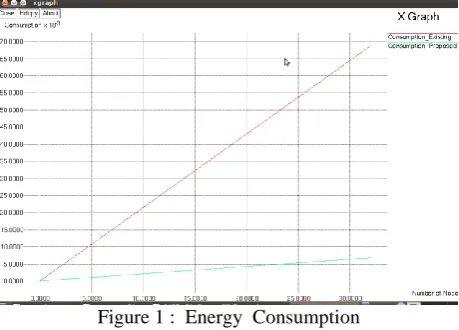
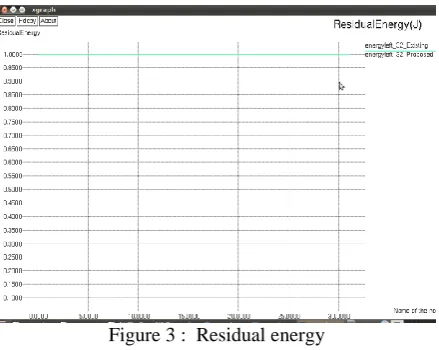
The simulation is done for Energy consumption , Lifetime and Residual energy whose results are shown in Figure 1 ,2 & 3 respectively.
Figure 1 : Energy Consumption
ISSN(Online): 2320-9801
ISSN (Print): 2320-9798
International Journal of Innovative Research in Computer
and Communication Engineering
(An ISO 3297: 2007 Certified Organization)
Vol. 3, Issue 2, February 2015
Figure 2 : Lifetime
The figure 2 shows that the lifetime of the proposed system is better than the existing system
Figure 3 : Residual energy
The above figure shows that the residual energy of the proposed system is higher than the existing system
VI.CONCLUSION AND FUTURE WORK
The Wireless Sensor Network is an emerging area which has wide applications. Hence the security in wireless sensor network is of great concern. Vampire attacks are important attack against a wireless sensor network in which an adversary develop and transmit messages that causes more energy to be consumed by the network than if an honest node transmitted a message of identical size to the same destination, although using different packet headers. So it is very important to detect the vampire nodes as early as possible. Here PLGP protocol is used to employ the vampire attacks. Since PLGP has two phases vampire node detection is also done in this two phases. The novel algorithm is the first sensor network routing protocol that provably bounds the damage from vampire attack in two phases of PLGP. This method reduces the energy utilisation, increases the lifetime. Here only PLGP protocol is considered, how the proposed solution works in other routing protocol is not considered. This method can be further extended to determine this problem.
REFERENCES
ISSN(Online): 2320-9801
ISSN (Print): 2320-9798
International Journal of Innovative Research in Computer
and Communication Engineering
(An ISO 3297: 2007 Certified Organization)
Vol. 3, Issue 2, February 2015
2. Y. Wang, G. Attebury, and B. Ramamurthy, “A Survey of Security Issues in Wireless Sensor Networks,” IEEE Comm. Surveys & Tutorials, vol. 8, no. 2, pp. 2-23, 2006
3. W. Heinzelman, A. Chandrakasan, and H. Balakrishnan, “An Application-Specific Protocol Architecture for Wireless Microsensor Networks,” IEEE Trans. Wireless Comm., vol. 1, no. 4, pp. 660- 670, Oct. 2002.
4. A. Manjeshwar, Q.-A. Zeng, and D.P. Agrawal, “An Analytical Model for Information Retrieval in Wireless Sensor Networks Using Enhanced APTEEN Protocol,” IEEE Trans. Parallel & Distributed Systems, vol. 13, no. 12, pp. 1290-1302, Dec. 2002.
5. J. Sun et al., “An Identity-Based Security System for User Privacy in Vehicular Ad Hoc Networks,” IEEE Trans. Parallel & Distributed Systems, vol. 21, issue no. 9, pp. 1227-1239, Sept. 2010.
6. S. Even, O. Goldreich, and S. Micali, “On-Line/Off-Line Digital Signatures,” Proc. Advances in Cryptology vol. 30, nos. 14/ 15, pp. 2826-2841, 2007.
7. A.A. Abbasi and M. Younis, “A Survey on Clustering Algorithms for Wireless Sensor Networks,” Computer Comm., vol. 30, nos. 14/ 15, pp. 2826-2841, 2007.
8. Huang Lu, Student Member, IEEE, Jie Li, Senior Member, IEEE, and Mohsen Guizani, Fellow, Secure and Efficient Data Transmission for Cluster-Based Wireless Sensor Networks IEEE Transactions on parallel and distributed systems, Vol. 25, issue no . 3, March 2014 9. Eugene Y. Vasserman, Nicholas Hopper, ” Vampire Attacks: Draining Life from Wireless Sensor Networks”, IEEE transactions onmobile