ISSN(Online): 2319-8753 ISSN (Print): 2347-6710
International Journal of Innovative Research in Science,
Engineering and Technology
(A High Impact Factor, Monthly, Peer Reviewed Journal)
Visit: www.ijirset.com
Vol. 8, Issue 3, March 2019
Effect of Tubes Surface Modification on
Thermal Performance of Cross Flow Heat
Exchanger
Prajwal kumar1, Abdul Razak R K2, Chethan K M2, Ismail Khan3,
P.G. Student, Department of Mechanical Engineering, P A College of Engineering, Mangalore, India1
Assistant Professor, Department of Mechanical Engineering, P A College of Engineering, Mangalore, India2
Professor, Department of Mechanical Engineering, P A Polytechnic, Mangalore, India3
ABSTRACT: The main objective of this paper is to experimental study the heat transfer characteristics of dimpled surfaces located on the surface of the tubes in cross flow conditions. Forced convection, steady state, laminar flow were maintained for the experiment. The various parameters considered in this study includes Nusselt number, heat transfer rate, Reynolds’s number, and coefficient of heat transfer. The outcome of the analysis shows significant increase in heat transfer in the dimpled surface of the tube as compared to plain surface.
KEYWORDS: Dimples, Reynolds number, Heat transfer, Steady state.
I.INTRODUCTION
The heat transfer rate through a given surface area is directly proportional to the area of the surface and temperature variation between its respective surfaces. The technique of heat transfer attrition is attained through alteration of the tube surfaces. The heat transfer attrition technique is used in thermal power plants, HVAC systems, automobiles, electronic gadgets, chemical industries, petrochemical industries, refrigeration and blades of gas turbines, heating and cooling of evaporators.
Investigations conducted by most of the researchers are focused on use of dimples on the surface for the analysis of the heat transfer rate. Hence too many analytical, experimental and numerical investigation has been done on the occasion of heat transfer analysis by studying the various development based on the variation in the flow analysis. The dimples are placed in proper internal or external position on the plain tube surfaces to create agitation in the flow field.
Heat transfer attrition is important to improve the efficiency and thermal performance of heat exchange devices for optimum use of geometrical adjustments to create agitation which creates vortices to increase the thermal boundary layer. The basis of research on heat transfer attritions with the use of protrusions and different types of fins i.e. slit fins, pin fins and louvered fins. The research on rectangular, circular, triangular and square shape of dimples are conducted to enhance the performance of heat exchangers for the increase of overall efficiency of heat exchangers.
The results of dimple method analysis is more efficient than grooves, fins, protrusions method since a minimum pressure loss in the case of dimples is recorded. Hence, the dimples are more effective than other methods. The flow resistance must be kept minimum to conduct the heat attrition technique. Dimples induces vortex flow through its hole for enhancement of heat transfer rate. Experimental analysis by researchers shows 30 to 40% increase in heat transfer rate by use of dimples. The strong vortex flow pattern in the dimples convective heat transfer coefficient can be obtained from its respective channels.
ISSN(Online): 2319-8753 ISSN (Print): 2347-6710
International Journal of Innovative Research in Science,
Engineering and Technology
(A High Impact Factor, Monthly, Peer Reviewed Journal)
Visit: www.ijirset.com
Vol. 8, Issue 3, March 2019
This heat transfer attrition techniques works with surface passages coupled with an array of dimples subjected to different geometries in a copper tube material. The copper tube material is surrounded by copper based ring thermocouple of k type with adjustable diameter at both the ends of the copper tube. The copper tube increases heat transfer coefficient with marginal increase in flow regime which generates rotational or secondary flow patterns. Secondary flow patterns expedites the degree of turbulence for interruption of the boundary layer phenomena to achieve effectual increase in heat transfer rate.
The result of five dimpled tubes placed parallel to each other with optimal spacing is heat transfer attrition. The dimples technique has application in diverse processing industries i.e. Food, beverage, chemical, pharmaceutical and biotechnology. The dimples technique has wide industrial application in aerospace, defense, electronics, construction for research and development to analyze numerical and experimental approach. The flow pattern generated by dimples technique to analyze its computational fluid dynamics for the estimation of temperature and flow regime at various points across the dimpled tube surface. The experimental analysis of five copper dimpled tubes in parallel with optimal spacing between the tubes on its surfaces with modification to analyze the thermal performance by cross flow pattern.
II.LITERATURE SURVEY
Kuethe A.N. [1] was the first person to recommend the use of surface dimples for heat transfer attrition technique in 1971. In his work, the surface dimples influences acts like a vortex generator from which there is a turbulent mixing in its flow that enhances heat transfer rate.
Khan, Amjad, et al. [2] carried work on spherical dimples at different angle of orientation. The experiment was done for laminar free convection conditions taking air as a working fluid. They observed that the heat transfer coefficient and Nusselt number rises with decrease in the orientation angle of dimples.
M.A.Dafedar et.al. [3] Conducted experiment to study the heat transfer amplification through various geometries of dimpled surfaces in lateral and longitudinal directions. Horizontal rectangular plates of copper and aluminium with different dimpled geometries for in-line arrangements were studied in natural convection with steady laminar external flow condition.
Faheem Akthar et.al. [4] Conducted an experimental investigation on natural convection heat transfer over round dimpled surfaces. Various heat transfer parameters like Nusselt number, heat transfer coefficient and heat transfer rate were used for the study. They concluded that, increased amount of heat transfer improvement does takes place for the dimpled surfaces. They [5] further extended the experiment in forced convection with the same arrangement and found an increase in heat transfer using dimples.
Khan, Amjad, et al. [6] carried an experimental study on spherical dimples of non-uniform diameter. The study was conducted under laminar and forced convection conditions [air as a working fluid]. It was observed that the heat transfer coefficient and Nusselt number were great for the plate in which the diameter of dimples upsurges centrally in the direction of flow as compared to the other cases.
Jamil et al [7] conducted an experimental investigation using forced convection heat transfer over square shaped dimples on a flat aluminium plate. The experiment was run under external laminar flow conditions. Both staggered and inline arrangements of the dimples were considered for the analysis. They observed that the coefficient of heat transfer coefficient was more for the plate having dimples.
Hasibur Rahman Sardar and Kaladgi [8] in their work made an experimental investigation using forced convection on circular shaped dimples of different diameters. The material used was flat copper plate under external laminar flow conditions. Experimental quantities on thermal characteristics of air (with various in flow rates) on a flat plate having dimples were conducted. From the obtained results, it was concluded that the coefficient of heat transfer and Nusselt number were high for the case of diameter increase in central direction of flow (case c) as related to the other cases.
ISSN(Online): 2319-8753 ISSN (Print): 2347-6710
International Journal of Innovative Research in Science,
Engineering and Technology
(A High Impact Factor, Monthly, Peer Reviewed Journal)
Visit: www.ijirset.com
Vol. 8, Issue 3, March 2019
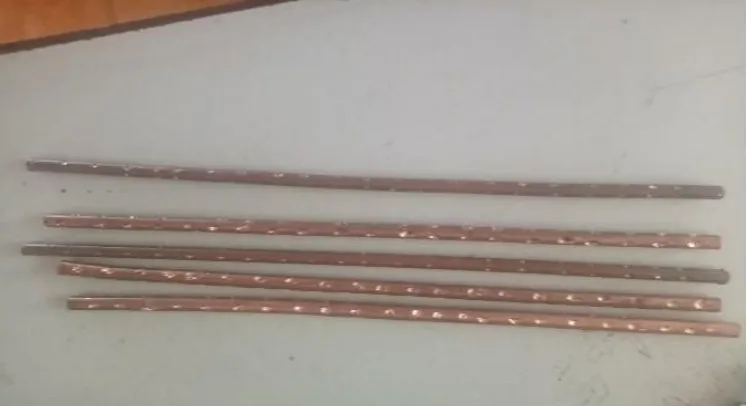
The circular shaped dimples are semi drilled on all the sides of the copper tubes with constant diameter. The spacing between dimples is kept constant. The five copper tubes are attached to copper based ring thermocouple with adjustable diameter wrapped with Teflon wire at the both the ends of the copper tubes. The application of copper ring thermocouple has more heat dissipation rate efficient compared to mild steel, aluminum and stainless steel.
III.EXPERIMENTALSETUP
ISSN(Online): 2319-8753 ISSN (Print): 2347-6710
International Journal of Innovative Research in Science,
Engineering and Technology
(A High Impact Factor, Monthly, Peer Reviewed Journal)
Visit: www.ijirset.com
Vol. 8, Issue 3, March 2019
Fig 1: Experimental setup showing rectangular duct
ISSN(Online): 2319-8753 ISSN (Print): 2347-6710
International Journal of Innovative Research in Science,
Engineering and Technology
(A High Impact Factor, Monthly, Peer Reviewed Journal)
Visit: www.ijirset.com
Vol. 8, Issue 3, March 2019
IV.EXPERIMENTALRESULTS
In this work, heat transfer analysis of dimple tubes in cross flow arrangements is carried out. The various results obtained from the analysis is discussed below.
1.
Air Speed vs. Nusselt NumberFigure 3: Variation of Nusselt Number with Air Speed
ISSN(Online): 2319-8753 ISSN (Print): 2347-6710
International Journal of Innovative Research in Science,
Engineering and Technology
(A High Impact Factor, Monthly, Peer Reviewed Journal)
Visit: www.ijirset.com
Vol. 8, Issue 3, March 2019
2. Air speed vs. Heat transfer rate
Figure 4: Variation of heat transfer rate with Air Speed
ISSN(Online): 2319-8753 ISSN (Print): 2347-6710
International Journal of Innovative Research in Science,
Engineering and Technology
(A High Impact Factor, Monthly, Peer Reviewed Journal)
Visit: www.ijirset.com
Vol. 8, Issue 3, March 2019
3. Air Speed vs. Effectiveness
Figure 5: Variation of effectiveness with Air Speed
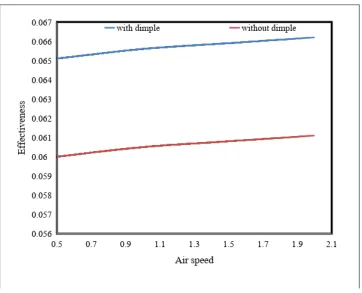
Figure 5 shows the variation of effectiveness with air speed for the plain and dimpled tubes. It is very much clear from the figure that as speed increases, the effectiveness also increases. It can also be observed that, rate of increase in heat transfer rate decreases with further increase in air speed indicating there is an optimum value of speed above which the heat transfer rate cannot increase. It is also observed that effectiveness is more for the tubes having dimples as compared to plain tubes without dimples. So it can be concluded that heat transfer rate is maximum for tubes having dimples.
V.CONCLUSION
In this work, heat transfer analysis of dimple tubes in cross flow arrangements is carried out. The various conclusions drawn from the analysis are
2. The Nusselt number increases as speed of the air increases.
3. The rate of increase in Nusselt number decreases as air flow rate increases.
4. The heat transfer rate and effectiveness also follow the same trend as of Nusselt number.
5. The various parameters considered for the study were high in case of tubes having dimples as compared to plain tubes
ISSN(Online): 2319-8753 ISSN (Print): 2347-6710
International Journal of Innovative Research in Science,
Engineering and Technology
(A High Impact Factor, Monthly, Peer Reviewed Journal)
Visit: www.ijirset.com
Vol. 8, Issue 3, March 2019
REFERENCES
1. M. Kuethe A. M., Boundary Layer Control of Flow Separation and Heat Exchange. US Patent No. 1191, 1970.
2. Khan, A., Bellary, M. Z., Ziaullah, M., & Kaladgi, A. R. (2015). An Experimental Study on Heat Transfer Enhancement of Flat Plates Using Dimples. American Journal of Electrical Power and Energy Systems, Vol. 4, No. 3, ISSN, 2326-9200.
3. M.A.Dafedar, Mujtabalayeeq I, Mohemmed TaherM, MohammadIdress urf Shahid I Heat Transfer Enhancement Through Different Circular Diametrical Dimple Surface Under Forced Convection –An Experimental Approach, IJRET: International Journal of Research in Engineering and Technology eISSN: 2319- 1163 | pISSN: 2321-7308, Volume: 02 Issue: 07 | Jul-2013
4. Faheem Akthar, Abdul Razak R Kaladgi and Mohammed Samee A Dafedar, Heat Transfer Enhancement Using Dimple Surfaces Under Natural Convection—An Experimental Study, Int. J. Mech. Eng. & Rob. Res. 2015, ISSN 2278 – 0149 Vol. 4, No. 1, January 2015.
5. Akthar, Faheem, Abdul Razak R. Kaladgi, and Mohammed Samee. "Heat transfer augmentation using dimples in forced convection–an experimental approach." International Journal of Mechanical Engineering and Robotics Research 4.1 (2015): 150-153.
6. Khan, A., Bellary, M. Z., Ziaullah, M., & Kaladgi, A. R. (2015). An Experimental Approach to Determine the Effect of Different Orientation of Dimples on Flat Plates. American Journal of Electrical Power and Energy Systems, Vol. 4, No. 3, Pages: 29-33, ISSN, 2326-9200.
7. Jamil Ahmed, Hasibur Rahman Sardar, & Kaladgi, A. R. (2015). Forced Convection Heat Transfer Analysis of Square Shaped Dimples on Flat Plates. American Journal of Energy Engineering, Vol. 3, No. 5, Pages: 66-70, ISSN, 2329-1648.