ISSN(Online): 2319-8753 ISSN (Print) : 2347-6710
I
nternational
J
ournal of
I
nnovative
R
esearch in
S
cience,
E
ngineering and
T
echnology
(A High Impact Factor, Monthly, Peer Reviewed Journal)
Visit: www.ijirset.com
Vol. 7, Issue 9, September 2018
Energy Analysis of a Prototype of Power
Generating Unit Using Sliding Plates
Piyush Jasooja1, Harish Chhatija2, Manish Kumar3
Graduate, Department of Mechanical Engineering, BIT, Durg, Chhattisgarh, India1
U.G. Student, Department of Mechanical Engineering, BIT, Durg, Chhattisgarh, India2
Assistant Professor, Department of Mechanical Engineering, BIT, Durg, Chhattisgarh, India3
ABSTRACT: Today, our whole lifestyle is dependent on electricity. But we know that the resources to generate electricity are limited, and this has led to the energy crisis. To attend this problem, we have made a system that can extract power which is wastedin form of friction. It can be observed that the number of vehicles on the roads and highways have been constantly increasing; which has escalated the traffic rates and consequently the energy produced by the traction between the road and the vehicle tyres. In this paper, the desolate energy incurred by the traction force of the tyres of a vehicle is converted into usable form of electrical energy. A prototype model is developed for generating electricity through the sliding plate mechanism. The vehicle is made to move over the sliding mild steel plate, the translation of which causes a rotation of the sprocket. This rotation is transferred to the shaft of the DC (Direct Current) stepper motor through several mechanisms. The rotation of motor shaft generates electricity, which then can be used to operate traffic lights or any low load equipment. In this way, the non-usable energy from the road tyres friction is converted into a productive from. This paper also clearly explains the working principle of the design system, its practical implementation, and advantages.
KEYWORDS: Energy, Speed Breaker Power Generation, Sliding Plate Mechanism, Electro Motive Force, Friction force, Road Power Generation.
I. INTRODUCTION
Electricity is one of the most widely used forms of Energy. With the increasing populationand the development of electric vehicles, the demand of electricity is rapidly increasing. According to the study [3], the power requirement of India in 2017 was 306 GW and is estimated to rise up to 575 GW in 2027. In India total energy shortage is 9 % with peak shortage at 15.2 %. To address this challenge, a novel method of generating electricity using traction force between the roads and the wheels of the passenger vehicles is undergoing research. The number of vehicles on the road is increasing rapidly. It was found in a study conducted in India[7], that the number of registered motor vehicles per 1000 population was 53 in 2001, which increased to 167 in 2015. Figure 1 shows the number of registered vehicles in some of the leading states in India. If we can convert some of the kinetic energy of these vehicles into the rotational motion of generator then we can produce significant amount of electricity, which is the main concept of the project.
II. RELATED WORK
ISSN(Online): 2319-8753 ISSN (Print) : 2347-6710
I
nternational
J
ournal of
I
nnovative
R
esearch in
S
cience,
E
ngineering and
T
echnology
(A High Impact Factor, Monthly, Peer Reviewed Journal)
Visit: www.ijirset.com
Vol. 7, Issue 9, September 2018
of the flywheel is used to rotate the shaft of the generator, thus producing electricity. AnuragPandey et.al [5] also generated electricity through a flip-plate mechanism. The electricity was stored to the lead 12-volt battery. Electricity stored in battery can be used to activate light, fan, etc. Noor Fatima et.al [10] attempted to convert kinetic energy of vehicle using a moving plate on the road. It takes the stroke motion of the vehicle and converts it into rotary motion by crank mechanism, thus running the generator and producing electricity.Sylvester W. Makumi et.al [9]discussed a new rack and pinion mechanism with MMR (Mechanical Motion Rectifier). J.D Jaymin et.al [4] suggested power generation from speed breakers by air compression.
In this paper, authors have presented a modified sliding plate mechanism to generate electricity. The adjustments made in this new model increased the power generation capacity of the system and hence improved the conversion efficiency. Through preliminary experiment we calculated the power output from the prototype and extrapolated the results for actual scenario. Also, various benefits in application of this system over its counterparts are discussed in this paper.
Fig1: Statistics showing number of vehicles in leading developed cities of India.
III. EXPERIMENTAL SETUP
ISSN(Online): 2319-8753 ISSN (Print) : 2347-6710
I
nternational
J
ournal of
I
nnovative
R
esearch in
S
cience,
E
ngineering and
T
echnology
(A High Impact Factor, Monthly, Peer Reviewed Journal)
Visit: www.ijirset.com
Vol. 7, Issue 9, September 2018
the sprocket is uniform and we have used chain drive here for the connection of the sprockets instead of ratchet and pawl.
Table 1
Specifications of the Major components used during fabrication.
COMPONENT SPECIFICATION
Metal plate 102 cm X 62 cm, Mild Steel Plate
Sprocket Teeth = 44, Pitch Circle Diameter = 18 cm
Freewheel Teeth = 18, Pitch Circle Diameter = 7.5 cm
Shaft Diameter = 2 cm, Length = 500 cm
Stepper Motor 500 rpm DC motor
Helical Spring Spring Constant, k = 520 N/m
LED light 3 V, 0.06 W
IV. METHODOLOGY
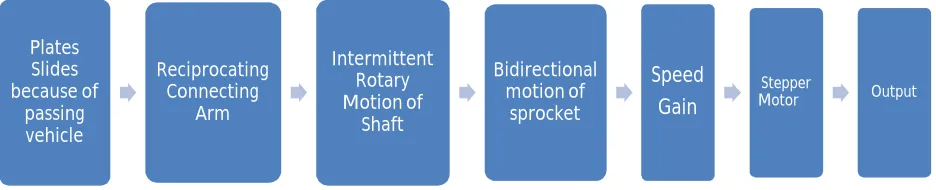
The system utilizes the traction force between the wheel and the sliding plate to generate electricity. When the plates reciprocates then the same motion is transferred to the larger sprocket with the help of shaft arrangement as shown in the figure ,thereby converting the reciprocating motion to the rotary motion, this rotary motion is then transferred to the smaller sprocket with the help of the chain drive hence the smaller sprocket also rotates, the rotary motion of the smaller sprocket is transferred to the attached shaft which is mounted on the roller bearing, this rotary motion of the shaft is then transferred to the stepper motor with the help of the gear and belt drive arrangement and then the power is produced, here the bipolar steeper motor is used attached with the three pin led hence the power is produced when the shaft rotates either in clockwise direction or the anticlockwise direction
Fig 2: Outline of the working of experimental setup Plates
Slides because of
passing vehicle
Reciprocating Connecting
Arm
Intermittent Rotary Motion of
Shaft
Bidirectional motion of
sprocket
Speed Gain
Stepper
ISSN(Online): 2319-8753 ISSN (Print) : 2347-6710
I
nternational
J
ournal of
I
nnovative
R
esearch in
S
cience,
E
ngineering and
T
echnology
(A High Impact Factor, Monthly, Peer Reviewed Journal)
Visit: www.ijirset.com
Vol. 7, Issue 9, September 2018
Fig 3: CAD model of sliding plate mechanism.
Fig. 4 shows different views of our fabricated model of sliding plate mechanism for generation of electricity. Different operations involved in fabrication are cutting, arc welding, and grinding.
ISSN(Online): 2319-8753 ISSN (Print) : 2347-6710
I
nternational
J
ournal of
I
nnovative
R
esearch in
S
cience,
E
ngineering and
T
echnology
(A High Impact Factor, Monthly, Peer Reviewed Journal)
Visit: www.ijirset.com
Vol. 7, Issue 9, September 2018
V. RESULT
When the plate is movedfrom the stationary position to the next extreme position, the LED (Light Emitting Diode) bulb of power rating 0.06 Watt lightens. Using a Multimeter, we measured a 0.03 amp and 15 v current outputs from the motor. In terms of power, we get 0.45W of electric power. After being pushed by the wheel, the plate returns to its original position which again produces electricity of 0.9W. Therefore, by moving one wheel of the vehicle over the plate we generate 0.9W of power.
If we analyse the situation, we will find that most of the times two wheels of a vehicle will pass over the plate and we get 1.8W of EMF (Electro Motive Force) from passing of a single vehicle over a single unit of this system. According to a survey conducted by MSRDC (Maharashtra State Road Development Corporation), as many as 90,000 vehicles pass through the Pune-Mumbai express highway. Considering 30,000 vehicles pass each day through a place anywhere in India. This gives us 54000 W or 54 kW of electric power in a day by using sliding-plate mechanism. Therefore, by installing a single unit of sliding plate mechanism we can generate up to 0.9 kW/h of power.
To calculate the efficiency of this system, we find the work done by the wheel of the vehicle on the plate. Friction force on the plate is given by Eq. (1)
= µ (1)
where, =Force in (N); µ= Coefficient of friction; = Mass in (kg); = acceleration due to gravity in (m/s2)
Taking the average mass of a vehicle to be 1500 kg, and assuming equal distribution of mass to all the four wheels, we can say that mass on one wheel would be 375 kg. Assume kinetic friction coefficient as 0.02 for mild steel.
And finally work done by the wheel is represented by Eq. (2). Distance between the plates is 5 cm or 0.05 m.
= ∗ (2)
where, = Work done in (J/s); = Distance in (m)
By calculation, we get the work done by the wheel on plate to be 3.68W. From previous data, the motion of one wheel over the plate generates 0.9W.So, the efficiency of the sliding plate mechanism is 24.46%.
VI. ADVANTAGES OF SLIDING PLATE MECHANISM
1. Generation of power without polluting the environment. 2. Eco-friendly and reliable source of power production. 3. Simple Construction and easy maintenance.
4. No consumption of any fossil fuel which is non – renewable source. 5. Utilizes the otherwise wasted energy from the vehicles.
6. Can be installed on any kind of road surface.
7. The more the frequency of the vehicles passing over it, greater will be the electricity generation.
VII. APPLICATIONS
1. This Technique can be used in all highways.
2. The Power is generated when the vehicles pass through it, which in turn can be stored in battery of vehicle or can be used to run the charging ports in vehicles.
ISSN(Online): 2319-8753 ISSN (Print) : 2347-6710
I
nternational
J
ournal of
I
nnovative
R
esearch in
S
cience,
E
ngineering and
T
echnology
(A High Impact Factor, Monthly, Peer Reviewed Journal)
Visit: www.ijirset.com
Vol. 7, Issue 9, September 2018
Sign Boards on the roads. Lightning of the bus stop.
Lighting of the check post on the highway. Lightening Street Lights.
VIII. CONCLUSION
In this project, we have discussed a sliding plate mechanism for RPG (Road Power Generation). It has been shown that this type of system utilizes very small place and can be installed anywhere, unlike SBPG system which cannot be installed everywhere. We have achieved a power output of 1.8 W through the sliding plate mechanism. The power output can be increased by arranging several machines in series and/or by using a generator with higher capacity. The efficiency of the system was found to be about 24.46%. However, this can be improved by increasing the distance by which plate moves and efficiency of mechanical gear and pulleys. The power generated by this machine can then be stored in batteries for use. This makes it convenient since power can be supplied even if there are no vehicles passing over the sliding plate.
REFERENCES
1. Ashtankar P.V.,Bendle P.H,KeneKrunal, KalbandeM. R., Makhe Pratik,. DhomneS.M..“Road Power Generation (RPG) by Flip plate Mechanism”. International Journal of Science, Engineering and Technology Research (IJSETR), Volume 3, Issue 3, pp. 560-562. March 2014. 2. BhagdikarP.,GuptaS.,Rana N.,Jegadeeshwaran R.. “Generation Of Electricity With The Use Of Speed Breakers”. International Journal of
Advances in Engineering &Technology,Vol. 7, Issue 2, pp. 589-595, May 2014.
3. KumarS.,BhattacharyyaB.,Gupta V. K.. “Present and Future Energy Scenario in India. Journal of the Institution of Engineers (India): Series B”, Volume 95, Issue 3, pp. 247-254September 2014. DOI: 10.1007/s40031-014-0099-7.
4. Jaymin J. D., Jaymin D., and Jaymin J. D., “Power Generation from Speed Breakers by Air Compression Method,” Int. J. Eng. Dev. Res., vol. 3, Issue no. 2, pp. 75–80, Year February 2018
5. Pandey A., Mohd. Maaz, Jawed Rafiq, “Road Power Generation by Flip Plate Mechanism”, International Journal of Engineering Development and Research 2015, IJEDR Volume 3, issue2, ISSN: 2321.pp. 240-242 Year May 2015
6. Mohammed Abdul RahmanUzair, Salman Ahmed Al-Ghanim, FarzanaSiddiqui, and Mohammed Abdul Ahad Yahiya. “Energy Extraction From Roadways”. International Journal of Science,Engineering and Technology Research (IJSETR), Volume 4, Issue 10, pp. 3564-3570October 2015.
7. https://community.data.gov.in/registered-motor-vehicles-per-1000-population-from-2001-to-2015/
8. Chandwani A., Patel A. N., KothariA..“Design of Road Power Generator (RPG): an Alternate Energy Source for Sustainability”. IJET Vol 9,Issue 2 pp. 494-501 Apr-May 2017. DOI:10.21817/ijet/2017/v9i2/170902010
9. Makumi S. W., Kiamba P.J., Bett H., Pius T. M..“Design and Fabrication of an Electric Power Generator Prototype: The Road as a Source of Clean Energy”. International Journal of Engineering Trends and Technology (IJETT) – Volume 56,Issue No. 1,pp 54-61 February 2018. 10. Fatima N., Mustafa J..” Production of electricity by the method of road power generation”. International Journal of Advances in Electrical and