ISSN(Online): 2319-8753 ISSN (Print): 2347-6710
I
nternational
J
ournal of
I
nnovative
R
esearch in
S
cience,
E
ngineering and
T
echnology
(A High Impact Factor, Monthly, Peer Reviewed Journal)
Visit: www.ijirset.com
Vol. 7, Issue 11, November 2018
Effects of Machining Parameters on the
Performance Characteristics in the EDM
Process of Ti-6Al-4V Using RSM
G. Kumanan
Assistant Professor, Department of Manufacturing Engineering, Annamalai University, Annamalainagar,
Tamilnadu, India
ABSTRACT: Electrical Discharge Machining(EDM) has been used to machine advanced materials with desired shape,
size and required accuracy. Machining of any electrically conductive material irrespective of its hardness, by the application of thermal energy is one of the prime advantages of EDM process. It is in general observed that out of the two main performance characteristics, Material Removal Rate(MRR) and Surface Roughness (Ra) have traditionally received greater research attention in comparison to surface roughness even though EDM is largely used for its high precision quality. In this study the influence of operating parameters such as peak current(I), pulse on time(Ton), electrode rotational speed(S) and flushing pressure(P) of Ti-6Al-4V on the machining characteristics of MRR and Ra ofEDM process. In this study, three different electrodes used such as Copper, Brass and Aluminum is most suitable for use as the tool electrode in EDM of Ti-6Al-4V alloy. In this study Response surface methodology(RSM) is used to investigate the relationships and parametric interactions between the four controllable variables on the MRR and Ra. The response was modeled using a response surface model based on experimental results.
KEYWORDS:Electrical discharge machining(EDM), Material removal Rate(MRR), Surface Roughness(Ra),
Response Surface Roughness(RSM).
I. INTRODUCTION
Ti-6Al-4V alloys have usually extensively in recent times due to their excellent corrosion resistance, high strength at elevated temperatures, high strength-to-weight-ratio and biological compatibility. In this behavior, Ti-6Al-4V alloys are used wide range of applications in the automotive, aerospace, chemical and medical field. However, the main reason for the increase in demand for titanium in the past few years has been the large consumption in the aerospace sector. The excellent strength-to-weight ratio of titanium alloys provides a decrease of aircraft weight and, therefore, a reduction in fuel consumption and emissions. However, titanium and its alloys are very difficult to machine materials owing to several inherent properties of the material. Such materials are difficult to machine by conventional machining methods. Hence, non-conventional machining methods including ultrasonic machining, electrochemical machining and Electro Discharge Machine (EDM) are applied to cut such hard materials. The EDM is accomplished of producing a fine, complicated surface.
ISSN(Online): 2319-8753 ISSN (Print): 2347-6710
I
nternational
J
ournal of
I
nnovative
R
esearch in
S
cience,
E
ngineering and
T
echnology
(A High Impact Factor, Monthly, Peer Reviewed Journal)
Visit: www.ijirset.com
Vol. 7, Issue 11, November 2018
The electrical discharge machining characteristics of Ti-6Al-4v have been studied by some of the researchersLee et al,(1) investigated EDM is the best known non-conventional manufacturing process being applicable to any conductive material irrespective of its mechanical properties, e.g. hardness, strength or thermal conductivity. During the EDM process, the sparks generate a high temperature that locally melts the material. Molten material is flushed away by a dielectric liquid (hydrocarbon oil or deionized water). The new surface is formed by a series of discrete discharges between the electrode (commonly copper or graphite) and the work piece. As a result, the surface comprises craters after high temperature sparks and drops of molten metal that is rapidly quenched by dielectric.Rahman et al (2)analyzed the influence of EDM parameters in terms of peak current, pulse on time and pulse off time on surface roughness of titanium alloy (Ti-6Al-4V). A mathematical model for surface finish is developed using response surface method (RSM) and optimum machining setting in favor of surface finish are evaluated. Design of experiments (DOE) techniques is implemented. Analysis of variance (ANOVA) has been performed to verify the fit and adequacy of the developed mathematical models. These results lead to desirable surface roughness and economical industrial machining by optimizing the input parameters.
II.EXPERIMENTATION
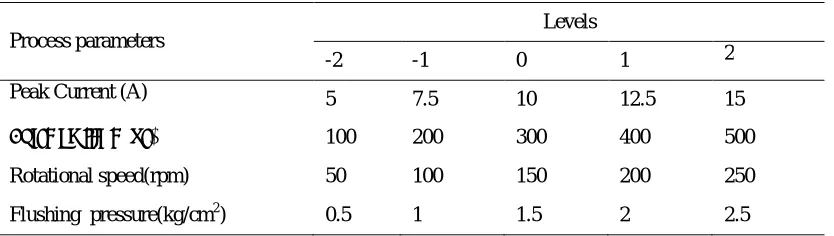
The machining experiments are performed using ‘Electronica- M100’ die sinking EDM machine, which is equipped with a transistor switched power supply. The electrode is fed downwards under servo control into the work piece. The copper, aluminium and brass cylindrical electrode of 12 mm diameter are used as an electrode (tool). Kerosene is used as a dielectric medium. Jet flushing is used to circulate the dielectric fluid. Material removal rate (MRR) is proportional to the product of the energy transferred per pulse and the pulse frequency. Changing the pulse current at a constant frequency varies the energy of the pulse. Hence, all the experiments are performed with peak current, pulse on time, flushing pressure, and electrode rotational speed as variables. Experiments have been conducted according to central composite design (CCD) covering full range of current and pulse on time settings to collect more number of data for modeling. For each experiment, a new set of tool and work piece has been used. The experiments are conducted on three different electrode materials. The response variables selected for this study are material removal rate (MRR) and surface roughness (Ra). The process parameters and their levels selected for the study are listed in Table .1 Experiments were conducted according to DOE concept covering the full range of input variables. For each experiment, a new set of tool and work piece has been used. The response variable calculated for this study are metal removal rate(MRR) and surface roughness(Ra).
Table 2.1 Process parameters and their levels
Process parameters
Levels
-2 -1 0 1 2
Peak Current (A) 5 7.5 10 12.5 15
Pulse on time (μs) 100 200 300 400 500
Rotational speed(rpm) 50 100 150 200 250
Flushing pressure(kg/cm2) 0.5 1 1.5 2 2.5
MRR, Ra are used to evaluate machining performance. The MRR is expressed as the ratio of the difference of weight of the work piece before and after machining to the machining time,
ISSN(Online): 2319-8753 ISSN (Print): 2347-6710
I
nternational
J
ournal of
I
nnovative
R
esearch in
S
cience,
E
ngineering and
T
echnology
(A High Impact Factor, Monthly, Peer Reviewed Journal)
Visit: www.ijirset.com
Vol. 7, Issue 11, November 2018
Where Wwb and Wwa are the weights of the work piece before and after machining, and ‘t’ is the machining time.
The surface roughness is measured on a surf coder SE1200 surface testing analyzer. For each sample, five set of readings on surface roughness have been taken and the average value of those five readings has been considered as the final reading.
2.2. Procedure of response surface methodology
Response surface methodology (RSM) is a collection of statistical and mathematical techniques useful for design of experiments and optimizing process parameters.In this work, RSM is utilized for establishing the relations between the different EDM process parameters with a variety of machining criteria and exploring their effects on MRR and Ra. To perform this task second order polynomial response surface mathematical models can be developed. In the general case, the response surface is described as (2).
= + + + +⋯… + ±∈(2)
Where, y is the corresponding response of MRR and Ra yield by the various EDM process variables and the xi (1, 2 , , , , n) are coded levels of n quantitative process variables, the terms C0,Ci,Cii and Cij are the second order regression coefficients. The second term under the summation sign of this polynomial equation is attributable to linear effect, whereas the third term corresponds to the higher-order effects; the fourth term of the equation includes the interactive effects of the process parameters. Equation (3) can be rewritten according to the four variables used as in(3).
= +∑ +∑ + ±∈ (3)
Where: x1, x2, x3 and x4 are peak current(I), pulse on time(Ton), electrode rotational speed(S) and flushing pressure(P) respectively.
III. RESULTS AND DISCUSSION
3.1 Effect of current (I) and pulse on time (Ton) on MRR and Ra
The Material removal rate in EDM mainly occurs by melting, evaporation, and spalling. Spalling is typical for some ceramic materials. This spalling effect is most often related to the generation of large micro cracks (perpendicular and parallel to the top surface) generated during EDM. These larger micro cracks make the separation of a small volume of material during successive discharges much easier [6]. The effect of parameters on MRR and Ra has been analysed through contour plots. The surface roughness of an electro discharge machined product can be defined as a chip-forming process where the chips are spherical debris melted by sparks [7]. So the surface roughness is depending on the size of spark crater. A large discharging energy causes violent sparks and impulsive forces and results in deeper and larger erosion, sand large size of the crater was produced on the machined surface [8].The material removal rate and surface roughness are increasing with peak current and pulse duration for each electrode material. Copper electrode gives thehigher material removal rate, followed by brass and aluminium. Brass and Aluminium electrodes exhibits the best performance with regard to surface roughness.
Effect of peak current and Pulse on time on MRR
Effect of peak current and rotational speed on MRR
Effect of peak current and Flushining pressure on MRR
100.00 200.00 300.00 400.00 500.00 5.00 7.50 10.00 12.50 15.00 0.3 0.4 0.5 0.6 0.7 0.8 M R R g /m in
A: Peak current(I) A B: Pluse on Time (Ton) µs
50.00 100.00 150.00 200.00 250.00 5.00 7.50 10.00 12.50 15.00 0.3 0.4 0.5 0.6 0.7 0.8 M R R g /m in
A: Peak current(I) A C: Rotational Speed (S) rpm
0.50 1.00 1.50 2.00 2.50 5.00 7.50 10.00 12.50 15.00 0.3 0.4 0.5 0.6 0.7 0.8 M R R g /m in
ISSN(Online): 2319-8753 ISSN (Print): 2347-6710
I
nternational
J
ournal of
I
nnovative
R
esearch in
S
cience,
E
ngineering and
T
echnology
(A High Impact Factor, Monthly, Peer Reviewed Journal)
Visit: www.ijirset.com
Vol. 7, Issue 11, November 2018
Effect of peak current and Pulse on time on Ra
Effect of peak current and rotational speed on Ra
Effect of peak current and Flushining pressure on Ra
Fig.3.1.2 Interaction graph for Copper electrode with Ra
The optimum pulse current and pulse on time is obtained as 12.5 amps and 400 μs. As the pulse current increases, the MRR, and the Ra increases. The increase in current intensity increases the pulse energy and hence, the MRR increases with current intensity. The increase in MRR increases the debris in the gap. This event is due to the increase in discharge energy, which subsequently causes a larger crater on the surface of the body. The MRR decreased with an increase in the pulse duration. Short pulse duration would cause less surface vaporization, whereas long pulse duration could cause the plasma channel to expand and to decrease the energy density for the workplace. The longer the spark is sustained to more material removal rate. Consequently, the resulting craters will be broader, deeper and therefore, the surface finish will be rougher. Obviously, with shorter duration of sparks, the surface finish will be better.
3.2.Effect of peak current(I) and electrode rotational speed(S)
The increase in electrode rotation would increase the MRR decrease the surface roughness. When the cylindrical electrode rotates, due to the centrifugal action, a new layer of dielectric fluid is drawn into the machining gap. This induces a conductive atmosphere for effective discharge and encourages process stability. The rotation of the electrode also contributes to better heat transfer from the electrode, thus bringing down the electrode’s surface temperature. With an increased peripheral speed of the electrode, the ignition time delay increases, thus bringing down the energy transferred through the individual discharges for material removal. This diminishes the crater dimensions to give a better roughness value. The interaction graph peak current and electrode rotational speed depicts the influence of peak current and rotational speed on MRR and Ra. Also shows that the value of MRR increases with increasing of rotational speed.
Effect of peak current and Pulse on time on MRR
Effect of peak current and rotational speed on MRR
Effect of peak current and Flushining pressure on MRR
Fig.3.2.1Interaction graph for Brass electrode with MRR
100.00 200.00 300.00 400.00 500.00 5.00 7.50 10.00 12.50 15.00 0.03 0.04 0.05 0.06 0.07 0.08 0.09 0.1 R a µ m
A: Peak current(I) A B: Pluse on Time (Ton) µs
50.00 100.00 150.00 200.00 250.00 5.00 7.50 10.00 12.50 15.00 0.03 0.04 0.05 0.06 0.07 0.08 0.09 0.1 R a µ m
A: Peak current(I) A C: Rotational Speed (S) rpm
0.50 1.00 1.50 2.00 2.50 5.00 7.50 10.00 12.50 15.00 0.03 0.04 0.05 0.06 0.07 0.08 0.09 0.1 R a µ m
ISSN(Online): 2319-8753 ISSN (Print): 2347-6710
I
nternational
J
ournal of
I
nnovative
R
esearch in
S
cience,
E
ngineering and
T
echnology
(A High Impact Factor, Monthly, Peer Reviewed Journal)
Visit: www.ijirset.com
Vol. 7, Issue 11, November 2018
Effect of peak current and Pulse on time on Ra
Effect of peak current and rotational speed on Ra
Effect of peak current and Flushining pressure on Ra
Fig.3.2.2Interaction graph for Brass electrode with Ra
3.3 Effect of current (I) flushing pressure(P) on MRR and Ra
The optimum flushing pressure is obtained as 2Kg/cm2. As the flushing pressure increases, it helps to move away the debris from the workpiece, which is removed by the spark discharges. The machining performance is improved since the removed particles in the machining gap are evacuated more efficiently, so the MRR increases. It can be seen that when flushing pressure is less than a certain pressure, it is impossible to do any machining. The improved flushing pressure results in maximum MRR as well as improved surface finish.
Fig.3 (a) depicts the influence of peak current and flushing pressure on MRR. Also shows that the value of MRR increases with increasing of flushing pressure. The flushing pressure of the dielectric fluid enhances the MRR, with increase in pressure of the dielectric fluid, the MRR tends to increase. This is because the machining performance has been improved, as the removed particles in the machining gap are evacuated more efficiently. The Fig.3(b) shows that the value of Ra increases with increase in peak current at least up to the maximum level, and it tends to increase the high valve of flushing pressure. Along with increased flushing pressure the surface roughness improved gradually for all current levels, with certain levels after that it will decrease
Effect of peak current and Pulse on time on MRR
Effect of peak current and rotational speed on MRR
Effect of peak current and Flushining pressure on MRR
Fig.3.3.1Interaction graph for Aluminium electrode with MRR
Effect of peak current and Pulse on time on MRR
Effect of peak current and rotational speed on MRR
Effect of peak current and Flushining pressure on MRR
ISSN(Online): 2319-8753 ISSN (Print): 2347-6710
I
nternational
J
ournal of
I
nnovative
R
esearch in
S
cience,
E
ngineering and
T
echnology
(A High Impact Factor, Monthly, Peer Reviewed Journal)
Visit: www.ijirset.com
Vol. 7, Issue 11, November 2018
IV. CONCLUSION
In this work, the Ti–6Al–4V alloy is machined by an electrical discharge machining process with different machining conditions and three different electrode materials. Summarizing the main features of the results, the following conclusions may be drawn.
RSM revealed that the all four input parameters such as peak current(I), pulse on time(Ton), electrode rotational speed(S) and flushing Pressure(P) are the most influential parameters for MRR and Ra.
When the increase the flushing pressure to the dielectric fluid, the surface roughness deteriorated with an increase in peak current. Since an increase in the peak current increased the discharge energy and the impulsive force, removing more molten material and generating deeper and larger discharge craters. Hence, the surface roughness became coarser.
The material removal rate and surface roughness are increasing with peak current and pulse duration for each electrode material. Copper electrode gives the higher material removal rate, followed by brass and aluminium. Brass and aluminium electrodes exhibits the best performance with regard to surface roughness.
REFERENCES
[1] Md. Ashikur Rahman Khan1 M.M. Rahman, K. Kadirgama, M.A. Maleque and M.Isha Journal of Mechanical Engineering and Sciences 1(2011)16-24.
[2] C.H.C. Haron, and Jawaid, The effect of machining on surface integrity of titanium alloy TI-6Al-4V, Journal of Material process technology, 166 (2005) 262-274.
[3] K.H. Ho and S.T. Newman, State of the art electrical discharge machining (EDM), International Journal of Machine Tools Manufacture, 43 (2003) 1287-1300.
[4] M. M. Rahman, Md. Ashikur Rahman Khan, K. Kadirgama M. M. Noor and Rosli A. Bakar, Modeling of Material Removal on Machining of Ti-6Al-4V through EDM using Copper Tungsten Electrode and Positive Polarity, International Journal of Mechanical and Materials Engineering, 1(2010) 135-140.
[5] Purcar Carmen and Ţîţu Mihail Aurel, Theoretical studies on electro discharge machining withRotating electrode tool. Romanian Association
of Nonconventional Technologies Romania, (2013) 67-74.
[6] D.Kanagarajan ,R.Karthikeyan, K.Palanikumar and J,P. Davim, Application of goal programming technique for Electric discharge machining (EDM) characteristics of cemented carbide(WC/Co), International Journal of Materials and product Technology,35 (2009 ) 216-227. [7] Ahmet Hascalik, and Ulas Caydas, Electrical discharge machining of titanium alloy (Ti-6Al-4V), Journal of Applied surface science, 253
(2007) 9007-9016.
[8] Yan Cherng Lin, Bing Hwa Yan and Young Chang, Maching characteristics of titanium alloy(Ti-6Al-4V) using a combination process of EDM with USM Journal of materials processing technology, 104 (2000) 171-177.
[9] Peter Fonda, Zhigang Wanga , Kazuo Yamazaki, and Yuji Akutsu,A fundamental study on Ti-6Al-4V’s thermal and electrical properties and their relation to EDM productivity, Journal of materials processing technology,202 (2008) 583-589.
[10] G.Krishna Mohana Rao, G Ranga Janardhana, D. Hanumantha Rao and M. Srinivasa Rao, Development of hybrid model and optimization of metal removal rate in electric discharge machining using artificial neural networks and genetic algorithm, ARPN Journal of Engineering and Applied Sciences, 209 (2008) 1512-1520.
BIOGRAPHY
G. Kumanan, Assistant Professor, Department of Manufacturing Engineering, Annamalai University,Annamalainagar-608002.