Towards a User-Friendly Platform for Building Language Resources based on
Web Services
Marc Poch, Antonio Toral, Olivier Hamon, Valeria Quochi, N ´uria Bel
UPF, DCU, ELDA, CNR, UPF Spain, Ireland, France, Italy, Spain
[email protected], [email protected], [email protected], [email protected], [email protected]
Abstract
This paper presents the platform developed in the PANACEA project, a distributed factory that automates the stages involved in the acquisition, production, updating and maintenance of Language Resources required by Machine Translation and other Language Technologies. We adopt a set of tools that have been successfully used in the Bioinformatics field, they are adapted to the needs of our field and used to deploy web services, which can be combined to build more complex processing chains (workflows). This paper describes the platform and its different components (web services, registry, workflows, social network and interoperability). We demonstrate the scalability of the platform by carrying out a set of massive data experiments. Finally, a validation of the platform across a set of required criteria proves its usability for different types of users (non-technical users and providers).
Keywords:service, workflow, interoperability
1.
Introduction
The EU-FP7 PANACEA1 project (7FP-ITC-248064) ad-dresses one of the most critical aspect of Machine Trans-lation (MT) and other Language Technologies (LT): the language-resource bottleneck. Although most statistical MT engines are language independent, they depend on the availability of Language Resources (LRs) for the language pairs and domains that they cover. The objective of the project is to build a platform that serves as a factory of LRs that automates the stages involved in the acquisition, pro-duction, updating and maintenance of language resources required by MT systems (as well as by other LT). Web crawled data and corpora could be processed in the factory to obtain new LR. On the other hand, already existing LR could be enriched using the platform tools.
LR production requires complex language processing chains. Based on a workflow manager, the PANACEA plat-form allows the user to combine different LR processors in order to build LRs. These processors are deployed as web services (WSs) that may be distributed on different servers and can be used by different users regardless of their lo-cation. A big advantage of using WSs is that users do not need to install any tool (LR processors); they can simply send requests and data to the services and obtain the results. From a technical point of view, users can use the tool with-out access to the source code. The platform is developed in three stages, i.e. there are three development cycles, so that improvements can be made on the basis of subsequent phases of experiments and tests. This paper will describe the second prototype and its validation.
2.
Other projects and related work
The research area of Natural Language Processing (NLP) has advanced notably in the last two decades. However,1
Platform for Automatic Normalized Annotation and Cost-Effective Acquisition of Language Resources for Human Lan-guage Technologies
there exists an access barrier as it is not straight-forward to use most of the tools derived from research, at least for non experts. Issues include the use of different formats in different tools (often incompatible), the difficulty to find the appropriate tools, and their complex installation (e.g. dependencies), lack of an easy to use framework to deploy WSs, to mention just a few.
There have been different initiatives to tackle these issues. On the one hand, integrated toolkits and frameworks have been devised. Two examples of these are GATE (Cunning-ham et al., 2011) for Information Extraction and corpus annotation and NLTK (Bird et al., 2009) for NLP. These toolkits offer an standardized ecosystem, from which the user can access a pool of resources (e.g. NLP tools, cor-pora), and build upon them. However, they are closely tied to a specific programming language and therefore the in-teraction with tools written in a different language is not straight-forward (Bone, 2008) or they are not designed to deploy an external tool as a web service.
A related work is U-Compare (Kano et al., 2011)2. It provides a GUI that allows users to build workflows us-ing UIMA components. However, it has two drawbacks compared to the current proposal: (i) it only allows to use UIMA components while the PANACEA approach allows to plug any SOAP web service and (ii) it uses a strongly typed system, specifically designed to tackle text mining, while the PANACEA approach is applicable to broader ap-plications (Kano et al., 2010). The PANACEA platform eases the process of deploying WSs independently from the programming language used by the NLP tool to be de-ployed and does not require a specific client to run the WSs. This can be very important for users and service providers with no expertise in computer science.
The Language Grid (Bramantoro et al., 2010) is another project aiming at the easy integration of WSs that has tack-led many different aspects of creating an infrastructure:
se-2
curity and IPR issues (Murakami et al., 2010), special user interfaces, a registry of services, etc. However, as with some other cases, deploying a tool as a web service can be difficult for non-experts and the whole infrastructure is not designed for processing large amounts of data (corpus processing). The PANACEA platform will show a scalable model that can easily deploy different tools as WSs which can handle large corpora and that is focused in usability for both users and service providers.
The comparison of all these projects, tools and frameworks would require a deeper analysis that exceeds the scope of this paper. During the design phase of the project, differ-ent tools and approaches were studied but limited resources and time constrains made it impossible to make all tests and study all possible scenarios (non-experts users, highly skilled users, naive Web Service Providers (WSPs), profes-sional WSPs with security demands, WSPs with massive job requests, etc.). Therefore, one of the main goals of the platform is to use tools, protocols and data formats that can be used by as many other projects and frameworks as possi-ble trying to benefit from everyone’s best features depend-ing on the situation.
3.
The platform
The factory is designed as a platform of WSs where the users can create and use these services directly or com-bine them in more complex chains. These chains are called workflows and can represent different combinations of tasks, e.g. extract the text from a PDF document and obtain the Part of Speech (PoS) tagging or Crawl this bilin-gual website and align its sentences. Each task, e.g. crawl the web, “get PoS tags”, etc. is carried out using NLP tools deployed as WSs in the factory.
WSPs are institutions (universities, companies, etc.) who are willing to offer services for some concrete tasks. One of the project objectives is to provide tools and guidelines to WSPs that facilitate the task of providing services (soft-ware, temporary files, interfaces, etc.). These guidelines and documents can be found on the PANACEA website3. The platform has been implemented as a proof of concept. It can be used to process different kinds of corpora depend-ing on the WSs. Most of the workflows are based on the web crawlers (Mastropavlos and Papavassiliou, 2011) that have been deployed as WSs. From this point of view, most workflows have been designed to process monolingual and bilingual data that is the output of those WSs although most WSs can process other kinds of data (i.e. PDF, DOC, TXT, CSV, XML, etc.).
Another important thing is that although the machine re-sources of the different WSPs (considering only the project partners and not other external WSPs) are very limited the platform scales to process large amounts of data.
The platform is based on a set of tools developed by my-Grid4team which are used for the Bioinformatics research. The aim of these tools is to help researchers work with e-Science. Figure 1 summarizes these tools and the role they play in the platform. These tools have successfully been
3
http://panacea-lr.eu 4
http://www.mygrid.org.uk
used in different projects and fields (i.e. social science, astronomy, music, chemistry). All different technologies used to develop the platform are explained in this section.
Figure 1: MyGrid tools
3.1. Web Services
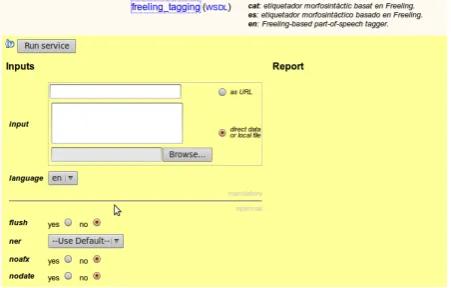
Soaplab (Senger et al., 2003) has been used to deploy WSs.5 This software allows a WSP to deploy a command line tool as a WS just by writing a metadata file that de-scribes the parameters of the tool. Soaplab is an easy to use tool that automatically takes care of all the typical issues regarding WSs, including temporary files, protocols, Web Service Description Language (WSDL) file and its parame-ters, etc. Moreover, it automatically creates a Web interface (called Spinet and showed in Figure 2) where WSs can be tested and used with input forms.
Figure 2: Spinet web client to run a web service
Soaplab is also adapted to be able to run long-lasting jobs avoiding the web service clients timeouts. When a web service client (i.e. a program, a workflow engine, a web browser, etc.) makes a request to a WS a timer is activated. If the web service does not give the answer in less than the specific timeout the execution will fail (i.e. a web browser produces an error message when a web is not responding after a few time). Soaplab clients can avoid these timeouts by sending periodic requests to check whether or not the job has finished.
5
even when the WSs had finished and sent its response. In-stead of using the retry system to actually retry the job Tav-erna leaves that iteration on hold while the others are nor-mally executed. When all data has been processed, iter-ations which are still waiting for data make the workflow execution never end. This was for some months the main reason for not fulfilling the massive data scalability tests and not being able to present satisfactory experiment results until now.
Working in collaboration with Taverna developers resulted in PANACEA developers testing Taverna 2.4 (a beta ver-sion not released to the public at that moment). This new Taverna fixed those bugs and our experiments confirmed the scalability of the platform. Figure 3 illustrates a typical scalability test designed to test server “iula04”. The work-flow has two WSs: PoS and a converter to the TO. Both WSs are configured with 3 parallel processes generating a total 6 parallel processes on the server. The corpus being processed is the result of a crawling task with 60M tokens and 13K files stored in a different server. The whole corpus was downloaded and processed in approx. 5 hours.
4.3. Third version of the platform
The final report on scalability is under development since the third version of the platform is not final yet. It will con-tain experiments carried on different WSPs servers and us-ing different kind of tools and workflows. EBI has been using Soaplab to deploy their massively used WSs for years (McWilliam et al., 2009) and with our massive data scalability experiments we will demonstrate that with more machine resources more jobs can be served from WSPs servers. With more machine resources the growing num-ber of requests (more users or more parallel jobs) will be fulfilled by WSPs.
Videos, guidelines, tutorials and general documentation can be found on the PANACEA website18for more detailed in-formation about all these topics and the platform in general.
5.
Validation
This section describes the assessment done within the PANACEA project of the platform machinery/technology mainly from technical perspective. An evaluation of the impact on SMT of the resources produced using the ser-vices integrates into platform is reported in (Pecina et al., 2011). Also, an industrial evaluation of the platform and its technologies will be performed at the end of the project for the final prototype of the platform.
The validation of the platform is performed on the basis of a set of criteria previously defined (see 5.1.) by three val-idators (5.2.) in order to determine whether required criteria are compliant with expectations; therefore, there are no val-idation scores: a requirement is either validated or not on a binary scale.
5.1. Validation criteria: requirements to be checked
The criteria for validation had been defined at the start of the project on the basis of the expected requirements and functionalities of our platform (for the automatic creation
18
http://panacea-lr.eu
of language resources). Here we briefly mention the most salient criteria for the scope of the paper, a complete list and specification of the various criteria can be found in the project deliverableD7.319.
The Registry. A set of criteria are defined for checking the availability of the registry, its searching mechanisms and the possibility of adding services by service providers and the like.
Web services: The set of criteria for checking the availabil-ity and accessibilavailabil-ity of the platform processors, i.e. WSs; the availability of metadata and closed vocabularies for their description and categorization; and that error mes-sages and exceptions are handled satisfactorily. Interoper-ability criteria have also been defined to check availInteroper-ability and compliance to the Common Interfaces and Traveling Object.
Workflows: a set of criteria defined for checking the func-tionality of a workflow editor; it’s handling workflows ex-ecutions, of provenance (e.g. errors, timestamps, etc.) and intermediate data; and the possibility of remotely execut-ing workflows, which is an relevant feature for long lastexecut-ing workflows.
5.2. User profiles and validators
Validation of the platform has been organized on the basis of two prospective typical users: platform users, and WSPs. Platform users aim at using WSs and workflows already designed, or at building new workflows using the avail-able WSs. Service providers aim at deploying and shar-ing their tools within the platform, through WSs and work-flows, they may also want to build workflows using their tools in pipeline with tools by other providers.
3 Validators were recruited so as to fit user types (i.e. plat-form user vs. service provider); two of them are researchers of the project active in the production of some components of the platform, but not directly involved in the platform design and development; while one validator, with the user profile, who had not been involved in service development has been selected to act as an ”external” validator.
5.3. Validation scenarios
The platform validation is based on scenarios. For the val-idation of this second version of the prototype, 5 scenarios have been defined taking into account both the user profiles (i.e. Service Provider and Platform User) and the criteria to be validated for the second version of the platform pro-totype. Each scenario aims at validating some of the cri-teria defined according to the user type and consists of a sequence of steps or tasks that the validator has to perform and a questionnaire the validator fills in at the end of the steps. The questions proposed to the validators required either yes/nos or open answers. Free feedback was also allowed in order to be able to make an overall qualitative assessment of the platform and to gather useful suggestions for further improvements.
19
Figure 3: Typical massive data scalability test
5.4. Validation material and procedure
Tutorials and videos prepared for documentation of the platform20 were provided to validators who were required to read them at least once during the training phase. Also, material was prepared for use by the validators with the ser-vices in order to have controlled and comparable outputs. After the training phase, the scenarios with task descrip-tions and question forms were provided to validators. Af-ter the validation was done, validators returned their forms which have then been analysed so as to learn the lessons of the task and improve the PANACEA platform.
5.5. Validation results
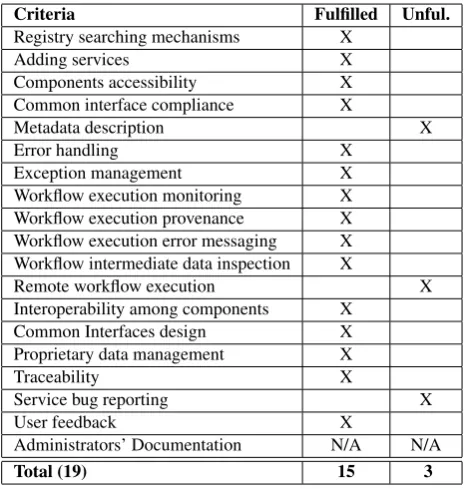
A quantitative and qualitative analysis of the returned forms reveal an overall good performance of the platform: most of the requirements are validated and the platform realizes its main expectations. Table 1 gives an overview of the validated fulfilled and unfullfilled criteria.
The Registry,myExperimentand the WSs are available and easily usable. Taverna, the workflow editor, can also suc-cessfully been used for running and creating workflows, al-though some problems and failures were reported. Thus, workflow management can be improved.
Regarding the registry, indeed validators were ease with its use and found its navigation natural. In particular, they mentioned the different views, the filtering options using categories and the WSs status as interesting and useful. However, improvements were suggested on the level of search functionalities for helping users in locating the de-sired WSs: for instance, providers should give more anno-tations to their WSs, or the search engine could be enriched with synonyms or new terms. The registration of a new WSs is not always clear: the distinction between SOAP and
20
http://panacea-lr.eu/en/tutorials/
Criteria Fulfilled Unful.
Registry searching mechanisms X
Adding services X
Components accessibility X Common interface compliance X
Metadata description X
Error handling X
Exception management X Workflow execution monitoring X Workflow execution provenance X Workflow execution error messaging X Workflow intermediate data inspection X
Remote workflow execution X Interoperability among components X
Common Interfaces design X Proprietary data management X
Traceability X
Service bug reporting X
User feedback X
Administrators’ Documentation N/A N/A
Total (19) 15 3
Table 1: Summary of the second validation results
Soaplab is rather confusing and the URL to submit is not clear and well defined. Also, metadata descriptions were insufficient according to validators. Metadata guidelines were in fact not available at the time of validation and are still under construction.
For the PANACEA myExperiment portal, similar consid-erations apply: search functionalities should be improved, workflows more extensively tagged and categorized so that users can find them easier.
u-compare with taverna. Bioinformatics, 26(19):2486– 2487.
Y. Kano, M. Miwa, K. B. Cohen, L. Hunter, S. Ananiadou, and J. Tsujii. 2011. U-compare: a modular nlp work-flow construction and evaluation system. IBM Journal of Research and Development, 55(3):11:1 – 11:10. Nikos Mastropavlos and Vassilis Papavassiliou. 2011.
Au-tomatic acquisition of bilingual language resources. In Proceedings of the 10th International Conference of Greek Linguistics, Komotini, Greece.
Hamish McWilliam, Franck Valentin, Mickael Goujon, Weizhong Li, Menaka Narayanasamy, Jenny Martin, Teresa Miyar, and Rodrigo Lopez. 2009. Web services at the European Bioinformatics Institute-2009. Nucleic acids research, 37(Web Server issue):W6–10, July. Paolo Missier, Stian Soiland-Reyes, Stuart Owen, Wei
Tan, Aleksandra Nenadic, Ian Dunlop, Alan Williams, Thomas Oinn, and Carole Goble. 2010. Taverna, reloaded. In M. Gertz, T. Hey, and B. Ludaescher, ed-itors,SSDBM 2010, Heidelberg, Germany, June. Yohei Murakami, Donghui Lin, Masahiro Tanaka, Takao
Nakaguchi, and Toru Ishida. 2010. Language service management with the language grid. In Nicoletta Cal-zolari (Conference Chair), Khalid Choukri, Bente Mae-gaard, Joseph Mariani, Jan Odijk, Stelios Piperidis, Mike Rosner, and Daniel Tapias, editors, Proceed-ings of the Seventh International Conference on Lan-guage Resources and Evaluation (LREC’10), Valletta, Malta, May. European Language Resources Association (ELRA).
Pavel Pecina, Antonio Toral, Andy Way, Vassilis Papavas-siliou, Prokopis Prokopidis, and Maria Giagkou. 2011. Towards using web-crawled data for domain adaptation in statistical machine translation. In Mikel L. Forcada, Heidi Depraetere, and Vincent Vandeghinste, editors, Proceedings of the 15th Annual Conference of the Euro-pean Associtation for Machine Translation, pages 297– 304, Leuven, Belgium. European Association for Ma-chine Translation.
Marc Poch and N´uria Bel. 2011. Interoperability and tech-nology for a language resources factory. In Proceed-ings of the Workshop on Language Resources, Technol-ogy and Services in the Sharing Paradigm, pages 32–40, Chiang Mai, Thailand, November. Asian Federation of Natural Language Processing.
Prokopis Prokopidis, Byron Geograntopoulos, and Haris Papageorgiou. 2011. A suite of nlp tools for greek. In Proceedings of the 10th International Conference of Greek Linguistics, Komotini, Greece.