NgramQuery - Smart Information Extraction from Google N-gram using
External Resources
Martin Aleksandrov
†and Carlo Strapparava
?†Sofia University, Sofia, Bulgaria [email protected]
?FBK-irst, Trento, Italy [email protected]
Abstract
This paper describes the implementation of a generalized query language on Google Ngram database. This language allows for very expressive queries that exploit semantic similarity acquired both from corpora (e.g.LSA) and fromWordNet, and phonetic similarity available from theCMU Pronouncing Dictionary. It contains a large number of new operators, which combined in a proper query can help users to extract n-grams having similarly close syntactic and semantic relational properties. We also characterize the operators with respect to their corpus affiliation and their functionality. The query syntax is considered next given in terms of Backus-Naur rules followed by a few interesting examples of how the tool can be used. We also describe the command-line arguments the user could input comparing them with the ones for retrieving n-grams through the interface of Google Ngram database. Finally we discuss possible improvements on the extraction process and some relevant query completeness issues.
Keywords:N-grams, WordNet, Lexical Similarity
1.
Introduction
In computational linguistics many tasks are properly dealt exploiting a combination of syntagmatic and domain fea-tures. Syntagmatic aspects are often managed by taking advantage of the analysis of large n-gram databases, while domain and ontological aspects are more properly modeled by semantic similarity spaces (e.g. latent semantic space) and lexical ontologies such as WordNet.
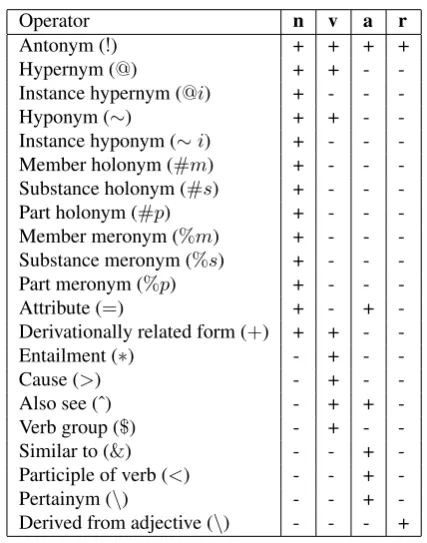
This paper describes the implementation of a generalized query language on Google Ngram database, whose expres-siveness boosting is accomplished by plugging semantic similarity acquired both from corpora (e.g. LSA) and from WordNet, and phonetic similarity available from pronounc-ing dictionaries. It contains several different operators, which combined in a proper query can help users to extract n-grams having similarly close syntactic and semantic re-lational properties. We also characterize the operators with respect to their functionality, i.e. similarity, part-of-speech, syntactic and semantic operators.
The tool can be useful in a variety of tasks, ranging from specific lexicon extraction and lexical substitution task (McCarthy and Navigli, 2007) to the automatization of cre-ative and figurcre-ative language processes (Strapparava et al., 2007; Stock et al., 2008; Veale, 2011) such as puns and portmanteau words generation, metaphors, hyperbolae and other rhetorical phenomena.
The paper is organized as follows. Section 2. briefly presents the notions of what we callThe Core languageand The Ngram-query language. Section 3. describes the oper-ators we have implemented and it groups them into cate-gories according to their functionality. In Section 4. we present how we can extract domain-specific concepts and how we can deal with orthographic and phonetic rhymes. Finally, in Section 5. we describe the expressiveness of the tool and some promising future directions.
2.
Implementation
2.1. Preliminary notes
The starting point was the Google Web 1T 5-Grams database (Brants and Franz, 2006). This data set con-tains English word n-grams and their observed frequency counts. The length of the n-grams ranges from unigrams to five-grams. The n-gram counts were generated from approximately 1 trillion word tokens of text from pub-licly accessible Web pages. For easily handling that huge dataset, we exploited Web1T5-Easy1, which is a collection of Perl scripts for indexing and querying the Google Web 1T 5-Grams database with the open-source database engine SQLite. The creation of our tool was inspired by the idea of combining different knowledge sources, in particular:
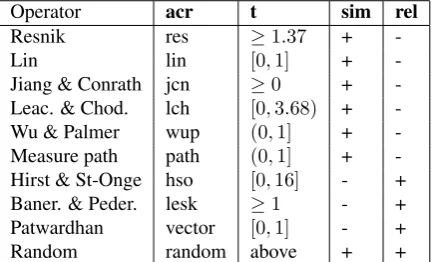
• Lexical concepts and their taxonomies, given by Word-Netlexicon database. Besides all the relations present in WordNet, we embedded in the query language also the common similarity measures (Budanitsky and Hirst, 2006; Pedersen et al., 2004) such as Resnik, Lin, Jiang-Conrath, etc.
• Exploiting a specific version of LSA space (Deer-wester et al., 1990) acquired from the full British Na-tional Corpus.
• TheCMU Pronouncing Dictionary2, for dealing with assonances, partial homophones, etc.
Finally we designed a query language that is able to express these concepts according Google N-gram database. Infor-mation extraction from such a database using fixed external
1http://cogsci.uni-osnabrueck.de/∼
korpora/ws/cgi-bin/Web1T5/Web1T5 freq.perl 2
implemented a single operator, which allows us to retrieve words with similar phonemic beginnings, endings or both. Its acronym is£and it is applied in a manner similar to the orthographic substring matching % operator inThe Core-query language, i.e.£tion,mod£or£gmat£. In Table 3 a comparison between the two operators is given.
Operator acr begin middle end
Orthographic % + + +
Phonetic £ + - +
Table 3: Syntactic and phonetic operators. Operator appli-cability:begin(at the beginning of a word);middle(within a word);end(at the end of a word)
The orthographic operator can be applied multiple times within a word, while the phonetic one can only be applied either at the beginning or the end of a word (or both). The following two examples clarify the use of the two operators. They also show how the user can use theword set term(i.e. asking for two different n-grams in the same query).
%quer%,%icle
181971412 article 54080132 vehicle
31285263 query . . .
8329460 particle 7821136 albuquerque
6939347 chronicle . . .
661990 konqueror 563796 follicle 439169 ventricle
. . .
We can see that % can be applied more than one times within a string. This is not the case with the operator £ as shown next. Recall, when £ operator is applied to a string then an overlapping between the given string and the words in the phonetic dictionary is performed and the posi-tive matches are returned as part of the results to the query.
£f ore
5933321709 for 277552584 before
129170208 four 2380057 fore 542725 heretofore
. . .
3.4. Query syntax
In this subsection we give a formalization of the query syn-tax inThe Ngram-query languagein terms of Backus-Naur grammar rules.
3.4.1. Grammar
Note that we have a natural restriction on the length of the query imposed by the fact that Google Ngram database con-tains up to five grams.
hqueryi::= ‘<term>’ ;; unigram
| ‘<term> <term>’ ;; bi-grams
| ‘<term> <term> <term>’ ;; 3-grams
| ‘<term> <term> <term> <term>’ ;; 4-grams
| ‘<term> <term> <term> <term> <term>’ A query is composed of terms. The terms, in particular, can be simple words or a combination of words and operators. We clear the details with the following rules presenting the syntax of the different kinds of terms.
htermi::= hterm 0i | hterm 1i | hterm 2i | hterm 3i hterm 0i::= hexpri
hexpri::= hwordi | h%-stringi | h£-stringi | hstring-£i | hexpri,(hexpri,. . .) h%-stringi::= h% within concepti h£-stringi::= h£ stringi
hstring-£i::= hstring £i
Examples of possible expressions are: ‘house’,
‘%ing’, ’£ture’, ‘ref£’, ‘data, roof,
ref£, %mics, ad%nt%e, £ics’.
hterm 1i::= hp ci#hterm 0i#hposi#hs ni | hterm 0i#hLi#hsimi#hfreqi
hp ci::= pointer concept hposi::= n|v|a|r hs ni::= sense number hLi::= letter L
hsimi::= number similar words hfreqi::= frequency threshold
In the terms, following the first case of this pattern, part-of-speech (hposi) and the sense number (hs ni) settings can be omitted. Instead their defaults values are used, i.e. noun and all senses, respectively. In the second case at least one setting must be specified, i.e. either the number of similar concepts or the cosine threshold. Note that the number of similar words should be less than one hundred, a constraint imposed by the specificity of the LSA matrix we used (see Section 3.2.). The following examples give some possible terms according to the above pattern,
i.e. ‘@#fast#a#2’, ‘concept#L#10#0.7’,
‘data#L#0.3’, ‘∼term#1’.
hterm 2i::= hp ci#hterm 0i#hposi#hs ni
#hLi#hsimi#hfreqi
| hp ci#hterm 0i#hposi#hs ni#hCi#hconcepti
| hterm 0i#hLi#hsimi#hfreqi#hCi#hconcepti
| hterm 0i#hposi#hs ni#hWi#htypei#hfreqi#hs ni
T. Pedersen, S. Patwardhan, and J. Michelizzi. 2004. WordNet::Similarity - measuring the relatedness of con-cepts. In Proceedings of the 19th National Confer-ence on Artificial IntelligConfer-ence (AAAI-2004), pages 1024– 1025, San Jose, CA, July. Lawrence Erlbaum Associates. O. Stock, C. Strapparava, and A. Valitutti. 2008. Ironic expressions and moving words.International Journal of Pattern Recognition and Artificial Intelligence (IJPRAI), 22:1045–1057.
C. Strapparava, A. Valitutti, and O. Stock. 2007. Affective text variation and animation for dynamic advertisement. InProccedings of 2ndInternational Conference on Affec-tive Computing and Intelligent Interaction (ACII2007), Lisbon, Portugal, September.