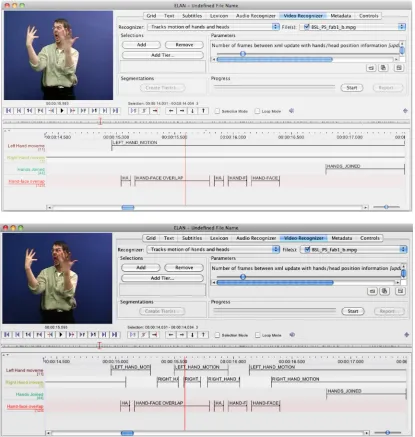
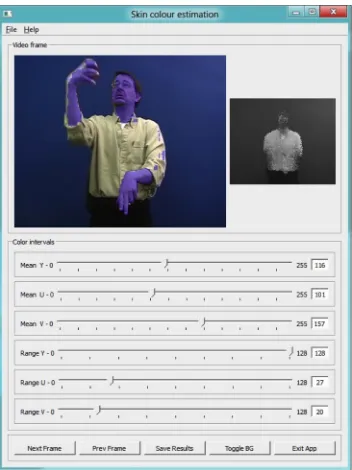
The algorithm works at first by segmenting the image in skin vs. non-skin pixels, using the information provided by the skin color estimator. The subsequent step in the detection process involves the search of seed points where the hands and heads regions most likely occur. Histograms along the horizontal and vertical directions compute the number of pixels with luminance and color values within the desired interval; the pixels where a maximum occur in both the directions are selected as seed points. A region-growing algorithm is then applied to the seed points in order to cluster together all the skin pixels in the neighbourhood. Each region is approximated by an ellipse, characterized by the position of the center, its orientation and the length of its axes and for tracking purposes each of them is assigned a label. The tracking is performed by analyzing the change in position and orientation of the ellipses along the timeline, assigning labels based on position of the regions in the current and previous frames.
2.9
User interaction
The expected data is very heterogeneous and in some cases baseline recognizers can perform poor with no additional adaptation. Furthermore the researchers cannot accept annotation errors, e.g., a segment that is wrongly labeled as no-speech but has speech in it (false negative). Therefore the analysis components support adaptation and feedback-loop mechanisms. By adaptation mechanism we mean that the researcher is able to give examples of aspects he likes to detect, e.g., samples of a speaker for automatic speaker detection or sample segments without speech for the automatic detection of speech. By feedback-loop mechanism we mean strategies where the user runs a recognition process at first, then gives feedback about the quality of the result and then runs the process with the updated information again. For example, this could be applied for the speaker identification process: The user adapts the recognizer before running the component the first time
No input from user was necessary. However, if the results would prove not satisfactory, the user has the possibility of providing examples of speech and non-speech segments in the recording. This ways the user is capable of
incorporating their own knowledge in the
process and improve the classification results. • Speakers in the recordings have been identified
and proper identifiers have been assigned to each segment. No user interaction is necessary at this step.
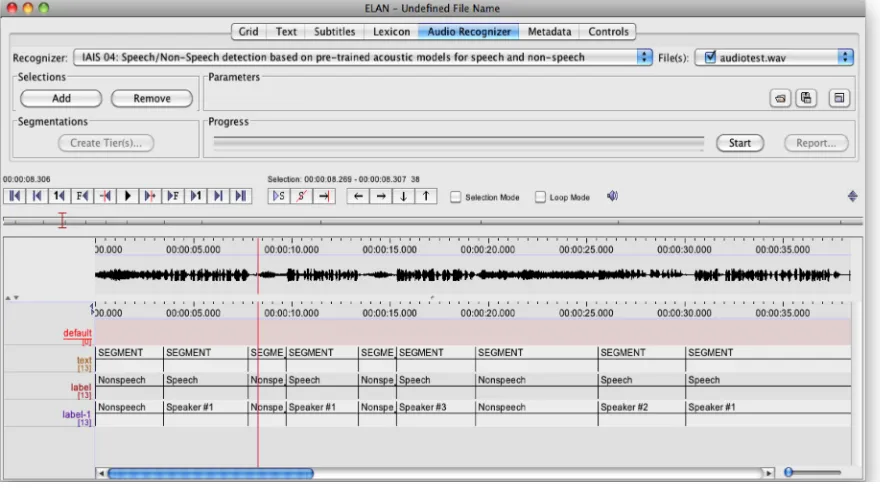
The results showing the automated annotation can be seen on Figure 3. Similarly to the previous case the automated results have been given to MPI researchers and they have adjusted them to their needs. The necessary work included correcting the boundaries of the segments, fixing the overlapping of speakers (this is not detected by the recognizers) and joining several separate speakers as one person (the opposite situation, detecting two persons as the same speaker, did not occur in our tests). Again, the time necessary to perform these
corrections has been significantly shorter than in case of
doing the annotation manually and was on the average
0.38 of the average time spent on manual annotation.
4.
Performance
The time necessary to execute the recognizers on the recordings has not been taken into account in our experiments, as it is considered to be of low importance because of the very little user involvement. After setting the initial parameters the researchers can carry out their work with different tasks. Also their computer is not used for the heavy computations, our project assumes that the algorithms are executed on local network servers, which
store all the video and audio data of MPI researchers, and only the resulting annotation files are returned to users’ computers. The waiting time is also not very long as all the recognizers perform between 2-10 times faster than real time, which means that a minute of a recording will take between 6 and 30 seconds to be processed by any recognizer.
5.
Conclusions
The specification and implementation of the above-described video processing recognizers has been performed in a very close contact with linguist researchers and according to the needs they have
specified. After testing the relative effectiveness of our
methods and witnessing the dramatic decrease of time necessary for annotations, we can say that our goals have been chosen correctly and our methods have proven very useful. As our next steps we are planning to fully develop the possibility of detecting and tracking the hands in the videos, differentiate left from right one and also work together with linguists to develop new recognizers that would create new types of annotations,
for different research questions. We believe this work would contribute significantly to the quality of linguistic data stored at the Language Archive of MPI and possibly in other locations.
6.
Acknowledgments
AVATecH is a joint project of Max Planck and
Fraunhofer, started in 2009 and funded by both Max Planck Society and Fraunhofer Society.
Some of the research leading to these results has received funding from the European Commission’s 7th
Framework Program under grant agreement n° 238405 (CLARA).
7.
References
Atzpadin, N., Kauff, P., Schreer, O., (2004), Stereo Analysis by Hybrid Recursive Matching for Real-Time Immersive Video Conferencing, Transactions on Circuits and Systems for Video Technology, Special Issue on Immersive Telecommunications, Vol.14, No.3, 2004, pp. 321-334.
Biatov, K., and Kohler, J., (2006), Improvement speaker clustering using global similarity features, in Proceedings of the Ninth International Confer- ence on Spoken Language Processing.
Biatov, K., and Larson, M., (2005), Speaker clustering
via bayesian informa- tion criterion using a global
similarity constraint, in Proceedings of the Tenth International Conference SPEECH and COMPUTER.
Dumitraş, A., Haskell, B.G. (2004). A look ahead method
for pan and zoom detection in video sequences using
block-based motion vectors in polar coordinates. Proceedings of International Symposium on Circuits and
systems, ISCAS 2004, Vancouver, Canada, May 2004.
Reynolds, D.A., (1995), Speaker verification using adapted gaussian mixture models, Speech
Communication Journal, 17(1-2), (1995).
Wittenburg, P., Auer, E., Sloetjes, H., Schreer, O., Masneri, S., Schneider, D., Tschopel, S., (2010), Automatic annotation of media field recordings, 4th
Workshop on Language Technology for Cultural