Textual Characteristics for Language Engineering
Mathias Bank
†, Robert Remus
‡, Martin Schierle
*†Pattern Science AG, 63579 Freigericht, Germany
‡Natural Language Processing Group, University of Leipzig, Germany
∗Mercedes-Benz RD North America, Palo Alto, USA
[email protected], [email protected], [email protected]
Abstract
Language statistics are widely used to characterize and better understand language. In parallel, the amount of text mining and information retrieval methods grew rapidly within the last decades, with many algorithms evaluated on standardized corpora, often drawn from newspapers. However, up to now there were almost no attempts to link the areas of natural language processing and language statistics in order to properly characterize those evaluation corpora, and to help others to pick the most appropriate algorithms for their particular corpus. We believe no results in the field of natural language processing should be published without quantitatively describing the used corpora. Only then the real value of proposed methods can be determined and the transferability to corpora originating from different genres or domains can be estimated. We lay ground for a language engineering process by gathering and defining a set of textual characteristics we consider valuable with respect to building natural language processing systems. We carry out a case study for the analysis of automotive repair orders and explicitly call upon the scientific community to provide feedback and help to establish a good practice of corpus-aware evaluations.
Keywords:Textual Characteristics, Language Engineering, Language Statistics
1.
Motivation
Language statistics and quantitative linguistics are widely used to study, characterize and better understand lan-guage, to help foreign learners or even to identify authors (Holmes, 1994). Tˇeˇsitelov´a (1992) provides a compre-hensive overview of the large pool of methods available today. Implicitly connected, natural language processing (NLP) methods often rely on statistical methods and ma-chine learning algorithms, which in turn massively rely on certaintextual characteristics, e.g. token frequencies, to-ken distributions and toto-ken probability transitions. Still, textual characteristics of corpora used for training and test-ing such methods and algorithms are rarely analyzed and documented. We strongly believe the successful creation of real world NLP systems, i.e. the selection of appropriate methods and algorithms, is only possible if the respective text types are soundly understood. Furthermore, we believe scientific publications in NLP must clearly document lan-guage statistics of the used corpora. This is necessary be-cause not all algorithms work equally on every text type and their portability may be questionable (Sekine, 1997; Escud-ero et al., 2000; Wang and Liu, 2011). Only by knowing the textual characteristics of a certain text type it is possible to estimate the transferability of proposed methods and hence assess their real value. To our best knowledge there is no previous work that uses language statistics to give guidance in building NLP systems, although this is a crucial part of everylanguage engineering(Cunningham, 1999) process. In the next Section, we select and present suitable language statistics. In Section 3. we apply them to English-language corpora from three differentgenres: news articles, web fora posts and automotive repair orders. In Section 4. we carry out a case study and demonstrate how textual characteris-tics may give guidance to select appropriate algorithms for a successful genre-specific information extraction system. Finally, we draw conclusions in Section 5.
2.
A Language Engineering Fingerprint
Although there is a broad range of language statistics avail-able, we only use a carefully handpicked set. We believe this set should be limited to support direct comparisons within one representative chart: a language engineering
fingerprint. Furthermore, we only use language statistics,
which can be easily and quickly calculated without the need for advanced language processing modules, e.g. part-of-speech (POS) taggers or syntax parsers. Such modules are usually highly text type-dependent (Sekine, 1997) and hence cannot be directly applied to previously unknown text types, as the selection of the most appropriate modules is precisely the goal of the analysis.
1. Shannon’sentropyH measures the average amount of information in an underlying data structure. Applied in the field of language engineering, the mean amount of information of a tokenti can be calculated by
ap-proximating its probability p(ti)via its frequency in
a given corpus. The entropy as given in Formula 1 is normalized to the vocabulary size|V|, i.e. the number of types in the corpus:
H = − X
ti∈V
p(ti) log|V|p(ti) (1)
A high entropy indicates that many words occur with small frequencies – instead of few words that occur with large frequencies.
2. Therelative vocabulary sizeRVoc (Tˇeˇsitelov´a, 1992,
chapter 1.2.3.3) is given by the ratio of the vocabu-lary size|V|and the total number of tokensNmwith
Nf})1, e.g. nouns, adjectives and verbs:
RVoc = |V|
Nm
(2)
A small relative vocabulary size indicates simple lan-guage, less morphological constructs and few spelling and tokenization errors. Thus, it provides information about word repetition and the success of dictionary-based methods.
3. Thevocabulary concentrationCVoc(Tˇeˇsitelov´a, 1992,
chapter 1.2.3.3) is defined by the ratio of the total num-ber of tokens Ntopwith respect to the most frequent
terms in the vocabularyV (Vtop={t|t∈V∧r(t)≤
10}) and the total number of tokensNin a corpus
CVoc =
Ntop
N (3)
where rankr(t)is defined as the position of a tokent in a frequency-ordered list. A high vocabulary concen-tration indicates the corpus is made up of only a few words. Dictionary- and rule-based methods are then easier to implement and to maintain than for corpora with low vocabulary concentration.
4. Thevocabulary dispersionDVocexpresses the relative
amount of low frequency tokens (Vlow = {t | t ∈
V ∧f(t)≤10}) in the vocabularyV:
DVoc = |Vlow|
|V| (4)
where frequencyf(t)is defined as the number of oc-currences of the tokent in a corpus. A high vocab-ulary dispersion indicates a high fraction of spelling and tokenization errors or a morphologically rich guage. Generally, this may significantly blow up lan-guage models and lead to large parameter spaces for machine learning methods. However, a high vocabu-lary dispersion may also give the opportunity (or obli-gation) to drastically apply pruning methods. Methods like POS tagging or named entity recognition (NER) are vulnerable to out-of-vocabulary words, which are more likely to occur in a corpus with a high vocabulary dispersion (Toutanova et al., 2003). If co-occurrences are to be calculated, significance measures like mutual information should be discarded for corpora with high vocabulary dispersion, as rare events would be overes-timated.
5. Thecorpus predictabilityCP expresses the transition probabilities between tokens. For this, we need to cal-culate the entropy of a first-order Markov sourceSof two tokensti, tjas given in Formula 5
H(S) = −X ti
p(ti)
X
tj
pti(tj) log pti(tj) (5)
1As function wordsN
f we defined: the, a, an, he, him, she,
her, they, us, we, them, it, his, to, on, above, below, before, from, in, for, after, of, with, at, and, or, but, nor, yet, so either, neither, both, whether
wherepti(tj)denotes the probability oftj given that it is preceded byti.CP is then calculated by
normal-izing the entropy of a first-order Markov source by its maximum possible entropy and subtracting it from1:
CP = 1− H(S)
Hmax(S)
(6)
A high corpus predictability indicates a very straight-forward writing style with words often followed by the same successors. This is an advantageous behavior for Hidden Markov Models (HMMs) or the calculation of neighborhood co-occurrences. If HMMs of higher or-der are used, the corpus predictability can be calcu-lated accordingly.
6. A rudimentary grammatical complexity GC can be calculated by the ratio of the number of function words Nf to the number of meaningful wordsNm:
GC = Nf
Nm
(7)
Although this rather basic approach cannot state a real level of grammatical structure in a corpus, it still pro-vides evidence for the amount of effort put into ex-pressing syntax. In conjunction with the average sen-tence length this language statistics may give guidance in which manner texts need to be processed, e.g. deep or shallow. For example, it may be possible to use rule-based POS taggers instead of more sophisticated POS taggers and thus significantly reduce calculation time. Sophisticated syntax parsers may be replaced by regular expression patterns (Trabold, 2007, chapter 8.2.3).
7. Theaverage sentence length LS influences parsing,
relation extraction etc. The length|s|of a sentences is defined by the amount of tokens it contains, and the average sentence length of all sentencesS is defined as in Formula 8:
LS =
1
|S|
X
s∈S
|s| (8)
8. Thespelling accuracySAVocis defined by the amount
of correctly spelled wordsNCorwith respect to the
to-tal number of tokensN:
SAVoc =
NCor
N (9)
This measure can furthermore be divided with respect to real-word errors and non-word errors and crucially influences which kind of spell-checking method needs to be employed, if any. A low spelling accuracy can significantly reduce the performance of context-based methods and machine learning in general.
9. Before developing an information extraction system, one should determine the corpus’information density
IDCorp, which is given by the ratio of relevant words
Nrwhich are to be extracted and the total amount of
tokensN:
IDCorp=
Nr
2.1. Further Language Statistics
Apart from the language statistics listed above, there are several more textual characteristics, which are tempting to use. Here, we list some of them and argue why we don’t consider them appropriate to characterize corpora for lan-guage engineering purposes.
1. The product of a token’s rankr(ti)and its frequency
f(ti) is known to be approximately constant (Zipf,
1949), and is given byZipf ’s first law:
r(ti)f(ti) ≈ k (11)
Although this regularity does not always fit well (Melz and Wittig, 2007), we still do not consider the devi-ations from Zipf’s first law large enough to provide much insight for language engineering.
2. Measures like the Gunning-Fox-Index (Gunning, 1952) are often used to assess thereadabilityof text, for example to select texts appropriate for children of different ages. The Gunning-Fox-Index estimates how many years of education are needed to understand a given text. Although this measure is helpful for edu-cational purposes, we do not consider it useful for lan-guage engineering, as it merely aggregates the aver-age sentence length and the percentaver-age of “complex” words containing three syllables or more, excluding compounds and proper nouns. While the amount of complex words may actually be a problem for a hu-man reader, it can be argued that they do not necessar-ily pose difficulties for machine learning algorithms, as they can be treated as every other feature of a text.
3. Especially in technical genres and domain-specific language, words tend to be syntactically less ambigu-ous than in more general language, making it therefore easier to assign POS tags to them. This is reflected in
thesyntactic ambiguityASof a corpus.AS is defined
as the average entropy of a tokenti’s POS tagsj. A
token occurring with only one POS tag has an entropy (and hence ambiguity) of zero, while its ambiguity in-creases for more syntactic classes being assigned to it with lesser probabilities:
AS = −
1
|V|
X
ti
X
sj
p(sj|ti) logp(sj|ti) (12)
A high syntactic ambiguity indicates possible diffi-culties for POS tagging, while a syntactic ambiguity stands for easy or even trivial POS tagging. Although we consider this measure as highly useful for language engineering, we discard it in the remainder, as it is very hard to calculate without advanced language pro-cessing modules.
4. Correspondingly to AS, the lexical ambiguityAL is
defined by the average entropy of a tokenti’s meaning
mj:
AL = −
1
|V|
X
ti
X
mj
p(mj|ti) logp(mj|ti) (13)
Intuitively, a high lexical ambiguity complicates infor-mation extraction massively, while corpora with only a few ambiguous words with few meanings are easier handle. Again, we discard this measure in the remain-der, as there is no way to calculate it automatically.
2.2. General Remarks on Language Statistics
Although we avoided language statistics which can only be calculated using advanced language processing meth-ods, we consider it feasible to inspect small samples of text manually. For example, the spelling accuracy can be semi-manually estimated from several hundred words.
Unfortunately, most language statistics cannot easily be normalized by corpus size and thus should be calculated on same- or at least similar-sized corpora. Obviously, lan-guage statistics may not be accurate enough on samples smaller than several ten thousand words.
Finally, the language statistics selected and presented by us cannot easily be interpreted as being in some way “better” or “worse” for higher or lower values when comparing cor-pora. An interpretation is always bound to the nature of the task to be accomplished. For the same reason, it is hard or even impossible to combine all textual characteristics into one artificial “quality” measure of some sort.
3.
Language Engineering Fingerprints of
Corpora from Different Genres
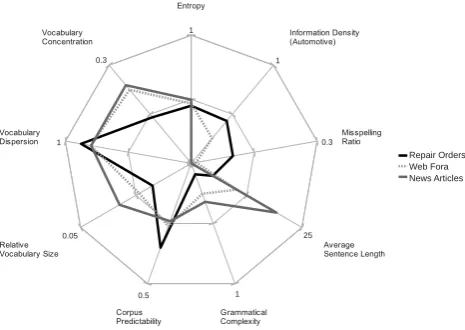
We now apply the textual characteristics described in Sec-tion 2. to three English-language corpora from different genres: English-language news articles from WikiNews2,posts to automotive web fora, and automotive repair orders. News articles were chosen as much scientific work focuses on then, posts to web fora are of increasing importance for web mining, and repair orders, which are scientifically not covered yet, are highly relevant for many manufactur-ing companies. Furthermore, news articles, posts to web fora and repair orders reflect an increasing level of
genre-specific language. As textual characteristics are partly
in-fluenced by corpus size, language statistics are calculated on three million token samples belonging to randomly cho-sen cho-sentences for each corpus.
In Figure 1 the increasing level of genre-specific language becomes evident. Relative vocabulary size is very small for repair orders, reflecting the restricted and highly genspecific language. The high vocabulary dispersion in re-pair orders is an indication for a low spelling accuracy. In-terestingly, the level of grammatical complexity and aver-age sentence length decreases greatly from news to web fora to repair orders; repair orders tend to be expressed in short and simply structured phrases. A surprising out-come is the small vocabulary concentration of repair orders, which is explained by the low frequency of function words. While the top 10 most frequent words of news and posts to web fora mainly include function words, the most frequent words of repair orders also include meaningful “content” words, which are also expressed by synonyms. Repair or-der’s vocabulary concentration is higher if calculated using the top 100 most frequent words instead of the top 10.
originating from different genres and domains and to es-timate the transferability of NLP methods and algorithms from one corpus to another. We do not consider this set to be complete or perfectly adequate for every language engi-neering process, but we appeal to the scientific community to contribute to it and to provide feedback, so that over time a standard can be established. We measured textual charac-teristics on corpora from three different genres and derived their language engineering fingerprint. In a case study we have shown, how textual characteristics may give guide to select appropriate algorithms for a successful information extraction system on a highly specific genre: automotive repair orders.
6.
References
Chris Biemann. 2006. Unsupervised Part-of-Speech Tag-ging Employing Efficient Graph Clustering. In Proceed-ings of the 21st International Conference on Computa-tional Linguistics (COLING) / Association for
Compu-tational Linguistics (ACL) Student Research Workshop,
pages 7–12.
Thorsten Brants. 2000. TnT – a statistical part-of-speech tagger. In Proceedings of the 6th Conference Applied
Natural Language Processing (ANLP), pages 224–231.
Eric Brill. 1992. A simple rule-based part of speech tagger.
InProceedings of the 3rd Conference on Applied Natural
Language Processing (ANLP), pages 112–116.
Hamish Cunningham. 1999. A definition and short history of language engineering. Natural Language Engineer-ing, 5:1–16, March.
Gerard Escudero, Llu´ıs M`arquez, and German Rigau. 2000. An empirical study of the domain dependence of supervised word sense disambiguation systems. In Pro-ceedings of the Joint Conference on Empirical Methods in Natural Language Processing and Very Large
Cor-pora (EMNLP/VLC), pages 172–180.
Jess Gim´enez and Llu´ıs M´arquez. 2004. SVMTool: A general POS tagger generator based on support vector machines. InProceedings of the 4th International
Con-ference on Language Resources and Evaluation (LREC),
pages 43–46.
Robert Gunning. 1952. The Technique of Clear Writing. McGraw-Hill, New York.
Christian H¨anig and Martin Schierle. 2009. Relation ex-traction based on unsupervised syntactic parsing. In Ger-hard Heyer, editor, Proceedings of the Conference on
Text Mining Services (TMS), pages 65–70.
Christian H¨anig, Stefan Bordag, and Uwe Quasthoff. 2008. UnsuParse: Unsupervised parsing with unsupervised part of speech tagging. InProceedings of the 6th
Inter-national Language Resources and Evaluation (LREC),
pages 1109–1114.
David Holmes. 1994. Authorship attribution. Computers
and the Humanities, 28:87–106.
Miguel Hormaz´abal. 2007. Implemation of a factored parser for the automatic classification of customer reports. Master’s thesis, Eberhard Karls University T¨ubingen.
Dan Klein and Christopher D. Manning. 2003a. Accurate unlexicalized parsing. InProceedings of the 41st Annual
Meeting of the Association for Computational
Linguis-tics (ACL), pages 423–430.
Dan Klein and Christopher D. Manning. 2003b. Fast ex-act inference with a fex-actored model for natural language parsing. Advances in Neural Information Processing
Systems, 15:3–10.
Ronny Melz and Thomas Wittig. 2007. Universal regulari-ties of language statistics. InStatistical Physics of Social Dynamics: Opinions, Semiotic Dynamics, and Laguage,
Satellite Workshop of STATPHYS 2007.
Martin Schierle, Sascha Schulz, and Markus Ackermann. 2008. From spelling correction to text cleaning – using context information. Data Analysis, Machine Learning
and Applications, pages 397–404.
Martin Schierle. 2011. Language Engineering for
Infor-mation Extraction. Ph.D. thesis, Leipzig University.
Helmut Schmid. 1994. Probabilistic part-of-speech tag-ging using decision trees. In Proceedings of the Inter-national Conference on New Methods in Language
Pro-cessing (ICNLP), pages 44–49.
Satoshi Sekine. 1997. The Domain Dependence of Pars-ing. In Proceedings of the 5th Conference on Applied
Natural Language Processing (ANLP), pages 96–102.
Marie Tˇeˇsitelov´a. 1992. Quantitive Linguistics. John Ben-jamins Publishing Company, Amsterdam/Philadelphia. Kristina Toutanova, Dan Klein, Christopher D. Manning,
and Yoram Singer. 2003. Feature-rich part-of-speech tagging with a cyclic dependency network. In Proceed-ings of the Human Language Technologies: North Amer-ican Chapter of the Association for Computational
Lin-guistics (HLT-NAACL), pages 173–180.
Daniel Trabold. 2007. Konzeption und Realisierung eines multilingualen Systems zur Erkennung benannter Entit-ten. Master’s thesis, Leipzig University.
Dong Wang and Yang Liu. 2011. A cross-corpus study of unsupervised subjectivity identification based on cal-ibrated em. In Proceedings of the 2nd Workshop on Computational Approaches to Subjectivity and Sentiment
Analysis (WASSA), pages 161–167.