© 2018 IJSRCSEIT | Volume 3 | Issue 3 | ISSN : 2456-3307
A Dynamic Method in the Cloud for Providing Data Security
Sarlarangaswamy1, Dr. U. Vidya Sagar2
1P G Student, Department of CSE.,St.John’s College of Engineering and Technology, Yerrakota, Andhra
Pradesh, India
2Professor & HOD, Department of CSE, St.John’s College of Engineering and Technology, Yerrakota, Andhra
Pradesh, India
ABSTRACT
Most present security arrangements depend on border security. In any case, Cloud computing breaks the association edges. At the point when data dwells in the Cloud, they live outside the hierarchical limits. This leads clients to a loos of control over their data and raises sensible security worries that back off the reception of Cloud computing. Is the Cloud specialist co-op getting to the data? Is it authentically applying the entrance control arrangement characterized by the client? This paper exhibits a data-driven access control arrangement with advanced part based expressiveness in which security is centeredaround ensuring client data in any case the Cloud specialist co-op that holds it. Novel character based and intermediary re-encryption methods are utilized to ensure the approval display. Data is scrambled and approval rules are cryptographically ensured to safeguard client data against the specialist co-op access or rowdiness. The approval demonstrate gives high expressiveness part progressive system and asset pecking order bolster. The arrangement exploits the rationale formalism gave by Semantic Web advances, which empowers propelled lead administration like semantic clash recognition. A proof of idea usage has been produced and a working prototypical arrangement of the proposition has been coordinated inside Google administrations.
Keywords: Data-centric security, Cloud computing, Role-based access control, Authorization.
I.
INTRODUCTION
Security is one of the fundamental client worries for the reception of Cloud computing. Moving data to the Cloud more often than not infers depending on the Cloud Service Provider (CSP) for data insurance. Despite the fact that this is generally overseen in view of lawful or Service Level Agreements (SLA), the CSP could possibly get to the data or even give it to outsiders. Additionally, one should believe the CSP to really apply the entrance control rules characterized by the data proprietor for different clients. The issue turns out to be significantly more mind boggling in Inter-cloud situations where data may spill out of one CSP to another. Clients may misfortune control on their data. Indeed, even the
trust on the united CSPs is outside the control of the data proprietor. This circumstance prompts reexamine about data security approaches and to move to a data-driven approach where data are self ensured at whatever point they live.
customers. The issue ends up being considerably more erratic in Inter-cloud circumstances where data may spill out of one CSP to another. Customers may disaster control on their data. Without a doubt, even the trust on the bound together CSPs is outside the control of the data proprietor. This situation prompts to reexamine about data security approaches and to move to a data driven approach where data are self-guaranteed at whatever point they live. Encryption is the most for the most part used procedure to guarantee data in the Cloud. Honestly, the Cloud Security Alliance security bearing recommends data to be guaranteed still, in development and being utilized [1]. Encoding data keeps up a key separation from undesired gets to. In any case, it includes new issues related to get the opportunity to control organization. A run based approach would be alluring to give expressiveness. Regardless, this accept a noteworthy test for a data driven approach since data has no count capacities free from any other individual. It isn't prepared to approve then again figure any get the opportunity to control lead or system. This raises the issue of game plan decision for a self-secured data package: who should survey the rules upon a get the chance to inquire? The to begin with choice is have them surveyed by the CSP, yet, it could possibly evade the models. Another decision is have rules evaluated by the data proprietor, however this induces either data couldn't be shared or the proprietor should be online to take a decision for each get the chance to inquire.
To defeat the beforehand specified issues, a couple of suggestions [2] [3] [4] endeavor to give data driven game plans in perspective of novel cryptographic segments applying Attribute based Encryption (ABE) [5]. These game plans rely upon Quality based Access Control (ABAC), in which benefits are yielded to customers according to a course of action of attributes. There is a long standing practical discourse in the IT social order about whether Part based Access Control (RBAC) [6] or ABAC is an unrivaled show for endorsement [7] [8] [9].Without
going into this wrangle about, the two approachs have their own specific favorable circumstances and disservices.
To the best of our knowledge, there is no data driven approach giving a RBAC model to get the opportunity to control in which data is encoded and selfensured. The recommendation in this paper accept a first response for a data driven RBAC approach, offering an other alternative to the ABAC show. A RBAC approach would be closer to current get the opportunity to control systems, coming to fruition more general to apply for get the opportunity to control approval than ABEbased parts. As far as expressiveness, it is said that ABAC supersedes RBAC since parts can be addressed as characteristics. Regardless, concerning data driven techniques in which data is encoded, ABAC courses of action are constrained by the expressiveness of ABE designs. The cryptographic tasks used as a piece of ABE usually confine the level of expressiveness for get the chance to control rules. For instance, part movement and challenge levels of leadership limits can't be refined by current ABE designs. Furthermore, they generally speaking don't have some mix with a customer driven approach for the get the opportunity to control game plan, where standard endorsement related segments like significance of customers or part assignments could be shared by unmistakable bits of data from comparable data proprietor.
endorsement show, giving more expressiveness to the rules by engaging the significance of fundamental however competent principles that apply to a couple of customers and resources because of advantage expansion through parts and levels of leadership. Technique oversee points of interest are in light of Semantic Web headways that enable enhanced represent definitions and pushed methodology organization features like conflict area. A data driven approach is used for data confidence, where novel criptograhpic techniques for instance, Proxy Re-Encryption (PRE) [10], Identity-Based Re-Encryption (IBE) [11] and Identity-Based Proxy Re-Encryption (IBPRE) [12] are used. They allow to re-encode data beginning with one key then onto the following without getting access and to use identities in cryptographic tasks. These frameworks are used to secure both the data and the endorsement illustrate. All of data is figured with its own specific encryption key associated with the endorsement model and rules are cryptographically secured to ensure data against the expert association get to or awful direct while surveying the standards. It also unites a customer driven approach for endorsement rules, where the data proprietor can describe a united get the chance to control plan for his data. The game plan engages a run based approach for endorsement in Cloud structures where rules are under control of the data proprietor and get the chance to control count is designated to the CSP, yet making it not ready to enable access to unapproved parties.
II.
DATA-CENTRIC SOLUTION FOR DATA
PROTECTION IN THE CLOUD
In the secured approval demonstrate determined that data isn't scrambled with the data proprietor character, yet with the protest's own personality (e.g. ido1). This takes after a datacentric approach for data insurance, in which data is scrambled with its own key under the cryptographic plan. In the event that an unadulterated PRE plot were utilized, the protest would be likewise scrambled utilizing its own
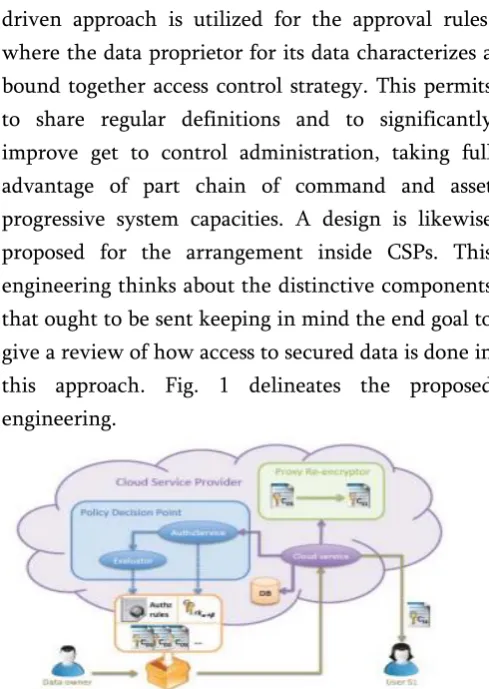
particular key combine. On another hand, a client driven approach is utilized for the approval rules, where the data proprietor for its data characterizes a bound together access control strategy. This permits to share regular definitions and to significantly improve get to control administration, taking full advantage of part chain of command and asset progressive system capacities. A design is likewise proposed for the arrangement inside CSPs. This engineering thinks about the distinctive components that ought to be sent keeping in mind the end goal to give a review of how access to secured data is done in this approach. Fig. 1 delineates the proposed engineering.
Figure 1. Architecture for Deployment in a CSP
give a review of how access to secured data is done in this approach. Figure 1 delineates the proposed engineering.
III.
RELATED WORK
Distinctive methodologies can be found in the writing to hold control over approval in Cloud computing. In [13] creators propose to keep the approval choices taken by the data proprietor. The entrance show isn't distributed to the Cloud yet kept secure on the data proprietor premises. Be that as it may, in this approach, the CSP turns into a minor stockpiling framework and the data proprietor ought to be online to process get to demands from clients. Another approach from [14] manages this issue by empowering a module instrument in the CSP that enables data proprietors to send their own particular security modules.
This licenses to control the approval instruments utilized inside a CSP. Nonetheless, it doesn't build up how the approval model ought to be ensured, so the CSP could possibly gather data and access the data. In addition, this approach does not cover Inter-cloud situations, since the module ought to be sent to various CSPs. Also, these methodologies don't secure data with encryption techniques. In the proposed SecRBAC arrangement, data encryption is utilized to keep the CSP to get to the data or to discharge it bypassing the approval component. Be that as it may, applying data encryption suggests extra difficulties identified with approval expressiveness. Following a direct approach, one can incorporate data in a bundle scrambled for the proposed clients. This is generally done when sending a record or archive to a particular beneficiary and guarantees that exclusive the collector with the suitable key can decode it. From an approval perspective, this can be viewed as a straightforward lead where just the client with benefit to get to the data will have the capacity to decode it (i.e. the one owning the key). Be that as it may, no entrance control expressiveness is given by
this approach. Just that straightforward lead can be implemented and only one single govern can apply to every datum bundle. Therefore, various scrambled duplicates ought to be made so as to convey similar data to various beneficiaries. To adapt to these issues, SecRBAC takes after a data-driven approach that can cryptographically secure the data while giving access control capacities.
of AND-ed OR-ed qualities. The data-driven arrangement displayed in this paper goes a stage forward as far as expressiveness, giving a control based approach following the RBAC conspire that isn't fixing to the impediments of current ABE approaches.
Distinctive proposition have been likewise created to endeavor to reduce ABE expressiveness constraints. Creators in [15] propose an answer in view of CP-ABE with help for sets of characteristics called Ciphertext Policy Attribute Set Based Encryption (CP-ASBE). Qualities are sorted out in a recursive set structure and access approaches can be characterized upon a solitary set or consolidating properties from numerous sets. This empowers the meaning of compound properties and determination of strategies that influence the traits of a set. An approach named Hierarchical Attribute-based Encryption is exhibited in [16]. It utilizes a various leveled age of keys to accomplish fine-grain get to control, versatility and appointment.
Nonetheless, this approach suggests that a similar root space specialist ought to oversee traits. In [17], creators broaden CP-ASBE with a progressive structure to clients keeping in mind the end goal to enhance adaptability and adaptability. This approach gives a various leveled answer for clients inside an area, which is accomplished by a progressive key structure. Another approach is Flexible and Efficient Access Control Scheme (FEACS) [2]. It depends on KP-ABE and gives an entrance control structure spoke to by an equation including AND, OR and NOT, empowering more expressiveness for KP-ABE.
IV.
CONCLUSION
A data-driven approval arrangement has been proposed for the secure insurance of data in the Cloud. SecRBAC permits overseeing approval following an administer based approach and gives enhanced part based expressiveness including part
and question chains of importance. Access control calculations are appointed to the CSP, being this unfit to get to the data, as well as unfit to discharge it to unapproved parties. Progressed cryptographic systems have been connected to secure the approval demonstrate. A re-encryption key supplement every approval govern as cryptographic token to ensure data against CSP trouble making. The arrangement is autonomous of any PRE plan or execution to the extent three particular highlights are upheld. A solid IBPRE plot has been utilized as a part of this paper with a specific end goal to give a complete and practical arrangement. A proposition in light of Semantic Web advances has been uncovered for the portrayal and assessment of the approval display. It makes utilization of the semantic highlights of on tologies and the computational abilities of reasoners to determine and assess the model. This likewise empowers the utilization of cutting edge strategies, for example, strife discovery and determination techniques. Rules for arrangement in a Cloud Service Provider have been likewise given, including a half and half approach perfect with Public Key Cryptography that empowers the use of standard PKI for key administration and circulation. A prototypical execution of the proposition has been additionally created and uncovered in this paper, together with some exploratory outcomes. Future lines of research incorporate the examination of novel cryptographic methods that could empower the secure alteration and cancellation of data in the Cloud. This would permit broadening the benefits of the approval show with more activities like adjust and erase. Another fascinating point is the muddling of the approval display for protection reasons. In spite of the fact that the utilization of nom de plumes proposed progressed.
V.
REFERENCES
[2]. Y. Zhang, J. Chen, R. Du, L. Deng, Y. Xiang, and Q. Zhou, "Feacs: A flexible and efficient access control scheme for cloud computing," in Trust, Security and Privacy in Computing and Communications,2014 IEEE 13th International Conference on, Sept 2014, pp. 310–319.
[3]. B. Waters, "Ciphertext-policy attribute-based encryption: An expressive, efficient, and provably secure realization," in Public Key Cryptography - PKC 2011, 2011, vol. 6571, pp. 53–70.
[4]. B. B and V. P, "Extensive survey on usage of attribute based encryption in cloud," Journal of Emerging Technologies in Web Intelligence, vol. 6, no. 3, 2014.
[5]. V. Goyal, O. Pandey, A. Sahai, and B. Waters, "Attribute-based encryption for fine-grained access control of encrypted data," in Proceedings of the 13th ACM Conference on Computer and Communications Security, ser. CCS ’06, New York, NY, USA, 2006, pp. 89–98. [6]. InterNational Committee for Information Technology Standards, "INCITS 494-2012 - information technology - role based access control - policy enhanced," INCITS, Standard, Jul. 2012. 7E. Coyne and T. R. Weil, "Abac and rbac: Scalable, flexible, and auditable access management," IT Professional, vol. 15, no. 3, pp. 14–16, 2013.
[7]. Empower ID, "Best practices in enterprise authorization: The RBAC/ABAC hybrid approach," Empower ID, White paper, 2013. [8]. D. R. Kuhn, E. J. Coyne, and T. R. Weil,
"Adding attributes to role based access control," Computer, vol. 43, no. 6, pp. 79–81, 2010. [9]. G. Ateniese, K. Fu, M. Green, and S.
Hohenberger, "Improved Proxy Re-encryption schemes with applications to secure distributed storage," ACM Transactions on Information and System Security, vol. 9, no. 1, pp. 1–30, 2006.
[10]. F. Wang, Z. Liu, and C. Wang, "Full secure identity-based encryption scheme with short
public key size over lattices in the standard model," Intl. Journal of Computer Mathematics, pp. 1–10, 2015.
[11]. M. Green and G. Ateniese, "Identity-based proxy re-encryption," in Proceedings of the 5th International Conference on Applied Cryptography and Network Security, ser. ACNS ’07. Berlin, Heidelberg: Springer-Verlag, 2007, pp. 288–306.
[12]. A. Lawall, D. Reichelt, and T. Schaller, "Resource management and authorization for cloud services," in Proceedings of the 7th International Conference on Subject-Oriented Business Process Management, ser. S-BPM ONE ’15, New York, NY, USA, 2015, pp. 18:1– 18:8.
[13]. D. Y. Chang, M. Benantar, J. Y.-c. Chang, and V. Venkataramappa, "Authentication and authorization methods for cloud computing platform security," Jan. 1 2015, uS Patent 20,150,007,274.
[14]. R. Bobba, H. Khurana, and M. Prabhakaran,
"Attribute-sets: A practically motivated enhancement to attribute-based encryption," in Computer Security - ESORICS 2009. Springer Berlin Heidelberg, 2009, vol. 5789, pp. 587– 604.
About Authors:
SARLA RANGASWAMY is current pursuing M.Tech in CSE. dept., St.John’s College of Engineering and Technology, Yerrakota, Yemmiganur, Kurnool (Dist.)-518 360, AP.