CSEIT1833446 | Received : 15 March 2018 | Accepted : 31 March 2018 | March-April-2018 [ (3 ) 4 : 975-978 ]
International Journal of Scientific Research in Computer Science, Engineering and Information Technology © 2018 IJSRCSEIT | Volume 3 | Issue 4 | ISSN : 2456-3307
975
Drowsy Driver Detection System
Gude Ramarao 1, S.Somnath2, D.V.Sashidhar Yadav2
1Associate Professor, Department of ECE, G.Pullaiah College of Engineering and Technology, Pudur, Andhra Pradesh, India
2B. Tech, G. Pullaiah College of Engineering And Technology, Pudur, Andhra Pradesh, India
ABSTRACT
Every year the amounts of deaths and injuries are increasing in traffic accidents due to human errors. Drowsiness and driving is a very hazardous and it is very difficult to identify. After alcohol drowsiness is the second leading cause of the road accidents. People are conscious about the risk of drinking and driving but don't realize the dangerous of drowsiness because no instruments exist to measure the driver drowsiness. This paper presents a new approach towards automobile safety and security. In recent time's automobile fatigue related crashes have really magnified. In order to minimize these issues, we have incorporated an improved sleep detection and driver alert system by monitoring the driver's eyes. This describes how to find and track the eyes. We also describe a method that can determine if the eyes are open or closed. The main criterion of this system is that it must be highly non-intrusive and it should start when the ignition is turned on without having at the driver initiate the system. Nor should the driver be responsible for providing any feedback to the system. The system must also operate regardless of the texture and the color of the face. It must also be able to handle diverse condition such as changes in light, shadows, reflections etc. In given paper a drowsy driver warning system using image processing.
Keywords: Face, Accuracy, Vehicles, Feature extraction, Fatigue, Face detection.
I.
INTRODUCTION
Improvement of public safety and the reduction of accidents are of the important goals of the Intelligent Transportation Systems (ITS).Driver fatigue is a significant factor in a large number of vehicle accidents. The development of technologies for detecting or preventing drowsiness at the wheel is a major challenge in the field of accident avoidance systems. Because of the hazard that Drowsiness presents on the road, methods need to be developed for counteracting its affects .The aim of this project is to develop a prototype drowsiness detection system. The focus will be placed on designing a system that will accurately monitor the open or closed state of the driver’s eyes in real-time. In today’s world where science has made amazing advances so have the
This paper involves controlling accident due to unconscious through Eye blink. Here one eye blink sensor is fixed in vehicle where if driver looses conscious and indicate through buzzer.
II.
DEFINING DROWSINESS
The term “drowsy” is synonymous with sleepy, which simply means an inclination to fall asleep. The stages of sleep can be categorized as awake, non-rapid eye movement sleep (NREM), and non-rapid eye movement sleep (REM). The second stage, NREM, can be subdivided into the following three stages . Stage I: transition from awake to asleep (drowsy) Stage II: light sleep Stage III: deep sleep. In order to analyze driver drowsiness, researchers have mostly studied Stage I, which is the drowsiness phase. The crashes that occur due to driver drowsiness have a number of characteristics: Occur late at night (0:00 am–7:00 am) or during mid-afternoon (2:00 pm–4:00 pm), Involve a single vehicle running off the road, Occur on high-speed roadways, Driver is often alone, Driver is often a young male, 16 to 25 years old, No skid marks or indication of braking. Statistics derived using these criteria cannot account fully for accidents caused by drowsiness because of the complexity involved; therefore, accidents that can be attributed to driver drowsiness may be more devastating than the statistics reveal. Hence, in order to avoid these types of accidents, it is necessary to derive effective measures to detect driver drowsiness and alert the driver.
III. ALGORITHM
Drowsiness of a person can be measured by the extended period of time for which his/her eyes are in closed state. In our system, primary attention is given to the faster detection and processing of data. The number of frames for which eyes are closed is monitored. If the number of frames exceeds a certain value, then a warning message is generated on the display showing that the driver is feeling drowsy.
3.1 Image sequence input
In image processing, it is defined as the action of retrieving an image from some source, usually a hardware-based source for processing. It is the first step in the workflow sequence because, without an image, no processing is possible.
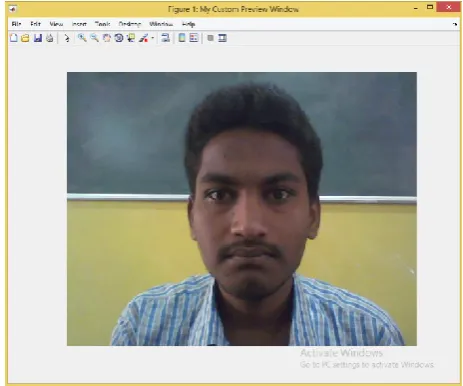
In our algorithm, first the image is acquired by the webcam for processing. Then we use the Haarcascade file face to search and detect the faces in each individual frame. If no face is detected then another frame is acquired. If a face is detected, then a region of interest in marked within the face. This region of interest contains the eyes. Defining a region of interest significantly reduces the computational requirements of the system. After that the eyes are detected from the region of interest by using Haarcascade.
BLOCK DIAGRAM
vobj=videoinput( 'winvideo',2,'YUY2_640x480','Retu rnedColorSpace','rgb');
figure('Name','My Custom Preview Window'); uicontrol('string','close','callback','close(gcf)');
% create an image object for previewing
hImage=image(zeros(vidRes(2),vidRes(1),nBands)); preview(vobj,hImage);
Figure 1. preview of image input
3.2 Face detection
In this stage we detect the region containing the face of the driver. A specified algorithm for detection of face in every frame. By face detection we means that locating the face in a frame or in other words finding location of facial characters through a type of technology with the use of computer. The frame may be any random frame. Only facial related structures or features are detected and all others types of objects like buildings, tree, bodies are ignored. We know that face is also a type of object. So we can consider detection of face as a particular case of object detection. In this type of class detection, we try to know where the objects in the interest image are located and what is their size which may belongs to a particular class. The work of algorithm that is made for face detection is mostly concentrated on finding the front side of the face. But the algorithms that are developed recently focus on more general cases. For our case it may be face in the tilted position or any other portion of the faces and also it finds the possibility of multiple faces. Which means the rotation axis with respect to the present observer from the reference of face in a particular? Or even if there is vertical rotation plane then also it is able to solve the purpose. In new type of algorithm it is
consider that the picture or video is a variable which means that different condition in them like hue contrast may change its variance. The amount of light may also affect. Also the position of the input may vary the output. Many calculations actualize the face-detection assignment as a two way pattern-differentiation task. of eye in the required particular region with the use of detection of several features. Generally Eigen approach is used for this process. It is a time taking process. When eye detection is done then the result is matched with the reference or threshold value for deciding the state of the driver.
Poor contrast of eyes generally creates lots of problem in its detection. After successful detection of face eye needs to be detected for further processing. In our method eye is the decision parameter for finding the state of the driver. Though detection of eye does not look complex but the actual process is quite hectic. In this case it performs the detection of eye in the specified region with the use of feature
subplot(1,2,2),imshow(EyeRegion),title('EYE REGION');
else
FlagEyes=0; end;
Figure 2. Detecting Eyes Result
To obtain the result large number of videos were taken and their accuracy in determining eye blinks and drowsiness was tested.
For this project we used a 0.3 mega pixel webcam connected to the computer. The webcam required white LEDs attached to it for providing better illumination. In real time scenario, infrared LEDs should be used instead of white LEDs so that the system is non-intrusive. Buzzer is used to produce alert sound output in order to wake up the driver when drowsiness exceeds a certain threshold.
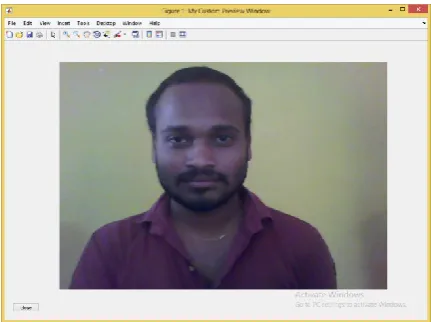
Figure 3. person with activeness
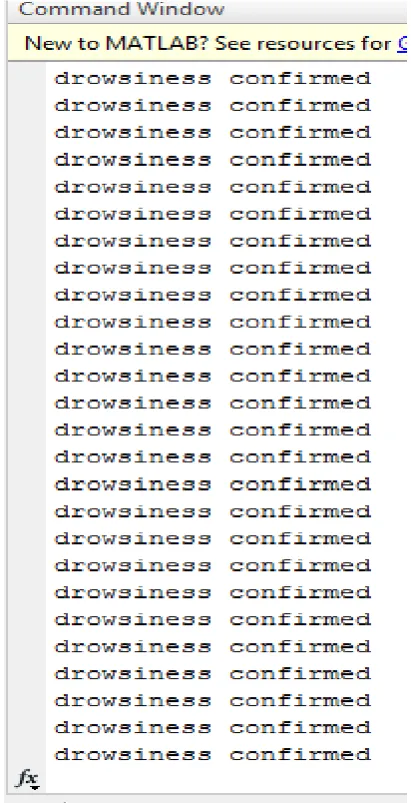
Figure 5. Person with drowsiness
The system was tested for different people in different ambient lighting conditions (daytime and night-time). When the webcam backlight was turned ON and the face is kept at an optimum distance, then the system is able to detect blinks as well as drowsiness with more than 90% accuracy. This is a good result and can be implemented in real time systems as well.
Sample outputs for various conditions in various images are given below. Videos were taken; in which both face and eyes were detected. Though the two processors have relatively equal accuracy.
Limitations
a) Dependence on ambient light.
must be taken care of. In real time scenario infrared backlights should be used to avoid poor lighting conditions.
b) Optimum range required
When the distance between face and webcam is not at optimum range then certain problems are arising, When face is away from the webcam (more than 70cm) then the backlight is insufficient to illuminate the face properly. So eyes are not detected with high accuracy which shows error in detection of
Considering the above difficulties, the optimum distance range for drowsiness detection is set to 40-70cm.
c) Hardware requirements
Our system was run in a PC with a configuration of 2.2GHz and 2GB RAM Pentium dual core processor.Though the system runs fine on higher configurations, when a system has an inferior configuration, the system may not be smooth and drowsiness detection will be slow.
d) Delay in sounding alarm
When drowsiness level exceeds a certain threshold, an alarm is produced by a system speaker. There is a significant delay between when drowsiness is detected and when system generates the alarm. But in real time, drowsiness is a continuous phenomenon rather than a one off occurrence. So the delay is not that problematic.
e) Poor detection with spectacles
When the driver wears glasses the system fails to detect eyes which are the most significant drawback of our system. This issue has not yet been resolved
and is a challenge for almost all eye detection systems designed so far.
f) Problems with a multiple faces
If more than on face is detected by the webcam, then our system gives an erroneous result. This problem is not important as we want to detect the drowsiness of a single driver.
Future works
In real time driver fatigue detection system it is required to slow down a vehicle automatically when fatigue level crosses a certain limit. Instead of threshold drowsiness level it is suggested to design a continuous scale driver fatigue detection system. It monitors the level of drowsiness continuously and when this level exceeds a certain value a signal is generated which controls the hydraulic braking system of the vehicle
Hardware components required
1. Dedicated hardware for image acquisition processing and display.
2. Interface support with the hydraulic breaking system which includes relay, timer, stepper motor and a linear actuator.
Function
they are localized. This would avoid the trade-off between having a wide field of view in order to locate the eyes , and narrow view in order to detect fatigue.
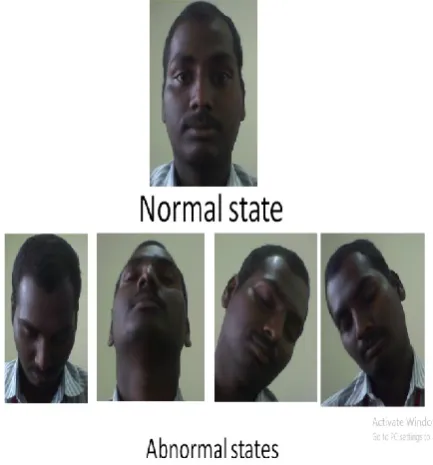
Figure 6. Detection of drowsiness in various angles. This system only looks at the number of consecutive frames where the eyes are closed. At that point it may be too late to issue the warning. By studying eye movement patterns, it is possible to find a method to generate thee warning sooner. Using 3D images is back. If little light is being reflected, the intensity of the light is increased. Darker skinned individual need much more light, so that when the binary image is constructed, the face is white, and the back ground is black.
IV. CONCLUSIONS
In this paper, we have reviewed the various methods available to determine the drowsiness state of a driver. Although there is no universally accepted definition for drowsiness, the various definitions and the reasons behind them were discussed. This paper also discusses the various ways in which drowsiness can be manipulated in a simulated environment. The various measures used to detect drowsiness include subjective, vehicle-based, physiological and behavioural measures; these were also discussed in detail and the advantages and disadvantages of each measure were described. Although the accuracy rate of using physiological measures to detect drowsiness is high, these are highly intrusive. However, this intrusive nature can be resolved by using contactless electrode placement. Hence, it would be worth fusing physiological measures, such as ECG, with behavioural and vehicle-based measures in the development of an efficient drowsiness detection system. In addition, it is important to consider the driving environment to obtain optimal results.
V.
REFERENCES
[1]. Ralph Oyini Mbouna, Seong G. Kong, SeniorMember,IEEE,(2013),Visual Analysis of Eye State and Head Pose for Driver Alertness Monitoring, (IEEE),pp.1462-1469,vol.14,USA [2]. S. Vitabile, A. De Paola, F. Sorbello, J Ambient
Intell Human Comput, "A real-time non-intrusive FPGA-based Drowsiness system" Springer, pp.251-262, University of Palermo, Italy 2011
[3]. Road safety information, rospa, "driver fatigue and road accidents",www.rospa.com, 2011 [4]. Arun Sahayadhas,Kenneth Sundaraj,"Detecting
Driver Drowsiness Based on Sensors A Review",pp.16937-16953, ISSN 1424-8220,
Malaysia 2012
[5]. Anirban dasgupta,anjith george,"A Vision Based System For Monitoring The Loss Of Attention in Automotive Drivers",(IEEE Transaction),vol.14,no.4 2013
[6]. AntoinePicot,SylvieCharbonnier,"On-Line Detection of Drowsiness Using Brain and Visual Information",IEEE Transaction on systems, man and cybernetics part a: systems and humans, VOL. 42, NO. 3,2012
[7]. Boon-Giin Lee and Wan-Young Chung, "Driver Alertness Monitoring Using Fusion of Facial Features and Bio-Signals", (IEEE) Sensors journal, vol. 12, no. 7,2012
[8]. Ralph Oyini Mbouna, Seong G. Kong, Senior Member, "Visual Analysis of Eye State and
Head Pose for Driver
AlertnessMonitoring",IEEE transactions on intelligent transportation systems, VOL. 14, NO. 3 2013
[9]. Rami N. Khushaba, Sarath Kodagoda, Sara Lal, and Gamini Dissanayake,"Driver Drowsiness Classification Using Fuzzy Wavelet-Packet-Based Feature-Extraction Algorithm", (IEEE) Transactions vol. 58, no. 1, 2011.
[10]. Raoul Lopes , D.J Sanghvi, Aditya Shah,"Drowsiness Detection based on Eye Movement, Yawn Detection and Head Rotation", Vol. 2, No.6,2012
[11]. Wei Zhang, Bo Cheng, Yingzi Lin," Driver Drowsiness Recognition Based on Computer Vision Technology",(IEEE) Vol.17, No.3, 2012. [12]. Karamjeet Singh,Rupinder Kaur,"Physical and
Physiological Drowsiness Detection Methods", IJIEASR, pp.35-43,vol.2,2013.
[13]. Dr. Xiong (Bill) Yu, P.E.,"Non-Contact Driver Drowsiness Detection System",(safety IDEA),2012
[14]. Di Huang, Student Member, IEEE, Caifeng Shan, Member, IEEE,"Local Binary Patterns and Its Application to Facial Image Analysis A Survey",(IEEE ),pp.765- 781,vol.41,2011.http://www.scholarpedia.org/a rticle/Local_Binary_P atterns
[15]. http://www.tytlabs.com/images/tech/photo/tec 3_detail_ph08-1.jpg
[16]. Jarek Krajewski,David Sommer,"Steering Wheel Behavior Based Estimation Of Fatigue", Fifth International Driving Symposium on Human Factors in Driver Assessment, Training and Vehicle Design, Germany.
[17]. L. Bergasa, J. Nuevo, M. Sotelo, R. Barea, and M. Lopez ,"RealTime System for Monitoring Driver Vigilance", (IEEE) Transactions on Intelligent Transportation Systems, Vol. 7, no. 1, March 2006
[18]. Artem A. Lenskiy and Jong-Soo Lee, "Driver’s Eye Blinking Detection Using Novel Color and Texture Segmentation Algorithms", International Journal of Control, Automation, and Systems,pp.317-327, 2012
[19]. Amol M. Malla, Paul R. Davidson, Philip J. Bones, Richard Green and Richard D. Jones,"Automated Video-based Measurement of Eye Closure for Detecting Behavioral Microsleep", presented at 32nd Annual International Conference of the IEEE EMBS Buenos Aires, Argentina 2010
[20]. http://www.medialt.no/pub/uikt/u2010/011-Krolak/index.html
[21]. Shivangi R.Mishra, Prof. S. B. Somani, Pranjali Deshmukh, Daman Soni, "EEG Signal Processing and Classification of Sensorimoter rhythm-based BCI",(IJERT),International Journal of Engineering Research & Technology Vol. 1 Issue 4, 2012
[22]. Behnoosh Hariri, Shabnam Abtahi,Shervin Shirmohammadi , LucMartel," A Yawning Measurement Method to Detect Driver Drowsiness ".Vandna Saini et al, / (IJCSIT) International Journal of Computer Science and Information Technologies, Vol. 5 (3) , 2014, 4245-4249 www.ijcsit.com 4248
[24]. R.sukanesh, V.vijayprasath, "Certain Investigations on Drowsiness Alert system based on Heart Rate Variability using labview" E-ISSN:2224-3402, Issue 11, Volume 10, November 2013
[25]. Parris, J., et.al, "Face and eye detection on hard datasets," Biometrics (IJCB), International Joint Conference on , vol., no., pp.1,10, 11-13Oct. 2011
[26]. Goel, P, et.al., "Hybrid Approach of Haar Cascade Classifiers and Geometrical Properties of Facial Features Applied to Illumination Invariant Gender Classification System," Computing Sciences (ICCS), 2012 International Conference on , vol., no., pp.132,136, 14-15 Sept. 2012