An Improved Hierarchical Word Sequence Language Model Using
Directional Information
Xiaoyi Wu
Nara Institute of Science and Technology Computational Linguistics Laboratory 8916-5 Takayama, Ikoma, Nara Japan
Yuji Matsumoto
Nara Institute of Science and Technology Computational Linguistics Laboratory 8916-5 Takayama, Ikoma, Nara Japan
Abstract
For relieving data sparsity problem, Hierarchi-cal Word Sequence (abbreviated as HWS) lan-guage model, which uses word frequency in-formation to convert raw sentences into spe-cial n-gram sequences, can be viewed as an effective alternative to normal n-gram method. In this paper, we use directional information to make HWS models more syntactically ap-propriate so that higher performance can be achieved. For evaluation, we perform intrin-sic and extrinintrin-sic experiments, both verify the effectiveness of our improved model.
1 Introduction
Probabilistic Language Modeling is a fundamental research direction of Natural Language Processing. It is widely used in many applications such as ma-chine translation (Brown et al., 1990), spelling cor-rection (Mays et al., 1991), speech recognition (Ra-biner and Juang, 1993), word prediction (Bickel et al., 2005) and so on.
Most research about Probabilistic Language Mod-eling, such as back-off (Katz,1987), Kneser-Ney (Kneser and Ney, 1995), and modified Kneser-Ney (Chen and Goodman, 1999), only focus on smooth-ing methods because they all take n-gram approach (Shannon, 1948) as a default setting for extracting word sequences from a sentence. Yet even with 30 years worth of newswire text, more than one third of all trigrams are still unseen (Allison et al., 2005), which cannot be distinguished accurately even us-ing a high-performance smoothus-ing method such as modified Kneser-Ney (abbreviated as MKN). It is
better to make these unseen sequences actually be observed rather than to leave them to smoothing method directly.
For the purpose of extracting more valid word se-quences and relieving data sparsity problem, Wu and Matsumoto (2014) proposed a heuristic approach to convert a sentence into a hierarchical word sequence (abbreviated as HWS) structure, by which special n-grams can be achieved. In this paper, we improve HWS models by adding directional information for achieving higher performance.
This paper is organized as follows. In Section 2, we give a complete review of the HWS language model. We present our improved HWS model in Section 3. In Section 4, we show the effectiveness of our model by several experiments. Finally, we summarize our findings in Section 5.
2 Review of HWS Language Model
The HWS language model is defined as follows. Suppose that we have a frequency-sorted vocab-ulary list V = {v1, v2, ..., vm}, where C(v1) ≥ C(v2)≥...≥C(vm)1.
According to V, given any sentence S=w1, w2, ..., wn, the most frequently
used word wi∈S(1≤i≤n) can be
se-lected2 for splitting S into two substrings SL=w1, ..., wi−1 and SR=wi+1, ..., wn.
Sim-ilarly, for SL and SR, wj ∈SL(1≤j ≤i−1)
and wk∈SR(i+ 1≤k≤n) can also be
se-lected, by which SL and SR can be splitted
1
C(v)represents the frequency ofvin a certain corpus. 2
Ifwiappears multiple times inS, then select the first one.
449
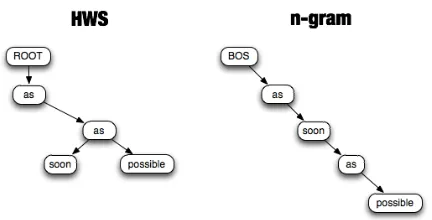
Figure 1: A comparison of structures between HWS and n-gram
into two smaller substrings separately. Ex-ecuting this process recursively until all the substrings become empty strings, then a tree T = ({wi, wj, wk, ...},{(wi, wj),(wi, wk), ...})
can be generated, which is defined as an HWS structure.
In an HWS structureT, assuming that each node depends on its preceding n-1 parent nodes, then spe-cial n-grams can be trained. Such kind of n-grams are defined asHWS-n-grams.
The advantage of HWS models can be considered
as discontinuity. Taking Figure 1 as an example,
since n-gram model is a continuous language model, in its structure, the second ‘as’ depends on ‘soon’, while in the HWS structure, the second ‘as’ depends on the first ‘as’, forming a discontinuous pattern to generate the word ‘soon’, which is closer to our lin-guistic intuition. Rather than ‘as soon ...’, taking ‘as ... as’ as a pattern is more reasonable because ‘soon’ is quite easy to be replaced by other words, such as ‘fast’, ‘high’, ‘much’ and so on. Consequently, even using 4-gram or 5-gram, sequences consist-ing of ‘soon’ and its nearby words tend to be low-frequency because the connection of ‘as...as’ is still interrupted. On the contrary, the HWS model ex-tracts sequences in a discontinuous way, even ‘soon’ is replaced by another word, the expression ‘as...as’ won’t be affected. This is how the HWS models re-lieve the data sparseness problem.
It unsupervisedly construct a hierarchical struc-ture to adjust the word sequence so that irrele-vant words can be filtered out from contexts and long distance information can be used for predict-ing the next word. On this point, it has some-thing in common with structured language model
(Chelba, 1997), which firstly introduced parsing into language modeling. The significant difference is, structured language model is based on CFG parsing structures, while HWS model is based on pattern-oriented structures.
The experimental results reported by Wu and Matsumoto (2014) indicated that HWS model keeps better balance between coverage and usage than nor-mal n-gram and skip-gram models (Guthrie, 2006), which means that more valid sequence patterns can be extracted in this approach.
However, the discontinuityof HWS models also brings a disadvantage. In normal n-gram models, since the generation of words is one-sided (from left to right), given any left-hand context, words gener-ated from it can be considered as linguistically ap-propriate. In contrast, HWS structures are essen-tially binary trees, which also generate words on the left side. However, according to the definition of HWS-n-grams, the directional information are not taken into account, which causes a syntactical prob-lem.
Taking Figure 1 as an example. According to the structure of HWS, HWS-3-grams are trained as
{(ROOT, as, as), (as, as, soon), (as, as, possible)}, where ‘soon’ and ‘possible’ are generated from con-text (as, as) without any distinction, which means, an illegal sentence such like ‘as possible as soon’ can be also generated from this HWS-3-gram model.
3 Directional HWS Models
To solve this problem, we propose to use direc-tional information. As mentioned previously, since HWS structures are essentially binary trees, direc-tional information has already been encoded when HWS structures are established.
mod-Figure 2: An example of HWS structure with directional information
els, we call n-grams trained in our way as
DHWS-n-grams.
In the above example of DHWS-3-grams, (as-R, as-L, soon) indicates that ‘soon’ is located between two ‘as’s, while (as-R, as-R, possible) indicates that ‘possible’ is located on the right side of the second ‘as’. Similarly, if we use DHWS-4-grams or higher order ones, the relative position of each word will be more specific. In other words, according to a DHWS structure, for each word (node), its position (relative to the whole sentence) can be strictly determined by its preceding parent nodes. The biggernis, the more syntactical information DHWS-n-grams can reflect. As for smoothing methods for HWS models, Wu and Matsumoto (2014) only used an additive smoothing. Although HWS-n-grams are trained in a special way, they are essentially n-grams be-cause each trained sequence is reserved as a (n−
1length context, word)tuple as normal n-grams, which makes it possible to apply MKN smoothing to HWS models. The main difference is that HWS models are trained by tree structures while n-gram models in a continuous way, which affects the count-ing of contextsC(wii−−n1+1).
Taking Figure 1 as an example. According to the structure of HWS, HWS-3-grams are trained as
{(ROOT, as, as), (as, as, soon), (as, as, possible)}, while the HWS-2-grams are trained as{(ROOT, as), (as, as), (as, soon), (as, possible)}. In the HWS-3-gram model, as the context of ‘soon’ and ‘possi-ble’, ‘as ... as’ appears twice, however, in the HWS-2-gram model,C(as, as)is counted only once. In normal n-gram models, C(wii−−1n+1) can be directly achieved from its lower model because they are con-tinuous, but in HWS models,C(wii−−n1+1)should be counted as P
wj∈{wi:C(wii−n+1)>0}C(w
i−1
i−n+1, wj), which means that the frequencies of contexts should
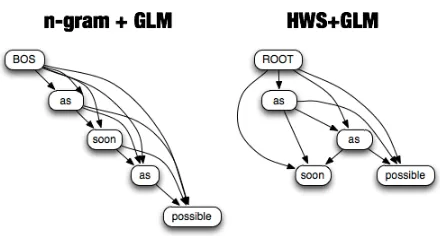
Figure 3: The interpolation of GLM model
Figure 4: A demonstration for applying GLM smoothing to HWS structure
be counted in the model with the same order. Taking this into account, MKN smoothing method can be also applied to HWS models and DHWS models.
As an alternative of MKN smoothing method, we can also use GLM (Pickhardt et. al., 2014). GLM (Generalized Language Model) is a combination of skipped n-grams and MKN, which performs well on overcoming data sparseness. GLM smoothing con-siders all possible combinations of gaps in a local context and interpolates the higher order model with all possible lower order models derived from adding gaps in all different ways. As shown in Figure 3, nstands for the length of normal n-grams for cal-culation, k indicates the number of words actually be used, and the wildcard ’ ’ represents the skipped words in a n-gram.
Since GLM is a generalized version of MKN smoothing, it can also be applied to HWS models (as shown in Figure 4). In the following experiments, we will use MKN and GLM as smoothing methods. To ensure the openness of our research, the source code used for following experiments can be down-loaded.3
3
data contains 1617 sentence pairs. For training lan-guage models, we set English as the target lanlan-guage. As for statistical machine translation toolkit, we use Moses system7to train the translation model and output 50-best translation candidates for each french sentence of the test data. Then we use the 139761 English sentences to train language models. With these models, 50-best translation candidates can be reranked. According to these reranking results, the performance of machine translation system can be evaluated, which also means, the language models can be evaluated indirectly.
We use following two measures for evaluating reranking results.
BLEU(Papineni et al., 2002): BLEU score mea-sures how many words overlap in a given candidate translation when compared to a reference transla-tion, which provides some insight into how good the fluency of the output from an engine will be.
TER(Snover et al., 2006): TER score measures the number of edits required to change a system out-put into one of the references, which gives an indi-cation as to how much post-editing will be required on the translated output of an engine.
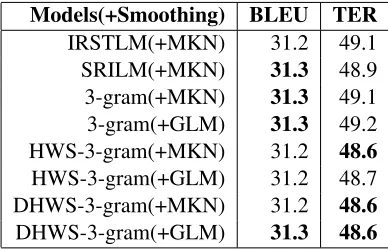
As shown in Table 2, since the results performed by our implementation (3-gram+MKN) is almost the same as that performed by existing language model toolkits IRSTLM8and SRILM9, we believe that our implementation is correct. Based on the results, considering both BLEU and TER score, DHWS-3-gram model using GLM smoothing outperforms other models.
5 Conclusion
We proposed an improved hierarchical word se-quence language model using directional informa-tion. With this information, HWS models can be build more syntactically appropriate while remain-ing its original advances. Consequently, higher per-formance can be achieved, both intrinsic and extrin-sic experiments confirmed our thoughts.
In this paper, we construct HWS structures (bi-nary trees) based on its original heuristic rule. It is conceivable that more valid discontinuous patterns
7http://www.statmt.org/moses/ 8
http://sourceforge.net/projects/irstlm/ 9
http://www.speech.sri.com/projects/srilm/
Models(+Smoothing) BLEU TER
IRSTLM(+MKN) 31.2 49.1 SRILM(+MKN) 31.3 48.9 3-gram(+MKN) 31.3 49.1 3-gram(+GLM) 31.3 49.2 HWS-3-gram(+MKN) 31.2 48.6
HWS-3-gram(+GLM) 31.2 48.7 DHWS-3-gram(+MKN) 31.2 48.6
DHWS-3-gram(+GLM) 31.3 48.6
Table 2: Performance of SMT system using different lan-guage models. For the settings of IRSTLM and SRILM, we use default settings except for using modified Kneser-Ney as the smoothing method
References
B. Allison, D. Guthrie, L. Guthrie, W. Liu, Y. Wilks. 2005. Quantifying the Likelihood of Unseen Events: A further look at the data Sparsity problem. Awaiting publication.
S. Bickel, P. Haider, and T. Scheffer. 2005. Predict-ing sentences usPredict-ing n-gram language models. In Pro-ceedings of the conference on Human Language Tech-nology and Empirical Methods in Natural Language Processing, HLT’05, pages 193-200, Stroudsburg, PA, USA. Association for Computational Linguistics. P. F. Brown, J. Cocke, S. A. Pietra, V. J. Pietra, F.
Je-linek, J. D. Lafferty, R. L. Mercer, and P. S. Roossin. 1990. A statistical approach to machine translation.
Computational linguistics,16(2):79-85.
C. Chelba. 1997. A Structured Language Model. Pro-ceedings of ACL-EACL, Madrid, Spain, 1997, 498-500.
S. F. Chen and J. Goodman. 1999. An empirical study of smoothing techniques for language modeling. Com-puter Speech & Language, 1999, 13(4): 359-393. D. Guthrie, B. Allison, W. Liu, L. Guthrie. 2006. A
Closer Look at Skip-gram Modeling. Proceedings of the 5th international Conference on Language Re-sources and Evaluation, 2006: 1-4.
S. Katz. 1987. Estimation of probabilities from sparse data for the language model component of a speech recognizer. Acoustics, Speech and Signal Processing, IEEE Transactions on, 1987, 35(3): 400-401.
R. Kneser and H. Ney. 1995. Improved backing-off for m-gram language modeling. Acoustics, Speech, and Signal Processing, 1995. ICASSP-95., 1995 Interna-tional Conference on. IEEE, 1995, 1: 181-184. C. D. Manning and H. Sch¨utze. 1999. Foundations of
statistical natural language processing. MIT Press, Cambridge, MA, USA.
E. Mays, F. J. Damerau, and R. L. Mercer. 1991.Context based spelling correction. Information Processing & Management, 27(5):517-522.
K. Papineni, S. Roukos, T. Ward, and W.J. Zhu. 2002.
BLEU: a method for automatic evaluation of machine translation. Proceedings of the 40th annual meeting on association for computational linguistics. Associa-tion for ComputaAssocia-tional Linguistics, 2002: 311-318. R. Pickhardt, T. Gottron, M. K¨orner, S. Staab. 2014. A
Generalized Language Model as the Combination of Skipped n-grams and Modified Kneser-Ney Smooth-ing. Proceedings of the 52nd Annual Meeting of the Association for Computational Linguistics, 2014, 1145-1154.
L. Rabiner and B.H. Juang. 1993. Fundamentals of Speech Recognition. Prentice Hall.
C. E. Shannon. 1948. A Mathematical Theory of Com-munication. The Bell System Technical Journal, 27: 379-423.
M. Snover, B. Dorr, R. Schwartz, L. Micciulla, and J. Makhoul. 2006. A study of translation edit rate with targeted human annotation. Proceedings of associa-tion for machine translaassocia-tion in the Americas, 2006: 223-231.