Loss Minimization in Parse Reranking
Ivan Titov
Department of Computer Science University of Geneva 24, rue G´en´eral Dufour CH-1211 Gen`eve 4, Switzerland [email protected]
James Henderson School of Informatics University of Edinburgh
2 Buccleuch Place
Edinburgh EH8 9LW, United Kingdom [email protected]
Abstract
We propose a general method for reranker construction which targets choosing the candidate with the least expected loss, rather than the most probable candidate. Different approaches to expected loss ap-proximation are considered, including es-timating from the probabilistic model used to generate the candidates, estimating from a discriminative model trained to rerank the candidates, and learning to ap-proximate the expected loss. The pro-posed methods are applied to the parse reranking task, with various baseline mod-els, achieving significant improvement both over the probabilistic models and the discriminative rerankers. When a neural network parser is used as the probabilistic model and the Voted Perceptron algorithm with data-defined kernels as the learning algorithm, the loss minimization model achieves 90.0% labeled constituents F1
score on the standard WSJ parsing task.
1 Introduction
The reranking approach is widely used in pars-ing (Collins and Koo, 2005; Koo and Collins, 2005; Henderson and Titov, 2005; Shen and Joshi, 2003) as well as in other structured classifica-tion problems. For structured classificaclassifica-tion tasks, where labels are complex and have an internal structure of interdependency, the 0-1 loss consid-ered in classical formulation of classification al-gorithms is not a natural choice and different loss functions are normally employed. To tackle this problem, several approaches have been proposed to accommodate loss functions in learning algo-rithms (Tsochantaridis et al., 2004; Taskar et al.,
2004; Henderson and Titov, 2005). A very differ-ent use of loss functions was considered in the ar-eas of signal processing and machine translation, where direct minimization of expected loss (Min-imum Bayes Risk decoding) on word sequences was considered (Kumar and Byrne, 2004; Stol-cke et al., 1997). The only attempt to use Mini-mum Bayes Risk (MBR) decoding in parsing was made in (Goodman, 1996), where a parsing al-gorithm for constituent recall minimization was constructed. However, their approach is limited to binarized PCFG models and, consequently, is not applicable to state-of-the-art parsing meth-ods (Charniak and Johnson, 2005; Henderson, 2004; Collins, 2000). In this paper we consider several approaches to loss approximation on the basis of a candidate list provided by a baseline probabilistic model.
The intuitive motivation for expected loss mini-mization can be seen from the following example. Consider the situation where there are a group of several very similar candidates and one very dif-ferent candidate whose probability is just slightly larger than the probability of any individual candi-date in the group, but much smaller than their total probability. A method which chooses the maxi-mum probability candidate will choose this outlier candidate, which is correct if you are only inter-ested in getting the label exactly correct (i.e. 0-1 loss), and you think the estimates are accurate. But if you are interested in a loss function where the loss is small when you choose a candidate which is similar to the correct candidate, then it is better to choose one of the candidates in the group. With this choice the loss will only be large if the outlier turns out to be correct, while if the outlier is cho-sen then the loss will be large if any of the group are correct. In other words, the expected loss of
choosing a member of the group will be smaller than that for the outlier.
More formally, the Bayes risk of a modely =
h(x)is defined as
R(h) =Ex,y∆(y, h(x)), (1)
where the expectation is taken over all the possi-ble inputs x and labels y and ∆(y, y0) denotes a loss incurred by assigningxtoy0when the correct label isy. We assume that the loss function pos-sesses values within the range from 0 to 1, which is equivalent to the requirement that the loss func-tion is bounded in (Tsochantaridis et al., 2004). It follows that an optimal reranker h? is one which chooses the label y that minimizes the expected loss:
h?(x) = arg min y0∈G(x)
X
y
P(y|x)∆(y, y0), (2)
where G(x) denotes a candidate list provided by a baseline probabilistic model for the input x. In this paper we propose different approaches to loss approximation. We apply them to the parse reranking problem where the baseline probabilis-tic model is a neural network parser (Henderson, 2003), and to parse reranking of candidates pro-vided by the (Collins, 1999) model. The result-ing rerankresult-ing method achieves very significant provement in the considered loss function and im-provement in most other standard measures of ac-curacy.
In the following three sections we will discuss three approaches to learning such a classifier. The first two derive a classification criteria for use with a predefined probability model (the first genera-tive, the second discriminative). The third de-fines a kernel for use with a classification method for minimizing loss. All use previously proposed learning algorithms and optimization criteria.
2 Loss Approximation with a Probabilistic Model
In this section we discuss approximating the ex-pected loss using probability estimates given by a baseline probabilistic model. Use of probabil-ity estimates is not a serious limitation of this approach because in practice candidates are nor-mally provided by some probabilistic model and its probability estimates are used as additional fea-tures in the reranker (Collins and Koo, 2005; Shen and Joshi, 2003; Henderson and Titov, 2005).
In order to estimate the expected loss on the ba-sis of a candidate list, we make the assumption that the total probability of the labels not in the can-didate list is sufficiently small that the difference δ(x, y0)of expected loss between the labels in the candidate list and the labels not in the candidate list does not have an impact on the loss defined in (1):
δ(x, y0) =
P
y /∈G(x)P(y|x)∆(y, y0)
P
y /∈G(x)P(y|x)
− (3)
P
y∈G(x)P(y|x)∆(y, y0)
P
y∈G(x)P(y|x)
This gives us the following approximation to the expected loss for the label:
l(x, y0) =
P
y∈G(x)P(y|x)∆(y, y0)
P
y∈G(x)P(y|x)
. (4)
For the reranking case, often the probabilistic model only estimates the joint probabilityP(x, y). However, neither this difference nor the denomi-nator in (4) affects the classification. Thus, replac-ing the true probabilities with their estimates, we can define the classifier
ˆ
h(x) = arg min y0∈G(x)
X
y∈G(x)
P(x, y|θˆ)∆(y, y0), (5)
whereθˆdenotes the parameters of the probabilis-tic model learned from the training data. This ap-proach for expected loss approximation was con-sidered in the context of word error rate minimiza-tion in speech recogniminimiza-tion, see for example (Stol-cke et al., 1997).
3 Estimating Expected Loss with Discriminative Classifiers
3.1 Estimation with Fisher Kernels
The Fisher kernel for structured classification is a trivial generalization of one of the best known data-defined kernels for binary classifica-tion (Jaakkola and Haussler, 1998). The Fisher score of an example input-label pair (x, y) is a vector of partial derivatives of the log-likelihood of the example with respect to the model parame-ters1:
φF Kθˆ (x, y) = (6)
(logP(x, y|θˆ),∂logP(x,y|θˆ) ∂θ1
,...,∂logP(x,y| ˆ
θ)
∂θl ).
This kernel defines a feature space which is appro-priate for estimating the discriminative probability in the candidate list in the form of a normalized exponential
P(x, y)
P
y0∈G(x)P(x, y0)
≈ (7)
exp(w?TφF Kˆ
θ (x, y))
P
y0∈G(x)exp(w?TφF Kˆ
θ (x, y 0))
for some choice of the decision vector w = w? with the first component equal to one.
It follows that it is natural to use an estimator of the discriminative probabilityP(y|x)in expo-nential form and, therefore, the appropriate form of the loss minimizing classifier is the following:
ˆ
hF K(x) = (8)
arg min y0∈G(x)
X
y∈G(x)
exp(AwˆTφθF Kˆ (x, y0))∆(y, y0),
where wˆ is learned during classifier training and the scalar parameterAcan be tuned on the devel-opment set. From the construction of the Fisher kernel, it follows that the optimal value A is ex-pected to be close to inverse of the first component ofw,ˆ 1/wˆ1.
If an SVM is used to learn the classifier, then the form (7) is the same as that proposed by (Platt, 1999), where it is proposed to use the logistic sig-moid of the SVM output as the probability estima-tor for binary classification problems.
1The first component logP(x, y|θˆ) is not in the strict sense part of the Fisher score, but usually added to kernel features in practice (Henderson and Titov, 2005).
3.2 Estimation with TOP Kernels for Reranking
The TOP Reranking kernel was defined in (Hen-derson and Titov, 2005), as a generalization of the TOP kernel (Tsuda et al., 2002) proposed for bi-nary classification tasks. The feature extractor for the TOP reranking kernel is given by:
φT Kˆ
θ (x, y) = (9)
(v(x, y,θˆ),∂v(x, y,θˆ) ∂θ1
,...,∂v(x, y, ˆ
θ)
∂θl ),
where
v(x, y,θˆ) = logP(x, y|θˆ)−log X y0∈G(x)−{y}
P(x, y0|θˆ).
The TOP reranking kernel has been demon-strated to perform better than the Fisher kernel for the parse reranking task (Henderson and Titov, 2005). The construction of this kernel is moti-vated by the minimization of the classification er-ror of a linear classifier wTφθˆ(x, y). This linear
classifier has been shown to converge, assuming estimation of the discriminative probability in the candidate list can be in the form of the logistic sig-moid (Titov and Henderson, 2005):
P(x, y)
P
y0∈G(x)P(x, y0)
≈ (10)
1 1 + exp(−w?TφT K
ˆ
θ (x, y))
for some choice of the decision vector w = w?
with the first component equal to one. From this fact, the form of the loss minimizing classifier fol-lows:
ˆ
hT K(x) = (11)
arg min y0∈G(x)
X
y∈G(x)
g(AwˆTφT Kˆ
θ (x, y
0))∆(y, y0),
wheregis the logistic sigmoid and the scalar pa-rameterAshould be selected on the development set. As for the Fisher kernel, the optimal value of Ashould be close to1/wˆ1.
3.3 Estimates from Arbitrary Classifiers
is appropriate for the SVM learning task with arbitrary kernels, as follows from (Platt, 1999). Also, for models which combine classifiers using votes (e.g. the Voted Perceptron), the number of votes cast for each candidate can be used to de-fine this discriminative probability. The discrim-inative probability of a candidate is simply the number of votes cast for that candidate normalized across candidates. Intuitively, we can think of this method as treating the votes as a sample from the discriminative distribution.
4 Expected Loss Learning
In this section, another approach to loss approx-imation is proposed. We consider learning a lin-ear classifier to choose the least loss candidate, and propose two constructions of data-defined loss kernels which define different feature spaces for the classification. In addition to the kernel, this approach differs from the previous one in that the classifier is assumed to be linear, rather than the nonlinear functions in equations (8) and (11).
4.1 Loss Kernel
The Loss Kernel feature extractor is composed of the logarithm of the loss estimated by the proba-bilistic model and its first derivatives with respect to each model parameter:
φLKθˆ (x, y) = (12)
(v(x, y,θˆ),∂v(x, y,θˆ) ∂θ1
,...,∂v(x, y, ˆ
θ)
∂θl ),
where
v(x, y,θˆ) = log( X y0∈G(x)
P(y0, x|θˆ)∆(y0, y)).
The motivation for this kernel is very similar to that for the Fisher kernel for structured classifica-tion. The feature space of the kernel guarantees convergence of an estimator for the expected loss if the estimator is in normalized exponential form. The standard Fisher kernel for structured classifi-cation is a special case of this Loss Kernel when
∆(y, y0)is 0-1 loss.
4.2 Loss Logit Kernel
As the Loss kernel was a generalization of the Fisher kernel to arbitrary loss function, so the Loss Logit Kernel is a generalization of the TOP kernel for reranking. The construction of the Loss Logit
Kernel, like the TOP kernel for reranking, can be motivated by the minimization of the classification error of a linear classifier wTφLLKˆ
θ (x, y), where
φLLKˆ
θ (x, y) is the feature extractor of the kernel
given by:
φLLKθˆ (x, y) = (13)
(v(x, y,θˆ),∂v(x, y,θˆ) ∂θ1
,...,∂v(x, y, ˆ
θ)
∂θl ),
where
v(x, y,θˆ) = log( X y0∈G(x)
P(y0|x,θˆ)(1−∆(y0, y)))−
log( X
y0∈G(x)
P(y0|x,θˆ)∆(y0, y)).
5 Experimental Evaluation
To perform empirical evaluations of the proposed methods, we considered the task of parsing the Penn Treebank Wall Street Journal corpus (Mar-cus et al., 1993). First, we perform experiments with SVM Struct (Tsochantaridis et al., 2004) as the learner. Since SVM Struct already uses the loss function during training to rescale the margin or slack variables, this learner allows us to test the hypothesis that loss functions are useful in pars-ing not only to define the optimization criteria but also to define the classifier and to define the feature space. However, SVM Struct training for large scale parsing experiments is computationally ex-pensive2, so here we use only a small portion of the available training data to perform evaluations of the different approaches. In the other two sets of experiments, described below, we test our best model on the standard Wall Street Journal parsing benchmark (Collins, 1999) with the Voted Percep-tron algorithm as the learner.
5.1 The Probabilistic Models of Parsing
To perform the experiments with data-defined ker-nels, we need to select a probabilistic model of parsing. Data-defined kernels can be applied to any kind of parameterized probabilistic model.
For our first set of experiments, we choose to use a publicly available neural network based probabilistic model of parsing (Henderson, 2003).
This parsing model is a good candidate for our ex-periments because it achieves state-of-the-art re-sults on the standard Wall Street Journal (WSJ) parsing problem (Henderson, 2003), and data-defined kernels derived from this parsing model have recently been used with the Voted Percep-tron algorithm on the WSJ parsing task, achiev-ing a significant improvement in accuracy over the neural network parser alone (Henderson and Titov, 2005). This gives us a baseline which is hard to beat, and allows us to compare results of our new approaches with the results of the original data-defined kernels for reranking.
The probabilistic model of parsing in (Hender-son, 2003) has two levels of parameterization. The first level of parameterization is in terms of a history-based generative probability model. These parameters are estimated using a neural network, the weights of which form the second level of pa-rameterization. This approach allows the prob-ability model to have an infinite number of pa-rameters; the neural network only estimates the bounded number of parameters which are relevant to a given partial parse. We define data-defined kernels in terms of the second level of parameteri-zation (the network weights).
For the last set of experiments, we used the probabilistic model described in (Collins, 1999) (model 2), and the Tree Kernel (Collins and Duffy, 2002). However, in these experiments we only used the estimates from the discriminative classi-fier, so the details of the probabilistic model are not relevant.
5.2 Experiments with SVM Struct
Both the neural network probabilistic model and the kernel based classifiers were trained on sec-tion 0 (1,921 sentences, 40,930 words). Secsec-tion 24 (1,346 sentences, 29,125 words) was used as the validation set during the neural network learning and for choosing parameters of the models. Sec-tion 23 (2,416 sentences, 54,268 words) was used for the final testing of the models.
We used a publicly available tagger (Ratna-parkhi, 1996) to provide the part-of-speech tags for each word in the sentence. For each tag, there is an unknown-word vocabulary item which is used for all those words which are not sufficiently frequent with that tag to be included individually in the vocabulary. For these experiments, we only included a specific tag-word pair in the
vocabu-R P F1 CM
SSN 80.9 81.7 81.3 18.3 TRK 81.1 82.4 81.7 18.2 SSN-Estim 81.4 82.3 81.8 18.3 LLK-Learn 81.2 82.4 81.8 17.6 LK-Learn 81.5 82.2 81.8 17.8 FK-Estim 81.4 82.6 82.0 18.3 TRK-Estim 81.5 82.8 82.1 18.6
Table 1: Percentage labeled constituent recall (R), precision (P), combination of both (F1) and
per-centage complete match (CM) on the testing set.
lary if it occurred at least 20 time in the training set, which (with tag-unknown-word pairs) led to the very small vocabulary of 271 tag-word pairs. The same model was used both for choosing the list of candidate parses and for the probabilistic model used for loss estimation and kernel feature extraction. For training and testing of the kernel models, we provided a candidate list consisting of the top 20 parses found by the probabilistic model. For the testing set, selecting the candidate with an oracle results in anF1score of 89.1%.
We used the SVM Struct software pack-age (Tsochantaridis et al., 2004) to train the SVM for all the approaches based on discriminative classifier learning, with slack rescaling and lin-ear slack penalty. The loss function is defined as
∆(y, y0) = 1−F
1(y, y0), where F1 denotes F1
measure on bracketed constituents. This loss was used both for rescaling the slacks in the SVM and for defining our classification models and kernels. We performed initial testing of the models on the validation set and preselected the best model for each of the approaches before testing it on the final testing set. Standard measures of pars-ing accuracy, plus complete match accuracy, are shown in table 1.3 As the baselines, the table in-cludes the results of the standard TOP reranking kernel (TRK) (Henderson and Titov, 2005) and the baseline probabilistic model (SSN) (Hender-son, 2003). SSN-Estim is the model using loss estimation on the basic probabilistic model, as ex-plained in section 2. LLK-Learn and LK-Learn are the models which define the kernel based on loss, using the Loss Logit Kernel (equation (13)) and the Loss Kernel (equation (12)), respectively. FK-Estim and TRK-FK-Estim are the models which
mate the loss with data-defined kernels, using the Fisher Kernel (equation (8)) and the TOP Rerank-ing kernel (equation (11)), respectively.
All our proposed models show betterF1
accu-racy than the baseline probabilistic model SSN, and all these differences are statistically signifi-cant.4 The difference inF1 between TRK-Estim
and FK-Estim is not statistically significant, but otherwise TRK-Estim demonstrates a statistically significant improvement over all other models. It should also be noted that exact match measures for TRK-Estim and SSN-Estim are not negatively af-fected, even though theF1 loss function was
opti-mized. It is important to point out that SSN-Estim, which improves significantly over SSN, does not require the learning of a discriminative classifier, and differs from the SSN only by use of the dif-ferent classification model (equation (5)), which means that it is extremely easy to apply in prac-tice.
One surprising aspect of these results is the fail-ure of LLK-Learn and LK-Learn to achieve im-provement over SSN-Estim. This might be ex-plained by the difficulty of learning a linear ap-proximation to (4). Under this explanation, the performance of LLK-Learn and LK-Learn could be explained by the fact that the first component of their kernels is a monotonic function of the SSN-Estim estimation. To test this hypothesis, we did an additional experiment where we removed the first component of Loss Logit Kernel (13) from the feature vector and performed learning. Sur-prisingly, the model achieved virtually the same results, rather than the predicted worse perfor-mance. This result might indicate that the LLK-Learn model still can be useful for different prob-lems where discriminative learning gives more ad-vantage over generative approaches.
These experimental results demonstrate that the loss approximation reranking approaches pro-posed in this paper demonstrate significant im-provement over the baseline models, achieving about the same relative error reduction as previ-ously achieved with data-defined kernels (Hender-son and Titov, 2005). This improvement is despite the fact that the loss function is already used in the definition of the training criteria for all the mod-els except SSN. It is also interesting to note that the best result on the validation set for estimation
4We measured significance of all the experiments in this paper with the randomized significance test (Yeh, 2000).
of the loss with data-defined kernels (12) and (13) was achieved when the parameterAis close to the inverse of the first component of the learned de-cision vector, which confirms the motivation for these kernels.
5.3 Experiments with Voted Perceptron and Data-Defined Kernels
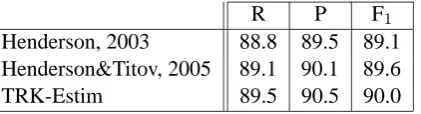
The above experiments with the SVM Struct demonstrate empirically the viability of our ap-proaches. The aim of experiments on the entire WSJ is to test whether our approaches still achieve significant improvement when more accurate gen-erative models are used, and also to show that they generalize well to learning methods different from SVMs. We perform experiments on the stan-dard WSJ parsing data using the stanstan-dard split into training, validation and testing sets. We replicate completely the setup of experiments in (Hender-son and Titov, 2005). For a detailed description of the experiment setup, we refer the reader to (Hen-derson and Titov, 2005). We only note here that the candidate list has 20 candidates, and, for the testing set, selecting the candidate with an oracle results in anF1score of 95.4%.
We selected the TRK-Estim approach for these experiments because it demonstrated the best re-sults in the previous set of experiments (5.2). We trained the Voted Perceptron (VP) modification described in (Henderson and Titov, 2005) with the TOP Reranking kernel. VP is not a linear classi-fier, so we were not able to use a classifier in the form (11). Instead the normalized counts of votes given to the candidate parses were used as proba-bility estimates, as discussed in section 3.3.
R P F1
Henderson, 2003 88.8 89.5 89.1 Henderson&Titov, 2005 89.1 90.1 89.6 TRK-Estim 89.5 90.5 90.0
Table 2: Percentage labeled constituent recall (R), precision (P), combination of both (F1) on the
test-ing set.
5.4 Experiments with Voted Perceptron and Tree Kernel
In this series of experiments we validate the state-ment in section 3.3, where we suggested that loss approximation from a discriminative classifier is not limited only to models with data-defined ker-nels. We apply the same method as used in the TRK-Estim model above to the Tree Ker-nel (Collins and Duffy, 2002), which we call the TK-Estim model.
We replicated the parse reranking experimen-tal setup used for the evaluation of the Tree Ker-nel in (Collins and Duffy, 2002), where the can-didate list was provided by the generative proba-bilistic model (Collins, 1999) (model 2). A list of on average 29 candidates was used, with an oracle F1 score on the testing set of 95.0%. We trained
VP using the same parameters for the Tree Ker-nel and probability feature weighting as described in (Collins and Duffy, 2002). A publicly avail-able efficient implementation of the Tree Kernel was utilized to speed up computations (Moschitti, 2004). As in the previous section, votes of the per-ceptron were used to define the probability esti-mate used in the classifier.
The results for the MBR decoding method (TK-Estim), defined in section 3.3, along with the stan-dard Tree Kernel VP results (Collins and Duffy, 2002) (TK) and the probabilistic baseline (Collins, 1999) (CO99) are presented in table 3. The pro-posed model improves in F1 score over the
stan-dard VP results. Differences between all the mod-els are statistically significant. The error reduction of TK-Estim is again about the same as the error reduction of TK. This improvement is achieved without adding any additional linguistic features. It is important to note that the model improves in other accuracy measures as well. We would expect even better results with MBR-decoding if larger n-best lists are used. The n-best parsing al-gorithm (Huang and Chiang, 2005) can be used to efficiently produce candidate lists as large as 106
R P F1∗ CB 0C 2C CO99 88.1 88.3 88.2 1.06 64.0 85.1 TK 88.6 88.9 88.7 0.99 66.5 86.3 TK-Estim 89.0 89.5 89.2 0.91 66.6 87.4
* F1for previous models may have rounding errors.
Table 3: Result on the testing set. Percentage la-beled constituent recall (R), precision (P), combi-nation of both (F1), an average number of
cross-ing brackets per sentence (CB), percentage of sen-tences with0 and≤ 2crossing brackets (0C and 2C, respectively).
parse trees with the model of (Collins, 1999).
6 Conclusions
This paper considers methods for the estimation of expected loss for parse reranking tasks. The pro-posed methods include estimation of the loss from a probabilistic model, estimation from a discrim-inative classifier, and learning of the loss using a specialized kernel. An empirical comparison of these approaches on parse reranking tasks is pre-sented. Special emphasis is given to data-defined kernels for reranking, as they do not require the introduction of any additional domain knowledge not already encoded in the probabilistic model. The best approach, estimation of the loss on the basis of a discriminative classifier, achieves very significant improvements over the baseline gener-ative probabilistic models and the discrimingener-ative classifier itself. Though the largest improvement is demonstrated in the measure which corresponds to the considered loss functional, other measures of accuracy are also improved. The proposed method achieves 90.0% F1 score on the standard Wall
Street Journal parsing task when the SSN neural network is used as the probabilistic model and VP with a TOP Reranking kernel as the discriminative classifier.
Acknowledgments
References
Eugene Charniak and Mark Johnson. 2005. Coarse-to-fine n-best parsing and MaxEnt discriminative reranking. In Proc. 43rd Meeting of Association for
Computational Linguistics, pages 173–180, Ann
Ar-bor, MI.
Michael Collins and Nigel Duffy. 2002. New rank-ing algorithms for parsrank-ing and taggrank-ing: Kernels over discrete structures and the voted perceptron. In Proc. 40th Meeting of Association for
Computa-tional Linguistics, pages 263–270, Philadelphia, PA.
Michael Collins and Terry Koo. 2005. Discriminative reranking for natural language parsing.
Computa-tional Linguistics, 31(1):25–69.
Michael Collins. 1999. Head-Driven Statistical
Mod-els for Natural Language Parsing. Ph.D. thesis, University of Pennsylvania, Philadelphia, PA.
Michael Collins. 2000. Discriminative reranking for natural language parsing. In Proc. 17th Int. Conf. on
Machine Learning, pages 175–182, Stanford, CA.
Joshua Goodman. 1996. Parsing algorithms and meth-ods. In Proc. 34th Meeting of the Association for
Computational Linguistics, pages 177–183, Santa
Cruz, CA.
James Henderson and Ivan Titov. 2005. Data-defined kernels for parse reranking derived from probabilis-tic models. In Proc. 43rd Meeting of Association for
Computational Linguistics, Ann Arbor, MI.
James Henderson. 2003. Inducing history representa-tions for broad coverage statistical parsing. In Proc.
joint meeting of North American Chapter of the As-sociation for Computational Linguistics and the Hu-man Language Technology Conf., pages 103–110,
Edmonton, Canada.
James Henderson. 2004. Discriminative training of a neural network statistical parser. In Proc. 42nd
Meeting of Association for Computational Linguis-tics, Barcelona, Spain.
Liang Huang and David Chiang. 2005. Better k-best parsing. In Proc. 9th Int. Workshop on Parsing
Tech-nologies, Vancouver, Canada.
Tommi S. Jaakkola and David Haussler. 1998. Ex-ploiting generative models in discriminative classi-fiers. Advances in Neural Information Processes Systems 11.
Terry Koo and Michael Collins. 2005. Hidden-variable models for discriminative reranking. In
Proc. Conf. on Empirical Methods in Natural Lan-guage Processing, Vancouver, B.C., Canada.
Shankar Kumar and William Byrne. 2004. Minimum bayes-risk decoding for statistical machine transla-tion. In Proceedings of the Human Language
Tech-nology Conference and Meeting of the North Amer-ican Chapter of the Association for Computational Linguistics, Boston, MA.
Mitchell P. Marcus, Beatrice Santorini, and Mary Ann Marcinkiewicz. 1993. Building a large annotated corpus of English: The Penn Treebank.
Computa-tional Linguistics, 19(2):313–330.
Alessandro Moschitti. 2004. A study on convolutional kernels for shallow semantic parsing. In Proc. 42nd
Meeting of the Association for Computational Lin-guistics, Barcelona, Spain.
John C. Platt. 1999. Probabilistic outputs for sup-port vector machines and comparision to regular-ized likelihood methods. In A. Smola, P. Bartlett, B. Scholkopf, and D. Schuurmans, editors,
Ad-vances in Large Margin Classifiers, pages 61–74.
MIT Press.
Adwait Ratnaparkhi. 1996. A maximum entropy model for part-of-speech tagging. In Proc. Conf. on
Empirical Methods in Natural Language Process-ing, pages 133–142, Univ. of Pennsylvania, PA.
Libin Shen and Aravind K. Joshi. 2003. An SVM based voting algorithm with application to parse reranking. In Proc. of the 7th Conf. on
Computa-tional Natural Language Learning, pages 9–16,
Ed-monton, Canada.
Andreas Stolcke, Yochai Konig, and Mitchel Wein-traub. 1997. Explicit word error minimization in n-best list rescoring. In Proc. of 5th European
Con-ference on Speech Communication and Technology,
pages 163–165, Rhodes, Greece.
Ben Taskar, Dan Klein, Michael Collins, Daphne Koller, and Christopher Manning. 2004. Max-margin parsing. In Proc. Conf. on Empirical
Meth-ods in Natural Language Processing, Barcelona,
Spain.
Ivan Titov and James Henderson. 2005. Deriving ker-nels from MLP probability estimators for large cate-gorization problems. In International Joint
Confer-ence on Neural Networks, Montreal, Canada.
Ioannis Tsochantaridis, Thomas Hofmann, Thorsten Joachims, and Yasemin Altun. 2004. Support vector machine learning for interdependent and structured output spaces. In Proc. 21st Int. Conf. on Machine
Learning, pages 823–830, Banff, Alberta, Canada.
K. Tsuda, M. Kawanabe, G. Ratsch, S. Sonnenburg, and K. Muller. 2002. A new discriminative ker-nel from probabilistic models. Neural Computation, 14(10):2397–2414.
Alexander Yeh. 2000. More accurate tests for the statistical significance of the result differences. In