Detecting Subevent Structure for Event Coreference Resolution
Jun Araki, Zhengzhong Liu, Eduard Hovy, Teruko Mitamura
Language Technologies Institute, Carnegie Mellon University 5000 Forbes Avenue, Pittsburgh, PA 15213, USA
[email protected], [email protected], [email protected], [email protected]
Abstract
In the task of event coreference resolution, recent work has shown the need to perform not only full coreference but also partial coreference of events. We show that subevents can form a particular hierarchical event structure. This paper examines a novel two-stage approach to finding and improving subevent structures. First, we introduce a multiclass logistic regression model that can detect subevent relations in addition to full coreference. Second, we propose a method to improve subevent structure based on subevent clusters detected by the model. Using a corpus in the Intelligence Community domain, we show that the method achieves over 3.2 BLANC F1 gain in detecting subevent relations against the logistic regression model.
Keywords:event coreference resolution, subevent structure, event relation learning
1
Introduction
Event coreference resolution is the problem of determining whether two event mentions refer to the same event. This problem is important in that resolved event coreference is useful in various tasks such as topic detection and tracking, information extraction, question answering, textual entail-ment, and contradiction detection (Bejan and Harabagiu, 2010).
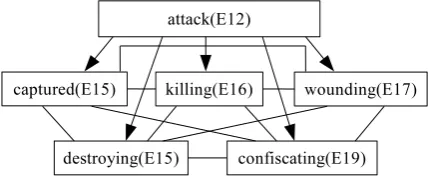
However, one aspect that makes the problem challenging is that events can form a complex structure and relate to each other in various ways (Huttunen et al., 2002; Bejan and Harabagiu, 2008). In particular, some of event relations exhibit subtle deviation from the perfect identity of events (Hovy et al., 2013). One of these relations is asubevent relation. This relation forms a stereotypical sequence of events, or a script (Schank and Abelson, 1977; Chambers and Jurafsky, 2008). Figure 1 shows some examples of that relation in the illustrative text below. In this figure, we say that E15 is a subevent of E12, for example.
Ismail said the fighting, which lasted several days, intensi-fied when forces loyal to Egal’s Ha-bar Awal sub-clan of the Issakattacked(E12) a militia stronghold of his main oppo-sition rival, . . .
Egal militia, claiming to be the national defence force, said they hadcaptured(E15) two opposition posts,killing(E16) andwounding(E17) many of the fighters,destroying(E18) three technicals (armed pick-up trucks) and confiscat-ing(E19) artillery guns and assorted ammunition.
As Figure 1 shows, we see that E15, E16, E17, E18, and E19 form a cluster under their parent E12. Let us call this cluster asubevent cluster. In this work, we also pay atten-tion to undirected relaatten-tions between subevents sharing the same parent. Let us call themsubevent sisterrelations, ex-emplified by lines in Figure 1.
In the context of event coreference resolution, we adopt the approach of (Hovy et al., 2013) in which a subevent rela-tion exhibits partial identity of events whereas normal event coreference represents full identity of them. For clarifica-tion, we refer to the latter asfull (event) coreferencein this paper. Unlike previous work on event coreference, we deal
Figure 1: Examples of the subevent relation. An arrow rep-resents a subevent relation with the direction from a parent to its subevent.
with subevent parent-child and sister relations as additional classes to be assigned. Detecting subevent structure is im-portant for event coreference resolution because we can re-duce the difficulty of full coreference resolution by exclud-ing subevent relations from candidates of full coreference chains after finding such structure.
In this paper, we propose a novel two-stage approach to de-tecting subevent structure, and evaluate the approach. We focus on within-document full coreference and subevent re-lations in the Intelligence Community (IC) domain. The contributions of this work are as follows:
• This is the first work to systematically detect subevent parent-child relations as partial coreference for event coreference resolution. We address the problem from the perspective of subevent structure based on subevent clusters.
• We present a multiclass logistic regression model us-ing a rich set of features to represent different lus-inguis- linguis-tic characterislinguis-tics, which can identify both full coref-erence and subevent relations. It is also able to deter-mine the direction of subevent relations.
and SP are 0.620 and 0.467 in terms of Fleisss kappa, re-spectively. In addition to relations manually annotated in the corpus, we also considered subevent relations extended from the combination of FC and SP relations. For instance, if A is a subevent of B, and B is coreferential with C, then A is also a subevent of C. We regarded this type of rela-tion as an SP relarela-tion. Table 1 shows the corpus statistics, including our data split. We conducted 5-fold cross valida-tion using the split.
Training+Dev Test Total
# Articles 49 16 65
# Relations 26499 9409 35908
FC 1037 216 1253
SP 997 201 1198
SS 399 139 538
NC 24066 8853 32919
Table 1: Corpus statistics.
4.2 Results
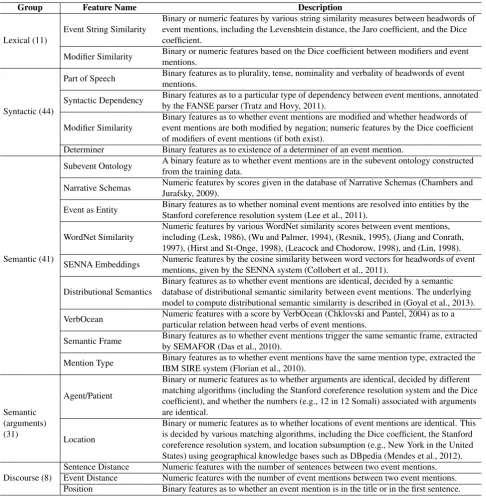
We constructed the logistic regression model using 135 fea-tures1. We employed MetaCost (Domingos, 1999) to ad-dress the data imbalance shown in Table 1. Table 2 shows the system performance in the first stage. In this table, P and R stand for precision and recall, respectively, for posi-tive and negaposi-tive links, and F1 stands for the final BLANC F1 score. Table 2 indicates that the system achieved rela-tively high precision on SS relations in the first stage. This is basically because we incorporated more effective fea-tures for SS.
Relation Pos Links Neg Links Avg
R P R P F1
FC 41.20 41.59 98.64 98.62 70.01 SP 8.46 34.00 99.64 98.03 56.19 SS 14.39 66.67 99.89 98.73 61.49 NC 98.18 95.36 23.92 45.24 64.02
Table 2: BLANC scores gained in the first stage.
Relation Pos Links Neg Links Avg
SP R P R P F1
Option 1 13.43 31.03 99.35 98.13 58.74 Option 2 14.43 33.33 99.37 98.15 59.45
Table 3: BLANC scores gained in the second stage.
Table 3 shows the performance on SP relations in the sec-ond stage in terms of the BLANC scores. As compared to the baseline performance (the second row in Table 2), the second stage with Option 1 and 2 improved the BLANC F1 score by 2.5 points and by 3.2 points, respectively. We also see from Table 3 that Option 2 achieved a better per-formance than Option 1.
1
See Appendix A for more details.
(a) A subevent cluster extracted in the first stage.
(b) A subevent structure extracted in the second stage.
Figure 2: An example of system output obtained in the two stages.
Figure 2 illustrates how the system performs subevent structure detection through the two-stage process with re-spect to the subevent structure shown in Figure 1. As shown in Figure 2a, the extracted subevent cluster lost E19, but still captured four subevents out of the five in the gold stan-dard. Figure 2b shows a subevent structure that the system obtained in the second stage from the subevent cluster ex-tracted in the first stage. The system selected out E23 for a parent of the four subevents, which is different from E12 in Figure 1. However, E12 and E23 are coreferential in the gold standard annotation. Hence, all detected links in the subevent structure shown in Figure 2b are correct by means of extended subevent relations.
5
Discussion
The comparison between Option 1 and 2 gives us an inter-esting insight on voting of subevents in an obtained cluster. Figure 3 provides an evidence to show where the perfor-mance difference between the two options comes from. In this figure, a numeric value stands for a subevent proba-bility between a parent candidate and a subevent. E22 is the correct parent for the subevent cluster {E23, E24} in this case. The parent selection algorithm with Option 1 mistakenly chose E21 for the parent because the highest subevent probability 0.881 comes from the subevent rela-tion between E21 and E23.
Figure 3: Parent selection from subevent sisters.
Group Feature Name Description
Lexical (11)
Event String Similarity
Binary or numeric features by various string similarity measures between headwords of event mentions, including the Levenshtein distance, the Jaro coefficient, and the Dice coefficient.
Modifier Similarity Binary or numeric features based on the Dice coefficient between modifiers and event mentions.
Syntactic (44)
Part of Speech Binary features as to plurality, tense, nominality and verbality of headwords of event mentions.
Syntactic Dependency Binary features as to a particular type of dependency between event mentions, annotated by the FANSE parser (Tratz and Hovy, 2011).
Modifier Similarity
Binary features as to whether event mentions are modified and whether headwords of event mentions are both modified by negation; numeric features by the Dice coefficient of modifiers of event mentions (if both exist).
Determiner Binary features as to existence of a determiner of an event mention.
Semantic (41)
Subevent Ontology A binary feature as to whether event mentions are in the subevent ontology constructed from the training data.
Narrative Schemas Numeric features by scores given in the database of Narrative Schemas (Chambers and Jurafsky, 2009).
Event as Entity Binary features as to whether nominal event mentions are resolved into entities by the Stanford coreference resolution system (Lee et al., 2011).
WordNet Similarity
Numeric features by various WordNet similarity scores between event mentions, including (Lesk, 1986), (Wu and Palmer, 1994), (Resnik, 1995), (Jiang and Conrath, 1997), (Hirst and St-Onge, 1998), (Leacock and Chodorow, 1998), and (Lin, 1998).
SENNA Embeddings Numeric features by the cosine similarity between word vectors for headwords of event mentions, given by the SENNA system (Collobert et al., 2011).
Distributional Semantics
Binary features as to whether event mentions are identical, decided by a semantic database of distributional semantic similarity between event mentions. The underlying model to compute distributional semantic similarity is described in (Goyal et al., 2013).
VerbOcean Numeric features with a score by VerbOcean (Chklovski and Pantel, 2004) as to a particular relation between head verbs of event mentions.
Semantic Frame Binary features as to whether event mentions trigger the same semantic frame, extracted by SEMAFOR (Das et al., 2010).
Mention Type Binary features as to whether event mentions have the same mention type, extracted the IBM SIRE system (Florian et al., 2010).
Semantic (arguments) (31)
Agent/Patient
Binary or numeric features as to whether arguments are identical, decided by different matching algorithms (including the Stanford coreference resolution system and the Dice coefficient), and whether the numbers (e.g., 12 in 12 Somali) associated with arguments are identical.
Location
Binary or numeric features as to whether locations of event mentions are identical. This is decided by various matching algorithms, including the Dice coefficient, the Stanford coreference resolution system, and location subsumption (e.g., New York in the United States) using geographical knowledge bases such as DBpedia (Mendes et al., 2012).
Discourse (8)
Sentence Distance Numeric features with the number of sentences between two event mentions. Event Distance Numeric features with the number of event mentions between two event mentions. Position Binary features as to whether an event mention is in the title or in the first sentence.