A Database of Full Body Virtual Interactions Annotated with Expressivity Scores
V. Demulier
1, E. Bevacqua
2, F. Focone
1, T. Giraud
1, P. Carreno
3, B. Isableu
4, S. Gibet
3, P. De Loor
2and J-C. Martin
11LIMSI-CNRS, Campus Université Paris Sud, Bât. 508, 91403 Orsay Cedex, France
2 UEB, Lab-STICC, ENIB, 25 rue C. Chappe, 29280 Plouzané, France
3IRISA, Université de Bretagne Sud, rue Yves Mainguy, BP 573, 56017 Vannes, France 4 CIAMS, Campus Université Paris Sud, Bât. 335, 91405 Orsay Cedex, France
E-mail: [email protected] ; [email protected] ; [email protected] ; [email protected] ; [email protected] ; [email protected] ; [email protected]@univ-ubs.fr ; [email protected] ; [email protected]
Abstract
Recent technologies enable the exploitation of full body expressions in applications such as interactive arts but are still limited in terms of dyadic subtle interaction patterns. Our project aims at full body expressive interactions between a user and an autonomous virtual agent. The currently available databases do not contain full body expressivity and interaction patterns via avatars. In this paper, we describe a protocol defined to collect a database to study expressive full-body dyadic interactions. We detail the coding scheme for manually annotating the collected videos. Reliability measures for global annotations of expressivity and interaction are also provided.
Keywords: bodily interaction, gesture, database, expressivity, experimental protocol, coding scheme
1.
Introduction
Research in nonverbal communication highlights the major role played by interactive patterns and expressivity in bodily interactions (Kendon, 2004; Knapp & Hall, 2006; Recanati, 1993). Recent technologies enable to exploit full body interaction in games, education, and interactive arts [4, 5]. There is thus an increasing need to better understand the mechanisms underlying expressive full-body dyadic interactions and to answer research questions such as: What is the impact of dyadic interaction on the expressive features of bodily expressions of two interacting partners? How are these features shared during interactions between two partners when each partner interacts with the avatar of the other partner? How do dyadic partners synchronize themselves during interactions?
The long-term goal of our project is to develop a virtual character that is capable of maintaining a full body expressive gestural coupling with a human user. As a first step, we need to collect whole body expressions data in interaction sessions including expressivity variations and expressions of emotions. In this paper, we describe a protocol including motion capture and video defined to collect a database to study expressive full-body dyadic interactions. We detail our coding scheme for manually annotating collected videos. Reliability measures for global annotations are also provided. We draw conclusions about the usefulness of such a database.
2.
Related work
A gesture can be defined as a body movement carrying some meaning or intention, with a semantic content (Recanati, 1993). Such information can be, for example, an action or a behavior that should be imitated by the interlocutor or an affective state that should be expressed (Argyle, 1988; Buck,
1984; Mehrabian & Friar, 1969). In our work, we consider a gesture as a movement involving the whole body.
Expressivity characterizes modulations of the movement.
Expressivity of the full body is described in details in art studies (Neff, 2012) and may be defined by a set of nuances that modulate actions. Expressive parameters such as fluidity, contraction, directness, amplitude, or velocity are considered for automatic recognition (Castellano et al., 2007) and synthesis (Héloir et al., 2006; Recanati, 1993). Expressivity may convey several communicative functions. For example, several studies aim at identifying discriminative features of emotions in static postures or in movements (Wallbott, 1998).
Gesture studies about dyadic interactions revealed several
interactive patterns such as mimicry and the chameleon effect
(Chartrand & Bargh, 1999), joint actions (Buck, 1984; Sebanz et al., 2006), synchrony (Argyle, 1988, Behrends et al., 2012) and coupling (Haken et al., 1985; Recanati, 1993; Warren, 2006). These interactive patterns are expected to support smooth interactions during interactions between humans, but also between a human and a virtual character (Forgas, 2001; Heeter, 2003).
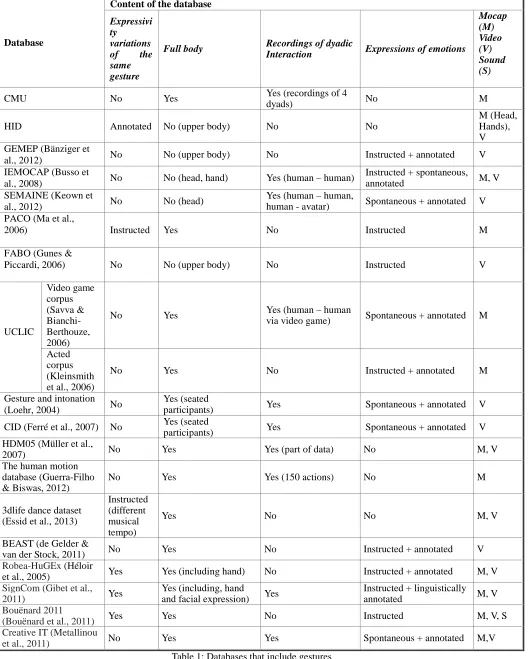
None of the existing databases contain at the same time variations of expressivity, full body standing expressions, and displays of emotions during an interaction via avatar (Table 1).
This overview of existing databases notes the need to create a new database that combines data 1) from dyadic partners interacting via avatars, 2) from the full body, 3) with expressivity variations to highlight the dynamic process of interaction, 4) including mocap data, 5) and including bodily
Table 1: Databases that include gestures
Database
Content of the database
Expressivi ty variations of the same gesture
Full body Recordings of dyadic
Interaction Expressions of emotions
Mocap (M) Video (V) Sound (S)
CMU No Yes Yes (recordings of 4
dyads) No M
HID Annotated No (upper body) No No
M (Head, Hands), V GEMEP (Bänziger et
al., 2012) No No (upper body) No Instructed + annotated V IEMOCAP (Busso et
al., 2008) No No (head, hand) Yes (human – human)
Instructed + spontaneous,
annotated M, V
SEMAINE (Keown et
al., 2012) No No (head)
Yes (human – human,
human - avatar) Spontaneous + annotated V PACO (Ma et al.,
2006) Instructed Yes No Instructed M
FABO (Gunes &
Piccardi, 2006) No No (upper body) No Instructed V
UCLIC
Video game corpus (Savva & Bianchi-Berthouze, 2006)
No Yes Yes (human – human
via video game) Spontaneous + annotated M
Acted corpus (Kleinsmith et al., 2006)
No Yes No Instructed + annotated M
Gesture and intonation (Loehr, 2004) No
Yes (seated
participants) Yes Spontaneous + annotated V
CID (Ferré et al., 2007) No Yes (seated
participants) Yes Spontaneous + annotated V HDM05 (Müller et al.,
2007) No Yes Yes (part of data) No M, V
The human motion database (Guerra-Filho & Biswas, 2012)
No Yes Yes (150 actions) No M
3dlife dance dataset (Essid et al., 2013)
Instructed (different musical tempo)
Yes No No M, V
BEAST (de Gelder &
van der Stock, 2011) No Yes No Instructed + annotated V Robea-HuGEx (Héloir
et al., 2005) Yes Yes (including hand) No Instructed + annotated M, V SignCom (Gibet et al.,
2011) Yes
Yes (including, hand
and facial expression) Yes
Instructed + linguistically
annotated M, V
Bouënard 2011
(Bouënard et al., 2011) Yes Yes No Instructed M, V, S
Creative IT (Metallinou
3.
Method
3.1
Requirements and challenges
There are several challenges in the collection of databases of expressive full-body interactions.
First, it is important to define the nature of the interactive
scenarios.
Collecting a database of expressive movements and expressions of emotions also raises issues about the
spontaneity of the collected behaviors (Petta et al., 2011).
Spontaneous gestures are expected to be more realistic and naturalistic but raise problems in terms of gesture segmentation and recognition, and controlled variations of expressivity (Kleinsmith et al., 2011).
To focus on bodily interaction, it is important that dyadic partners are prevented from any interaction through facial expressions that are a privileged channel to display expressive and fast reactions (Moody et al., 2007). Thus, a mediated interaction via an avatar of the distant interlocutor appears to be relevant to collect data that show how people communicate solely through bodily movements.
3.2
Protocol
3.2.1 Participants
Our goal is to design an interactive virtual agent that can be exploited in artistic settings. Two experienced actresses from a professional theatre company participated in this data collection. We decided to collect data only from two female actresses. Females are observed to have a greater capacity than males to understand others’ thoughts and feelings (Klein & Hodges, 2001), to express higher levels of empathy than males (Masaskill et al., 2002; Schieman & Gundy, 2000), and are more often performing expressive gestures (Mayo et Henley, 1981; Hall, 1990).
3.2.2 Gestures
We collected body expressions on a continuum from acted expressions to more spontaneous expressions. To define the repertoire of gestures, we were inspired by Etienne Decroux’s work. Thus, 18 movements grouped into three repertoires were defined. In a first step of investigation only one repertoire is presented: sea repertoire that consist of rowing, hoisting a sail, cleaning the deck, throwing a fishing net, bringing back a fishing net, winching, imitating a ferryman, and walking during a storm. These gestures feature different levels of complexity 1) very simple gestures composed of only a few actions and 2) more complex gestures that can be decomposed into multiple actions. The gestures involve several segments of the full body and are expected to allow some spontaneity in their realization.Expressivity and Interaction.
3.2.3 Expressivity and Interaction
We considered three expressivity parameters that been observed to be relevant for expressive gesture studies: amplitude, fluidity and velocity (Gibet et al., 2005). Gestures were to be performed by the actresses with three possible values for each of these parameters (i.e., low, normal, high).
The interaction situations that we defined are based on theatre exercises of expressive bodily movements avoiding contact between the parties. We also discarded the exercises in which facial and acoustic expressions were needed
Recordings were performed under two conditions. In the
non-interactive condition, the actresses did not interact with
each other, and no avatar was displayed in front of them. Instead, they were asked to perform one by one the gestures. Then, the participants were asked to repeat these gestures with some expressivity variations to create the gesture repertoire used later in the interactive condition.
In the interactive condition, the actresses interacted with each other through their human size avatars displayed on the screen in front of them. We defined two interactive situations: imitation, and bodily emotional interaction.
In the situation of imitation, one actress (the follower) had to imitate the movements performed by the other actress (the leader). In the situation of bodily emotional interaction, one actress expresses an emotional state through bodily movements. The other actress attempts to transmit another emotional state. The two parties create a dynamic emotional dialogue based only on full-body movements.
3.2.4 Video and Motion Capture
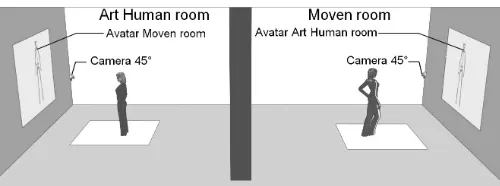
Video recordings provide information that is complementary to mocap data. Videos and manual annotations provide high-level information whereas low-level information are given by video, automatic image processing and 3D mocap (Kleinsmith et al., 2006). The full body was recorded using Sony HDR-CX550 cameras (50fps) in two rooms from a 45° angle because the three dimensions are of importance for capturing expressivity and emotions (Fig. 1).
Figure 1: Experiment set up: two actresses interact bodily with the avatar of the other actress.
3.2.5 Procedure
Recordings were conducted in two separate rooms. Each actress was asked to wear a motion capture suit. Their tracked movements were used to animate in real time the body of a simple avatar displayed on a screen, so that each actress could interact with the avatar that represented the other actress.
To study the transitions between different expressivities, we recorded the actresses performing several scripted sequences of movements. Each gesture was performed with a pre-defined expressivity. The gestures were selected in the repertoire described above. In the imitation situation, the actresses interact with each other. We imposed two constraints: (a) the gestures had to be selected from the sea repertoire and (b) the actresses had to change roles at least twice during the whole interaction. No specific sequence of movements was imposed. Both the actresses were free to vary the expressivity of their movements.
In the situation of bodily emotional interaction, the actresses had to interact by playing scripted emotionally colored stories with positive or negative emotions. Each story was specified with the aim of fixing a sequence of emotional states, but no constraint was imposed on the movements to perform.
In both of the interacting conditions, we recorded also some free interactions.
3.3 Collected Data
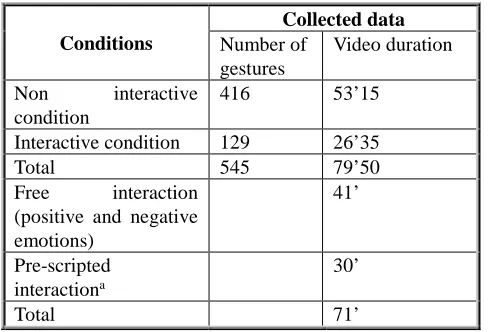
The collected corpus includes 545 gestures performed either in a non-interactive condition or in an interactive condition (Table 2).
Conditions
Collected data
Number of gestures
Video duration
Non interactive condition
416 53’15
Interactive condition 129 26’35
Total 545 79’50
Free interaction (positive and negative emotions)
41’
Pre-scripted interactiona
30’
Total 71’
a.Washerwoman, teacher/student, restaurant, chess game, conference. Table 2: Collected data
3.4 Coding Scheme and Data Annotation
Our scheme enables the manual annotation of perceived synchrony, expressivity and gestural variations.
Videos were manually annotated in terms of gesture, expressivity, synchrony and role by two expert annotators. At first, the two videos of each dyad were annotated separately.
The gestures were segmented. Then, a label was selected to describe the perceived expressivity of the gesture (i.e., the amplitude, the fluidity, and the velocity).
The two videos of each dyadic interaction were then displayed side-by-side and annotated together in terms of
interaction. The annotation was based on the perceived
synchrony between the two participants. The annotators could choose one out of four options: 0 (absence of synchrony), 1 (slight synchrony), 2 (moderate synchrony), and 3 (almost perfect synchrony). Finally, the role (i.e., unknown, leader, and follower) in the dyad was annotated.
Inter-rater agreement measures were computed to assess the reliability of the annotations performing Cohen’s Kappa (table 3) (Banerjee et al., 1999; Warrens, 2010).
A range of value between 0.41 and 0.6 is interpreted as a moderate agreement whereas a range value between 0.61 and 0.81 is interpreted as a substantial agreement (Banerjee et al., 1999).
Fleiss Kappa Value
Amplitude
0.74
Fluidity
0.80
Velocity
0.41
Synchrony
0.61
Emotional valence
0.48
Role
0.78
Table 3: Fleiss Kappa values
Anova were performed to compare the expressivity style of each actress. The three expressivity parameters were entered as dependent variables, whereas actresses were entered as a fix factor. The analysis reveals no significant difference between the two actresses neither for the amplitude
F(1,21) = 0.057, p = 0.813; nor the fluidity F(1,21) = 0.241, p
= 0.626; nor the velocity of their gestures: F(1,21) = 0.028, p = 0.867. Thus, we did not observe any significant difference between the perceptions of the expressive styles of the two actresses when they interacted together.
4. Discussion and Conclusions
The purpose of the present experimental protocol is to collect data from dyadic full body nonverbal interactions mediated via avatars. A main contribution is the description of the collected database of virtual interactions with full body expressivity scores. Dyadic interaction information related to gesture, expressivity, and synchrony are collected via manual video annotation. Our first global measures suggest that our coding scheme is reliable.
Pattern Recognition, vol. 1, pp. 1148–1153.
Haken,H., Kelso, J. A., & Bunz, H.(1985). A theoretical model of phase transitions in human hand movements. Biol
Cybern, vol. 51, no. 5, pp. 347–356.
Hall, J. A. (1990). Nonverbal sex differences: Communication
accuracy and expressive style. Baltimore, MD: The Johns
Hopkins University Press.
Heeter, C. (2003). Reflections on Real Presence by a Virtual Person. Presence: Teleoperators and Virtual Environments, vol. 12, no. 4, pp. 335–345.
Héloir, A., Courty, N., Gibet, S., & Multon,F. (2006). Temporal alignment of communicative gesture sequences.
Computer Animation and Virtual Worlds, vol. 17, no. 3–4,
pp. 347–357.
Hid-human interaction database (2007), http://paloma.isr.uc.pt/hid/ Robot Interaction Based on Bayesian Analysis of Human Movements 541.
Kendon, A. (2004). Gesture: Visible Action as Utterance. New York: Cambridge Univ. Press.
Klein, K. J. K., & Hodges, S. D. (2001). Gender differences, motivation, and empathic accuracy: when it pays to understand. Personality and Social Psychology Bulletin, 27, 720–730.
Kleinsmith, A., Bianchi-Berthouze, N., & Steed, A.(2011). Automatic Recognition of Non-Acted Affective Postures.
IEEE Transactions on Systems, Man, and Cybernetics, Part B: Cybernetics, vol. 41, no. 4, pp 1027–1038.
Kleinsmith, A., De Silva, P. R., & Bianchi-Berthouze, N. (2006). Cross-cultural differences in recognizing affect from body posture. Interacting with Computers, vol. 18, no. 6, pp. 1371–1389.
Knapp, M. L., & Hall, J. A. (2006). Nonverbal communication
in human interaction. Belmont, CA: Wadsworth/Thomson
Learning.
Loehr, D. P. (2004). Gesture and Intonation. PhD Thesis. Ma, Y., Paterson, H. M., & Pollick, F. E. (2006). A motion
capture library for the study of identity, gender, and emotion perception from biological motion. Behavior Research
Methods, vol. 38, no. 1, pp. 134–141.
Macaskill, A., Maltby, J., & Day, L. (2002). Forgiveness of self and others and emotional empathy. The Journal of
Social Psychology, 142, 633-665. doi:
10.1080/00224540209603925
Mayo, C. & Henley, N. M. (1981). Gender and nonverbal
behavior. New York, NY: Springer-Verlag.
McKeown, G., Valstar, M., Cowie, R., Pantic, M., & Schroder, M. (2012). The SEMAINE Database: Annotated Multimodal Records of Emotionally Colored Conversations between a Person and a Limited Agent. IEEE Transactions on Affective Computing, vol. 3, no. 1, pp. 5–17.
Mehrabian, A., & Friar, J. T. (1969). Encoding of attitude by a seated communicator via posture and position cues. Journal
of Consulting and Clinical Psychology, vol. 33, no. 3, pp.
330–336.
Metallinou, A., Lee, C-C., Busso, C., Carnicke, S., &
Narayanan, S.S. (2012). The USC CreativeIT Database: A Multimodal Database of Theatrical Improvisation. In
Multimodal Corpora: Advances in Capturing, Coding and Analyzing Multimodality, 55-58, edited by M. Kipp, J-C.
Martin, P. Paggio, & D. Heylen. Valetta, Malta, http://embots.dfki.de/doc/MMC2010-Proceedings.pdf. Moody E.J., McIntosh D.N., Mann L.J., Weisser K.R. (2007).
More than mere mimicry? The influence of emotion on rapid facial reactions to faces. Emotion 7:447–457
Müller, M., Röder, T., Clausen, M., Eberhardt, B., Krüger, B., & Weber, A. (2007). Documentation Mocap Database HDM05, Universität Bonn, CG-2007-2.
Neff, M. (2012). Lessons from the Arts: What the Performing Arts Literature Can Teach Us about Creating Expressive Character Movement. Nonverbal Communication in Virtual Worlds, ETC Press.
Petta, P., Pelachaud, C., & Cowie, R. (2011). Introduction to Emotion-Oriented Systems: The Humaine Handbook, Springer, pp. 850.
Recanati, F. (1993). Direct reference: From language to
thought. Blackwell Oxford.
Savva, N., & Bianchi-Berthouze, N. (2012). Automatic Recognition ofAffective Body Movement in a Video Game Scenario. Intelligent Technologies for Interactive Entertainment, A. Camurri and C. Costa, Eds. Springer
Berlin Heidelberg, pp. 149–159.
Schieman S., Van Gundy K. (2000). The personal and social links between age and self-reported empathy. Social
Psychology Quarterly, 63,152–174.
Sebanz, N., Bekkering, H., & Knoblich, G. (2006). Joint action: bodies and minds moving together. Trends Cogn.
Sci, vol. 10, no. 2, pp. 70–76.
Wallbott, H. G. (1998). Bodily expression of emotion.
European Journal of Social Psychology, vol. 28, no. 6, pp.
879–896.
Warren, W. H. (2006).The dynamics of perception and action.
Psychol Rev, vol. 113, no. 2, pp. 358–389.