Using TEI, CMDI and ISOcat in CLARIN-DK
Dorte Haltrup Hansen
1, Lene Offersgaard
2, Sussi Olsen
3University of Copenhagen, Centre for Language Technology Njalsgade 140, DK-2300 Copenhagen
E-mail: [email protected], [email protected], [email protected]
Abstract
This paper presents the challenges and issues encountered in the conversion of TEI header metadata into the CMDI format. The work is carried out in the Danish research infrastructure, CLARIN-DK, in order to enable the exchange of language resources nationally as well as internationally, in particular with other partners of CLARIN ERIC. The paper describes the task of converting an existing TEI specification applied to all the text resources deposited in DK-CLARIN. During the task we have tried to reuse and share CMDI profiles and components in the CLARIN Component Registry, as well as linking the CMDI components and elements to the relevant data categories in the ISOcat Data Category Registry. The conversion of the existing metadata into the CMDI format turned out not to be a trivial task and the experience and insights gained from this work have resulted in a proposal for a work flow for future use. We also present a core TEI header metadata set.
Keywords: CMDI, TEI, metadata
1.
Background
CLARIN-DK1 is a Danish infrastructure of language resources. It is part of DigHumLab2, a national distributed research infrastructure that integrates and promotes digital resources, tools, communities, and opportunities to Danish researchers in the humanities and social sciences At the same time CLARIN-DK is the Danish national consortium of CLARIN ERIC3, the Common Language Resources and Technology Infrastructure, which aims at providing easy and sustainable access for scholars in the humanities and social sciences to digital language data.
CLARIN-DK is rooted in an earlier Danish infrastructure project (The Danish CLARIN project4, 2008-2011) with focus on the detection, collection and creation of resources for researchers from the humanities. The project was a broad collaboration between 8 educational and cultural institutions, which resulted in a large amount of varied, heterogeneous language resources, written, spoken and visual, that were made available for the researchers in a digital repository.
The aim of CLARIN-DK is firstly to transform the resources of the old repository into a research infrastructure for Danish researchers from the humanities, adapting the existing resources to the new structure, and secondly to facilitate the import of new resources and to
1
http://info.clarin.dk
2
http://www.dighumlab.dk
3
http://www.clarin.eu
4
http://dkclarin.ku.dk/english/
give access to a variety of language processing tools and services.
2.
Motivation
By adapting the existing resources to the new infrastructure (Offersgaard et al., 2013), we want to facilitate the processing, storing, and sharing of data, sharing not only within the Danish research community but also internationally with the other CLARIN partners. The exchange of resources inside CLARIN ERIC takes place by providing the resources with harvestable CMDI metadata which is visible through the Virtual Language Observatory, VLO 5 . The text resources of the CLARIN-DK had originally metadata following the TEI standard. A common TEI text header (Asmussen, 2012) was defined and used for all text based resources of the repository. Therefore, the main goal of the conversion is to maintain all the information stored in the TEI headers of the existing resources while converting it into the CMDI format. Opposed to other projects (see e.g. Hedeland & Wörner, 2012) we have decided to convert all metadata and not only a subset of them to CMDI. In this way we simplify the complexity of the repository by working with only one metadata format for texts. Furthermore, we can share the richness of the metadata with others through e.g. CLARIN federated content search.
This document presents a tested workflow for this conversion task and gives a list of issues and challenges to consider for an optimal conversion process. It also
5
which were provided with extra elements whereas the rest were created from scratch.
5.
Issues and Challenges
5.1
CMDI issues
When creating a CMDI profile from an existing metadata scheme, challenges arise both when mapping the existing structure onto the CMDI structure, when trying to reuse existing CMDI profiles and components and when trying to create a common usable CMDI profile. These challenges are discussed in following sections.
5.1.1
Re-use of components
CLARIN-DK cooperates with other research communities on a shared CMDI-TEI header profile but it is not as straightforward as expected. A CMDI-TEI profile along with various components has, as mentioned previously, already been defined and published in the
CLARIN Component Registry but since public profiles (and public components) cannot be changed, the existing public profiles cannot be modified in order to account for our specific requirements. If extra elements or components are required, a new version of the profile including these features should be made, but if a slightly different structure is needed, then the profile isn’t backward compatible any longer and it is not a new version of the profile but an entirely new profile. Currently CMDI does not have a facility to handle versioning.
The work on a shared profile must therefore take place before profiles and components are published and still are private to anyone but the user who created them. To accommodate the discovery and analysis of both published and unpublished profiles and components that might be reusable, the recently created SMC browser is a very useful tool (Ďurčo, 2013).
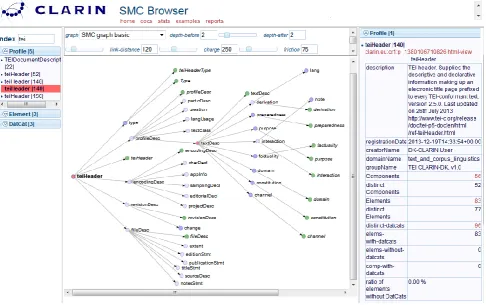
Figure 1: The defined CMDI-TEI header viewed through the SMC browser
In the SMC browser, the user can visualize a selected CMDI profile as a tree. In the visualization the profile is shown as the root node, the used components are shown as intermediate nodes and elements or data categories are shown as leaf nodes. Figure 1 shows our CMDI-TEI header profile in the SMC browser. To ease the readability of the figure only the component textDesc is extended into details. The green bullets refer to ISOcat references, blue refer to elements, and grey refer to components. The user interface is easily configurable
with a number of parameters10, and gives info and statistics about the current profile.
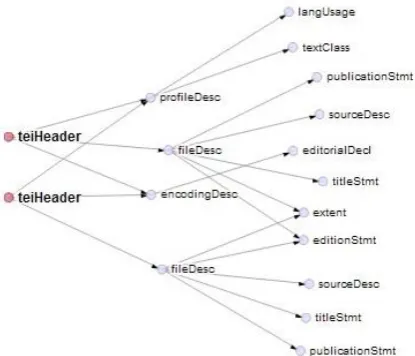
The SMC browser also facilitates that the user can visualize and compare different profiles at the same time, where overlapping nodes of the profiles show shared components or elements. Figure 2 shows the overlap and differences between two TEI header profiles.
10
Figure 2: Overlap of two different CMDI-TEI headers viewed through the SMC browser
We provided the researchers11 developing the browser with the CMDI identifier of our unpublished profile after which they included the profile into the browser. We were then able to explore both the overlap of components between different profiles and the completeness of ISOcat references of the profile.
5.1.2 Simple values in CMDI
Problem with structural differences may occur when converting existing metadata into CMDI. In TEI elements can contain attributes as well as other elements, but the structure in CMDI must be divided into components and elements where only elements can contain string values and only components can contain other elements and components. The difference in the two standards might introduce new levels in the structures, here illustrated by the TEI element name
which in the TEI standard can contain other elements such as date and email:
<name> Center for Language Technology <date when=”2011”/>
<email>[email protected]</email>
</name>
In CMDI this must be modelled as:
<cmd:name>
<cmd:name> Center for Language Technology</cmd:name > <cmd:date when=”2011”/>
<cmd:email>[email protected]</cmd:email>
</cmd:name>
which introduces a name element in the name component
resulting in a new structure.
11
Our contact person is Matej Ďurčo from the CLARIN Center Vienna
5.1.3 Fixed structure in CMDI
The defined structure in the CMDI component requires that all defined elements must be structurally placed before the rest of the content of the component. This can result in another ordering of child nodes than stated in the examples in the TEI header standard specification.
Furthermore, the TEI standard has a bracket-nested alternating syntax for expressing allowed sub-structures. This cannot be modelled in CMDI as the CLARIN Component Registry only allows for optional elements in a specified order, but does not give the option to specify a number of alternating elements in the same position. This can be illustrated by part of the declaration for the TEI element notesStmt:
(model.noteLike | relatedItem )+
which means that one of the two elements model.noteLike
or relatedItem must be present in the structure. The arity (0-n or 1-n) on each of the elements in CMDI does not give the same result.
For all the above mentioned reasons a valid CMDI-TEI header cannot necessarily be converted backward to a valid TEI header.
5.1.4 Attributes in CMDI
TEI operates with global attributes and attributes specific to a particular module of which some have been grouped in attribute classes. The eight global attributes (including xml:id and xml:lang) are optional and can be applied to all modules. CMDI does not facilitate the use of user defined global attributes nor allow for using the xml namespace as defined in the global TEI attributes .
The locally specified attributes in TEI can be either mandatory or optional with either a fixed list of legal values or free values. E.g. the TEI element application
has two mandatory attributes @ident and @version with no specified values plus a list of optional attributes. The element title has a list of optional attributes, of which one,
@level, has a list of fixed values.
In the current version of the CMDI standard there are no means to express the requiredness of attributes. This is of course a problem when having to create CMDI metadata from an existing (TEI) metadata scheme where some attributes are defined as mandatory as e.g. date@when:
<cmd:date when=”2011”/>
where the actual value of the element date is inside the attribute when. The former mentioned attributes
application@ident and application@version which are defined as mandatory from the TEI standard raise the same problem. As we see it, the only way of dealing with this problem is to validate the resources with a stricter scheme.
VLO13(Van Uytvanck, 2012) is a source for the investigation of the diversity of metadata for text resources. It harvests metadata from a large number of repositories with different types of resources using the OAI-PMH protocol and enables facetted browsing using only a few metadata. Selecting the value “CLARIN-DK” for the facet “NATIONALPROJECT” everyone is able to inspect CMDI TEI metadata from the CLARIN-DK repository. VLO, however, uses other labels for metadata e.g. collection, continent, country, dataprovider, format, genre, keywords, modality, nationalproject, organization, resourceclass, subject. A broadly acceptable interoperable core of metadata for text resources could also here ease the search and retrieval of resources.
6.
Conclusion
In this paper we have outlined a workflow for the conversion of existing metadata (in this case TEI) to the metadata framework standard CMDI. The workflow was used for developing a common TEI header profile covering TEI resources of two CLARIN repositories. The profile is now public and available in the CLARIN Component Registry with ISOcat references on all elements. We encountered some structural challenges converting existing TEI metadata, that it was not possible to transfer the power of expression of the TEI standard directly to CMDI syntax. More important we experienced that it is very difficult to create and share general profiles, components and data categories since the focus and use will differ from project to project. We believe, however, that creating sharable components, profiles and working together in focused groups (e.g. with a common interest in creating and sharing a profile for a TEI header) is a very fruitful way to interoperable repositories and infrastructures. Along this path, we suggest a core TEI metadata set as a point of departure for the discussion on a larger set of obligatory metadata.
It is our hope that developers of language resources in future will use the already existing CMDI profiles and components as their metadata starting point even before creating new resources.
7.
Acknowledgements
We want to thank Menzo Windhouwer from CLARIN-NL and Matej Ďurčo from the CLARIN Center Vienna for cooperation on the common TEI header profile in CMDI.
The TEI header definitions in ISOcat were made as cooperation between Menzo Windhouwer, Matej Ďurčo and the CLARIN-DK-UCPH group (consisting of Lene Offersgaard, Sussi Olsen and Dorte Haltrup Hansen). The definition of a common CMDI-TEI header was made in cooperation with Matej Ďurčo from the CLARIN Center Vienna.
13
http://catalog.clarin.eu/vlo
8.
References
Asmussen, J. (2012): Text metadata - What the header of a text item looks like. Technical Report, DK-CLARIN WP 2.1, Copenhagen.
Broeder, D., van Uytvanck, D., M. Gavrilidou, Trippel T.(2012): Standardizing a component metadata infrastructure. In Proceedings of the 8th Conference on International Language Resources and Evaluation.
LREC 2012, Istanbul, Turkey.
Ďurčo, Matej (2013). SMC Browser. CLARIN Annual Meeting, Prague, Czech Republic.
https://www.clarin.eu/sites/default/files/SMC_Browser .pdf
Hedeland, H., Wörner, K. (2012): Experiences and Problems creating a CMDI profile from an existing Metadata Schema. In the proceedings of the workshop
Describing LRs with Metadata: Towards Flexibility and Interoperability in the Documentation of LR. LREC 2012, Istanbul, Turkey.
Mörth, K., Ďurčo M. (2013): CMDI & TEI, TEI & CMDI. Presentation at CLARIN and TEI workshop,
Rome,2013-09-30.
http://www.clarin.eu/sites/default/files/DurcoMoerth_0 .pdf
Offersgaard, L., Jongejan, B., Seaton, M., Haltrup Hansen, D. (2013). CLARIN-DK – status and
challenges. Proceedings of the 19th Nordic Conference of Computational Linguistics (NODALIDA 2013, NEALT Proceedings Series 16