CSEIT1722371 | Received : 25 April 2017 | Accepted : 04 May 2017 | May-June-2017 [(2)3: 43-47]
International Journal of Scientific Research in Computer Science, Engineering and Information Technology © 2017 IJSRCSEIT | Volume 2 | Issue 3 | ISSN : 2456-3307
43
Enhanced Education System Based on Active Learning
Navaneethakrishnan K, R. Karthiyayini
Master of Computer Application, University College of Engineering, Anna University, BIT Campus, Tiruchirapalli, Tamil Nadu, India
ABSTRACT
New Vision for Education, to examine the pressing issue of skills gaps and explore ways to address these gaps through technology. Academic institutions are shortly drawing attention in Active learning methods for making effective learning style, for identifying learner’s achievements and demand, for tracing academic progress and besides for performance. People’s increased confidence for accountability and transparency makes it imminent to enforce big data analytics in the educational institution. Analytics can be defined as the process of determining, assessing, and interpreting meaning from volumes of data. Educational institutions are instantly illustrating acceptance in finding methods for making operative learning process, for classifying learner’s Strength and weakness, for outlining academic activities and also for predicting student future performance. Being a arch democracy, India is further trying to join this know backwards and forwards learning era. This paper will explain educational technology trends revealed that roughly can be done to develop higher-order competencies and character qualities in Education sector. It also concentrate technologies with Active learning objectives and to develop learning approaches that efficiently and comprehensively deploy technology throughout the stages of proposition and learning.
Keywords : Active Learning, Education Analytics, Clustering.
I.
INTRODUCTION
Currently ―big data‖ has become buzzword in business, education, Health studies, statistics and many other fields. Big data analytics is where advanced analytic techniques operate on big data sets. Hence, big data analytics is really about two things—big data and analytics—plus how the two have teamed up to create one of the most profound trends in business intelligence (BI) today. Let’s start by defining advanced analytics, then move on to big data and the combination of the two. Instead of ―advanced analytics,‖ a better term would be ―discovery analytics,‖ because that’s what users are trying to accomplish. (Some people call it ―exploratory analytics.‖) In other words, with big data analytics, the user is typically a business analyst who is trying to discover new business facts that no one in the enterprise knew before. To do that, the analyst needs large volumes of data with plenty of detail. This is often data that the enterprise has not yet tapped for analytics.
The rapid advancement of big data analytics makes it necessary for any organization to coincide it with their management and measurement processes. While considering the education sector it is now becoming essential to analyses data for the development of both learning and academic activities. So, the analytics in education sector can be divided into two broader categories:
Active learning analytics (ALA) and Traditional Learning Analytics (TLA). One of the most important problems is the teaching and learning strategy at a university. In a typical classroom setting, students are involved in listening to the instructor, reading the textbook, observing the explanations or following the solving of problems.
II.
METHODOLOGY
2.1 Traditional learning:
Traditional education, also known as back-to-basics, conventional education or customary education, refers to long-established customs that society traditionally used in schools. Some forms of reform promote the adoption of progressive education practices, a more holistic approach which focuses on individual students' needs and self-control. In the eyes of reformers, traditional teacher-cantered methods focused on rote learning and memorization must be abandoned in favor of student-cantered and task-based approaches to learning. However, many parents and conservative citizens are concerned with the maintenance of objective educational standards based on testing, which favors a more traditional approach.
2.2 Active learning:
Active learning is generally defined as any instructional method that engages students in the learning process. In short, active learning requires students to do meaningful learning activities and think about what they are doing. While this definition could include traditional activities such as homework, in practice, active learning refers to activities that are introduced into the classroom. The core elements of active learning are student activity and engagement in the learning process. Active learning is often contrasted to the traditional lecture where students passively receive information from the instructor.
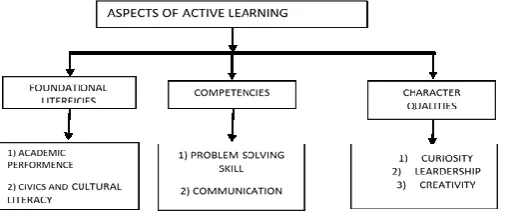
2.2.1 Foundational literacies:
Foundational literacies represent how students apply core skills to everyday tasks. These skills serve as the base upon which students need to build more advanced and equally important competencies and character qualities. This category includes not only the globally assessed skills of literacy and numeracy, but also scientific literacy, ICT literacy, 5 financial literacy and cultural and civic literacy. Acquisition of these skills has been the traditional focus of education around the world. Historically, being able to understand written texts and quantitative relationships was sufficient for entry into the workforce. Now, these skills represent just the starting point on the path towards mastering student’s aspects of21st-century skills.
2.2.2 Competencies literacies:
Competencies describe how students approach complex challenges. For example, critical thinking is the ability to identify, analyses and evaluate situations, ideas and information in order to formulate responses to problems. Creativity is the ability to imagine and devise innovative new ways of addressing problems, answering questions or expressing meaning through the application, synthesis or repurposing of knowledge. Communication and collaboration involve working in coordination with others to convey information or tackle problems. Competencies such as these are essential to the 21st-century workforce, where being able to critically evaluate and convey knowledge, as well as work well with a team, has become the norm.
2.2.3 Character qualities:
Character qualities describe how students approach their changing environment. Amid rapidly changing markets, character qualities such as persistence and adaptability ensure greater resilience and success in the face of obstacles. Curiosity and initiative serve as starting points for discovering new concepts and ideas. Leadership and social and cultural awareness involve constructive interactions with others in socially, ethically and culturally appropriate ways.
Figure 1. Aspects of learning
III.
LITERATURE SURVEY
Educational data analytics describes at which point it can be used to improve the sensible activities of education over students, teachers and the behavior classes are arranged. Educational story analytics help students, teachers and management to organize the manner of teaching classes and their schedule to improve students’ performance and also promote the student in taking decision for their academic carrier. Normally Educational Research paper will be point out the students and staffs need, opportunities, challenges, and activities.
Data related to the field of education industry and analysis of educational data is called educational data analytics. It consists of data of student, teacher, faculty, courses, teaching hours, schools, colleges, universities etc. Educational data analytics is used for describe the
Student performance and other learning techniques to remove the drawbacks in educational sector and improve the performance of students. A lot of new institutions have come up both from public and private sector offering variety of courses for under graduating and post graduating
Students. The rates of enrolments for education has also increased but not as much as the number of higher institutions are increasing. It is a concern for today’s education system and this gap has to be identified and properly addressed to the learning community.
Educational data can provide us with an improved understanding of students’ knowledge and better assessments of their progress. The educational systems currently face number of issues. Data analytics provides a set of techniques, which can help the educational system to overcome these
Issues and enhance the quality of education. It will enable the institution to guide the students and help
teachers and management in enhancing the performance of the institute
* Student Performance - Predictive Analysis:
Research papers also pointed out towards a few factors that pre-empted the probability
Of wealth of a student
* Academic analytics:
Academic analytics is concerned with the improvement of resources, processes and workflows of the academic institution through the use of learner, academic, and institutional data.
Public expectations for accountability and transparency have increased in every sector, including education. Through the implementation of big data analytics students can track their academic
And behavioral progress and faculty visibility into student performance can further be improved.
V. R Tool:
R is a system for statistical computation and graphics. It provides, among other things, a programming language, high level graphics, interfaces to other languages and debugging facilities. This manual details and defines the R language. The R language is a dialect of S which was designed in the 1980s and has been in widespread use in the statistical community since. Its principal designer, John M. Chambers, was awarded the 1998 ACM Software Systems Award for S.
IV.
SYSTEM SPECIFICATION
Hardware specification:
SYSTEM: Pentium IV2.4 GHz HARD DISK: 40GB
MONITOR:15VGA Color RAM:1GB
KEYBOARD: 110 keys enhanced
Software specification:
OPERATING SYSTEM: Windows XP and above TOOLS:RTool, Exel.
V.
VII. PROPOSED SYSTEM
The data are collected in traditional learning based on the categories academic performance, communication skill, behavior of the student, attendance. The data collected for active learning is based on the categories of foundational literacies, competence literacies and character qualities. Then the data are pre-processed, clustered to find the difference between the traditional learning and the active learning. Thus we found that Active learning is better than the traditional learning. The skill, activity, academic performance, creativity, leadership, adaptability, tolerance, intuiting power, observation capacity, are improved for the students those who are under the active learning. The sector which provide this kind of active learning also well improved in skills and their mind set are totally beyond the imaginary level. We are now at the twenty first century, with all featured items so we recommend this active learning for this new trending century. The analysis between the traditional and active learning are collected and the processes were taken under the R-tool.
Architectural Design
Figure 2
VI.
RESULTS
The Dashboard page is used to display the overall top students list based on the completion of projects and courses and top trending courses and projects based on the enrollment of the students of the department of the user signed in.
Import the traditional learning datasets to R tool and related objects also the data item. Segregate the data as for frequent data item should be classified.
Import the active learning data sets for its related data object Active learning data item defined how student’s interaction to the class and how well those are all performed. And it’s also define performance of the students.
After importing data item for both traditional and active learning students data set
Portioning to the data sets separately. Which improves the scalability of the analysing result.
Similarly we can proceed the data partition and analyse the data for active learning data sets
It’s defined the students’ performance using for active learning techniques.
Finally this analysis defined the Active learning is the way for improving students’ performance and knowledge more than Traditional learning.
VII.
CONCLUSION
Educational data can provide us with an improved understanding of students’ knowledge and better assessments of their progress. The educational systems currently face number of issues. Data analytics provides a set of techniques, which can help the educational system to overcome the current issues and enhance the quality of education. Active learning will enable the institution to guide the students and help teachers and management in enhancing the performance of the students. It can help to improve an education system by enabling better understanding of the concepts to the students. The extra information can help the teachers to manage their classes better and the management to make better policies. Thus, the analysis describes the importance of active learning and is better than the current educational system.
VIII.
REFERENCES
[1]. Educational Data Mining for Improving Educational Quality Pooja Gulati , Dr. Archana Sharma
[2]. ROLE OF DATA MINING IN EDUCATION SECTOR Dr. Mohd Maqsood Ali
[3]. Big Data Analytics in the Education Sector: Needs, Opportunities and Challenges Shikha Anirban