A Simple Method for Tagset Comparison
Markus Dickinson and Charles Jochim
Indiana University
[email protected], [email protected]
Abstract
Based on the idea that local contexts predict the same basic category across a language, we develop a simple method for comparing tagsets across corpora. The principle differences between tagsets are evidenced by variation in categories in one corpus in the same contexts where another corpus exhibits only a single tag. Such mismatches highlight differences in the definitions of tags which are crucial when porting technology from one annotation scheme to another.
1.
Introduction and Motivation
While it is desirable to develop corpus-independent meth-ods in natural language processing for learning from corpus annotation, the distinctions made in corpus annotation can have a great impact on accuracy. For example, which part-of-speech (POS) distinctions are made affects the success of a tagger (cf., e.g., Brants, 1997), especially the amount of non-locality in tagging distinctions across tagsets. Tagging algorithms thus sometimes use tagset-specific features or features optimized for a particular annotation scheme (e.g., Toutanova and Manning, 2000). The difficulty then lies in transferring the technology from one annotation scheme to another. For example, if one annotation scheme does not explicitly annotate case, technology designed to be trained on that scheme may have difficulty in moving to a scheme which does, in that it may not have been designed to empha-size morphological properties. Finding and understanding such differences is thus crucial for improving technology, in addition to providing a window on better linguistic un-derstanding.
To determine the exact effect of the tagset on technol-ogy, one must compare annotation schemes. Specifically, one needs to investigate the quality of a (morphosyntactic) tagset, or annotation scheme, where byqualitywe refer to the linguistic information encoded in a tagset, and which can vary in syntactically meaningful ways across tagsets. Two tagsets can differ in quality if one encodes distinctions that the other does not, e.g., a difference in baseform and present tense verbs.
Tagset comparison tends to either emphasize theinternal
quality of a tagset, i.e., whether it can be tagged accurately, or theexternalquality, i.e., whether it makes important lin-guistic distinctions (see D´ejean, 2000, sec. 2 & 7), and such methods generally either require sophisticated machinery or complete manual evaluation. What would be prefer-able is an automatic or semi-automatic method to compare tagsets which uses only simple properties from the data. Further, we want it to tell us something about what the categories denote across tagsets, both to pinpoint the most problematic cases for taggers and to provide feedback to humans (cf. also Babarczy et al., 2006).
A simple question that provides some guidance in explor-ing these issues is: for cases where two annotation schemes could have made the same tagging decision, do they in fact
make the same distinction? Or do they differ? Note that this question sidesteps the issue of internal and external quality, instead focusing on a more general notion of quality, en-compassing both. The key to answering this question lies in defining properties of different corpora such that we can determine when the same morphosyntactic decision could have been made.
A field of research that defines such properties, often re-lying on simple but accurate corpus properties, is annota-tion error detecannota-tion. Techniques for detecting inconsisten-cies predict areas of consistent annotation. Furthermore, the method we build from (Dickinson and Meurers, 2003) uses the local contextual information shown to be relevant for human category learning (Mintz, 2003). Thus, as de-scribed below, we have a simple and cognitively plausible method to use, which gives an indication about the quality of the categories.
The representation of data for error detection, then, allows for a relatively simple way to compare annotations. As discussed in section 2., very short contexts can be found across corpora, and thus inconsistency detection can high-light areas where the context is the “same,” thereby pre-dicting similar tags across different corpora. By using only local context, differences in tags indicate that either there is a potentially unclear distinction which humans have dif-ficulty with, or the distinction requires non-local informa-tion to disambiguate. The latter is a problem for taggers (internal criterion), and the former a problem in the cat-egory definition (external criterion). As outlined in sec-tion 3.1., this cross-corpus comparison also provides a more thorough evaluation of corpus-independent error detection methods. In section 3.2., we discuss using the same rep-resentation to more robustly pinpoint tagset discrepancies, and in section 4. we evaluate this work.
2.
Comparable units of data
To compare tagsets, we need units of data to compare across corpora that allow for the same tagging decision to be made. But what are comparable contexts? To find a suit-able definition, we start with the variationn-gram error de-tection method (Dickinson and Meurers, 2003; Dickinson, 2005), which detects errors by looking for items occurring multiple times in a corpus with varying annotation. These
Wall Street Journal (WSJ) corpus, part of the Penn Tree-bank 3 release (Marcus et al., 1993), the string in (1) is a variation 12-gram sinceoff is a variation nucleus that in one corpus occurrence is tagged as a preposition (IN), while in another it is tagged as a particle (RP). Dickinson (2005) shows that examining those cases with identical local con-text (e.g.,ward off a) results in an error detection precision of 92.8%; we will refer to these cases aslocalized variation nuclei.
(1) to wardoffa hostile takeover attempt by two Euro-pean shipping concerns
Why is this useful here? Not only are these contexts (i.e., trigrams) short and often recurring, but they seem to pre-dict the usage of the same tag, at least when the annotation scheme is held constant. This is precisely the property we desire: a context which uniquely identifies a tag using one tagset means that the same decision could have been made when using another tagset.
Furthermore, these contexts are psychologically plausible contexts for category acquisition. Mintz (2002, 2003, 2006) shows that local word context predicts the same category for human category acquisition. Thus, both error detection and category acquisition point to a word immediately sur-rounded by identical words as a useful predictor of a single category. Indeed, Mintz (2003) points out that local context generally predicts the same basic class, even across differ-ent child-directed corpora.
The claim we are making is that the same context predicts the same category, and here we define a context as a local-ized variation nucleus. Mintz defines a context as aframe
consisting only of the immediately surrounding words— i.e., not including the nucleus—and one could attempt to use such a context for cross-corpus comparison. However, being unsure of its precision for even one corpus, we use localized variation nuclei. For other languages, other con-textual features might be more appropriate, such as affix information (cf., e.g., Tseng et al., 2005).
The claim is further that these contexts only predict the samebasiccategory, such as verb; more fine-grained dis-tinctions may or may not be present across corpora, and thus by predicting the same basic category, we can isolate spots where one corpus defines categories differently. In example (2), for instance, we see how the Brown corpus (see section 4.) uses the tag vb (verb) for both present tense (2a) and baseform (2b) instances. The Penn Treebank ver-sion of the Brown corpus, however, makes a distinction, between these two, as shown in (3).
(2) a. So youknow/vbsomething of the classics
b. do youknow/vbsomething I don’t know?
(3) a. So youknow/VBPsomething of the classics
b. do youknow/VBsomething I don’t know?
If this claim is true across corpora, then local contexts can be compared to spot important differences in tagset defini-tions. Thus, localized variation nuclei can be employed as our units of data.
3.
Tagset comparison
However we use units of comparison (localized nuclei) to compare tagsets as a whole, we know that errors could cause spurious differences or highlight areas of difficulties, and so we first explore annotation error detection as a way to compare tagsets and then look at more specific differ-ences across corpora.
3.1. Annotation error detection
While the variationn-gram method is highly accurate for the WSJ, there has been no thorough evaluation across cor-pora, to determine the effect of the tagset. Part of our pur-pose is to determine how comparable localized contexts are within and across corpora, and more fully evaluating the variationn-gram method gets at this question. Previously testing the method on the BNC-sampler (Leech, 1997) and finding much lower accuracy (52%) (Dickinson, 2005) did not take into account the differences between a news cor-pus (WSJ) and a balanced corcor-pus (BNC-sampler). In other words, we do not know whether the difference in precision is more attributable to the tagset or to the differences in genre.
Thus, as a first method for comparing tagsets, we propose examining the output of the variationn-gram method, com-paring the error detection precision and also the qualitative differences in tag variations. The more precise error de-tection is, the more local the tag decisions are; likewise, lower precision tends to indicate more non-local distinc-tions. This analysis will not only serve as a method of tagset comparison in its own right, but it will help us interpret the results of tagset discrepancies, in that we will know which variations are more likely errors.
3.2. Tagset discrepancies
Using the same units of comparison, we can more specif-ically examine disagreements in variation for the same lo-calized nuclei. Discrepancies in how much variation there is for a given localized nucleus can indicate significant dif-ferences between the tagsets.
To calculate discrepancies, we investigate how much a vari-ation between tagsXandY (denoted here asX/Y) maps to a single tag. As mentioned at the outset, this will indi-cate not only non-local tag differences, but differences in the difficulty of tagging for humans, as we will see in sec-tion 4.3.
Alternative calculations For qualitative evaluation, we will find that automatically generating these discrepan-cies is sufficient for turning up crucial differences between tagsets. One could explore more refined calculations, of course.
For example, one could factor out cases of corresponding variation, by using a difference metric. That is, one could count the number of variations featuring a distinction in one corpus and its corresponding variation or non-variation tag(s) in the other. Using these correspondences, one could then calculate how often a tag variation in one corpus corre-sponded to no variation in the other minus how often there was variation in the other corpus. For example, there are a total of 125 JJ/NN variations in one corpus which have no variation in the other versus 21 JJ/NN variations with corresponding variation, leading to a score of 104.
One could also explore all possible mappings between tagsets. In other words, one could compare how often JJ/NN maps to jj against how often it maps to nn (or per-haps some other set of tags).
Since we are really only interested in the discrepancies be-tween the tagsets, we are simply examining the direct cor-respondences between variations and non-variations, as this is the most primary calculation. The alternative metrics are based upon these individual discrepancies. It is also impor-tant to point out that the use of comparable contexts readily supports all these possible calculations.
4.
Evaluation
4.1. The Data
On the one hand, to emphasize the general nature of local-ized variation nuclei across texts, we want to run our ex-periments on a variety of texts, i.e., a balanced corpus. On the other hand, to control for differences between corpora and focus on differences in the tagset, we would at first like the text to be highly similar across annotations. The Brown corpus (Kucera and Francis, 1967) is thus an ideal test case: this balanced corpus contains its original annotation, but it was also re-annotated with a related, but simpler, tagset as part of the Penn Treebank (Marcus et al., 1993). We refer to these corpora as Brown and Brown-PTB, respectively. Due to tokenization differences, Brown contains 1,161,192 tokens, and Brown-PTB has 1,170,811 tokens. In addi-tion to slight textual differences, the corpora differ in tagset granularity, with Brown having 86 tags and Brown-PTB 45. While a full analysis of these two corpora will show us much about the method, using two tagsets can only begin to give us an indication of how our methods can be used for comparison. For a more thorough analysis, we addi-tionally explore a third corpus—which happens also to be based on the Brown data—for the tagset discrepancy cal-culation (section 4.3.). The SUSANNE corpus (Sampson, 1995) has approximately 151,600 tokens and provides a
much more fine-grained annotation scheme, with 424 lexi-cal categories.1 Comparing it to the other two tagsets will provide insights into whether and how fine-grained distinc-tions make a difference in context, i.e., whether they are actually more difficult to disambiguate or not.2
4.2. Annotation error detection
Running the variationn-gram method on the first two cor-pora results in 1605 localized variation nuclei for Brown and 1809 for Brown-PTB. The amount of variation is thus roughly comparable, but they differ widely in their error detection precision: from these sets, we sampled 100 cases of each and marked for each variation whether it pointed to an error in POS annotation. For Brown, we find 42% pre-cision and for Brown-PTB, 84%, indicating that legitimate non-locality is a greater problem in Brown and that errors (and unclear distinctions) are more problematic for Brown-PTB. We thus confirm that local context has a critically dif-ferent impact on difdif-ferent tagsets: as there are fewer legiti-mate ambiguities in Brown-PTB, disambiguating words in Brown-PTB appears to be, in some sense, slightly easier than in Brown.
Perhaps as important as the absolute difference in error de-tection precision are the reasons for the differences, stem-ming from both the general quality of the annotation effort and the distinctions made in the tagsets. Brown, for ex-ample, uses function tags to indicate, e.g., that the word is being used in a headline (hl). This is clearly a non-local use, and 32 variations involved the hl tag. Removing these gives 62% precision (42/68), an improvement, but still con-siderably lower than for Brown-PTB.
The correctly ambiguous cases in both corpora involve dis-tinctions which often require non-local information, e.g., VB/VBP (baseform verb/present tense verb) in Brown-PTB and cs/in (subordinating conjunction/preposition) in Brown (see also the discussion in section 4.3. below).
There were also several cases which were unclear, such as the distinction between adjective (JJ) and noun (NN) in Brown-PTB, which is perhaps not adequately explicated for compounds in the guidelines (Santorini, 1990), leading to variation as in (4).
(4) a. ... through most of theliquid/JJhelium .
b. ... to isolate the tube ... from
theliquid/NNhelium surface
Finally, many of the variations reveal constructions which are difficult to analyze linguistically, most involving com-parative constructions, such asand as far as X, where the firstaserroneously varies between adverb (RB) and prepo-sition (IN) in Brown-PTB, as in (5).
(5) a. ...or fine points treated singly, andas/RBfar as possible impersonally.
b. The Class had entries from as far west as Wis-consin andas/INfar south as Kentucky.
1This token count does not include
breakandghosttokens.
2Brants (1995), for example, shows that tagsets can be reduced
Innot nearly as X,nearlycorrectly varies between qualifier (ql) and adverb (rb) in Brown—a distinction collapsed into RB in Brown-PTB—as shown in (6). Determining these cases not only often requires more context to disambiguate, but some knowledge of linguistic theory (see, e.g., Pollard and Sag, 1994, sec. 9.4).
(6) a. notnearly/rbas complex/jj b. notnearly/qlas much/ap
Manually examining the error detection output thus uncov-ers tag distinctions which are problematic in one way or another in one tagset. We still need to pinpoint the exact differences between tagsets, and we thus turn to the tagset discrepancy calculations.
4.3. Tagset discrepancies
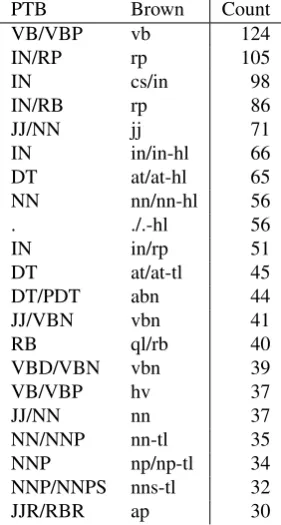
Brown and Brown-PTB The highest-ranking correspon-dences between the Brown and Brown-PTB tagsets are shown in figure 1. We can notice a variety of things from this chart.
PTB Brown Count
VB/VBP vb 124
IN/RP rp 105
IN cs/in 98
IN/RB rp 86
JJ/NN jj 71
IN in/in-hl 66
DT at/at-hl 65
NN nn/nn-hl 56
. ./.-hl 56
IN in/rp 51
DT at/at-tl 45
DT/PDT abn 44
JJ/VBN vbn 41
RB ql/rb 40
VBD/VBN vbn 39
VB/VBP hv 37
JJ/NN nn 37
NN/NNP nn-tl 35
NNP np/np-tl 34
NNP/NNPS nns-tl 32
JJR/RBR ap 30
Figure 1: Correspondences between Brown & Brown-PTB
First of all, as mentioned above, the clearly non-local -hl tag adds many spurious variations, which have a clear cor-respondent in the other tagset.
Secondly, the highest scores in both directions (VB/VBP7→ vb and cs/in7→IN) reflect tags which are combined in the other tagset. The non-local distinction cs/in in Brown never has a corresponding variant in Brown-PTB because these tags were conflated into IN; likewise, VB/VBP in Brown-PTB is conflated into vb in Brown.
Thirdly, aside from cases of variation with function tags, there is much more variation for Brown-PTB than for Brown. This high variation results from at least two ma-jor factors.
Firstly, clear differences in the tagsets can lead to varia-tion in one corpus but not the other. In Brown, for exam-ple, verbs ending in -ed are tagged vbn (past participle), even when acting as a noun modifier. However, as can be seen in (7), in Brown-PTB these lexical forms may also be tagged as JJ. This new distinction between JJ and VBN in the tagset can make disambiguation more difficult.
(7) a. ...impartial/jj andstandardized/vbnprocedure b. ...impartial/JJ andstandardized/JJprocedure
Secondly, we also find that a number of annotation errors stem from these tagset differences, as the introduction of a new distinction may be one which is difficult to make, not just for automatic taggers, but also for humans. With this distinction between adjectives and past participles, we thus find clear examples of inconsistency in the annotation, as in (8), where both should be JJ.
(8) a. You would besurprised/VBNhow ... b. he would not besurprised/JJif ...
Other examples, like (9), are less clear as to whether they are an error or simply difficult to disambiguate. Thus, for all these reasons, it is no surprise that we find 41 cases of variation of JJ/VBN in Brown-PTB, corresponding to a sin-gle tag, vbn, in Brown.
(9) a. After well broken/JJ andequipped/JJwith 12-oz. shoes on behind, bare-footed in front, she would trot...
b. The Royal Lao Army, on the other hand, was paid/VBN andequipped/VBNwith American funds.
To take another example, IN, RB (adverb), RP (particle) in Brown-PTB are defined differently than their counterparts in Brown, and so we find a high number of correspondences for the three pairs IN/RP (105), IN/RB (86), and RB/RP (26) all of which most frequently correspond to the single tag rp in Brown.3This distinction in Brown-PTB is difficult to disambiguate and fraught with errors; as it turns out, the notion of adverb and particle is more lexicalized in Brown, which leads to such correspondences. As it states in the Brown manual (Francis and Kucera, 1979),
It was decided instead to consider this a syntactic and semantic rather than a taxonomic problem, and to give the “portmanteau” tag RP (for “ad-verb or particle”) to the ten wordsabout,across,
down,in,off,on,out,over,through, andup, ex-cept when they are functioning as prepositions, when they receive the normal preposition tag IN.
Thus, we often find non-variation for these words, and without such a strict lexical principle, there is (often erro-neous) corresponding variation in Brown-PTB, as in (10).
(10) a. ...the back pressure of the manometer was builtup/RPfrom the material fed from be-tween the blocks...
3Additionally, variation between all three tags, IN/RB/RP,
b. The fixed wooden scaffold was removed, and so as to reach all the frieze, one of pipe, on wheels, builtup/INfrom the floor.
We have turned up cases where the tagsets do not align, in ways that lead to dramatic differences in difficulty. This is crucial in understanding tag correspondences (e.g., Man-ning and Sch¨utze, 1999, table 4.5) and their definitional dif-ferences, and also in understanding that a tagger optimized on one tagset will not necessarily transfer to another. For example, in order to disambiguate adverbs, prepositions, and particles, Toutanova and Manning (2000) use a feature “adding information on verbs’ preferences to take specific words as particles, or adverbs, or prepositions.” This fea-ture, while useful for a tagset such as Brown-PTB’s, is less useful for Brown since particle (rp) is often a lexical prop-erty, and there is much less confusion.
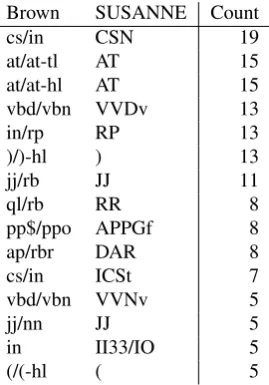
Brown and SUSANNE Turning to a comparison of the Brown and SUSANNE corpora, we know that SUSANNE has a much finer-grained tagset. However, we see in fig-ure 2 that there is more variation in Brown than in SU-SANNE for the same local contexts. In other words, gran-ularity is not a good indicator of difficulty of tagging (cf, e.g., Voutilainen and J¨arvinen, 1995).
Brown SUSANNE Count
cs/in CSN 19
at/at-tl AT 15
at/at-hl AT 15
vbd/vbn VVDv 13
in/rp RP 13
)/)-hl ) 13
jj/rb JJ 11
ql/rb RR 8
pp$/ppo APPGf 8
ap/rbr DAR 8
cs/in ICSt 7
vbd/vbn VVNv 5
jj/nn JJ 5
in II33/IO 5
(/(-hl ( 5
Figure 2: Correspondences between Brown & SUSANNE
Like the previous comparison between Brown and Brown-PTB, with Brown and SUSANNE we find that using the correspondences between tags highlights tagset distinc-tions, and again pinpoints errors in one tagset versus the other. Lexical distinctions between the tagsets play an im-portant role, as can be seen with the first item on the list, cs/in versus CSN. CSN is used for all instances of the wordthan in SUSANNE, while Brown makes the gram-matical distinction between subordinating conjunction (cs) and preposition (in).
As mentioned, SUSANNE makes more distinctions than Brown, but these do not show up as problems in context, meaning that these distinctions are more clearly defined, local, and/or infrequent. On the other hand, consider the case of ql/rb (qualifiers/adverbs). This disinction in Brown is more difficult to disambiguate, as it requires non-local
context (cf. (6)). This confirms our hypothesis that the type of variations we find are ones which break the assumption of needing only local context to disambiguate.
The distinction between possesive pronouns (pp$) and ac-cusative pronouns (ppo) in Brown is also found in SU-SANNE, and the fact that the variation does not occur in both leads us to discover that this is an error in Brown. In this case it is due to an error annotating heras accusative instead of possessive. As examples like this show, high-lighting cases of variation in one corpus without variation in another corpus can actually be a way to improve error detection precision: we are more confident that something is amiss when the other corpus has no variation.
Note that, for counts of five or higher, the only variation in SUSANNE which does not have variation in Brown is II33/IO, but this is easily disambiguated in context because it is a ditto tag that is tagged in conjunction with the previ-ous tags II31 and II32.4
Brown-PTB and SUSANNE Examining the differences in Brown-PTB and SUSANNE, as shown in figure 3, turns up many similar cases to the discrepancies between Brown and SUSANNE above, likely due to their shared history. Again, the coarser-grained tagset winds up having more variation in context. This is also likely related to annota-tion quality (cf. the comparison between the WSJ and SU-SANNE in Dickinson, 2005)
PTB SUSANNE Count
JJ/NN JJ 25
IN/RP RP 23
IN/RB RP 21
DT/PDT DBa 17
JJR/RBR DAR 15
JJ/NNP JJ 13
VBD/VBN VVNv 12
IN/RB/RP RP 8
WDT/WP DDQ 6
VBD/VBN VVDv 6
JJS/RBS DAT 6
DT/RB ATn 6
PRP/PRP$ APPGf 5
JJ/PDT DAz 5
IN/RB II 5
DT/JJ/PDT DAz 5
IN II33/IO 5
Figure 3: Correspondences between Brown-PTB & SU-SANNE
Even though both tagsets make use of adjective (JJ) and particle (RP) tags, they seem to be more easily annotated in SUSANNE, i.e., with less variation. Given the results in section 4.2., it is likely that a good portion of these varia-tions are errors, indicating the difficulty with which anno-tators had making the distinctions.
4
5.
Summary and Outlook
We have developed a simple method to easily compare tagsets, in order to both understand the linguistic distinc-tions employed in a tagset and the impact of differing cat-egories on the technology using them. This is important in porting technology from one tagset to another and in pro-viding feedback on which parts of an annotation scheme are most difficult. By using a simple notion of local context which easily transfers across corpora in the same language, tagset discrepancies can be highlighted which point out the major differences in category definitions.
The method was based on a notion of local context which has been shown to be useful in human category acquisition. In comparing categories across corpora, we are beginning to employ local context to identify areas of identical dis-ambiguation. Thus, future work could more fully explore the information needed for disambiguation across corpora and extend into category induction. One crucial step in this work will be to compare corpora of different genres and different languages, in order to see how general localized variation nuclei are in their prediction of the same basic category.
In parallel with the development of error detection methods (Dickinson, 2005), the methods explored here can also po-tentially be extended to more complex forms of annotation, where there is an even greater need for comparison, such as syntactic annotation (cf. Rehbein and van Genabith, 2007).
References
Babarczy, Anna, John Carroll, and Geoffrey Sampson (2006). Definitional, personal, and mechanical con-straints on part of speech annotation performance. Jour-nal of Natural Language Engineering12, 77–90.
Brants, Thorsten (1995). Tagset Reduction Without Infor-mation Loss. In Proceedings of ACL-95. Cambridge, MA.
Brants, Thorsten (1997). Internal and External Tagsets in Part-of-Speech Tagging. InProceedings of Eurospeech. Rhodes, Greece.
D´ejean, Herv´e (2000). How to Evaluate and Compare Tagsets? A Proposal. In Proceedings of LREC-00. Athens.
Dickinson, Markus (2005). Error detection and correction in annotated corpora. Ph.D. thesis, The Ohio State Uni-versity.
Dickinson, Markus and W. Detmar Meurers (2003). Detect-ing Errors in Part-of-Speech Annotation. InProceedings of EACL-03. Budapest, Hungary, pp. 107–114.
Francis, W. N. and H. Kucera (1979).Brown Corpus Man-ual. Tech. rep., Department of Linguistics, Brown Uni-versity, Providence, Rhode Island, US.
Kucera, Henry and W. Nelson Francis (1967). Computa-tional Analysis of Present-Day American English. Prov-idence, RI: Brown University Press.
Leech, Geoffrey (1997).A Brief Users’ Guide to the Gram-matical Tagging of the British National Corpus. UCREL, Lancaster University.
Manning, Christopher D. and Hinrich Sch¨utze (1999).
Foundations of Statistical Natural Language Processing. Cambridge, MA: The MIT Press.
Marcus, Mitchell P., Beatrice Santorini and Mary Ann Marcinkiewicz (1993). Building a large annotated cor-pus of English: The Penn Treebank.Computational Lin-guistics19(2), 313–330.
Mintz, Toben H. (2002). Category induction from distribu-tional cues in an artificial language. Memory & Cogni-tion30, 678–686.
Mintz, Toben H. (2003). Frequent frames as a cue for gram-matical categories in child directed speech.Cognition90, 91–117.
Mintz, Toben H. (2006). Finding the verbs: distribu-tional cues to categories available to young learners. In K. Hirsh-Pasek and R. M. Golinkoff (eds.),Action Meets Word: How Children Learn Verbs, New York: Oxford University Press, pp. 31–63.
Pollard, Carl and Ivan A. Sag (1994).Head-Driven Phrase Structure Grammar. Chicago: University of Chicago Press.
Rehbein, Ines and Josef van Genabith (2007). Treebank Annotation Schemes and Parser Evaluation for German. InProceedings of EMNLP-CoNLL-07. pp. 630–639.
Sampson, Geoffrey (1995). English for the Computer: The SUSANNE Corpus and Analytic Scheme. Oxford: Clarendon Press.
Santorini, Beatrice (1990).Part-Of-Speech Tagging Guide-lines for the Penn Treebank Project (3rd Revision, 2nd printing). Tech. Rep. MS-CIS-90-47, The University of Pennsylvania, Philadelphia, PA.
Toutanova, Kristina and Christopher D. Manning (2000). Enriching the Knowledge Sources Used in a Maxi-mum Entropy Part-of-Speech Tagger. InProceedings of EMNLP/VLC-2000. Hong Kong.
Tseng, Huihsin, Daniel Jurafsky and Christopher Manning (2005). Morphological features help POS tagging of un-known words across language varieties. InProceedings of the Fourth SIGHAN Workshop on Chinese Language Processing.