LIRICS semantic role annotation:
design and evaluation of a set of data categories
Volha Petukhova and Harry Bunt
Department of Communication and Information Sciences Tilburg University, Netherlands
{v.petukhova,harry.bunt}@uvt.nl Abstract
In this paper we report on the analyses of alternative approaches to semantic role annotation (FrameNet (FrameNet, 2005), PropBank (Palmer et al., 2005) and VerbNet (Kipper, 2006)) with respect to their models of description; granularity of semantic role sets; definitions of semantic roles concepts; and consistency and reliability of annotations, and we propose a methodological basis for identifying and analysing semantic roles, including a data-driven account of defining semantic role concepts. We present evaluation results of the defined concepts for semantic role annotation concerning the redundancy and completeness of the tagset, and concerning the reliability of annotations in terms of inter-annotator agreement.
1.
Introduction
Semantic roles have often proved to be useful labels for stating linguistic generalisations of various sorts. There is, however, a lack of agreement on their defining crite-ria, which causes serious problems for semantic roles to be a useful classificatory device for predicate-argument re-lations. These criteria should (a) support the design of a semantic role set which is complete but does not contain redundant relations; (b) be based on semantic rather than morphological, lexical or syntactic properties; and (c) en-able formal interpretation.
In the LIRICS1 project, alternative approaches to the
an-notation and representation of semantic role information were analysed; methodological principles for characteris-ing well-defined concepts were developed; and a set of semantic roles and their definitions was designed in ISO 12620 format.
This paper is organised as follows. First, we briefly dis-cuss the results of comparative analyses of recent projects concerned with semantic role annotation such as FrameNet (FrameNet, 2005), PropBank (Palmer et al., 2005), VerbNet (Kipper, 2006) and LIRICS (Bunt and Romary, 2002). We then describe annotation experiments carried out in order to evaluate the set of semantic roles proposed in the LIRICS project, and discuss the quantitative and qualitative results. Finally, we point out some interesting issues arising from the annotation and evaluation tasks.
2.
Approaches to semantic role annotation
In an early stage of the LIRICS project several approaches and existing projects were analysed and compared with re-spect to (1) description model; (2) semantic granularity; (3) definitions of semantic roles; and (4) consistency and relia-bility of annotation.
2.1. Description models
FrameNet (FrameNet, 2005) is designed as an ontology of frames, which are representations of prototypical situations
1L
¯inguistic I¯nfR¯astructure for I¯nteroperable ResourC¯es and S
¯ystems (http://lirics.loria.fr).
(events or states). There are more general and more specific situations (e.g. communication events and reporting events respectively). The higher-level frames are considered as characterising the basic structural properties of events and relations in the more specific frames. Each frame pro-vides its set of semantic roles which corresponds to cate-gories of entities or concepts that occur in an event or state. FrameNet has a rich set of relations between frames, e.g. an
is-a relation between a parent frame and a child frame that
implies full inheritance of semantic roles, and where a child frame has at least one difference. This hierarchically struc-tured set of semantic roles could in principle be extended to support annotations that are useful for various applications. In contrast to FrameNet, PropBank (Palmer et al., 2005) and VerbNet (Kipper, 2006) have a verb-dependent model of description of semantic relations. PropBank is a prac-tical approach to semantic annotation, which adds seman-tic role information to the syntacseman-tic structures of the Penn Treebank. The main purpose of PropBank is to provide a description of every verb in the Penn Treebank corpus and to define semantic roles per verb sense based on the num-ber of arguments. Arguments are numnum-bered as Arg0, Arg1, etc. depending on the valency of the verb in question. Prop-Bank’s framesets are verb-specific. PropBank limits itself to annotating the literal meaning of a verb2. VerbNet (Kip-per, 2006) is based on the assumption that syntactic frames associated with a particular verb of a particular class (based on Levin’s verb classes) reflect underlying aspects of mean-ing. VerbNet refined and extended Levin’s verb classes, their number growing to 247 classes that cover 5257 verb senses.
Different approaches to semantic role annotation maintain different levels of semantic granularity. VerbNet accounts for high-order generalisations about verb lexical meanings, and defined an exhaustive set of 23 general (”high-level”) roles. In addition, there are roles like Theme1 and Theme2, Patient1 and Patient2, which are used for a few classes where there seems to be no distinction between the argu-ments. FrameNet, by contrast, defines semantic roles
rela-2
VerbNet PropBank FrameNet LIRICS
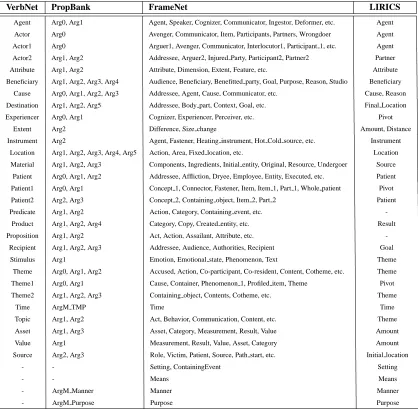
Agent Arg0, Arg1 Agent, Speaker, Cognizer, Communicator, Ingestor, Deformer, etc. Agent Actor Arg0 Avenger, Communicator, Item, Participants, Partners, Wrongdoer Agent Actor1 Arg0 Arguer1, Avenger, Communicator, Interlocutor1, Participant 1, etc. Agent Actor2 Arg1, Arg2 Addressee, Arguer2, Injured Party, Participant2, Partner2 Partner Attribute Arg1, Arg2 Attribute, Dimension, Extent, Feature, etc. Attribute Beneficiary Arg1, Arg2, Arg3, Arg4 Audience, Beneficiary, Benefitted party, Goal, Purpose, Reason, Studio Beneficiary
Cause Arg0, Arg1, Arg2, Arg3 Addressee, Agent, Cause, Communicator, etc. Cause, Reason Destination Arg1, Arg2, Arg5 Addressee, Body part, Context, Goal, etc. Final Location Experiencer Arg0, Arg1 Cognizer, Experiencer, Perceiver, etc. Pivot
Extent Arg2 Difference, Size change Amount, Distance
Instrument Arg2 Agent, Fastener, Heating instrument, Hot Cold source, etc. Instrument Location Arg1, Arg2, Arg3, Arg4, Arg5 Action, Area, Fixed location, etc. Location Material Arg1, Arg2, Arg3 Components, Ingredients, Initial entity, Original, Resource, Undergoer Source
Patient Arg0, Arg1, Arg2 Addressee, Affliction, Dryee, Employee, Entity, Executed, etc. Patient Patient1 Arg0, Arg1 Concept 1, Connector, Fastener, Item, Item 1, Part 1, Whole patient Pivot Patient2 Arg2, Arg3 Concept 2, Containing object, Item 2, Part 2 Patient Predicate Arg1, Arg2 Action, Category, Containing event, etc.
-Product Arg1, Arg2, Arg4 Category, Copy, Created entity, etc. Result Proposition Arg1, Arg2 Act, Action, Assailant, Attribute, etc.
-Recipient Arg1, Arg2, Arg3 Addressee, Audience, Authorities, Recipient Goal Stimulus Arg1 Emotion, Emotional state, Phenomenon, Text Theme
Theme Arg0, Arg1, Arg2 Accused, Action, Co-participant, Co-resident, Content, Cotheme, etc. Theme Theme1 Arg0, Arg1 Cause, Container, Phenomenon 1, Profiled item, Theme Pivot Theme2 Arg1, Arg2, Arg3 Containing object, Contents, Cotheme, etc. Theme
Time ArgM TMP Time Time
Topic Arg1, Arg2 Act, Behavior, Communication, Content, etc. Theme Asset Arg1, Arg3 Asset, Category, Measurement, Result, Value Amount Value Arg1 Measurement, Result, Value, Asset, Category Amount Source Arg2, Arg3 Role, Victim, Patient, Source, Path start, etc. Initial location
- - Setting, ContainingEvent Setting
- - Means Means
- ArgM Manner Manner Manner
- ArgM Purpose Purpose Purpose
Table 1:Semantic roles in different projects.
LIRICS defines semantic roles as relational notions which link a participant to some real or imagined situation (’event’). For each role we first made a list of entailments associated with each semantic role, starting with the most frequently used ones (e.g. Agent and Theme), and looked further for non-arbitrary boundaries between roles to design a set which is ideally complete and does not contain redun-dant relations. These entailments were converted into a set of properties, e.g. [+/- intentionality], [+/- independent ex-istence], etc. Table 2 illustrates the differences between the
Theme and Result roles.
Theme Result
- intentionality - intentionality
- affectedness - affectedness
+ independent existence - independent existence
Table 2:Semantic properties for THEME and RESULT roles.
Thus, Theme differs from Result in that a Result does not exist independently of the event, it is rather the product of the event described by the verb, whereas a Theme existed
before the event started, e.g. Elene read a book and Elene
wrote a book.
In this way the set of 295’high-level’ roles was constructed
(Schiffrin and Bunt, 2007).
2.3. Granularity of semantic roles
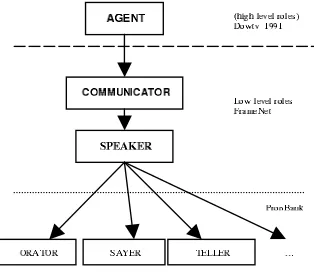
The LIRICS meta-model (see Figure 1) has two levels of granularity: coarse (high-level) and fine (low-level). For the latter level the FrameNet approach was used, namely the idea of hierarchical structure due to the links to con-ceptual frames (inheritance relations). A certain low-level semantic role inherits all the properties of the relevant high-level semantic role except for at least one, which would reflect (a) more specific entailment(-s) of a particular pred-icate or class of predpred-icates. For example, the Agent role is defined in LIRICS as:
5LIRICS defines 11 roles which are central to any event, e.g.
Agent, Theme, Patient, etc., 10 adjunct roles, e.g. Time, Loca-tion, Manner, etc., and 8 sub-roles for Time and LocaLoca-tion, e.g. Duration, Frequency, Path, etc. For definitions and illustrative
• participant in an event,
• who initiates and carries out the event intentionally or consciously,
• and who exists independently of the event.
For the verbs of communication (communication events) the participant who plays the Agent role would be
Commu-nicator (see (FrameNet, 2005)) and would be defined as: • participant in an event,
• who initiates and carries out the communication event intentionally or consciously using written, spoken or
nonverbal language or combination of those, • and who exists independently of the event.
Figure 1:LIRICS metamodel for semantic role annotation.
This shows that the Communicator has all the properties of the Agent plus what is specific for this class of predicates. If we go one more level down we can define more specific roles, again benefiting from the FrameNet hierarchy. For a particular sub-class of verbs of communication, for exam-ple, Speaker would be defined as a participant who initi-ates and carries out the communication event intentionally or consciously using speech. Finally, at the verb-specific level Speaker could be Sayer, Teller, Orator, Broadcaster, etc. Here, the semantic roles defined by PropBank could be used. Figure 2 shows the possible hierarchy according to the model in 1.
2.4. Completeness and redundancy of semantic role set
The LIRICS set of semantic roles was evaluated with re-spect to redundancy, completeness and reliability (see Sec-tion 3). We tested defined semantic roles on redundant in-formation both by looking at annotated data while search-ing for boundaries between semantic roles to avoid over-lapping information and analysing the set of defined prop-erties, eliminating roles with the same properties. This lead to removing some roles like Recipient, Stimulus and
Expe-riencer. Recipient has the same properties as Goal, Stimu-lus overlaps with Theme, and Experiencer either with Pa-tient in events or Pivot in states, but the latter roles are more
broader concepts and not just restricted to mental, psycho-logical or perception events/states, like Stimulus or
Expe-riencer. The completeness of the defined set of roles was
measured both theoretically by comparing our observations
Figure 2:Possible AGENT-roles hierarchy.
with the semantic role sets defined in various other projects (Petukhova et al., 2007) and empirically, as described in Section 3.
It should also be noted here that, once we have analysed the redundancy and completeness of the set of high-level roles, this does not need to be done again for the low-level roles, since the low-level roles inherit the relevant properties from the high-level ones.
3.
Evaluation of LIRICS semantic role set
The LIRICS set of semantic role was evaluated for com-pleteness and reliability in terms of inter-annotator agree-ment. For this purpose multilingual test suites were con-structed for English, Dutch, Italian and Spanish. For En-glish FrameNet and PropBank data was used. We selected three unbroken FrameNet texts (120 sentences) and isolated sentences (83 sentences). The PropBank data consists of isolated sentences (355 sentences). For Dutch 15 unbro-ken texts were selected from news articles, with a total of 260 sentences. News articles were also selected to con-struct Italian test suites (101 sentences), all taken from the Italian Treebank corpus. For Spanish, the LIRICS test suite consists of 189 sentences taken from the Spanish FrameNet corpus.
3.1. Annotation taks
The semantic role annotation task involved two main activ-ities:
• Identification and labeling of markables: expressions that represent the entities involved in semantic role re-lations. Markables come in two varieties:
– anchors, which correspond to one of three
situ-ation (or ’eventuality’) types: events, states and facts; every semantic role must be ’anchored’ to a situation of one of these types. Anchors are re-alised mainly by verbs but sometimes by nouns or adverbs.
– situation participants. The are realised mainly by
nouns, noun phrases and pronouns, but also by various types of subordinate clauses.
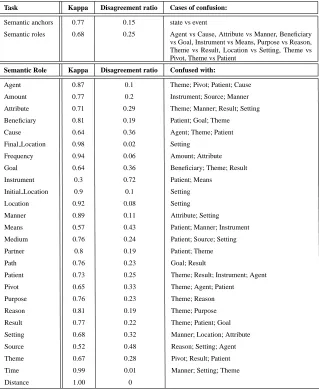
an-Task Kappa Disagreement ratio Cases of confusion:
Semantic anchors 0.77 0.15 state vs event
Semantic roles 0.68 0.25 Agent vs Cause, Attribute vs Manner, Beneficiary vs Goal, Instrument vs Means, Purpose vs Reason, Theme vs Result, Location vs Setting, Theme vs Pivot, Theme vs Patient
Semantic Role Kappa Disagreement ratio Confused with:
Agent 0.87 0.1 Theme; Pivot; Patient; Cause Amount 0.77 0.2 Instrument; Source; Manner Attribute 0.71 0.29 Theme; Manner; Result; Setting Beneficiary 0.81 0.19 Patient; Goal; Theme Cause 0.64 0.36 Agent; Theme; Patient Final Location 0.98 0.02 Setting
Frequency 0.94 0.06 Amount; Attribute Goal 0.64 0.36 Beneficiary; Theme; Result Instrument 0.3 0.72 Patient; Means
Initial Location 0.9 0.1 Setting
Location 0.92 0.08 Setting
Manner 0.89 0.11 Attribute; Setting Means 0.57 0.43 Patient; Manner; Instrument Medium 0.76 0.24 Patient; Source; Setting
Partner 0.8 0.19 Patient; Theme
Path 0.76 0.23 Goal; Result
Patient 0.73 0.25 Theme; Result; Instrument; Agent Pivot 0.65 0.33 Theme; Agent; Patient
Purpose 0.76 0.23 Theme; Reason
Reason 0.81 0.19 Theme; Purpose
Result 0.77 0.22 Theme; Patient; Goal Setting 0.68 0.32 Manner; Location; Attribute Source 0.52 0.48 Reason; Setting; Agent Theme 0.67 0.28 Pivot; Result; Patient
Time 0.99 0.01 Manner; Setting; Theme
Distance 1.00 0
Table 4: Inter-annotator agreement on on semantic anchors and (individual) roles expressed in Kappa scores and ratio and cases of
disagreement
as Means, and by the third annotator was not identified as a participant of the ’dealing’ event. For Instrument some in-consistency in identification of this type of participants was observed between annotators; while Annotator 1 identified 11 participants with Instrument role and Annotator 2 identi-fied 10 of those, reaching an agreement of 84%, Annotator 3 identified zero participants with the Instrument role and reached zero agreement with both other annotators. The role Source was frequently confused with Reason:
(4) His doubts stemmed from the fact that several years
ear-lier a Princeton University researcher, Arnold Levine , had found in experiments with mice that a gene called p53 could transform normal cells into cancerous ones.
In this case two annotators assigned the Source role to the participant marked in bold and one annotator assigned the role Reason. We may assume that ’the fact...’ is the
Rea-son of ’his doubts’, but the Source of the ’stemming’ event,
because Reason represents the set of facts or circumstances explaining why a state exists or an event occurs. Source, by contrast, is a participant in an event that is the non-locative and non-temporal start point of an action.
Spatial and temporal roles (Location and Time, and their
sub-roles) were easier to identify than others. These roles are usually less ambiguous, but some confusing cases do occur, for example, for Location vs Setting. Setting is dis-tinguished from Location by whether it defines a set of cir-cumstances of the occurrence of event or state, or not; if it does, then it is a Setting; if not, then it is a Location.
Loca-tion is a participant that represents the place where an event
occurs, or a state that is true. For example 5:
(5) It hopes to speak to students at theological colleges about the joys of bell ringing.
The participant ’theological colleges’ in 5 is ambiguous and can refer to a building, a school for advanced education, an organization, or students and teachers of these organisation. Some situations are ambiguous, e.g. Reason vs Purpose:
(6) Laws exist to prevent crimes.
LIRICS defines semantic roles as a way a participant takes part in an event, and a participant’s involvement is poten-tially manifold. Thus, a participant may have one or more semantic roles associated with an event. For example, for verbs like ’pay’, ’supply’ and ’provide’, a participant, who receives something may have two roles, namely
Benefi-ciary, but also Goal, for example:
(7) Germany and China allegedly provided technical and mate-rial assistance to the Al-Fatah program.
The participant the Al-Fatah program is clearly advantaged by the event (Beneficiary) and it also describes a terminal point which will be reached in the normal course of events or in all possible courses of events (Goal).
Overall, the results are encouraging and promising, consid-ering the fact that annotations were made by ’naive’ an-notators with little experience in annotation work and very limited training. After a close inspection of the results, we concluded that some moderate Kappa values were mainly due to the fact that the annotation guidelines were not yet well-established. As an outcome of the results described above both the annotation guidelines and some of the se-mantic role definitions were improved.
4.
Conclusions and future research
In conclusion we would like to highlight some benefits of the LIRICS description model and semantic role set. The LIRICS model incorporates important findings of other projects in the same area and makes a step forward by pro-viding a complete set of semantic roles without redundan-cies, defined as purely semantic concepts by virtue of dis-tinctive semantic properties. The LIRICS model encom-passes different levels of granularity enabling hierarchical structures of semantic roles, making this model extendable and attractive for many applications. Finally, the LIRICS semantic role set can be used reliably for annotation pur-poses. It was established that annotators exhibit substan-tial agreement using the proposed data categories. Those categories which were frequently confused by the annota-tors underwent some revision. For example, the definitions of Instrument and Means were revised and the distinction between them was clarified in the property of independent
existence, where the Instrument does exist independently
from the event, whereas Means is a participant in an event that represents a procedure for performing the action in terms of component steps, or a method by which an inten-tional act is performed by an agent, and does not necessarily exist independently of the event.
In the future, more effective annotation guidelines will be designed where roles are organised in a taxonomy exploit-ing semantic features, allowexploit-ing annotators to deal with dif-ferent levels of granularity and perform a case-by-case de-cision. Finally, we aim to support annotators by incorporat-ing other resources, such as the VerbNet index and Sem-Link, and provide systematic mappings of roles defined within other projects to those defined in LIRICS.
5.
References
H. C. Bunt and L. Romary. 2002. Requirements on
multimodal semantic representations. Proceedings of
ISO TC37/SC4 Preliminary Meeting, pages 59–68,
Dor-drecht, Seoul.
H. C. Bunt and V. Petukhova and A. Schiffrin. 2007. LIR-ICS Deliverable D4.4. Multilingual test suites for seman-tically annotated data. http://lirics.loria.fr.
J. Cohen. 1960. A coefficient of agreement for nomi-nal scales. Education and Psychological Measurement, 20:37-46.
D. Dowty. 1991. Thematic Proto-Roles and Argument Se-lection. Language, 67:547–619.
ICSI. 2005. FrameNet. http://framenet.icsi.berkeley.edu..
P. Kingsbury and M. Palmer and M. Marcus. 2002. Adding Semantic Annotation to the Penn TreeBank.
Proceed-ings of the Human Language Technology Conference,
San Diego, California.
K. Kipper. 2002. VerbNet: A Class-Based Verb Lexicon.
http://verbs.colorado.edu/ mpalmer/projects/verbnet.html.
E. Loper and Szu-ting Yi and M. Palmer. 2007. Com-bining Lexical Resources: Mapping Between PropBank and VerbNet. Proceedings of the Seventh International
Workshop on Computational Semantics (IWCS-7), pages
118–129.
M. Palmer and D. Gildea and P. Kingsbury. 2002. The Proposition Bank: An Annotated Corpus of Semantic Roles. Computational Linguistics, 31(1):71-106.
V. Petukhova and A. Schiffrin and H. Bunt. 2007. Defin-ing Semantic Roles. ProceedDefin-ings of the Seventh
Interna-tional Workshop on ComputaInterna-tional Semantics (IWCS-7),
pages: 362–365, Tilburg.
T. Rietveld and R. van Hout. 1993. Statistical techniques
for the study of language and language behavior. Berlin:
Mouton de Gruyter.