for the next cluster of. If the user judgments are “not
identical” for every central sentence of, the
is added
into. Note that the central sentence does not change on
merging the two clusters, i.e., one central sentence is cho-sen and then continuously used. Therefore, the system out-put is unique, and the maximum number of user judgments
is .
}
,
,
,
{
d
1d
2d
ND
=
L
Input
cluster D to k clusters
C
=
{
C
1,
C
2,
L
,
C
k}
}
{
C
1A
=
,
C
=
{
C
2,
C
3,
L
,
C
k}
for( i =2; i < k+1; i++) {
z is the center of
foreach C in A {
x is the center of C
give (x,z) to user
get Const from user
if (Const = must-link) {
; break
}
}
if (Const = cannot-link) {
}
}
i
C
i
C
C
C
←
∪
}
{
C
iA
A
←
∪
Output A
w
and initial cluster number k
construct
Figure 1: System algorithm
2.2. System description
Figure 27 show our system. The system is implemented
using Perl CGI. First, we input the target word (Figure 2).
Figure 2: Input of a target word
The system retrieves example sentences including the tar-get word from a corpus (Figure 3). As the search engine
software, we use HyperEstraier provided in the following site.
http://hyperestraier.sourceforge.net/ index.html
Figure 3: Example sentences
Then, the system conducts clustering for example sentences (Figure 4). As the clustering engine software, we use CLUTO provided in the following site.
http://glaros.dtc.umn.edu/gkhome/ views/cluto
Figure 4: Initial clustering result
Figure 5: Typical sentences
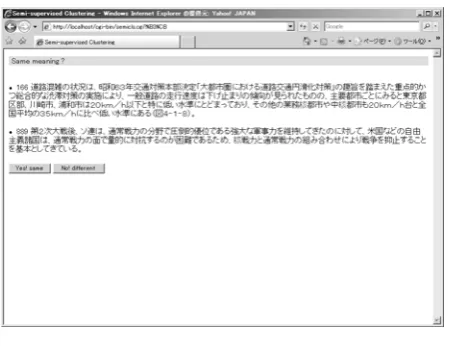
The next stage is the semi-supervised clustering. The sys-tem shows a pair of typical sentences to the user, and the user judges whether target words in two sentences are used in same meaning, or not (Figure 6).
Figure 6: User judgment
After some iteration of this procedure, the system presents the final clustering result (Figure 7).
Figure 7: Final clustering result
2.3. Similarity between sentences
A measure of the similarity of the sentences is essential in our system.
The system converts a sentence into a feature list. Using this feature list, the system measures similarities between sentences. Our system uses the following features used in the paper (Shinnou and Sasaki, 2003). Suppose the target word is , which is the
-th word in the sentence. e1: the word
e2: the word
e3: two content words in front of e4: two content words behind e5: thesaurus ID number of e3 and e4
For example, let’s consider the following sentence2 in which the target word is ‘kiroku( )’3.
kako/saikou/wo/kiroku/suru/ta/.
The system generates the following feature list from the above example sentence.
{ e1=wo, e2=suru, e3=saikou, e3=kako, e4=suru, e4=., e5=3192, e5=31920, e5=1164, e5=11642 }
Because of space limitations, we sketch out the similarity measurement between two feature lists,and .
The is the sum of three kinds of similarities.
sim(A,B) = 1/3 * {
(Similarity of the feature e1) + (Similarity of the feature e2)
+ (Similarity of the feature e3,e4 and e5)}
The similarity is 1 if the feature has the same value, and 0 if it does not. In addition, the similarity is adjusted using some ad-hoc rules.
2
A sentence is segmented into words, and each word is trans-formed into its original form by morphological analysis.
3The word ‘kiroku( )’ has at least two meanings: “memo”
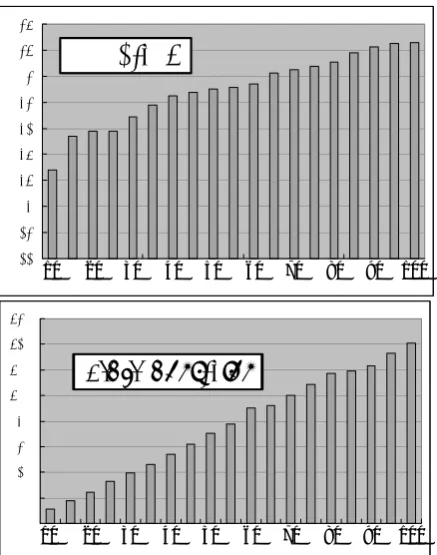
0.66 0.68 0.7 0.72 0.74 0.76 0.78 0.8 0.82 0.84
1 6 11 16
0 20 40 60 80 100 120 140 160
1 6 11 16
Accuracy
# of constrains
10 20 30 40 50 60 70 80 90 100 10 20 30 40 50 60 70 80 90 100
Figure 8: Constrains and accuracy for the initial cluster numbers
To measure similarity, use of a thesaurus is essential. We use Bunrui-goi-hyou5 as the thesaurus. We can improve similarity measurement by using more powerful thesaurus. Improvement of similarity measurement is our future work. To do it, we must construct the thesaurus suitable for our task.
5.
Conclusion
In this paper, we have described a system that divides exam-ple sentences based on the meaning of the target word. In this task, the estimation of the number of possible meanings is essential. Therefore, our system uses semi-supervised clustering. First, a data set is divided into many small clus-ters by using an initial clusclus-ters number entered by the user. Next, the system merges these clusters by asking the user for feedback. An experiment using 12 nouns demonstrated the high accuracy of our system, using a small number of constraints given by the user. In the future, we will improve the accuracy of the similarity measurements to obtain more accurate clustering results.
Acknowledgements
This research was partially supported by the Ministry of Education, Science, Sports and Culture, Grant-in-Aid for Scientific Research on Priority Areas, Japanese Corpus , 19011001, 2007.
5
Japanese standard thesaurus
6.
References
Sugato Basu, Arindam Banerjee, and Raymond J. Mooney. 2004. Active semi-supervision for pairwise constrained clustering. pages 333–344.
Mikhail Bilenko, Sugato Basu, and Raymond J. Mooney. 2004. Integrating Constraints and Metric Learning in Semi-Supervised Clustering. In ICML-2004, pages 81– 88.
David Cohn, Rich Caruana, and Andrew McCallum. 2003. Semi-supervised Clustering with User Feedback. Tech-nical Report TR2003–1892, Cornell University.
Donald Hindle. 1990. Noun classification from predicate argument structures. In Proceedings of the 28th annual meeting on Association for Computational Linguistics (ACL-90), pages 268–275.
Dan Klein, Sepandar D. Kamvar, and Christopher D. Man-ning. 2002. From Instance-level Constraints to Space-level Constraints: Making the Most of Prior Knowledge in Data Clustering. In ICML-2002, pages 307–314. Masaki Murata and Masao Utiyama and Kiyotaka
Uchi-moto and Qing Ma and Hitoshi Isahara. 2001. Japanese word sense disambiguation using the simple Bayes and support vector machine methods. In Proceedings of the SENSEVAL-2, pages 135–138.
Resnik Philip. 1992. WordNet and Distributional Analysis: A Class-based Approach to Lexical Discovery. In Pro-ceedings of AAAI-92 Workshop on Statistically-Based NLP Techniques, pages 48–56.
Hiroyuki Shinnou and Minoru Sasaki. 2003. Unsupervised learning of word sense disambiguation rules by estimat-ing an optimum iteration number in the EM algorithm. In Proceedings of Seventh Conference on Natural Lan-guage Learning (CoNLL-2003), pages 41–48.