Semiotic-based Ontology Evaluation Tool
S-OntoEval
Renata Dividino, Massimo Romanelli and Daniel Sonntag
Fraunhofer Institute for Computer Graphics (IGD), German Research Center for AI (DFKI) Fraunhoferstrasse 5 D-64283 Darmstadt, Stuhlsatzenhausweg 3 D-66123 Saarbr¨ucken [email protected], [email protected], [email protected]
Abstract
The objective of the Semiotic-based Ontology Evaluation Tool (S-OntoEval) is to evaluate and propose improvements to a given on-tological model. The evaluation aims at assessing the quality of the ontology by drawing upon semiotic theory (Stamper et al., 2000), taking several metrics into consideration for assessing the syntactic, semantic, and pragmatic aspects of ontology quality. We consider an ontology to be a semiotic object and we identify three main types of semiotic ontology evaluation levels: the structural level, assessing the ontology syntax and formal semantics; the functional level, assessing the ontology cognitive semantics and; the usability-related level, assessing the ontology pragmatics. The Ontology Evaluation Tool implements metrics for each semiotic ontology level: on the structural level by making use of reasoner such as the RACER System (Haarselv and M¨oller, 2001) and Pellet (Parsia and Sirin, 2004) to check the logical consistency of our ontological model (TBoxes and ABoxes) and graph-theory measures such as Depth; on the functional level by making use of a task-based evaluation approach which measures the quality of the ontology based on the adequacy of the ontological model for a specific task; and on the usability-profiling level by applying a quantitative analysis of the amount of annotation. Other metrics can be easily integrated and added to the respective evaluation level. In this work, the Ontology Evaluation Tool is used to test and evaluate the SWIntO Ontology of the SmartWeb project.
1.
Introduction
Ontology evaluation is a basis for defining what a good on-tology is. By analyzing the heterogeneous nature of works with respect to the assessment of the ontology, we could note three groups of evaluation methods: those assessing the graph structure and formal semantics of an ontology (Guarino and Welty, 2002; Yao et al., 2005; Huang and Diao, 2006); the second group assessing an ontology’s in-tended use (Maedche and Staab, 2002; Porzel and Malaka, 2004; Daelemans and Reinberger, 2004; Lozano-Tello and Gomez-Perez, 2004); and the last group addressing to the quality level of the ontology’s annotations (Noy, 2004). These three assessment approaches are directly analogous to a semiotic assessment (Stamper et al., 2000).1 Follow-ing Saussures, semiotics embraces the traditional branches of linguistics: syntactics (deals with the structure of signs and sign systems), semantics (deals with the meanings of signs and sign systems; that is, the meanings of words, sentences, gestures, paintings, mathematical symbols, etc.), and pragmatics (deals with inferential meaning, not merely logical inference, but the subtler aspects of communication expressed through indirection, e.g., ”It’s drafty in here” = ”Close the door”, and through social context).
In order to evaluate an ontology at its semiotic dimensions and we first identify the ontology’s semiotic characteris-tics. Fundamentally, an ontology is a special kind of mation object, structured in graph-like format. This
infor-1
Semiotic, from the greek word seemeiootikee, denotes the study of signs, what they represent and signify, and how we act and think in their universe. Semiotic Theory was developed inde-pendently by the logician and philosopher Charler Sanders Peirce and the linguist Ferndinand de Saussure. Saussure’s approach was a generalization of formal, structuralist linguistics; Peirce’s was an extension of reasoning and logic in the natural sciences.
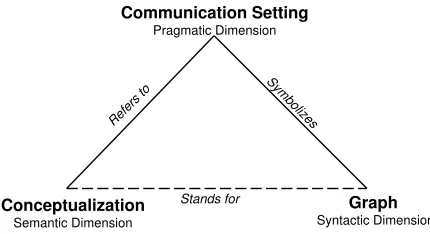
mation object structure is used to represent the ontology in-tended conceptualization, i.e., its meaning or formal seman-tics. An ontology’s intended meaning is established within a communication setting related to specific social-cultural definitions. Considering an ontology is a semiotic object (see figure 1), the quality of an ontology may be assessed with respect to its structure (syntax and formal semantics), its intended conceptualization (cognitive semantics), and its communication setting (pragmatics).
Graph Syntactic Dimension Conceptualization
Semantic Dimension
Communication Setting Pragmatic Dimension
Stands for
Ref ers
to Symbo
liz es
Figure 1: Ontology as a Semiotic Object
ontol-ogy with respect to its conceptualization (or intended use); and finally, its usability dimension by adopting approaches addressing the quality level of the set of annotations about the ontology and its elements.
The next section presents the implementation of the on-tology evaluation tool according to the theoretical con-siderations. Subsequently, the evaluation results for the SmartWeb Integrated Ontology (SWIntO) (Oberle et al., 2007) use case is described.
2.
Evaluation in Semiotic Levels
The Structural Evaluation employs structural measures fo-cussed on the syntax of ontology graphs, thus assessing the ontology’s topological dimension. Measures related to topological dimensions are Depth, Breath, Modular-ity, Connectivity (Gangemi et al., 2006; Huang and Diao, 2006). Measures related to logical adequacy (formal se-mantic) measures are, for instance, Consistency, Complex-ity, Concept SatisfiabilComplex-ity, Concept Subsumption (Gangemi et al., 2006). The Functional Evaluation and correspond-ing measures assess the accuracy of the ontology with re-spect to its conceptualization. A good ontology should be a close approximation to the conceptualization that is sup-posed to be described. The more similar the ontologys in-tended meaning is to the conceptualization, the better the ontology is. The applicability of functional measurement is based on approximation measures, i.e., on a process of matching. Matching accuracy is evaluated by three mea-sures: Precision, Recall, and F-measure (Baeza-Yates and Ribeiro-Neto, 1999). An appropriate evaluation strategy in-volve ways to capture the ontology conceptualization given expertise (Steels, 1990), task (Porzel and Malaka, 2004), or competency (Uschold and Gr¨uninger, 1996). By applying this method, we are actually capturing domain functionality instead of capturing domain conceptualization itself. Thus, the functional dimension is related to the intended use of the ontology. The Pragmatic Evaluation is seen as an eval-uation of a usability profile: Usability profiling measures focus on the ontology profile. An ontology profile is a set of annotations about the ontology and its elements. Measures of an ontology profile address the communication context (i.e., its pragmatics) of an ontology with the user.From a semiotic point of view, an ontology profile should consist of set of structural, functional and user-oriented annotations containing all relevant information about the ontology from the point of view of an specific user (on-tology engineer and on(on-tology consumer) or group. Our S-OntoEval tool evaluates an ontology with respect to its three semiotic dimensions. The tool consists of the struc-tural module, the functional module, and the usability mod-ule responsible for the assessment of the ontology in the correspondly dimension (see figure 2).2
S-OntoEval is a Java stand-alone application. It requires a configuration file at the start with settings such as the on-tology file path, onon-tology repositories, reasoners, etc. The results of the evaluation is written in a report that can later
2Some other auxiliaries modules (rating module, searching
module, and publishing module) enable the concurrent evaluation
of more than only a single ontology and allow the use of multiple metrics at each semiotic evaluation level.
Agents\ Applications
Rating
Structural
Searching Publishing
Ontologies Reports
Metrics Functional
Usability
Figure 2: S-OntoEval Tool Architecture
serve as ontology-internal annotation or external HTML re-port. Basically, the GUI is composed of three tab windows, one for each semiotic level. Each tab presents the visual components of the corresponding semiotic level evaluation. In what follows, we provide a detailed description of the GUI elements and user interaction possibilities at each eval-uation level.
2.1. Structural Evaluation
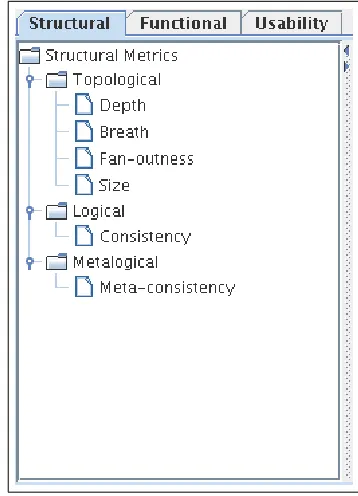
The structural evaluation tab is composed of five panels. As figure 3 shows, the left panel consists of a list of the structural metrics available for the evaluation organized in a tree structure. The tree structure presents an overview of the hierarchy among the available metrics. The tree tab also allows the selection of multiple metrics for a single evaluation step, i.e., metrics can be combined to generate a final evaluation score.
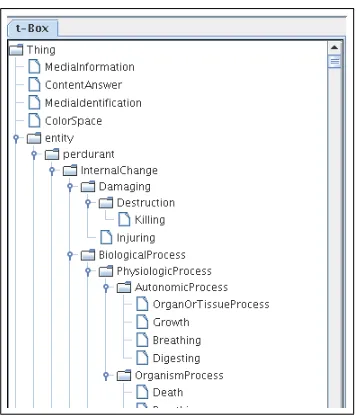
Figure 4: Ontology Concept Hierarchy
The right panel of the structural tab presented in figure 4 shows the ontology to be evaluated in form of a tree ture (according to the ontology taxonomy). The tree struc-ture facilitates the navigation through the ontology concept hierarchy, that is, the user is able to navigate through the concept tree by expanding and collapsing the tree nodes. Configuration settings for the evaluation at the structural level can be defined in addition. At this evaluation level the user should choose (from a list of reasoners plugged-in to the system) the reasoner to be used during the evaluation process. In order to start the process, the user either clicks on a metric in the tree structure of the right panel (with a right mouse click to choose the evaluation option at the pop-menu), or chooses one or more metrics in the table of the top panel. Then the evaluation can be started by press-ing the evaluation button. The center panel of the structural tab (figure 5) shows the evaluation results.
2.2. Functional Evaluation
The functional evaluation tab of the S-OntoEval GUI is ba-sically composed of four panels. Similarly to the structural tab, the left panel consists of functional metrics organized in a tree structure (see figure 6). Likewise, the right-bottom panel shown in figure 4 presents the ontology to be eval-uated in form of the tree structure (ontology taxonomy), and the bottom panel presents the configuration settings de-fined by the user. Because the fact that in the functional tab the functional visual elements strongly depend on the functional metric chosen by the user during the evaluation process, different visual elements are displayed for each available functional metric. The S-OntoEval implements the task-based approach (or performance approach) which measures the performance of the ontology against a gold standard. For the performance metric, there are basically four elements to be set up in a configuration setting panel: a gold standard, set of instances, a corpus of question, and the reasoner.
Consequently, in the performance evaluation process, the center-top panel shows the corpus of question, i.e., the list of question to be evaluated by our tool to test its
perfor-mance, and finally, the right-top panel shows the concept hierarchy of the gold standard ontology as reference ontol-ogy. To start the evaluation process at the functional level, the user has to click on a metric. Figure 7 shows the func-tional tab of the S-OntoEval GUI.
Figure 6: Functional Measures in Tree Structure
2.3. Usability Evaluation
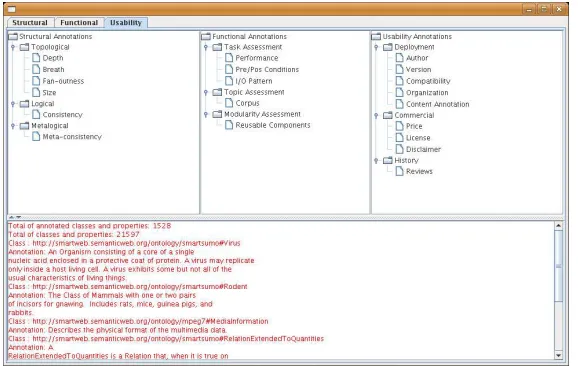
In the S-OntoEval GUI, the usability evaluation is realized through the usability evaluation tab. From a semiotic point of view, usability metrics should consist of a set of struc-tural, functional, and user-oriented metrics assessing the quality of the ontology annotation from a specific user’s perspective (or the perspective of a group of ontology engi-neers or other ontology consumers). The three top panels in the usability tab show the metrics for structural, functional, and user-oriented evaluation at the usability assessing level in form of a tree structure. To start the usability evalua-tion, the user chooses the usability metric. Figure 8 shows the usability evaluation tab and its visual components. The bottom panel presents the evaluation results.
3.
Evaluation of the SWIntO Use Case
In this section, we present the semiotic-based evaluation3ofthe SWIntO ontology (Oberle et al., 2007) developed in the SmartWeb project (Reithinger et al., 2006; Sonntag et al., 2007; Wahlster, 2007). SmartWeb aims to provide intuitive multimodal access to a rich selection of Web-based infor-mation services. The advanced ontology-based representa-tion of facts and media structures (SWIntO) serves as cen-tral description for rich media content. We have made the choice of implementing simple evaluation metrics which on the one hand are relevant to the evaluation of the test object (e.g., the SWIntO ontology), and on the other hand we also believe to be representative in any ontology evaluation pro-cess. The main idea of conceptualizing the semiotic frame-work tool is not to implement at once all existent measures at each semiotic evaluation levels but to provide an extend-able framework for attaching new more evaluation metrics (gradual enhancement). We describe the evaluation results of the SWIntO at each semiotic level.
3
Figure 5: Structural Tab of the S-OntoEval GUI and the Maximum Depth Evaluation Results
Figure 7: Functional Tab and Task-based Evaluation Results