FreeLing 2.1: Five years of open-source language processing tools
Llu´ıs Padr´o∗, Miquel Collado∗, Samuel Reese⋄, Marina Lloberes†, Irene Castell´on†
∗Software Department – TALP Research Center
Universitat Polit`ecnica de Catalunya
[email protected], [email protected]
⋄ISAE – Supaero
Universit´e Paul Sabatier [email protected]
†GRIAL research group
Universitat de Barcelona
{marina.lloberes,icastellon}@ub.edu
Abstract
FreeLing is an open-source multilingual language processing library providing a wide range of language analyzers for several languages. It offers text processing and language annotation facilities to natural language processing application developers, simplifying the task of building those applications. FreeLing is customizable and extensible. Developers can use the default linguistic resources (dictionaries, lexicons, grammars, etc.) directly, or extend them, adapt them to specific domains, or even develop new ones for specific languages.
This paper overviews the recent history of this tool, summarizes the improvements and extensions incorporated in the latest version, and depicts the architecture of the library. Special focus is brought to the fact and consequences of the library being open-source: After five years and over 35,000 downloads, a growing user community has extended the initial three languages (English, Spanish and Catalan) to eight (adding Galician, Italian, Welsh, Portuguese, and Asturian), proving that the collaborative open model is a productive approach for the development of NLP tools and resources.
1. Introduction
Basic language processing tasks such as tokenizing, morphological analysis, lemmatizing, part-of-speech tagging, word sense disambiguation (WSD), depen-dency parsing, etc. are a need for most natural lan-guage processing (NLP) applications such as Machine Translation, Summarization, Dialogue systems, Text mining, etc.
This makes language analyzers very valuable re-sources for researchers and developers in NLP. Also, the lack of out-of-the-box state-of-the-art systems is a severe bottleneck for faster progress in the area, both in research and development.
FreeLing was undertaken with the believe that steps should be taken towards general availability of basic NLP tools and resources, which may be used without restrictions. Thus, to enable faster advances and more portable systems in our area, an open–source model was chosen.
After five years (first version was released on 2004), over 35,000 downloads, and a growing user commu-nity which has extended the initial three languages (English, Spanish and Catalan) to eight (adding Gali-cian, Italian, Welsh, Portuguese, and Asturian) prove
that the collaborative open model is a productive ap-proach for the development of NLP tools and re-sources.
In the next section we review FreeLing evolution in its five-year life. Section 3 describes the most recent enhancements to the library, and Section 4 presents a shallow technical overview of the library. Section 5 outlines some conclusions and further work.
2. FreeLing project evolution
The first version of FreeLing (1.0) was released in 2003, and presented to the community in LREC 2004 (Carreras et al., 2004). That first version was a re-implementation of several tools (Atserias et al., 1998; Carreras and Padr´o, 2002) developed at the TALP re-search center1in UPC2.
The new version, was rewritten from scratch with the following goals:
• Build a fast state-of-the-art analyzer that could be used to process large amounts of text and to develop NLP applications.
3.3. Modules offering new services
There are several recently added functionalities, some are small (such as the possibility of prefix handling in morphological analysis), some are entire new modules offering a new NLP analysis task, such as Word Sense Disambiguation or Coreference Resolution:
• A language-independent WSD module has been integrated. The code is straightforwardly ex-tracted from the UKB disambiguator7developed by (Agirre and Soroa, 2009). The only requirement to use that module on a certain language is the exis-tence of a WordNet-like ontology that relates the words to senses, and the senses among themselves. • A coreference resolution module has been devel-oped from scratch, using Machine Learning tech-niques. The approach is based on that of (Soon et al., 2001), and currently, trained models are pro-vided only for Spanish (still with under state-of-the-art accuracy).
4. Data structure and language analysis services
FreeLing is conceived as a library on top of which powerful NLP applications can be developed, and ori-ented to ease the integration of language analysis ser-vices into higher level applications.
Its architecture consists of a simple two-layer client-server approach: A basic linguistic service layer which provides analysis services (morphological anal-ysis, tagging, parsing, ...), and an application layer which, acting as a client, requests the desired services from the analyzers.
The internal architecture of the system is based on two kinds of objects: linguistic data objects and processing objects.
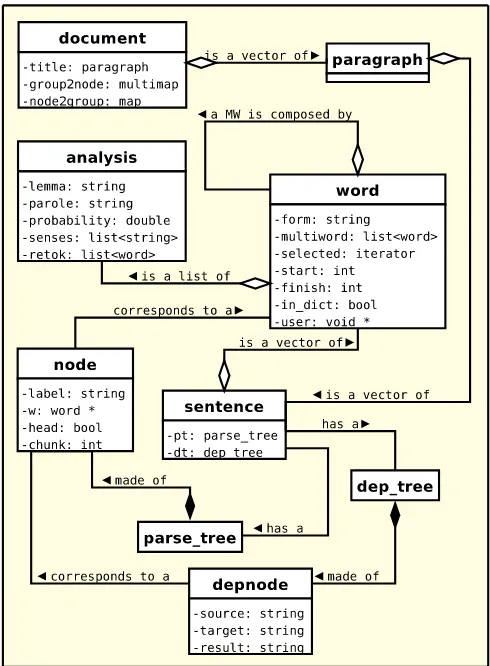
4.1. Linguistic Data Classes
The basic classes in the library are used to contain lin-guistic data (such as a word, a PoS tag, a sentence, a document...). Any client application must be aware of those classes in order to be able to provide to each processing module the right data, and to correctly in-terpret the module results.
The linguistic classes supported by the current version are:
• analysis: A tuple<lemma, PoS tag, probability, sense list>.
• word: A word form with a list of possible
analysisobjects.
7http://ixa2.si.ehu.es/ukb/
• sentence: A list of word known to be a com-plete sentence, it may include also a parse tree and/or a dependency tree.
• paragraph: A list ofsentenceknown to be an independent paragraph.
• document: A list of paragraph that form a complete document. It may contain also corefer-ence information about the entity mentions in the document.
Figure 1 presents a UML diagram with the linguistic data classes.
Figure 1:FreeLing-2.1 Linguistic Data Classes.
4.2. Processing Classes
Apart from classes containing linguistic data, the li-brary provides classes able to transform them. A UML diagram can be found in Figure 2.
• tokenizer: Receives plain text and returns a list ofwordobjects.
mor-Jordi Carrera, Irene Castell´on, Marina Lloberes, Llu´ıs Padr´o, and Nevena Tinkova. 2008. Dependency grammars in freeling. Procesamiento del Lenguaje
Natural, (41):21–28, September.
Xavier Carreras and Llu´ıs Padr´o. 2002. A flexible dis-tributed architecture for natural language analyzers. In Proceedings of the 3rd International Conference
on Language Resources and Evaluation, LREC, Las
Palmas de Gran Canaria, Spain.
Xavier Carreras, Llu´ıs M`arquez, and Llu´ıs Padr´o. 2002. Named entity extraction using adaboost. In
Proceedings of CoNLL Shared Task, pages 167–
170, Taipei, Taiwan.
Xavier Carreras, Isaac Chao, Llu´ıs Padr´o, and Muntsa Padr´o. 2004. Freeling: An open-source suite of language analyzers. In Proceedings of the 4th
In-ternational Conference on Language Resources and Evaluation (LREC’04).
Montserrat Marimon, N´uria Bel, Sergio Espeja, and Natalia Seghezzi. 2007. The spanish resource grammar: pre-processing strategy and lexical ac-quisition. In Proceedings of the Workshop on Deep
Linguistic Processing, Association for Computa-tional Linguistics (ACL-DLP).
Llu´ıs Padr´o, Samuel Reese, Eneko Agirre, and Aitor Soroa. 2010. Semantic services in freeling 2.1: Wordnet and ukb. In Proceedings of the 5th
Inter-national Conference of the Global WordNet Associ-ation (GWC-2010), Bombay, India, February.
Llu´ıs Padr´o. 1998. A Hybrid Environment for Syntax–
Semantic Tagging. Ph.D. thesis, Dep. Llenguatges
i Sistemes Inform`atics. Universitat Polit`ecnica de Catalunya, February. http://www.lsi.upc.es/˜padro. W.M. Soon, H. T. Ng, and D.C.Y. Lim. 2001. A