Like Finding a Needle in a Haystack: Annotating the American National Corpus
for Idiomatic Expressions
Laura Street, Nathan Michalov, Rachel Silverstein, Michael Reynolds, Lurdes Ruela, Felicia
Flowers, Angela Talucci, Priscilla Pereira, Gabriella Morgon, Samantha Siegel, Marci
Barousse, Antequa Anderson, Tashom Carroll, Anna Feldman
Montclair State University
1 Normal Avenue, Montclair, New Jersey, 07043, USA {streetl1, michalovn1, silversteir2, feldmana}@mail.montclair.edu
Abstract
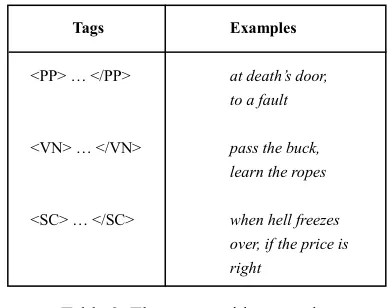
This paper presents the details of a pilot study in which we tagged portions of the American National Corpus (ANC) for idioms composed of verb-noun constructions, prepositional phrases, and subordinate clauses. The three data sets we analyzed included 1,500-sentence samples from the spoken, the non-fiction, and the fiction portions of the ANC. This paper provides the details of the tagset we developed, the motivation behind our choices, and the inter-annotator agreement measures we deemed appropriate for this task. In tagging the ANC for idiomatic expressions, our annotators achieved a high level of agreement (> .80) on the tags but a low level of agreement (< .00) on what constituted an idiom. These findings support the claim that identifying idiomatic and metaphorical expressions is a highly difficult and subjective task. In total, 135 idiom types and 154 idiom tokens were identified. Based on the total tokens found for each idiom class, we suggest that future research on idiom detection and idiom annotation include prepositional phrases as this class of idioms occurred frequently in the nonfiction and spoken samples of our corpus
1.
Introduction
Researchers have been investigating idioms and their properties for many years. According to traditional approaches, an idiom is “in its simplest form…a string of two or more words for which meaning is not derived from the meanings of the individual words comprising that string” (Swinney and Cutler, 1979: 523). As such, the meaning of to kick the bucket (which is ‘to die’) cannot be obtained by breaking down the idiom and analyzing the meanings of its constituent parts, to kick and the bucket. In addition to being influenced by the principle of compositionality, the traditional approaches are also influenced by theories of generative grammar (Flores d’Arcais, 1993: 80-82; Langlotz, 2006: 15-16). The properties that traditional approaches attribute to idiomatic expressions are also the properties that make them difficult for generative grammars to describe. For instance, idioms can be syntactically ill-formed (e.g., by and large), resistant to grammatical transformations (e.g., the bucket was kicked by him ≠ ‘he died’), impervious to lexical substitutions (e.g., to kick the pail ≠ ‘to die’), and semantically ambiguous without context (e.g., Charles kicked the bucket and was buried last night vs. Charles kicked the bucket through the window).
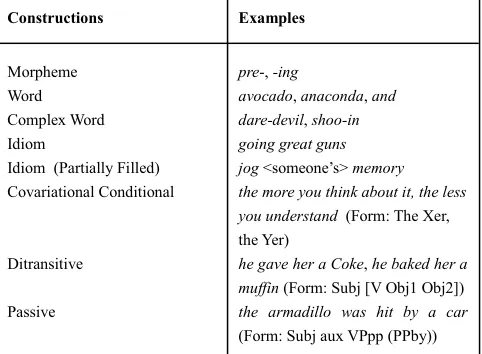
In recent years, post-generative approaches to idioms have argued that idioms, like all linguistic expressions, are a type of construction. As Goldberg (2003: 219) states: “Constructions are pairings of form and function, including morphemes, words, idioms, partially lexically filled and fully general linguistic patterns.” To be more precise, a construction is any linguistic pattern where an aspect of its form or function is unpredictable based on its component parts or other known constructions. When conducting research on idiomatic expressions, a constructionist approach is advantageous because it seeks to describe language in
general. That is to say, it does not disregard unusual linguistic phenomena (such as idioms) because they are ‘peripheral’ rather than part of the ‘core’ of language. Constructionist approaches are also beneficial because they claim that constructions are acquired based on their frequency in the input and this works well with a corpus-based approach where data and frequency counts are used to capture properties of linguistic phenomena such as collocations, multi-word expressions, etc. For a more detailed discussion of the approach we take to idioms in this paper, please refer to (Goldberg, 2003).
Constructions Examples
Morpheme pre-, -ing
Word avocado, anaconda, and Complex Word dare-devil, shoo-in
Idiom going great guns
Idiom (Partially Filled) jog <someone’s> memory
Covariational Conditional the more you think about it, the less you understand (Form: The Xer, the Yer)
Ditransitive he gave her a Coke, he baked her a muffin (Form: Subj [V Obj1 Obj2]) Passive the armadillo was hit by a car
(Form: Subj aux VPpp (PPby))
Table 1. Examples of constructions (adapted from Goldberg 2003: 220)
3. Measuring Inter-Annotator Agreement
& Reliability
To ensure reliability of the results two alpha scores were calculated for each of the three sections using the following variation of Krippendorff's Alpha1:
Do
(n-1)∑cOcc - ∑c nc(nc–1) α = 1 - ___ = _____________________ De n(n-1) - ∑cnc(nc-1)
Where Do represents observed disagreement among the annotators, De is the disagreement which would be expected to occur if tags had been selected by chance. ∑ indicates summation of all data of the given type, n represents the number of items associated with the given subscript (where no subscript is present n indicates the total number of tags), and subscripts relate to the coincidence matrices which are described in more detail below.
Krippendorff’s Alpha was used because it was appropriate for our data set. It is specifically designed to analyze nominal data sets generated by multiple annotators, including instances where one or more annotators did not provide a rating for some of the units in the data set. While Fleiss’ Kappa and Cohen’s Kappa are commonly used to analyze inter-annotator agreement, they were inappropriate in the current study as Cohen’s Kappa can only be used with two annotators and Fleiss’ Kappa cannot be used when data sets contain units that are not rated by all of the annotators.
The first alpha evaluated annotator reliability in the detection of idioms within the corpus and accounted for annotator reliability regarding the status of a phrase as idiomatic or not. The second alpha determined reliability in the categorization of detected idioms. In cases where annotators disagreed on the scope of idioms and overlapping tags were noticed, these tags were grouped together for alpha scoring and noted for annotators. Given the size of the corpus and the fact that tag lists were obtained by machine search, it is possible that not all of the overlapping tags were noticed, which could have affected the preliminary alpha score. Given that subsequent modifications were made manually by the annotators, however, such artifacts are not present in the final corpus and all tags agree in all relevant domains.
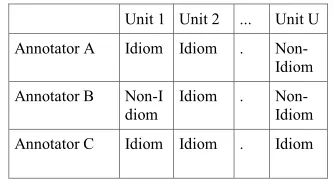
The specific methodology of the alpha scoring was to form two tables of annotator responses. The first table (Table 3) was used to generate the first alpha score. It contains all the phrases (units) that were marked as idioms by at least one annotator. Columns beneath each unit record whether the corresponding annotator marked the phrase as an idiom or not.
1
Information regarding Krippendorff’s Alpha can be found at Klaus Krippendorff’s website: http://www.asc. upenn.edu/usr/krippendorff/dogs.html
Unit 1 Unit 2 ... Unit U
Annotator A Idiom Idiom . Non- Idiom
Annotator B Non-I diom
Idiom . Non- Idiom
Annotator C Idiom Idiom . Idiom
Table 3. Table of phrases marked as idioms
The second table (Table 4) was used to generate the second alpha score. It contains all the phrases (units) that were tagged as idioms along with their corresponding tags. (Note: '.' indicates that the annotator did not mark the phrase as being an idiom.) The final row records the total number of tags for a given phrase, and the final column records the number of each type of tag a given idiom received. Mu is the total number of tags and is present only in the second table as the reliability of idiom
categorization can only be
determined in cases where annotators have marked a statement as a type of idiom. In the first case, all annotators will have marked any given phrase as idiomatic or not, so Mu will always equal the number of annotators and its inclusion in the table would be redundant.Unit 1 Unit 2 Unit 3 . Unit U
Annotator A VN SC PP . SC
Annotator B VN SC PP . .
Annotator C VN PP . . .
Number of values in unit (Mu)
3 3 2 . 1 ∑ Mu
Table 4. Presents tags assigned to each given phrase.
Data within the tables were then used to generate coincidence matrices of the form:
Values:
1 .
k .
.
1
o
11. o
1k.
.
n
1.
.
.
.
.
.
.
.
c
o
c1.
o
ck.
.
n
c=
Σ
ko
ck.
.
.
.
n
1.
n
k.
.
n =
Σ
cΣ
kn
ckFigure 1. Sample matrix used to calculate the number of tag pairs that occur.
Where Ock is determined using the following formula:
o
ck=
∑
uNumber of c-k pairs in unit u
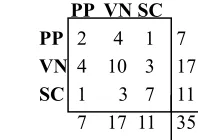
For example, if a given phrase was tagged as a VN by two annotators and a PP by a third, there would be 6 possible pair combinations of the given tags: 2 VNPP, 2PPVN, and 2VNVN pairs. Note that in calculating ck pairs, the ordering matters and PPVN is not the same as VNPP. The number of pairs of each type is then normalized by dividing it by one less than the total number of tags for the unit. In the given example each pair would be divided by 2 (3 tags - 1) to create a value of 1VNPP, 1PPVN, and 1VNVN. The matrix then displays the total number of normalized tag pairs of each type. Matrices figures are then used in the alpha formula.
Values: PP VN SC
PP 2 4 1 7 VN 4 10 3 17 SC 1 3 7 11 7 17 11 35
Figure 2. An example of how the matrix appears for tag pairs
The alpha score is obtained by calculating the difference of observed disagreement over expected disagreement, or the amount of agreement that would be expected if tags were assigned at random, subtracted from one (1 – (Do/De)) so that perfect annotator agreement would result in α = 1 (1 – (0/1) = 1) and if annotator agreement were equal to chance α=0 (1 – (1/1) = 0). Specifically the form of the alpha for nominal data used here is obtained by subtracting the total possible number of agreeing tag pairs given the annotations made (∑ nc(nc-1)) from the actual number of agreeing tag pairs made by the annotators (∑ occ), and then multiplying by one less than the total number of tags in agreement (n-1). This number is then divided by the difference obtained by subtracting the number of possible tag pairs given the number of each tag type (again ((n-1)∑occ)) from the maximum possible tag pair agreement for the overall number of tags (n(n-1)). Put more generally, the formula can be seen as calculating reliability in the following way:
(# of actually agreeing tag pairs) – (# of possible pairs given tags) (Maximum # agreeing pairs given tags) – (# of possible pairs given tags)
An alpha of ≥ .80 is considered reliable.
4. Results & Discussion
4.1 Inter-Annotator Agreement
Alpha scores for each section were as follows:
Spoken:
Tag agreement: 1.0 Idiom agreement: -0.34
Non-Fiction:
Tag agreement: 0.85 Idiom agreement: -0.199
Fiction:
Tag agreement: 0.83 Idiom agreement: -0.28
For each section of the annotated sample, alpha scores for tag agreement exceeded the .80 threshold of reliability, indicating that annotators agreed reliably and significantly above chance upon the types of idioms tagged. Tag agreement was most notable in the section of the sample drawn from spoken narratives, where a 1.0 alpha score indicates 100% agreement among annotators with regard to the type of tag. That is, when an idiomatic expression such as drawing a blank occurred, all annotators agreed that the idiom constituted a VN construction. Annotators also noted a few constructions for which they did not have tags, in particular suggesting that future research include a tag for verb + prepositional phrase constructions (VPPCs) such as walking on air.
Unlike the alpha scores for tag agreement, the alpha scores for idiom agreement were all very low, indicating that the level of agreement among annotators regarding which phrases were actually idioms was no better than chance. In fact, there were many instances in which only one annotator tagged a particular construction as an idiomatic expression. One possible explanation for the low inter-annotator agreement could be, as some studies suggest (Gibbs 1984), that there is no clear psychological distinction between literal and figurative expressions, so annotating for idioms is a rather difficult and subjective task, and the level of disagreement our annotators demonstrated on literal-idiom expressions is to be expected. The fact that we did not give our annotators a preset list of idioms to look for (as is usually done in corpus-based research on idioms) might have made the task more difficult as well.
Because the inter-annotator agreement for each idiom list was low, each group of annotators held a meeting following the analysis of the results to create a finalized list of idioms to be used as the official idioms for the corpus. The annotated corpus is currently available on Montclair State’s server and will soon be available on the following website as well: http://netdrive.montclair.edu/ ~streetl1/index.htm. We hope that the tagset and the methodology we have developed for this pilot study can serve as the basis for developing a more complete tagset for annotating the entire ANC.
4.2 Type and Token Counts
Table 5. Type and token counts for each sample
VNC PP SC ∑
∑ Tokens 122 29 3 154
Table 6. Total token counts for each idiom type
As one might expect, most of the annotated idioms occurred in the fiction sample. The total number of tokens in the fiction sample (n = 96) was almost three times the total number of tokens in the spoken sample (n = 33) and almost four times the total number of tokens in the nonfiction sample (n = 25). Variations between fiction, nonfiction, and transcribed speech are well documented, so it is not surprising that more idioms occurred in the fiction sample. Figurative language just tends to be more commonplace in fiction. Another major finding was that 79% of the idioms tagged were VNCs (n = 122). What was surprising, however, was that VNCs and PPs occurred in much closer numbers in both the nonfiction (n = 10, n = 14) and the spoken samples (n = 19, n = 12). PPs also occurred roughly 4.3 times more in the nonfiction and spoken samples than in the fiction sample. These findings indicate that many idioms are missed when researchers annotate texts solely for VNCs— particularly if those texts come from genres other than fiction. One possible explanation for why VNCs outnumber PPs in the fiction domain is that novel figurative language, which tends to occur more frequently in fiction, is likely to take the form of a VNC rather than a PP. More research needs to be done, however, to explain why VNCs occur more frequently than PPs in this domain. Finally, since there were so few instances of SCs, we recommend that future research on idiom detection prioritize other types of constructions over SCs. In particular, verb + prepositional phrase constructions (VPPCs) appear to be a good candidate as several of our annotators noted higher instances of them while tagging.
5. Conclusion
In a pilot study, portions of the American National Corpus (ANC) were tagged for idioms composed of verb-noun constructions, prepositional phrases, and subordinate clauses. The three data sets we analyzed included 1,500-sentence samples from the spoken, the non-fiction, and the fiction portions of the ANC. In tagging the ANC for idiomatic expressions, our annotators achieved a high level of agreement (> .80) on the tags but a low level of agreement (< .00) on what counted as an idiom. These findings support the claim that identifying idiomatic and metaphorical expressions in a text is a highly difficult and subjective task. In total, we
identified 135 idiom types and 154 idiom tokens. Based on the total tokens found for each idiom class, we suggest that future research on idiom detection and idiom annotation include prepositional phrases. This class of idioms occurred frequently in the nonfiction and spoken portions of our corpus.
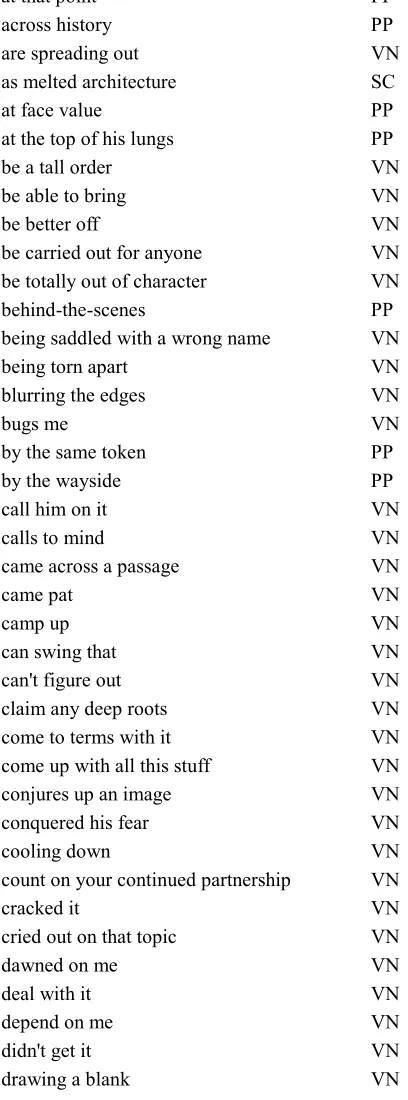
6. Appendix
The final list of idioms for all three groups of
annotators:
at that point PP
across history PP
are spreading out VN
as melted architecture SC
at face value PP
at the top of his lungs PP
be a tall order VN
be able to bring VN
be better off VN
be carried out for anyone VN
be totally out of character VN
behind-the-scenes PP
being saddled with a wrong name VN
being torn apart VN
blurring the edges VN
bugs me VN
by the same token PP
by the wayside PP
call him on it VN
calls to mind VN
came across a passage VN
came pat VN
camp up VN
can swing that VN
can't figure out VN
claim any deep roots VN
come to terms with it VN
come up with all this stuff VN
conjures up an image VN
conquered his fear VN
cooling down VN
count on your continued partnership VN
cracked it VN
cried out on that topic VN
dawned on me VN
deal with it VN
depend on me VN
didn't get it VN
drawing a blank VN
Fiction Nonfiction Spoken
Types Tokens Types Tokens Types Tokens
VNC 85 93 10 10 16 19
PP 3 3 14 14 10 12
SC 0 0 1 1 1 2
fell on the vermicelles VN fess up to how things had developed VN
figure out VN
find your way around VN
fished around VN
foot a bill VN
for anything in the world PP
freeze with horror VN
from point to point PP
from the bottom of my heart PP
from time to time PP
gave himself back VN
get off his butt VN
get off my back VN
get over it VN
get round the issue VN
get through it VN
get your goat VN
give you a hand VN
go on about that VN
go to great lengths VN
go up VN
going my own way VN
grabbed my attention VN
grew out of a popular mass movement VN
had a gift VN
had my share VN
have a clue VN
have a foot to stand on VN
have his memory in common VN
have the same connection to him VN
having such an impact VN
hear about it VN
held our attention VN
higher in the feudal chain PP
hit me VN
hit me VN
if I don't make it SC
in a related vein PP
in the right direction PP
in trouble PP
into boys PP
is a world away VN
keeled over VN
keep them from selling it VN
keep up to his example VN
keep your head high VN
land us in trouble VN
learned first hand VN
left for dead VN
lies with you VN
log off VN
make it up VN
of the gods PP
off the hook PP
on my dad's side PP
on the downside PP
on the other hand PP
open your eyes VN
pencil children VN
pick out VN
picked it apart VN
picking up your contribution VN
picture things VN
playing a mean practical joke on them VN
put on display VN
putting your gift to work VN
reach out to more girls VN
round-the-clock PP
run into VN
sandwiching concentrated time VN
seeing loved ones off VN
set up camp VN
shafted you VN
skip school VN
smack in the center PP
sparks negative attitudes VN
stir up a little mud in this matter VN
sums it up VN
sweeps away the vestiges VN
take the first step VN
take the sting out of them VN
take your pledge VN
taken aback VN
throwing out onto him VN
to be at odds PP
took his eyes off the other VN
torn in many directions VN
turn a look of astonishment on him VN
turned away VN
turned back VN
under god and under law PP
up-to-the-minute PP
walk in someone else's shoes VN
was caught up in this idea VN
was crowded with passengers VN
was more or less VN
7.
References
Baldwin, T., Bannard, C., Tanaka, T., Widdows, D. (2003). An empirical model of multiword expression decomposability. In Proceedings of the ACL 2003 Workshop on Multiword Expressions: Analysis, Acquisition and Treatment, pp. 89-96.
Bannard, C. (2007). A measure of syntactic flexibility for automatically identifying multiword expressions in corpora. In Proceedings of the ACL-07 Workshop on a Broader Perspective on Multiword Expressions, pp. 1-8.
Birke, J., Sarkar, A. (2006). A clustering approach for the nearly unsupervised recognition of nonliteral language. In Proceedings of the EACL-06, pp. 329-336.
Dekang, L. (1999). Automatic identification of noncompositional phrases. In Proceedings of the ACL-99, pp. 317–324.
Fazly, A., Stevenson, S. (2006). Automatically constructing a lexicon of verb phrase idiomatic combinations. In Proceedings of the EACL-06, pp. 337-344.
Fazly, A., Cook, P., Stevenson, S. (2009). Unsupervised type and token identification of idiomatic expressions. Computational Linguistics, 35(1), pp. 61-103.
Fillmore, C., Ide, N., Jurafsky, D., Macleod, C. (1998). An American National Corpus: A Proposal. In Proceedings of the First International Language Resources and Evaluation Conference, pp. 965-70. Flores d’ Arcais, G. B. (1993). The comprehension and
semantic interpretation of idioms. In C. Cacciari and P. Tabossi (Eds.) Idioms: Processing, Structure, and Interpretation, (pp. 79-98). New Jersey: Lawrence Erlbaum and Associates, Inc.
Gibbs, R. W. (1984). Literal meaning and psychological theory. Cognitive Science 8, pp. 275-304.
Goldberg, A. E. (2003). Constructions: A new theoretical approach to language. TRENDS in Cognitive Sciences, 7(5), pp. 219-224.
Hashimoto, C., Kawahara, D. (2008). Construction of an idiom corpus and its application to idiom identification based on wsd incorporating idiom-specific features. In Proceedings of the Conference on Empirical Methods in Natural Language Processing, pp. 992-1001. Katz, G., Giesbrecht, E. (2006). Automatic identification
of non-compositional multiword expressions using latent semantic analysis. In Proceedings of the ACL/COLING-06 Workshop on Multiword Expressions: Identifying and Exploiting Underlying Properties, pp. 12–19.
Kuiper, K., McCann, H., Quinn, H., Aitchison, T., van der Veer, K. (2003). A syntactically annotated idiom dataset (SAID). Philadelphia: Linguistic Data Consortium, University of Pennsylvania.
Langlotz, A. (2006) Idiomatic Creativity: A Cognitive-Linguistic Model of Idiom- Representation, (pp. 15-53). Philadelphia: John Benjamins North America.
Sporleder, C., Li, L. (2009). Unsupervised recognition of literal and non-literal use of idiomatic expressions. In Proceedings of the EACL, pp. 754–762.