Large Aligned Treebanks for Syntax-based Machine Translation
Gideon Kotz´e, Vincent Vandeghinste, Scott Martens, J¨org Tiedemann
University of Groningen, University of Leuven, University of T¨ubingen, University of Uppsala [email protected], [email protected], [email protected], [email protected]
Abstract
We present a collection of parallel treebanks that have been automatically aligned on both the terminal and the nonterminal constituent level for use in syntax-based machine translation. We describe how they were constructed and applied to a syntax- and example-based machine translation system called Parse and Corpus-Based Machine Translation (PaCo-MT). For the language pair Dutch to English, we present evaluation scores of both the nonterminal constituent alignments and the MT system itself, and in the latter case, compare them with those of Moses, a current state-of-the-art statistical MT system, when trained on the same data.
Keywords:Parallel Treebank, Syntax-based MT, Constituent Alignment
1.
Introduction
For statistical modeling in NLP, such as that used in ma-chine translation, large parallel corpora are typically re-quired. Most of the data-driven MT research has been per-formed on flat sequence representations of sentences, on strings. By usingtree structuresone can exploit the linguis-tic relationships between words and phrases. This requires syntactically parsing these corpora and aligning them on the constituent level, producing a collection of parallel tree-banks.
Various systems have been developed for non-terminal con-stituent alignment, either making use of hand-crafted rules (Menezes and Richardson, 2001; Groves et al., 2004) or fully unsupervised methods (Zhechev and Way, 2008; Lavie et al., 2008). We have opted to use Lingua-Align, a supervised tree-to-tree aligner implementing discriminative models (Tiedemann, 2010). We have also implemented a recently developed rule-based algorithm to produce an ad-ditionalhigh recallversion of our parallel treebanks, with many more alignments added. Clean corpora are tokenized, sentence aligned, parsed, word aligned and tree aligned. The end result is two fully annotated and aligned sets of parallel treebanks consisting of millions of sentence pairs in four language combinations.
In currenttree-basedMT research, most systems use one or another form of probabilistic synchronous context-free grammars (SCFGs) such as the tree-based models of the Moses toolkit (Koehn et al., 2007).1 There are other, more
complex types of synchronous grammars which can also be learned from parallel treebanks and which accept trees on both the left and right hand side of the grammar rules, allowing such operations as raising and lowering of nodes (Chiang, 2006). Depending on the operations that are al-lowed, we distinguish between synchronous tree substi-tution grammars (STSGs) (Schabes, 1990; Eisner, 2003) which allow substitution,synchronous tree insertion gram-mars (STIGs) (Nesson et al., 2006), which allow both substitution and insertion; andsynchronous tree adjoining grammars(STAG) (Shieber and Schabes, 1990) which al-low substitution, insertion and adjoinment.
We used the parallel treebank, with alignments at the
con-1
http://www.statmt.org/moses/
stituent level to train the PaCo-MT system, which is a syntax-based MT engine using an STSG transducer to bridge the gap between source sentence parse tree and tar-get language parse tree.
The remainder of the paper is organised as follows: Sec-tion 2. describes how the parallel treebank was constructed. Section 3. describes how we used this treebank as training data for the PaCo-MT system, and section 4. draws conclu-sions and describes future work.
2.
Producing a parallel treebank
The parallel treebanks were produced by obtaining a col-lection of parallel corpora containing only the raw text and processed automatically by applying a series of tools. In the next few sections, we describe in more detail how the data was processed.2.1. Data collection
We collected Dutch-English and Dutch-French subsets of the following parallel corpora:
• Europarl 3 (Koehn, 2005), a corpus containing the pro-ceedings of the European Parliament in several lan-guages from 1996 to 2006.
• the DGT Multilingual Translation Memory of the Ac-quis Communautaire: DGT-TM.2
• OPUS: the open parallel corpus (Tiedemann, 2009).3
• an additional private translation memory (Transmem).
2.2. Parsing
The corpora of all three languages involved were annotated using separate monolingual parsers. We first parse all the texts before they are sentence aligned. In doing so, we have the maximum amount of trees available for target language modeling.
The Dutch data was parsed using the Alpino parser (van Noord, 2006). Some additional processing was applied in order to make the resulting parse trees more uniform, for
2
http://langtech.jrc.it/DGT-TM.html
3
Table 1: Word and sentence counts on the 1:1 Dutch/English and English/Dutch parallel treebanks.
Dutch-English English-Dutch
Corpus Sentence pairs Words Sentence pairs Words
Europarl 1,180,706 57,812,824 1,190,501 57,810,789
DGT-TM 478,972 19,974,703 484,186 20,222,021
OPUS+Transmem 1,097,834 20,393,721 1,102,958 20,493,131
Total 2,757,512 98,181,248 2,777,645 98,525,941
Table 2: Word and sentence counts on the 1:1 Dutch/French and French/Dutch parallel treebanks.
Dutch-French French-Dutch
Corpus Sentence pairs Words Sentence pairs Words
Europarl 1,188,022 60,987,015 1,188,757 61,231,725
DGT-TM 385,317 17,750,535 385,644 17,801,831
OPUS+Transmem 720,487 18,962,966 722,494 19,038,759
Total 2,293,826 97,700,516 2,296,895 98,072,315
though the ratios are the same. Manual investigation would suggest that the same principle can be applied to linked leaf ratios. We therefore introduce a penalty score to be sub-tracted from the ratios, the results of which constitute the leaf ratio similarity and linked leaf ratio similarity scores respectively.
Simply subtracting the differences would lead to a score below 0 in all cases except when the difference itself is 0. Therefore, it seemed to be in order to normalize it against an imagined maximum number of leaves. In this case, we proceeded with trial and error, and set the denominator at the value of 80.
We can now define our leaf ratio similarity score as follows:
lrs(si, tj) =leaf ratio(si, tj)−
abs(|sx≤si| − |ty≤tj|)
z
where z denotes the normalization value. Similarly, our linked leaf similarity score can be expressed as follows:
lls(si, tj)
=llr(si, tj)
−|sx≤si|+|ty≤tj| −(|lsx≤si|+|lty ≤tj|)
z
Provisionally, we set our thresholds for the leaf ratio simi-larity at 0.35 and for the linked leaf ratio simisimi-larity at 0.45. Additionally, a link is made fuzzy if its value came within the range of 0.05 of the thresholds. Finally, we assume that sentence alignment is perfect and therefore change all fuzzy links between root nodes to good.
We found that the parsers treated punctuation differently, and that the existence of a punctuation mark inside or out-side a subtree should not dictate an alignment decision as much as for example a content word does. Another obser-vation is that in many cases, subtrees should still be aligned even if a fuzzy link goes to the outside - in other words,
when a token in one of the two subtrees links to a token in another subtree. However, if a good link goes to the outside, it is less likely that they should be linked. There-fore, we have decided to allow for a certain amount of non-wellformedness in the case of fuzzy links.
Table 3 presents the evaluation results of both our high pre-cision and high recall approaches on a gold standard of 200 sentence pairs for Dutch to English, taking only nontermi-nal alignments into account. The sentences were extracted from Europarl and manually aligned using the Stockholm TreeAligner. F-scores are balanced and are based on both sure and possible links.
Table 3: Evaluation scores ofhigh precisionvs.high recall
approaches tested on a Dutch to English gold standard.
Data set Precision Recall F-score
High precision 93.3 61.2 73.9
High recall 72.0 82.3 76.8
Noticeable is the very significant decrease in alignment pre-cision and a similar increase in recall. The F-score, though, increases by almost 3%. Implementing our algorithm on the full data set results in the statistics presented in table 4. In section 3.3. we discuss the effects of training our system on either set.
3.
Using the parallel treebanks in MT
The preprocessing steps described in the previous section allow to extract transduction rules: synchronous grammar rules indicating the mapping of the source language trees onto the target language trees. By keeping track of how many times such mappings occur, we can add weights to the synchronous grammar.
Table 4: Counts of alignments applied to all the parallel treebanks
Language pair Moses/GIZA++ Lingua-Align Rules Total
Dutch/English 48,011,840 5,049,496 9,818,623 62,879959
English/Dutch 38,060,911 11,820,036 9,301,941 58,182,888
Dutch/French 46,976,046 9,128,714 6,021,967 62,126,727
French/Dutch 47,017,307 6,237,574 5,259,590 58,514,471
Total 180,066,104 32,235,820 30,402,121 242,704,045
3.1. Rule extraction
In the extraction of an STSG for our MT system, we limit ourselves to grammar rules with a horizontally complete
subtree on both the source and the target side of each gram-mar rule. Subtrees are horizontally complete(Boitet and Tomokiyo, 1995) if, when a daughter node of a node is in-cluded in the subtree, then so are all of its sisters.
Figure 1 is an example4of two sentences aligned at both the
sentence and constituent level. For each alignment point, either one or two rules are extracted. First, each align-ment point is a lexical alignalign-ment, creating a rule that maps a source language word or phrase to a target language one (Figure 2 (a), (b) and (c)).
Figure 1: Two sentences with subsentential alignment.
Figure 2: Rules extracted from the alignments in Figure 1
(a) →
(b) → (c) →
(d) →
Secondly, each aligned pair of sentences engenders fur-ther rules by partitioning each tree at each alignment point, yielding non-lexical grammar rules. For these rules, the
4The edge labels have been omitted from these examples, but
were used in the actual rule induction.
alignment information is retained at the leaves so that these trees can be recombined (Figure 2 (d)).
Figure 2 shows the four rules extracted from the alignments in Figure 2.3.. Rules are extracted by passing over the entire aligned treebank, identifying each aligned node pair and recursively iterating over its children to generate a substi-tutable pair of trees whose roots are aligned, and whose leaves are either terminal leaves in the treebank or corre-spond to aligned vertices. As shown in Figure 2, when a leaf node corresponds to an alignment point, we retain the information to identify which target tree leaf aligns with each such source leaf.
Many such tree substitution rules recur many times in the treebank, and a count is kept of the number of times each pair appears, resulting in astochasticsynchronous tree sub-stitution grammar.
3.2. The PaCo-MT engine
Figure 3 presents the general system architecture of the PaCo-MT system (Parse and Corpus-based MT). A source language sentence gets syntactically analysed by a parser, that leads to a source language parse tree. We make an abstraction of the surface ordering in the source language parse tree and put the children of every node in a canonical order.
Figure 3: The architecture of the PaCo-MT system
We transfer this unordered parse tree by applying tree transductionwith thetransfer grammar, i.e. the grammar rules as extracted from the parallel treebank, as explained in section 3.1.. Note that the grammar also makes an ab-straction of the surface ordering of both source and target sides.
B. de Marneffe, M.and MacCartney and C. Manning. 2006. Generating typed dependency parses from phrase struc-ture parses. InProceedings of the 5th edition of the Inter-national Conference on Language Resources and Evalu-ation (LREC).
G. Doddington. 2002. Automatic evaluation of machine translation quality using n-gram cooccurrence statistics. In Proceedings of the Human Language Technology Conference (HLT), pages 128–132, San Diego, USA.
J. Eisner. 2003. Learning non-isomorphic tree mappings for machine translation. InProceedings of the 41st An-nual Meeting of the ACL, pages 205–208. ACL.
D. Groves, M. Hearne, and A. Way. 2004. Robust sub-sentential alignment of phrase-structure trees. In Pro-ceedings of the 20th International Conference on Com-putational Linguistics (COLING-2004), pages 1072– 1078.
P. Koehn, H. Hoang, A. Birch, C. Callison-Burch, M. Fed-erico, N. Bertoldi, B. Cowan, W. Shen, C. Moran, R. Zens, Dyer D., O. Bojar, A. Constantin, and E. Herbst. 2007. Moses: Open source toolkit for statistical machine translation. InProceedings of the 45th Annual Meeting of the Association for Computational Linguistics (ACL), pages 177–180, Prague, Czech Republic.
P. Koehn. 2005. Europarl: a parallel corpus for statistical machine translation. InProceedings of MT Summit X, pages 79–97. IAMT.
G. Kotz´e. 2011a. Improving syntactic tree alignment of aligned parallel treebanks. In Proceedings of ESSLLI 2011 Student Session, pages 122–127, Ljubljana, Slove-nia.
G. Kotz´e. 2011b. Rule-induced error correction of aligned parallel treebanks. InProceedings of Corpus Linguistics, pages 35–40, Saint Petersburg, Russia.
A. Lavie, A. Parlikar, and V. Ambati. 2008. Syntax-driven learning of sub-sentential translation equivalents and translation rules from parsed parallel corpora. In
Proc. SSST, pages 87–95.
J. Lundborg, T. Marek, M. Mettler, and M. Volk. 2007. Us-ing the stockholm treealigner. InProceedings of the 6th Workshop on Treebanks and Linguistic Theories, pages 73–78, Bergen, Norway.
A. Menezes and S.D. Richardson. 2001. A best-first align-ment algorithm for automatic extraction of transfer map-pings from bilingual corpora. InProceedings of the ACL 2001 Workshop on Data-Driven Methods in Machine Translation, pages 39–46, Toulouse, France.
R. Nesson, S. Shieber, and A. Rush. 2006. Induction of probabilistic synchronous tree-insertion grammars for machine translation. InProceedings of the 7th Confer-ence of the Association for Machine Translation in the Americas, pages 128–137, Cambridge, USA.
F.J. Och and H. Ney. 2003. A systematic comparison of various statistical alignment models. Computational Linguistics, 29(1):19–51.
K. Papineni, S. Roukos, T. Ward, and W. J. Zhu. 2002. Bleu: a method for automatic evaluation of machine translation. InProceedings of the 40th Annual meeting
of the Association for Computational Linguistics, pages 311–318.
Y. Schabes. 1990. Mathematical and Computational As-pects of Lexicalized Grammars. Ph.D. thesis, University of Pennsylvania,.
S. Shieber and Y. Schabes. 1990. Synchronous tree-adjoining grammars. InProceedings of the 13th Interna-tional Conference on ComputaInterna-tional Linguistics (COL-ING), volume 3, pages 1–6.
M. Snover, B. Dorr, R. Schwartz, L. Micciulla, and J. Makhoul. 2006. A study of translation edit rate with targeted human annotation. InProceedings of Associa-tion for Machine TranslaAssocia-tion in the Americas.
J. Tiedemann and G. Kotz´e. 2009. A discriminative ap-proach to tree alignment. InProceedings of Recent Ad-vances in Natural Language Processing (RANLP-2009). J. Tiedemann. 2009. News from opus - a collection of multilingual parallel corpora with tools and interfaces. InProceedings of Recent Advances in Natural Language Processing (RANLP-2009), pages 237–248.
J. Tiedemann. 2010. Lingua-align: An experimental tool-box for automatic tree-to-tree alignment. InProceedings of the 7th International Conference on Language Re-sources and Evaluation (LREC’2010), Valetta, Malta. G.J. van Noord. 2006. At last parsing is now operational.
InProceedings of Traitement Automatique des Langues Naturelles (TALN), pages 20–42.
V. Vandeghinste and S. Martens. 2009. Top-down transfer in example-based mt. In Proceedings of the 3rd Work-shop on Example-based Machine Translation, pages 69– 76, Dublin, Ireland.
V. Vandeghinste and S. Martens. 2010. Bottom-up transfer in example-based machine translation. InProceedings of the 14th International Conference of the European As-sociation for Machine Translation (EAMT-2010), Saint-Rapha¨el, France.
V. Vandeghinste, S. Martens, G. Kotz´e, J. Tiedemann, J. Van den Bogaert, K. De Smet, F. Van Eynde, and G. van Noord. in press. Parse and corpus-based ma-chine translation. In Essential Speech and Language Technology for Dutch: resources, tools and applications. Springer.
V. Vandeghinste. 2009. Tree-based target language mod-eling. InProceedings of the 13nd International Confer-ence of the European Association for Machine Transla-tion (EAMT-2009), Barcelona, Spain.
D. Varga, L. N´emeth, P. Hal´acsy, A. Kornai, V. Tr´on, and V. Nagy. 2005. Parallel corpora for medium density lan-guages. In Proceedings of Recent Advances in Natural Language Processing (RANLP-2005), pages 590–596. V. Zhechev and A. Way. 2008. Automatic generation
Figure 4: An example of a packed forest as output of the transducer for the Dutch sentenceHet heeft ook een wettelijke reden. Note that?marks an alternation.
Table 5: Comparing the different transduction approaches for Dutch to English trained on Europarl
Transducer Prec/Recall BLEU NIST TER V&M (2009) Precision 13.53 5.70 70.36 V&M (2010) Precision 20.65 6.44 63.72
PaCo-MT Precision 22.28 6.43 64.14
PaCo-MT Recall 25.48 7.36 61.12
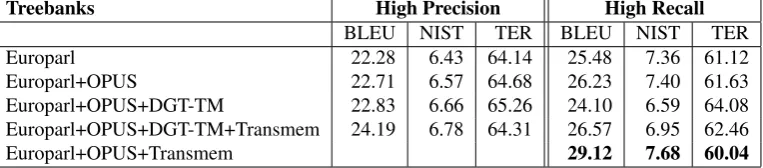
Table 6: Evaluation of adding data to the model
Treebanks High Precision High Recall
BLEU NIST TER BLEU NIST TER
Europarl 22.28 6.43 64.14 25.48 7.36 61.12
Europarl+OPUS 22.71 6.57 64.68 26.23 7.40 61.63
Europarl+OPUS+DGT-TM 22.83 6.66 65.26 24.10 6.59 64.08
Europarl+OPUS+DGT-TM+Transmem 24.19 6.78 64.31 26.57 6.95 62.46