Exploring the Relationship between Semantic Spaces and Semantic Relations
Akira Utsumi
Department of Systems Engineering The University of Electro-Communications 1-5-1 Chofugaoka, Chofushi, Tokyo 182-8585, Japan
Abstract
This study examines the relationship between two kinds of semantic spaces — i.e., spaces based on term frequency (tf) and word cooccurrence frequency (co) — and four semantic relations — i.e., synonymy, coordination, superordination, and collocation — by comparing, for each semantic relation, the performance of two semantic spaces in predicting word association. The simulation experiment demonstrates that the tf-based spaces perform better in predicting word association based on the syntagmatic relation (i.e., superordination and collocation), while the co-based semantic spaces are suited for predicting word association based on the paradigmatic relation (i.e., synonymy and coordination). In addition, the co-based space with a larger context size yields better performance for the syntagmatic relation, while the co-based space with a smaller context size tends to show better performance for the paradigmatic relation. These results indicate that different semantic spaces can be used depending on what kind of semantic relatedness should be computed.
1.
Introduction
Recent research effort in computational lexical semantics has been directed at a semantic space model (Landauer et al., 2007; Pad´o and Lapata, 2007; Sch¨utze, 1998), a corpus-based method for acquiring and representing the meaning of words. Semantic space models are computationally effi-cient as a way of representing meanings of words, because they take much less time and less effort to construct mean-ing representation and they can provide a more fine-grained similarity measure between words than other representa-tion methods such as thesauri (e.g., WordNet). Semantic space models are also psychologically plausible; a num-ber of studies have shown that vector-based representation achieves remarkably good performance for simulating hu-man verbal behavior (Bullinaria and Levy, 2007; Landauer et al., 2007).
Semantic spaces (or word vectors) are constructed from large bodies of text by observing distributional statistics of word occurrence. A number of methods have been pro-posed for generating semantic spaces. Latent semantic analysis (LSA) is the most well-known method that uses the frequency of words (i.e., term frequency) in a fraction of documents to assess the coordinates of word vectors. An-other popular method is based on the frequency of word cooccurrence within a “window” spanning some number of words (Bullinaria and Levy, 2007; Sch¨utze, 1998).
However, despite the fact that there are different kinds of similarity between words, or different semantic rela-tions underlying word similarity such as synonym and antonym, little has been known about the relationship be-tween semantic spaces (or methods for constructing seman-tic spaces) and semanseman-tic relations. It is crucial to know what kinds of semantic relations can be represented by what kinds of semantic spaces.
One notable exception is the work of Sahlgren (2006), who relates Saussure’s syntagmatic-paradigmatic distinc-tion of semantic reladistinc-tion to different uses of context for
computing word vectors. A semantic relation between two words is syntagmatic if they cooccur more often than would be expected by chance, and a semantic relation is
paradig-matic if two words do not cooccur but they can substitute
for one another. Sahlgren argues that syntagmatic relations can be represented by the use of term frequency in the same fraction of documents (which is referred to as tf-based in this paper), while paradigmatic relations can be represented by the use of term cooccurrence frequency within a context window of the same size (which is referred to as co-based in this paper). However, in his study this relationship is not justified directly or it is simply assumed to be true; he only examined which type of context use (i.e., tf-based or co-based) achieved better performance on each specific task such as word association and thesaurus comparison. For ex-ample, since word association is based on both syntagmatic and paradigmatic relations, one cannot derive any conclu-sions about the validity of his argument on the relationship between semantic relations and semantic spaces. Further-more, Utsumi and Suzuki (2006) also examined the rela-tionship between different semantic spaces and two kinds of similarity (i.e., taxonomic similarity and associative sim-ilarity), but their study suffers from the same problems that two kinds of similarity were examined without being com-pletely separated and thus no direct evidence was obtained for the relationship between the semantic space and the se-mantic similarity.
Table 1: Four types of semantic relations
Relation Definition and description Examples
Synonymy Two words have identical or very similar meanings. student – pupil, buy – purchase, hungry – starved
Coordination Two words cluster together on the same level of detail. Antonyms come into this category.
desk – chair, red – green, black – white (antonymy)
Superordination One word is a superordinate (i.e., hypernym) of another word. This category includes meronymy.
animal – dog, color – red, car – engine (meronymy)
Collocation Two words are likely to cooccur in the text, because they form a predicate-argument structure.
rose – red, love – affair, baseball – play
2.
Semantic Relation
In this study, semantic relations are classified into four types, which are shown in Table 1. This classification is psychologically motivated; many empirical studies on word searches and speech disorders have revealed that men-tal lexicon is organized by these four semantic relations (Aitchison, 2003).
Among four relations, the synonymy relation is obvi-ously paradigmatic since synonyms tend to not cooccur, while the collocation relation is thoroughly syntagmatic by definition. The coordination relation is in principle paradig-matic, but may have a syntagmatic nature. (For example, coordinate words of fruits such as apple, orange and grape may cooccur when we talk about favorite fruits.) On the other hand, the superordination relation is basically syntag-matic, but involves a paradigmatic nature. (For example, apples, oranges or grapes can be substituted for “fruits” in the sentence “This shop sells fruits.”)
3.
Semantic Space
Semantic spaces are constructed by representing all content words ti as n-dimensional vectors wi =
(wi1, wi2,· · ·, win). The degree of semantic similarity between any two words can be easily computed as, for ex-ample, the cosine of the angle formed by their vectors.
For tf-based spaces,wijis calculated as term frequency i.e., the number of times the wordti occurs in a piece of textsj(e.g., paragraph or article). For co-based spaces,wij is calculated as the number of times wordsti andtjoccur within the context window of the sizem(i.e., the number of times the wordtjoccurs withinmwords around the word ti).
4.
Method
In order to examine what kind of semantic relation do se-mantic spaces represent, I classify word association pairs (i.e., stimulus and associate words) by their underlying se-mantic relations, and analysed the performance of tf-based and co-based spaces in predicting word associations for each classification. The word association pairs used in this study are top 10 associates of 201 stimulus words in a Japanese word association norm “Renso Kijunhyo” (Umemoto, 1969). These pairs are classified into four types of semantic relations listed in Table 1. Some association
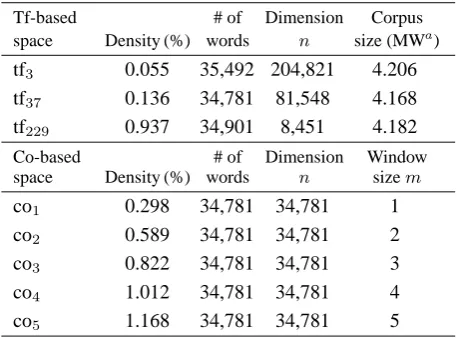
Table 2: Semantic spaces used in this study
Tf-based # of Dimension Corpus space Density (%) words n size (MWa)
tf3 0.055 35,492 204,821 4.206
tf37 0.136 34,781 81,548 4.168
tf229 0.937 34,901 8,451 4.182
Co-based # of Dimension Window space Density (%) words n sizem
co1 0.298 34,781 34,781 1
co2 0.589 34,781 34,781 2
co3 0.822 34,781 34,781 3
co4 1.012 34,781 34,781 4
co5 1.168 34,781 34,781 5
Note. The density of semantic spaces denotes the percentage of nonzero elements of word vectors, i.e., (the number of nonzero elements) / (the number of words×n)×100. aMW = million words.
pairs are then removed from the analysis because their as-sociate words (e.g., names of persons) do not or rarely oc-cur in the corpus and thus cannot be included in the seman-tic spaces. As a result, four sets of word association pairs Tsyn,Tcoo,Tsup, andTcolare obtained which are based on the synonymy, coordination, superordination, and colloca-tion relacolloca-tions, respectively. These sets include 77, 164, 129, and 788 pairs.
400 600 800 1000 1200
Median
Rank
tf3 tf37 tf229 co1 co2 co3 co4 co5 (a) Synonymy
0 60 120 180 240
Median
Rank
tf3 tf37 tf229 co1 co2 co3 co4 co5 1
(b) Coordination
0 200 400 600 800
Median
Rank
tf3 tf37 tf229 co1 co2 co3 co4 co5 1
(c) Superordination
300 450 600 750 900
Median
Rank
tf3 tf37 tf229 co1 co2 co3 co4 co5 ≈
1300
(d) Collocation
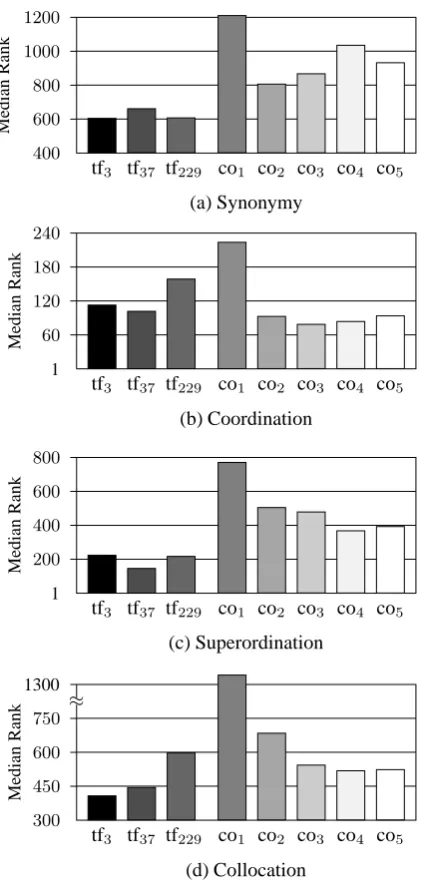
Figure 1: Median ranks of the tf-based and co-based se-mantic spaces for four sese-mantic relations.
and tf37. All co-based spaces are generated from the set of texts for tf37.1
The performance of these semantic spaces in predicting word association is measured by the median rankrmed(T) of associates in a set of word association pairsT(Griffiths et al., 2007).
rmed(T) =
r
|T|+1 2
if|T|is odd.
1 2(r|T|
2 +r
|T|
2 +1)
if|T|is even. (1)
For each pair(tSi, tAi ) ∈ T of a stimulus wordtSi and an associate wordtA
i , the rankrioftAi is assessed by comput-ing the cosine similarity betweentS
i and all other words in a semantic space and sorting all words in descending order
1The subscript of a tf-based space denotes the minimum
num-ber of words included in a contextsj(i.e., a paragraph or an arti-cle). On the other hand, the subscript of a co-based space denotes the window sizem.
Table 3: Comparison of my result and Sahlgren’s (2006) prediction on which kind of space is more suited for repre-senting semantic relations
Relation This study Sahlgren Paradigmatic relation
Synonymy tf co
Coordination co co
Syntagmatic relation
Superordination tf tf
Collocation tf tf
of cosine. A list of ranksr1,· · ·, r|T|are then obtained by sorting the ranksr1,· · ·, r|T|in ascending order. (Hence, for example,r1 is the minimum rank inr1,· · ·, r|T|.) The median rank is computed for each set of word association pairs, i.e.,Tsyn,Tcoo,Tsup, andTcol. Smaller median ranks indicate better performance.
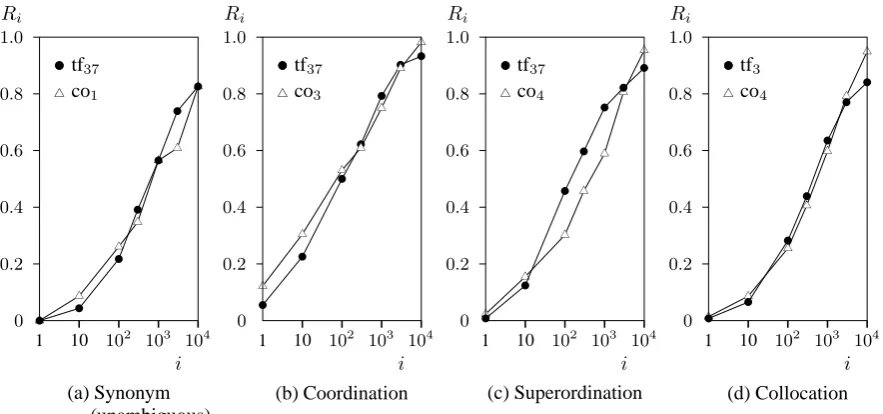
In addition, I use a secondary measure, recall of asso-ciates. The recallRi(T)of a set of word association pairs T is calculated as the fraction of associates tAj which are included in the set of the topiwords with the highest simi-larity totSj.
Ri(T) = | {(tS
j, tAj)|rj ≤i} |
|T| (2)
Note that higher recall scores indicate better performance.
5.
Result
Figure 1 shows the median ranks of associates computed by the eight semantic spaces for each semantic relation.
The overall result is that tf-based semantic spaces achieve better performance than co-based spaces for the synonymy, superordination, and collocation relations. Co-based semantic spaces (except co1) yield better perfor-mance only for the coordination relation. The same pat-tern of results is obtained if the best (i.e., minimum) me-dian rank over the eight spaces is considered; the tf-based spaces (tf3or tf37) have the minimum median rank for the synonymy, superordination, and collocation relations, but the co-based space co3achieves the minimum median rank for the coordination relation.
The findings on the coordination, superordination, and collocation relations are consistent with Sahlgren’s (2006) argument, but the result of the synonymy relation is incom-patible with his argument, as summarized in Table 3. One possible explanation of this incompatibility would be that synonyms are less likely to be substituted for each other than would be expected because all senses of the synonyms are not identical or they have different connotations of the common meaning.
Table 4: Top five associates of some stimulus words pre-dicted by tf-based and co-based semantic spaces
Associates
Stimulus tf37 co3
Fish SMALL FISH MEAT
(sakana) (kozakana) (niku)
SWIM VEGETABLE
(oyogu) (yasai)
FLOUNDER DELICIOUS
(hirame) (oishii)
TROPICAL FISH EAT
(nettaigyo) (taberu)
FISHERMAN COOKING
(ryoushi) (ryouri)
Drink TEA GET DRUNK
(nomu) (ocha) (you)
GLASS EAT
(gurasu) (taberu)
POT ALMOST DROWN
(potto) (oboreru)
PILL COFFEE
(jyouzai) (kˆohˆı)
BEER WATER
(bˆıru) (mizu)
Note. Associates in aa and aa are connected to stim-ulus words by the superordination and coordination re-lations, respectively. Other associates are based on the collocation relation. Some associates are multiwords, but their original Japanese expressions are single words.
ness. However, the result of Figure 1 that for none of the semantic relations does the least sparse tf-based space tf229 achieve the best performance indicates that reduction of sparseness by using a larger context is not necessarily an efficient way of overcoming this difficulty. Dimensional-ity reduction may provide a solution to this problem; LSA takes this approach by reducing the original semantic space into a much smaller space by using a technique of singular value decomposition. It would be interesting to examine the effects of dimensionality reduction on the representa-tional power of semantic spaces, although I do not discuss this issue here.
Table 4 shows some examples of the top five associates produced by two semantic spaces tf37and co3. The result is consistent with the finding obtained by median rank; the tf-based space tf37is likely to list as top associates subordinate or collocated words of the stimulus, but the co-based space tends to pick out coordinate words.
6.
Discussion: Do Subcategories of Semantic
Relations Yield Consistent Results?
Some of the four relations used in this study can be fur-ther divided into subcategories, which have been discussed in lexical semantics (Cruse, 1986). Hence, the following0 30 60 90 120
Median
Rank
tf3 tf37 tf229 co1 co2 co3 co4 co5 (a) Antonymy
100 160 220 280 340
Median
Rank
tf3 tf37 tf229 co1 co2 co3 co4 co5 (b) Non-antonymous coordination
100 250 400 550 700
Median
Rank
tf3 tf37 tf229 co1 co2 co3 co4 co5 (c) Hyponymy (is-a)
0 400 800 1200 1600
Median
Rank
tf3 tf37 tf229 co1 co2 co3 co4 co5 (d) Meronymy (part-of)
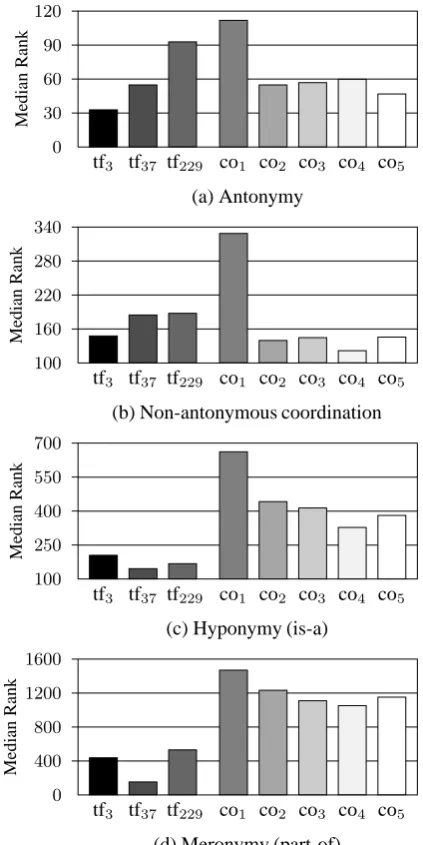
Figure 4: Median ranks of the semantic spaces for subcate-gories of the semantic relations
subrelations are considered and the median ranks for these subrelations are computed.3
• Coordination
– Antonymy (or opposition): Two words have the
opposite meaning. (e.g., black – white).
– Non-antonymous coordination: Two words do
not have the opposite meaning but cluster to-gether on the same level. (e.g., desk – chair). • Superordination
– Hyponymy: One word is a kind of another word.
Hyponymy is also referred to as a “is-a” relation. (e.g., animal – dog).
3
– Meronymy: One word is a part of another word.
Meronymy is also referred to as a “part-of” rela-tion. (e.g., engine – car).
Figure 4 shows the result of the tf-based and co-based spaces for each of these subrelations. Concerning the sub-categories of superordination, they show the same pattern of results that the tf-based spaces yield better performance, although the performance of the meronymy (part-of) tion is totally worse than that of the hyponymy (is-a) rela-tions. For the subcategories of coordination, however, one noteworthy finding is obtained which is incompatible to the finding of Figure 1; the antonymy relation is better repre-sented by the tf-based space tf3than by the co-based spaces, although the co-based performance is also very high. This finding may be due to the distinctive nature of antonymy that antonymous words are more likely to cooccur than other coordinate words; we often say “good news and bad news,” “boy meets girl,” “win or lose,” and so on. Hence, antonymy has a syntagmatic nature and thus can be better represented by the tf-based spaces.
7.
Concluding Remarks
In this paper, I have examined the relationship between two kinds of semantic spaces (i.e., tf-based and co-based) and four semantic relations (i.e., synonymy, coordination, su-perordination, and collocation) in a systematic way, and obtained the following findings.
• The tf-based and co-based semantic spaces better rep-resent different kind of semantic relations; A co-based space is suited for representing the paradigmatic re-lation, while a tf-based space is appropriate for the syntagmatic relation. This finding is consistent with Sahlgren’s (2006) claim.
• Computing the semantic relatedness between synony-mous words is affected by their polysemy. When syn-onymous words are highly polysemous and thus they are not truly synonyms, co-based spaces are less ap-propriate for computing the semantic similarity.
• Antonymy is better judged by the tf-based spaces, in contrast to non-antonymous coordination, which is better represented by the co-based spaces. This may be because antonymy is more syntagmatic in nature.
• The co-based space with a larger context size yields better performance in computing the semantic relat-edness based on the syntagmatic relation, while the co-based space with a smaller context size tends to show better performance for the paradigmatic relation. This finding is consistent with Peirsman et al.’s (2008) claim.
These findings indicate that different semantic spaces can be used depending on what kind of semantic similarity should be computed.
It would be vital for further research to examine whether these findings are generalised to other space generation methods including a topic model (Griffiths et al., 2007), other languages, other similarity measure, and other kinds
of corpus, as well as to develop a versatile method for rep-resenting all kinds of semantic relations. Another impor-tant topic that should be addressed is to examine the effec-tiveness of dimensionality reduction, and the relationship between dimensionality reduction techniques and semantic relations.
8.
Acknowledgment
This study was supported by a Grant-in-Aid for Scientific Research(C) (No.20500234) from Japan Society for the Promotion of Science.
9.
References
Aitchison, J. (2003). Words in the Mind: An Introduction
to the Mental Lexicon, 3rd Edition. Oxford, Basil
Black-well.
Bullinaria, J.A. and Levy, J.P. (2007). Extracting seman-tic representations from word co-occurrence statisseman-tics: A computational study. Behavior Research Methods, 39(3):510–526.
Cruse, D.A. (1986). Lexical Semantics. Cambridge Uni-versity Press.
Griffiths, T.L., Steyvers, M., and Tenenbaum, J.B. (2007). Topics in semantic representation. Psychological
Re-view, 114:211–244.
Landauer, T.K., McNamara, D.S., Dennis, S., and Kintsch, W. (2007). Handbook of Latent Semantic
Anal-ysis. Lawrence Erlbaum Associates.
Pad´o, S. and Lapata, M. (2007). Dependency-based con-struction of semantic space models. Computational
Lin-guistics, 33(2):161–199.
Peirsman, Y., Heylen, K., and Geeraerts, D. (2008). Size matters: Tight and loose context definitions in English word space models. In Proceedings of the ESSLLI
Work-shop on Distributional Lexical Semantics, pages 34–41.
Sahlgren, M. (2006). The Word-Space Model: Using
Dis-tributional Analysis to Represent Syntagmatic and Para-digmatic Relations between Words in High-dimensional Vector Spaces. Ph.D. thesis, Stockholm University.
Sch¨utze, H. (1998). Automatic word sense discrimination.
Computational Linguistics, 24(1):97–123.
Umemoto, T. (1969). Renso Kijunhyo (Free Association
Norm). Tokyo Daigaku Shuppankai, Tokyo.
Utsumi, A. and Suzuki, D. (2006). Word vectors and two kinds of similarity. In Proceedings of the 21st
Interna-tional Conference on ComputaInterna-tional Linguistics and the 44th Annual Meeting of the Association for Computa-tional Linguistics (COLING-ACL 2006) Main Confer-ence Poster Sessions, pages 858–865.
Yamaguchi, T. (2006). Nihongo Dai-Thesaurus CD-ROM