Semantic Feature Engineering for Enhancing Disambiguation Performance in
Deep Linguistic Processing
Danielle Ben-Gera, Yi Zhang, Valia Kordoni
Department of Computational Linguistics, Saarland University& German Research Center for Artificial Intelligence (DFKI GmbH)
P.O.Box 15 11 50, D-66041 Saarbr¨ucken, Germany
{danielle,yzhang,kordoni}@coli.uni-sb.de
Abstract
The task of parse disambiguation has gained in importance over the last decade as the complexity of grammars used in deep linguis-tic processing has been increasing. In this paper we propose to employ the fine-grained HPSG formalism in order to investigate the contribution of deeper linguistic knowledge to the task of ranking the different trees the parser outputs. In particular, we focus on the incorporation of semantic features in the disambiguation component and the stability of our model cross domains. Our work is carried out within DELPH-IN (http://www.delph-in.net), using the LinGo Redwoods and the WeScience corpora, parsed with the English Resource Grammar and the PET parser.
1.
Introduction
&
Previous Work
Deep parsing of natural language is a difficult task. In or-der to gain wide meaningful coverage of a given language complex grammars are employed. Grammars such as the English Resource Grammar (henceforward ERG; (Copes-take and Flickinger, 2000)) offer a broad coverage analy-sis of English, but are at the same time faced with chal-lenges, as the number of correct structures that are licensed by the grammar is often vast. Parsers, such as the PET parser (Callmeier, 2000) which are mostly used in combi-nation with the ERG for the processing of large-scale data, often return thousands of different readings for one single sentence. Those readings may differ from one another in significant ways. The task of automatically ranking the dif-ferent readings and returning the correct one is hence an important one.
Different methods have been suggested in the literature for the task of parse selection, both for more traditional treebanks, such as the Penn Treebank ((Charniak, 1997), (Collins, 1997)), and for so-called dynamic treebanks, like the Redwoods treebank ((Toutanova et al., 2002), (Toutanova et al., 2005), and (Zhang et al., 2007)).
Both generative and discriminative models were employed for the task. In generative models the classifier derives the probability of a certain observation to belong to a certain class (P(Y|X), whereY is the class andX is the obser-vation) using the prior and the joint probability ofX and Y. Discriminative models are generally considered a more direct approach, since the conditional probabilityP(Y|X) is being calculated directly using log-linear models. As a result of estimating the posterior probability, discrim-inative models do not assume independence of features. This characteristic makes log-linear models more appealing to our task since linguistics features are often dependent on each other.
The most extensive work using HPSG treebanks was done by (Toutanova et al., 2005). In their work both discrimina-tive and generadiscrimina-tive models for parse disambiguation are in-vestigated and up to 14% error reduction is achieved when
using discriminative models over generative ones with the same features. This supports our choice of using a discrim-inative model.
In our work we are trying to extend this previous attempt to include more explicit semantic features directly from the full Minimal Recursion Semantics (MRS; (Copestake et al., 2005)) representation. (Toutanova et al., 2005) uses a sim-plified semantic graph that is extracted from the complete MRS feature structure.
In addition, we put a focus on investigating domain adapt-ability of our discriminative model. To the best of our knowledge, former approaches that made use of the HPSG formalism were carried out on the Redwoods treebank (Oepen et al., 2002) which is very well adjusted to the grammar and hence might not provide a clear insight to the difficulties of the task. Therefore testing our models on new independent corpora is valuable for the performance evalu-ation of the method.
The disambiguation of the different results typically takes place offline, on the output of the parser. This approach has the advantage that all the information from the parser was already collected and it is possible to achieve exact ranking of the different parses even with non-local features that are not available during parsing. A considerable disadvantage of this method is that the output of the parser can be partial. It is often the case that due to the complexity of the parsing task, most systems keep only the n-best hypotheses during parsing and potentially discard parses that might be signifi-cant to the training process, in particular a correct parse can be lost.
guage can be combined. The object language is a spe-cific first order language with generalized quantifiers. The basic units of an MRS representation are called elemen-tary predictions. An elemenelemen-tary predication has the form label : relation(var1, ..., varn, hole1, ..., holen), where
label and hole1n are called handles and constitute part of
the meta language. In addition, an MRS structure contains a set of constraints between handles, called qeq-constraints and a unique top-handle. In a configuration of an MRS, handles are identified pairwise such that elementary pre-dictions can be substituted into the hole-handles identified with their labels. This way quantifier scoping is explicitly resolved. However such a structure is only called a config-uration of the MRS if it satisfies all qeq-constraints. The qeq-constraintf =q gis satisfied if eitherf is identified
withg orf outscopesg. The set of configurations for the MRS corresponds to the set of its readings.
Using these treebanks and the grammar we conduct exper-iments to investigate the influence of adding semantics to the disambiguation model. We conduct each experiment on two random splits and averaged the results. We designed the experiments such that in addition to the question of the influence of adding the semantics to the model, we will also examine the cross-domain stability.
2.2. Baseline
For the analysis of the mentioned data, we have thus created a reliable baseline that allows us to evaluate the contribution of different properties to the task of disambiguation. Fol-lowing previous work, it is common practice to choose a set of features that includes the derivation trees rules that are being used. Adding a certain level of parenting improves results depending on the data-set. Since the ERG underly-ing the Redwoods corpus has a maximally binary structure, the result trees are not as flat as in other corpora such the Penn Treebank (Marcus et al., 1994) and do not contain much context within the span of a single rule. This charac-teristic makes it important to include non-local information such as parenting.
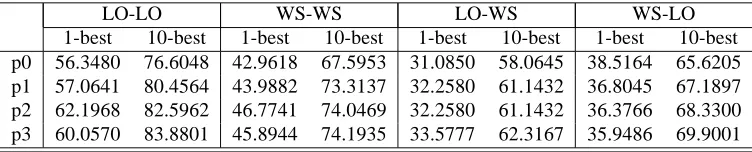
Since no previous baseline exists for the specific data-set, we approach the task by choosing a simple set of features consists of rules up to the third level of parenting. As can be observed in table 1, there is a clear improvement when using 2nd level grandparenting (up to 5% in the same do-main). When raising the tree depth to 3-grandparenting level, we can no longer observe an obvious improvement of results. In some cases there is even a drop in the result of the best pick (up to 2% in the LOGON-LOGON experi-ment).
2.3. Deep semantic features
Deeper properties of the derivations must be extracted from the Redwoods treebank using the grammar as a reference. The treebank contains a basic derivation tree, where the nodes are annotated with the rules that have been used to derive its structure. From this schemata information we can reproduce the full feature structure that describes the sentence. The HPSG-based ERG provides MRS semantic representations. In order to have access to those features, we first extract this information from the basic derivation
tree that is available in the treebank. Since the derivation tree is labeled with a unique rule that was used to create the node, we can use the grammar to trace back bottom-up all the feature-value pairs and create a full description of the parse including the MRS. This can be achieved using the [incr itsdb()] toolkit2which is also part of the DELPH-IN collaboration open source repository.
Looking at the semantics of sentences helps us disam-biguate structure where the syntax cannot provide any hints, since more than one reading is syntactically correct. This is often the case with PP attachments or complex noun com-pounding.
Consider, for instance, the sentence in (1) below. This is an example from the Redwoods treebank. The phrase
Nor-wegian Mountain Museum has 29 different derivation trees
in the treebank. Here we look at two of them in order to exemplify the difference:
(1)
There is a clear difference of meaning between those two readings. In (2a) the modifier Norwegian modifies the noun phrase Mountain Museum, while in (b) the adjective modifies only the word Mountain. On the syntactic level both those solutions are possible, but looking at the MRS of those two parses we can see a clear difference.
(2) (a)
{e2:
e2:unknown[ARG x4:_museum_n_of]
e9:_norwegian_a_1[ARG1 x4:_museum_n_of] e11:compound[ARG1 x4:_museum_n_of,
ARG2 x10:_mountain_n_1] }
(b)
{e2:
e2:unknown[ARG x4:_museum_n_of] e10:compound[ARG1 x4:_museum_n_of,
ARG2 x9:_mountain_n_1] e15:_norwegian_a_1[ARG1 x9:_mountain_n_1] }
Notice that the MRS representation here is a simplified one that can be viewed as a semantic dependency structure. From those structures we can extract features that model the dependencies. Although the dependency structures tend to be flatter than the syntax trees, one can still often observe some nesting in the structure. Taking this into account al-lows us to consider wider context for the semantics, in a similar way to the one we use for the syntactic structure, i.e., using various parenting levels. That allows a better
2
LO-LO WS-WS LO-WS WS-LO 1-best 10-best 1-best 10-best 1-best 10-best 1-best 10-best p0 56.3480 76.6048 42.9618 67.5953 31.0850 58.0645 38.5164 65.6205 p1 57.0641 80.4564 43.9882 73.3137 32.2580 61.1432 36.8045 67.1897 p2 62.1968 82.5962 46.7741 74.0469 32.2580 61.1432 36.3766 68.3300 p3 60.0570 83.8801 45.8944 74.1935 33.5777 62.3167 35.9486 69.9001
Table 1: Results of using different levels of parenting and grandparenting on different data-sets. In this table LO stands for LOGON and WS stands for WeScience. LO-WS for example means the model was trained on and tested WeScience.
comparison between the contribution of the syntax and the contribution of the semantics.
In addition to this simplified structure we also have access to the full MRS of the sentence. The full structure allows us to extract explicitly information such as the scope of the quantifiers in the sentence. This information is important specially since in the MRS formalism many ambiguities are created due to the fact that every NP is viewed as a scope baring element that can hence overscope, or be overscopped, by other elements. This creates many of possible configurations for a given sentence.
(3)
<h1,e2,
{h3:unknown_rel<0:24>(e2, x4), h5:udef_q_rel<0:24>(x4, h6, h7), h8:compound_rel<0:24>(e10, x4, x9), h11:udef_q_rel<0:24>(x9, h12, h13), h14:_norwegian_a_1_rel<0:8>(e15, x9), h14:_mountain_n_1_rel<10:17>(x9), h8:_museum_n_of_rel<19:24>(x4, i16)}, {h6 qeq h8,
h12 qeq h14}>
Example (3) is the full MRS of the same sentence (1). The structure includes the top-handle (h1), the set of predi-cates and lastly the set of qeq constraints. In addition, the quantifiers are explicitly mentioned. The quantifier undef q relappears twice and takes scope over
moun-tain (x9) and museum (x4), we use this information as well in our semantics model.
In order to build a less sparse model that reflects more gen-eral observations, we would like to abstract away from the specific semantic relations and use the categories of words which we extract from the lexicon. We are experimenting with different models both with lexical categories and with the word specific semantic relations.
2.4. Evaluation and Error Analysis
We conducted four experiments, two where training and testing is being done on the same domain, and two cross-domain experiments. We evaluated each experiment in terms of best pick, where only if the highest ranked read-ing is the optimal one it is considered a correct choice by the disambiguator. In addition we also evaluate how often the correct reading is in the top ten ranked parses. Top-10 evaluation is significant since the differences between the readings can be very small (due to the fine-grained analyzes that an HPSG-oriented grammar like the ERG provides),
and often human annotators are not fully consistent with minor details. Furthermore one can benefit greatly from a tool that will narrow down the number of possible results from a maximum of 1000 to 10.
(Toutanova et al., 2005) report little improvement when combining semantic properties into the learner. One of the reasons for this is the fact that the results in this work were evaluated on the syntactic structure solely. The manually annotated gold standard was created with the correct syn-tactic structure as a guideline, mostly ignoring the semantic part. Evaluating the disambiguator on a test set that was annotated with the correct MRS structure in mind might be necessary in order to truly understand the contribution of the semantics.
Part of the goal of our work has also been to conduct a de-tailed error analysis in order to investigate the contribution of the semantics component to the disambiguation model. We show that using the semantic features we are able to disambiguate a range of phenomena that is beyond the syn-tactic level. (Toutanova et al., 2005) indicate that a signifi-cant portion of real errors, i.e., errors that are not caused by human wrong annotations, or by the grammar licensing im-possible derivations, are errors where semantic knowledge is needed. PP-attachment, modifier attachment and even the correct choice of lexical item often require knowledge about the meaning of the sentence.
The semantic model is more stable when applying it to dif-ferent domains and shows less drop of results when testing the model on a new corpus. The syntax-only model shows a drop of almost 10% between the WeScience-WeScience in domain experiment and the WeScience-LOGON exper-iment where the learner is being tested on more unseen structures from new corpus. In the model that uses the se-mantics, however, we see only 7.5% drop.
The semantics of a sentence is in a sense where the essence of sentence is being captured. When we utter a phrase we are really interested in the its meaning. The syntax, or the structure of the sentences, is being employed to serve this purpose of conveying the meaning. In that sense the se-mantic representation is more domain independent as it is not influenced by a specific structure that might be common in a certain corpus.
2.5. Results and Discussion
LO-LO WS-WS LO-WS WS-LO 1-best 10-best 1-best 10-best 1-best 10-best 1-best 10-best p3 (baseline) 60.0570 83.8801 45.8944 74.1935 33.5777 62.3167 35.9486 69.9001
sem-d2 40.7988 73.7517 26.0997 61.4369 20.5278 51.7595 23.9657 58.0599 syn+sem 61.7689 83.8801 46.0410 74.9266 35.7771 62.9032 38.5164 69.3295
Table 2: Results of the experiments with semantics-only model and a model that incorporate both the semantics and the syntactic features.
add new information to the model. This additional informa-tion is especially helpful where the syntactic features reach their limits.
In order to check the contribution of the semantics to the task of disambiguation, we have trained a model consist-ing of semantic features only. It is interestconsist-ing to note that this model preforms much better on the LOGON corpus, with 40% precision in best pick (much higher then a ran-dom pick which is 27%). However it does not perform well in the other experiments. We suspect that this is due to the work that was done on LOGON. was used as a develop-ment set for building the ERG grammar and in particular the MRS part of the grammar. For that reason we expect higher results when training and testing on this treebank. The syntax alone with level-three grandparenting gives us precision of about 43% on average. This is better than the semantic-only model, but one should note that the syntax model is able to take into account more of the context using the granparenting. Here too we can observe that the results on the data-set are much higher and exhibit a clear bias. From table 2 one can draw some general observations about the different data-sets we have used. As mentioned above, the WeSicence corpus is much more diverse and represents data that was collected from the Internet. In addition, no fine tuning of the grammar was done on this corpus, and hence it is a more realistic scenario of using the disam-biguator.
It is not surprising that in all the different configurations of the model cross domain testing yields lower results. Fur-thermore, we can see that training on and testing on We-Science gives the lowest results. Since LOGON is more specific and less diverse the trainer simply does not en-counter enough examples to be able to cope with the more complex input of the Wikipedia articles. When we reverse the experiment and train the model on WeScience, we ob-tain better results (e.g. 38.5% instead of 35.7% in the syn-tax and semantics model).
The more significant improvement when adding the seman-tics is apparent in the best pick, where we see more than 1.5% better precision on average. On the other hand the top-10 is not influenced as much. It seems that the ad-ditional semantic information helps to disambiguate fine grained information that allows us to re-rank the top can-didates in a more precise way.
Examining different domains by using different corpora gives us a much better understanding of the contribution of the various features to the models. The contribution of the semantic features can be observed most clearly in the cross domain experiments where adding the semantics gives up a visible improvement of 2.2% when training on LOGON
and 2.6% when training on the WeScience in the best pick evaluation.
In some of the experiments, we have observed that adding more syntactic features (by increasing the parenting level) does not help improve the performance. These data-sets seem to have fully used the information that the syntax can provide us. On those sets, that naturally yield lower base-line results, we see a better performance after the integra-tion of the semantic features into the model.
3.
Conclusion and Outlook
From our experiments so far it is clear that adding infor-mation about the meaning of the sentence can be beneficial for disambiguating the parser’s output. We have shown that the MRS structures that are provided by the grammar can be translated into features that contribute to the disambigua-tion model.
Moreover, that the same improvement can be observed in cross domain experiments as well. The semantic informa-tion consistently helps the model to re-rank the readings and increases the precision.
Another important result of this work is the observation that the LOGON corpus is a very artificial choice to evaluate systems developed using the ERG. We can see that in all our experiments working solely with the LOGON treebank results in very high figures that do not represent the true abilities of the disambiguation model.
4.
References
U. Callmeier. 2000. PET–a platform for experimenta-tion with efficient HPSG processing techniques. Natural
Language Engineering, 6(01):99–107.
J. Carroll and S. Oepen. 2005. High efficiency realization for a wide-coverage unification grammar. Lecture notes
in computer science, 3651:165.
E. Charniak. 1997. Statistical parsing with a context-free grammar and word statistics. In Proceedings of the
Na-tional Conference on Artificial Intelligence, pages 598–
603.
M Collins. 1997. Three generative, lexicalised models for statistical parsing. In Jonathan David Bobaljik and Tony Bures, editors, Proceedings of the 35th Annual Meeting
of the Association for Computational Linguistics, pages
16–23, NJ, USA. ACL.
A. Copestake, D. Flickinger, C. Pollard, and I.A. Sag. 2005. Minimal recursion semantics: An introduction.
Research on Language & Computation, 3(4):281–332.
L. Huang. 2008. Forest reranking: Discriminative parsing with non-local features. In In Proceeding of Association
for Computational Linguistics. ACL.
M.P. Marcus, B. Santorini, and M.A. Marcinkiewicz. 1994. Building a large annotated corpus of English: The Penn Treebank. Computational linguistics, 19(2):313–330. S. Oepen, K. Toutanova, S. Shieber, C. Manning,
D. Flickinger, and T. Brants. 2002. The LinGO Red-woods treebank motivation and preliminary applications. In Proceedings of the 19th international conference on
Computational linguistics-Volume 2, pages 1–5.
Asso-ciation for Computational Linguistics Morristown, NJ, USA.
K. Toutanova, C.D. Manning, S. Shieber, D. Flickinger, and S. Oepen. 2002. Parse disambiguation for a rich HPSG grammar. In Proceedings of the First Workshop on
Tree-banks and Linguistic Theories, pages 253–263.
K. Toutanova, C.D. Manning, D. Flickinger, and S. Oepen. 2005. Stochastic HPSG parse disambiguation using the Redwoods corpus. Research on Language &
Computa-tion, 3(1):83–105.