Unsupervised Word Sense Disambiguation
with Multilingual Representations
Erwin Fernandez-Ordo ˜nez, Rada Mihalcea, Samer Hassan
Department of Computer Science University of North Texas
[email protected],[email protected],[email protected]
Abstract
In this paper we investigate the role of multilingual features in improving word sense disambiguation. In particular, we explore the use of semantic clues derived from context translation to enrich the intended sense and therefore reduce ambiguity. Our experiments demonstrate up to 26% increase in disambiguation accuracy by utilizing multilingual features as compared to the monolingual baseline.
Keywords: word sense disambiguation, multilingual natural language processing, lexical semantics
1. Introduction
Ambiguity has been always intertwined with human language and its evolution. Some argue that ambiguity of the human languages is a byproduct of its complex-ity, with words that are frequently used in language often being assigned to more than one reference in the real world, thus resulting in ambiguity. For instance, the word “bank” has several distinct interpretations, including that of “financial institution” and “edge of a river.” The following sentences illustrate the use of this word with the two meanings: The van pulled up outside the bank and three masked men got out, where the word “bank” has a different meaning as compared to its usage in the context The boy leapt from the bank into the cold water. While it is often easy for a human to identify the correct meaning of a word in a given context, the same task when performed by a computer is among the most difficult problems in natural lan-guage processing.
In this paper, we propose a method for word sense disambiguation (WSD), defined as the task of auto-matically assigning a meaning to an ambiguous word in a given context. Specifically, similar to one of the original WSD methods (Lesk, 1986), we formulate the task under an unsupervised setting, and assume that the only knowledge available is a dictionary with defi-nitions for the various meanings of a given ambiguous word.
We investigate a new unsupervised WSD method that is able to take additional advantage of a multilingual representation of the word sense definitions and of the context where the ambiguous word occurs. We con-sequently try to identify the correct meaning of the word in several multilingual spaces. We show that by
using this multilingual representation, we are able to improve the performance of the WSD system by a sig-nificant margin, as compared to a traditional system that uses only monolingual features.
2. Related Work
Despite the large number of word sense disambigua-tion methods that have been proposed so far, target-ing the resolution of word ambiguity in different lan-guages, there are only a few methods that try to ex-plore more than one language at a time.
The work that is perhaps most closely related to our is the WSD method with multilingual features proposed in (Banea and Mihalcea, 2011), where both training and test contexts are translated into French, German, and Spanish, and consequently a supervised WSD al-gorithm is applied on this multilingual feature space. In that work, the multilingual representation brings er-ror rate reductions of up to 25%, as compared to the monolingual classifier. All the evaluations are how-ever done in a supervised setting, which, unlike our method, assumes the availability of hand-annotated data.
Another closely related work is the bilingual boot-strapping method introduced in (Li and Li, 2002), where word translations are automatically disam-biguated using information iteratively drawn from two languages. Unlike that approach, which iterates be-tween two languages to select the correct translation for a given target word, in our method we simulta-neously use the features extracted from several lan-guages.
Ng et al., 2003), but in that line of work the paral-lel texts were mainly used as a way to induce word senses or to create sense-tagged corpora, rather than as a source of additional multilingual views for the disambiguation features. Another related technique is concerned with the selection of correct word senses in context using large corpora in a second language (Da-gan and Itai, 1994), but as before, the additional lan-guage is used to help distinguishing between the word senses in the original language, and not as a source of additional information for the disambiguation context. Also related is the recent SEMEVALtask that has been proposed for cross-lingual lexical substitution, where the word sense disambiguation task was more flexibly formulated as the identification of cross-lingual lexical substitutes in context (Mihalcea et al., 2010). A num-ber of different approaches have been proposed by the teams participating in the task, and although several of them involved the translation of contexts or substitutes from one language to another, none of them attempted to make simultaneous use of the information available in the two languages.
Finally, although the multilingual subjectivity classi-fier proposed in (Banea et al., 2010) is not directly ap-plicable to the disambiguation task we address in this paper, their findings are similar to ours. In that paper, the authors showed how a natural language task can benefit from the use of features drawn from multiple languages, thus supporting the hypothesis that multi-lingual features can be effectively used to improve the accuracy of a monolingual classifier.
3. Motivation
To motivate our work and demonstrate the utility of using translation for WSD, we present several exam-ples in Table 1. The sentences were collected from the web and they showcase three different senses of the word “capital.” Namely, capital as “main city,” as “available wealth or assets,” and as “letter represented in uppercase.” Along with each English sentence we also provide its Spanish translation. In the first exam-ple, we see that “capital” carries the meaning of city and the context provides some useful clues, among them “country,” geo-location attributes like “South West,” and some named entities like “Bangkok” and “Thailand.” The context also provides ambiguous clues such as “bank.” In the hypothetical scenario in which a WSD system would strongly favor the “bank” clue to support the “asset” sense of capital, the incor-rect sense assignment would result. By translating the context to Spanish, we notice that the ambiguous no-tion of “bank” has been resolved to “orilla” (shore), hence resulting in more cohesive context clues to the intended sense. The notion repeats in the second ex-ample where “capital” indicates the sense of assets. This time, the ambiguous clue of bank has been
cor-rectly resolved to “bancos” and “bancarios” hence strengthening the financial aspect of the context and biasing the classification of the “capital” sense in the proper direction. Similarly, the last two examples ex-hibit an analogous pattern. While Example 3 carries the “capital” sense of assets, it emits ambiguous clues like “letter” which represents an alternative sense. The Spanish translation conveniently resolves this incon-sistency by utilizing “carta” (paper). In Example 4, we see that not only did the translation help disambiguate polysemous contextual clues like “letter,” but it also disambiguated the target word (capital) by choosing “mayusculas” (upper case) as its translation. This demonstrates the inherent power of alternative con-text representation through translation, as the ambi-guity of the context is weakened with every additional language. The contextual clues permeate from every language and lend their disambiguating power to ev-ery monolingual fragment, thus allowing for a clearer relationship to transpire. This relationship manages to capture the quintessential meaning of the fragments in question.
En: Bangkok is the capital of Thailand, in the South West part of the country, on the east bank of the Chao Phraya River, near the Gulf of Thailand.
Es: Bangkok es la capital de Tailandia, en la parte sur oeste del pa´ıs, en la orilla oriental del r´ıo Chao Phraya, cerca del Golfo de Tailandia.
En: Europe’s big banks will be forced to find e108bn ($150bn) of fresh capital over the next six to nine months under a deal to strengthen the banking system agreed by European Union finance ministers.
Es: Los grandes bancos europeos se ver´an obligados a en-contrare108bn ($ 150 mil millones) de capital fresco en los pr´oximos seis a nueve meses en virtud de un acuerdo para fortalecer el sistema bancario acordado por la Uni´on Europea a los ministros de finanzas.
En: Please find attached the reply of the Supervisory Board to the letter from the Capital Assets Management Agency of the Republic of Slovenia (AUKN) with regard to holiday allowance paid for 2011.
Es: Se adjunta la respuesta del Consejo de Vigilancia a la carta de la Agencia de Gesti´on de Activos de Capital de la Rep´ublica de Eslovenia (AUKN) con respecto al subsidio de vacaciones pagadas para el a˜no 2011.
En: The usage of capital letters can have different mean-ings in emails CAPS can sound rude, but when used prop-erly, especially in web design they can be pretty effective to get attention and to showcase main information
Es: El uso de letras may ´usculas puede tener significados diferentes - en los correos electr´onicos CAPS pueden sonar grosero, pero cuando se utilizan correctamente, en especial en el dise˜no de paginas de web, pueden ser muy eficaces para llamar la atenci´on y mostrar la informaci´on principal.
4. Multilingual Word Sense Disambiguation
We approach the WSD task using an unsupervised method based on the Lesk algorithm (Lesk, 1986). Given a sequence of words, the original Lesk al-gorithm attempts to identify the combination of word senses that maximizes the redundancy (overlap) across all corresponding definitions. The algorithm was later improved through a method for simulated annealing (Cowie et al., 1992), which solved the com-binatorial explosion of word senses, while still find-ing an optimal solution. However, recent comparative evaluations of different variants of the Lesk algorithm have shown that the performance of the original algo-rithm is significantly exceeded by an algoalgo-rithm vari-ation that relies on the overlap between word senses and current context (Vasilescu et al., 2004). We are thus using this latter Lesk variant in our implementa-tion, and select the meaning of an open-class word by finding the word sense that leads to the highest overlap between the corresponding dictionary definition and the current context.
One of the main drawbacks associated with the Lesk algorithm is the fact that often times no overlap is found between the word sense definitions and the given input context, which is primarily due to the small size of these definitions and the contexts, as well as to the diversity of language. Even if for a given example such as The van pulled up outside the bank and three masked men got out, it is clear that the tended meaning for “bank” was that of “financial in-stitution,” it may be difficult for a computer to find any overlap with the corresponding definition of “a finan-cial institution that accepts deposits and channels the money into lending activities.” We try to address this problem by expanding the representation into a mul-tilingual space, and therefore seek to find an overlap between the context and the sense definitions under different linguistic realizations. In this way, as men-tioned before, we are solving the ambiguity of sev-eral word representations by using their translation in other languages. At the same time, we are also iden-tifying additional matches by using the representation of words in other languages.
In our experiments, we use four different languages: English (En), French (Fr), German (De), and Span-ish (Es). For a given target word, we first iden-tify its meaning definitions in the WordNet dictionary (Miller, 1995). Next, since we also need the corre-sponding definitions of these word meanings in the other languages under consideration, we first explored the idea of using EuroWordNet (Vossen, 1998). We ran however into several issues, the major one being the partial coverage of this resource for some of the word senses, which would have resulted in gaps in our word sense representations. We thus decided to use another solution, and gather definitions for the target
word senses in the other languages by using automatic machine translation. An alternative we may consider in future work is BabelNet (Navigli and Ponzetto, 2010), which combines WordNet and Wikipedia into a very large multilingual network.
For a target word, we use the Google Translate API and collect translations in the three languages (French, German, Spanish) for all its sense definitions. These translations, along with the original English defini-tions, form the multilingual sense representations for the target word. Given a context, we apply a simi-lar process, and create a multilingual context repre-sentation by translating the text into the three lan-guages, again by using the Google Translate API. Although the automatic translation is naturally error prone, based on previous work that compared auto-matic and manual translations and their role in lan-guage processing tasks (Banea et al., 2008), we do not expect the potential translation noise to play an impor-tant role in the overall quality of the disambiguation system.
Finally, the simplified Lesk algorithm is applied sep-arately on each of the four language representations, and the sense that maximizes the overlap between its definition and the input context is selected. The final sense selection is then made using a voting among the senses chosen for the individual languages.
To measure the overlap, we use a simple metric that counts the number of common words between a defi-nition and a context, after tokenizing the text and re-moving the function words. This metric is normal-ized with the length of the definition. We also ex-perimented with stemming as a way to increase the number of word matches between the definition and the context, but we did not notice any improvements, and therefore our current implementation does not use stemming.
5. Experiments and Evaluations
In order to evaluate our approach, we use a subset of 30 ambiguous words from the SEMEVAL 2007 task (Pradhan et al., 2007). Although the task covered 100 ambiguous words, we decided to only use a subset in our experiments for two main reasons. First, this is the same dataset as used in the supervised multilin-gual WSD evaluations reported in (Banea and Mihal-cea, 2011).Second, because we are using the Google Translate API to collect the translations, we have to account for the limitations imposed by this API, which only allows for a limited number of contexts to be translated daily.1 Note however that since our ap-proach is unsupervised, it can be potentially applied to any word that has a dictionary definition (e.g., more than 100,000 words in the English WordNet).
1This limitation would not apply if one would use an
For the entire set of 30 ambiguous words, there are a total of 19,200 contexts, with an average of 640 con-texts per word. Each of these concon-texts is translated into French, German, and Spanish, thus resulting in a total of 76,800 contexts.
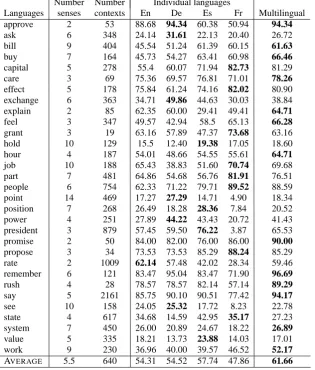
For these 30 ambiguous words, we also extract their WordNet definitions for all their senses, for a total of 173 definitions. All these definitions are then trans-lated into the three languages, and we apply the sim-plified Lesk algorithm on each individual language. We evaluate the performance of the algorithm for each language, by determining the number of times that the correct word sense is selected for each of the 19,200 contexts. Finally, we create and evaluate a meta sense classifier, which for each sense chooses the sense that was selected by most of the individual language classi-fiers, using a random sense selection to break the ties. Table 2 shows the results obtained for the individual words, along with the overall results calculated as the micro-average over all 30 words.
6. Discussion
As seen in Table 2, the combination of four languages leads to significant improvements with respect to the accuracy obtained for the individual languages, result-ing in an error rate reduction of up to 26%. This result demonstrates the usefulness of using a multilingual space for WSD, which is inline with previous find-ings concerned with the use of multilingual features for other language processing tasks, including super-vised WSD (Banea and Mihalcea, 2011) and subjec-tivity analysis (Banea et al., 2010).
To place results in perspective, we calculate an unsu-pervised baseline, determined by randomly selecting a sense for each context, which results in an accuracy of 22.29%. Compared to this baseline, the results ob-tained for all the individual languages are significantly better.
As a reference, we also calculate the accuracy ob-tained with the most frequent sense heuristic, deter-mined as 64.0%. It is important to note that this is a supervised algorithm, as it relies on sense annotated corpora, and thus it is not directly comparable with our fully unsupervised method.
By looking at the results, we observe that the indi-vidual systems for the English, German, and Spanish models perform well (55%-57%), however the French model seems to perform poorly in comparison. We investigated this outlier and identified the translation quality as a possible cause for this weaker perfor-mance. Given the fine granularity of some of the word senses, the distinction between senses becomes even more difficult in another language. This effect could be accentuated for languages with lower translation quality. If one takes the number of internet users as an indicator for the corpora size available on the web,
there are 153 million users utilizing Spanish as their language, versus 75 million for German and 60 mil-lion for French, 2 potentially corresponding to less data available for producing English-French transla-tions.
7. Conclusions
In this paper, we introduced a method for unsuper-vised WSD that relies on multilingual representations. We extend the Lesk algorithm to other languages, and combine the knowledge drawn from multiple WSD systems covering several languages. Through experi-ments on a SEMEVALdataset, we show that the use of a multilingual space can lead to up to 26% error rate reduction as compared to a monolingual WSD system.
Acknowledgments
This material is based in part upon work supported by the National Science Foundation CAREER award #0747340 and IIS award #1018613. Any opinions, findings, and conclusions or recommendations ex-pressed in this material are those of the authors and do not necessarily reflect the views of the National Sci-ence Foundation.
8. References
C. Banea and R. Mihalcea. 2011. Word sense dis-ambiguation with multilingual features. In Interna-tional Conference on Semantic Computing, Oxford, UK.
C. Banea, R. Mihalcea, J. Wiebe, and S. Hassan. 2008. Multilingual subjectivity analysis using ma-chine translation. In Proceedings of the Conference on Empirical Methods in Natural Language Pro-cessing (EMNLP 2008), Honolulu, Hawaii.
C. Banea, R. Mihalcea, and J. Wiebe. 2010. Multi-lingual subjectivity: Are more languages better? In Proceedings of the 23rd International Conference on Computational Linguistics (Coling 2010), pages 28–36, Beijing, China, August.
J. Cowie, L. Guthrie, and J. Guthrie. 1992. Lexi-cal disambiguation using simulated annealing. In Proceedings of the 5th International Conference on Computational Linguistics (COLING 1992). I. Dagan and A. Itai. 1994. Word sense
disambigua-tion using a second language monolingual corpus. Computational Linguistics, 20(4):563–596.
M. Diab and P. Resnik. 2002. An unsupervised method for word sense tagging using parallel cor-pora. In Proceedings of the 40st Annual Meeting of the Association for Computational Linguistics (ACL 2002), Philadelphia, PA, July.
2http://www.internetworldstats.com/
Number Number Individual languages
Languages senses contexts En De Es Fr Multilingual approve 2 53 88.68 94.34 60.38 50.94 94.34 ask 6 348 24.14 31.61 22.13 20.40 26.72 bill 9 404 45.54 51.24 61.39 60.15 61.63 buy 7 164 45.73 54.27 63.41 60.98 66.46 capital 5 278 55.4 60.07 71.94 82.73 81.29 care 3 69 75.36 69.57 76.81 71.01 78.26 effect 5 178 75.84 61.24 74.16 82.02 80.90 exchange 6 363 34.71 49.86 44.63 30.03 38.84 explain 2 85 62.35 60.00 29.41 49.41 64.71 feel 3 347 49.57 42.94 58.5 65.13 66.28 grant 3 19 63.16 57.89 47.37 73.68 63.16 hold 10 129 15.5 12.40 19.38 17.05 18.60 hour 4 187 54.01 48.66 54.55 55.61 64.71 job 10 188 65.43 38.83 51.60 70.74 69.68 part 7 481 64.86 54.68 56.76 81.91 76.51 people 6 754 62.33 71.22 79.71 89.52 88.59 point 14 469 17.27 27.29 14.71 4.90 18.34 position 7 268 26.49 18.28 28.36 7.84 20.52 power 4 251 27.89 44.22 43.43 20.72 41.43 president 3 879 57.45 59.50 76.22 3.87 65.53 promise 2 50 84.00 82.00 76.00 86.00 90.00 propose 3 34 73.53 73.53 85.29 88.24 85.29 rate 2 1009 62.14 57.48 42.02 28.34 59.46 remember 6 121 83.47 95.04 83.47 71.90 96.69 rush 4 28 78.57 78.57 82.14 57.14 89.29 say 5 2161 85.75 90.10 90.51 77.42 94.17 see 10 158 24.05 25.32 17.72 8.23 22.78 state 4 617 34.68 14.59 42.95 35.17 27.23 system 7 450 26.00 20.89 24.67 18.22 26.89 value 5 335 18.21 13.73 23.88 14.03 17.01 work 9 230 36.96 40.00 39.57 46.52 52.17 AVERAGE 5.5 640 54.31 54.52 57.74 47.86 61.66
Table 2: Disambiguation accuracy for the unsupervised WSD method. Results are shown for the individual languages, and for the combined method that includes all languages.
M.E. Lesk. 1986. Automatic sense disambiguation using machine readable dictionaries: How to tell a pine cone from an ice cream cone. In Proceedings of the SIGDOC Conference 1986, Toronto, June. C. Li and H. Li. 2002. Word translation
disambigua-tion using bilingual bootstrapping. In Proceedings of 40th Annual Meeting of the Association for Com-putational Linguistics, Philadelphia, Pennsylvania. R. Mihalcea, R. Sinha, and D. McCarthy. 2010.
Semeval-2010 task 2: Cross-lingual lexical substi-tution. In Proceedings of the ACL Workshop on Se-mantic Evaluations, Uppsala, Sweden.
G. Miller. 1995. Wordnet: A lexical database. Com-munication of the ACM, 38(11).
R. Navigli and S. Ponzetto. 2010. Babelnet: Build-ing a very large multilBuild-ingual semantic network. In Proceedings of the 48th Annual Meeting of the As-sociation for Computational Linguistics, Uppsala, Sweden.
H.T. Ng, B. Wang, and Y.S. Chan. 2003. Exploiting parallel texts for word sense disambiguation: An empirical study. In Proceedings of the 41st Annual
Meeting of the Association for Computational Lin-guistics (ACL 2003), Sapporo, Japan, July.
S. Pradhan, E. Loper, D. Dligach, and M. Palmer. 2007. Semeval-2007 task-17: English lexical sam-ple, srl and all words. In Proceedings of the Fourth International Workshop on Semantic Evaluations (SemEval-2007), Prague, Czech Republic, June. P. Resnik and D. Yarowsky. 1999. Distinguishing
systems and distinguishing senses: new evaluation methods for word sense disambiguation. Natural Language Engineering, 5(2):113–134.
F. Vasilescu, P. Langlais, and G. Lapalme. 2004. Evaluating variants of the Lesk approach for dis-ambiguating words. In Proceedings of the Con-ference of Language Resources and Evaluations (LREC 2004), Lisbon, Portugal.