Design and Data Collection for Spoken Polish Dialogs Database
Krzysztof Marasek, Ryszard Gubrynowicz
Department of Multimedia
Polish-Japanese Institute of Information Technology Koszykowa st., 86, 02-008 Warsaw, Poland
[email protected], [email protected]
Abstract
Spoken corpora provide a critical resource for research, development and evaluation of spoken dialog systems. This paper describes the telephone spoken dialog corpus for Polish created by Polish-Japanese Institute of Information Technology team within the LUNA project (IST 033549). The main goal of this project is to create a robust natural spoken language understanding (SLU) toolkit, which can be used to improve the speech-enabled telecom services in multilingual context (Italian, French and Polish). The corpus has been collected at the call center of Warsaw Transport Authority, manually transcribed and richly annotated on acoustic, syntactic and semantic levels. The most frequent users’ requests concern city traffic information (public transportation stops, routes, schedules, trip planning etc.). The collected database consists of two parts: 500 human-human dialogs of approx. 670 minutes long with a vocabulary of ca. 8000 words and 500 human-machine dialogs recorded via the use of Wizard-of-Oz paradigm. The syntactic and semantic annotation is carried out by another team (Mykowiecka et al.,2007). This database is the first one collected for spontaneous Polish speech recorded through telecommunication lines and will be used for development and evaluation of automatic speech recognition (ASR) and robust natural spoken language understanding (SLU) components.
1.
Introduction
Speech and language understanding forms an essential component in the design of spoken dialog systems. The integration of automatic speech recognition and spoken language understanding technologies is crucial for development of user friendly dialog systems. The Polish-Japanese Institute of Information Technology (PJIIT) is involved in preparation of a database for advancing and evaluatingresearch and development of such systems using multi-language approach. The work presented is conducted within the LUNA (IST 033549) project (www.ist-luna.eu), which started in September 2006 as a STREP project within the 6th framework of the EU. The main goal of this project is to create a robust natural spoken language understanding (SLU) toolkit which can be used to improve the speech-enabled telecom services in multilingual context (Italian, French and Polish). The project consortium involves academic (RWTH Aachen, University of Trento, University of Avignon, Institute of Computer Science Polish Academy of Science and PJIIT) as well industrial partners (CSI-Piemonte, France Telecom R&D and Loquendo acting as the project coordinator). One of the central goals of the LUNA is to develop language-independent SLU tools. The multilingual portability of SLU components will be designed along with the communication protocols.
2.
Dialog domains
The main goal of corpus collection was to provide a valuable resource for research in speech recognition, spoken language understanding, dialog management, machine learning, and language generation, especially for preparing and testing of LUNA project outcomes. The whole database will be composed of two parts – human-human dialogs and human-machine. The
“Wizard of Oz” (WoZ) approach (Fraser&Gilbert, 1991) for gathering simulated human-machine dialog data is now being applied. We decided to collect the data at real call center to provide realistic data and insight into spontaneous dialogs.
Following this, the corpus of dialogs was collected at the Warsaw Transport Authority information center known as ZTM Service Center. Its telephone number is posted on all city transportation line stops in the city and within the vehicles.
The domain of dialogs recorded at the city transport call center is defined by the quite complex structure of the Warsaw public transport (numerous lines of trams, buses, city trains and one underground line). The surface lines are named by numbers (trams 1-46, busses 100-809 or letter-number combinations for night and special lines, together 328 lines) and their stops are named according to the places, street crosses, local buildings and public facilities, usually supplemented by a number to distinguish several stops located close to a given point (e.g. Dworzec Centralny 05, Central Railway Station 05).
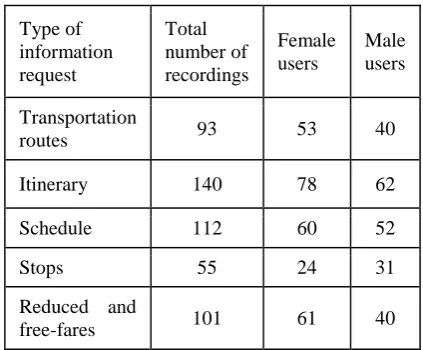
The user’s requests are balanced around five main
groups:
- information requests on the itinerary between given points in the city;
- timetable for a given stop and given line and the travel time from given stop to destination;
- information on line routes, type of bus, tram (e.g. wheelchairs allowed);
- information on stops (the nearest
; - information on fares, their reductions and fare-free transportation for specified groups of citizens (children, youth, seniors, disabled persons, etc.).
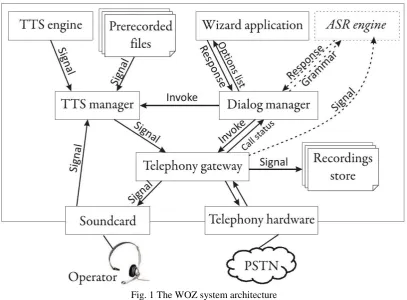
wishes and depending on his answers switched the dialog to the next step at which a new request is synthesized, simulating an action of an automated dialog system. Instead of ASR part (Fig.1) a menu driven application was used. Through mouse click on a simple wizard prompt and response panels the operator could choose the most appropriate answer or ask for
additional information from a user. An operator can also ask a user for repetition. At each dialog step the user can ask for human operator’s help and operator can break the WOZ mode of operation switching to human-human conversation. All speech activities are recorded in a separate file for each call.
Fig. 1 The WOZ system architecture
6.
Discussion
An important question is how the WOZ system should simulate accurately a real dialog system. The target system is a real SLU system (with an automatic speech engine) referred to city transport information service. If the WOZ should simulate an advanced SLU system, which has a flexible dialog management system, the problem of accurate simulation is a complex task, especially for Polish language. However, there are some benefits of adopted WOZ approach, between them it gives information how users would like to interact with a system, both in terms of dialog strategy and language. Although we used a partially strict approach, which is very constraining this strategy, the user is not aware of the system limitations initially and only gradually tends to restrict his/her input commands to get the system to work.
We observed that the users, although they were advised at the very beginning they had to do with an automatic system, they often do not took it into account because they dialed the normal phone number of the call center. For this reason, the dialogs started hardly with many pauses, hesitation marks or WOZ repetitions. The mean durations of recorded dialogs is about 40-50% greater
than in case of human-human communication, even though limited vocabulary and dialog language.
Yet another observation is a quite low acceptance of automated service. From 844 calls recorded, only 459 actually used the WOZ system. The rest wanted to either immediately speak to the operator, or waited silently for the operator to respond, ignoring the system altogether (Koržinek et al., 2008).
7.
Conclusions
In current spoken dialog systems, the design of user interfaces strongly depends on tasks and domains. In LUNA project the main objective is to develop a general purpose spoken dialog system being language independent and of multi-domain application. Up to now, we have constructed for Polish an example of database by first collecting human-to-human and human-machine dialogs and converting speech to text.
LUNA's research results will be validated on different application scenarios, targeted to dialogue-based telephone services of different complexity (e.g. from call routing with utterance classification to dialogue systems with complex semantic domains). The SLU models will be trained and applied to different multilingual spoken dialog systems in French, Italian and Polish.
8.
Acknowledgements
Authors would like to thank the Warsaw Transportation Authority (ZTM Warszawa) and its call center employees for their support and cooperation.
This project is supported by EC LUNA project (IST033549).
9.
References
Fraser, N.,Gilbert, N.S. (1991). Simulating speech systems. Computer Speech and Language, 5:81-99. Koržinek D., Brocki Ł., Gubrynowicz R. and Marasek
K. (2008). Wizard of Oz Experiment for a
Telephony-Based City Transport Dialog System. In Proceedings of the 16th Int. Conference Intelligent Information Systems,Zakopane, Poland (in print) Rodriguez K.J., Dipper S., Götze M., Poesio M,
Riccardi G., Raymond C. and Wiśniewska J. (2007). Standoff Coordination for Multi-Tool Annotation in a Dialogue Corpus. In Proc. of the Linguistic
Annotation Workshop at the ACL'07 (LAW-07),
Prague, Czech Republic, 2007
C. Barras, E. Geoffrois, Z. Wu, and M. Liberman, Transcriber: development and use of a tool for assisting speech corpora production, Speech Communication special issue on Speech Annotation and Corpus Tools, Vol. 33, No 1-2, January 2000 Mykowiecka A., Marasek K., Marciniak M.,