Building Concept Frames based on Text Corpora
Birte L¨onneker
Institute of Romance Languages Hamburg University
Von-Melle-Park 6, 20146 Hamburg, Germany [email protected]
Abstract
Linguists have been using different kinds of frame representation since the emergence of the notion “frame”. The main goal of the annotation system described in this paper is to provide an interactive and easy-to-use tool for structuring concept-specific information in linguistic frames for discourse analysis or cultural studies. These frames take into account background or “world” knowledge associated with the concepts, which is not necessarily present in lexicographic frames. A frame hierarchy providing default information, example texts containing specific information on a concept, and the annotations made by a user are combined together in one database. All frames have a predefined structure, and the information they contain is represented in natural language. The collected information can also be used as input to knowledge bases, or for defining patterns for Information Extraction.
1.
Introduction
Linguists have been using different kinds of frame rep-resentation since the emergence of the notion “frame” in Minsky (1975). The main fields in which linguistic frames play a role are discourse analysis (van Dijk, 1987; Klein & Meißner, 1999), etymology and metonymy (Blank, 1999; Koch, 1999) and lexicography (Konerding, 1993; Fillmore, Wooters & Baker, 2001). The main goal of the annotation system described in this paper is to provide a tool for struc-turing concept-specific information in frames for discourse analysis and metonymy or metaphor studies. These frames take into account background or “world” knowledge asso-ciated with the concepts, which is not necessarily present in lexicographic studies like FrameNet (cf. Fillmore, Wooters & Baker (2001)).
The propositional frames produced with our tool can be used in sociological or cultural studies, or as input to knowledge bases and text generation systems. Working with corpora enables the users to encode knowledge that does not reflect their own culture. Furthermore, the combi-nation of a frame hierarchy, the annotations made, and the underlying example texts in one database offers new pos-sibilities of detecting patterns for Information Extraction. The combination of annotated propositions with the exam-ple texts allows to detect co-occurrences of frame informa-tion. The tool we developed can be used without having to learn a logical language. Annotations are made in natural language, according to a special frame structure.
The remainder of the paper is structured as follows: Section 2. presents the frame structure and the top hierar-chy of frames used by the tool. In section 3., the annotation tool itself is explained and situated in the process of corpus collection and information gathering. Section 4. describes related work, and section 5. is the conclusion.
2.
Prerequisites: structure and hierarchy of
concept frames
The concept frames in our system are propositional frames. They are centered around a concept name, a noun, which can refer to “things” or “events” (“continuants” or
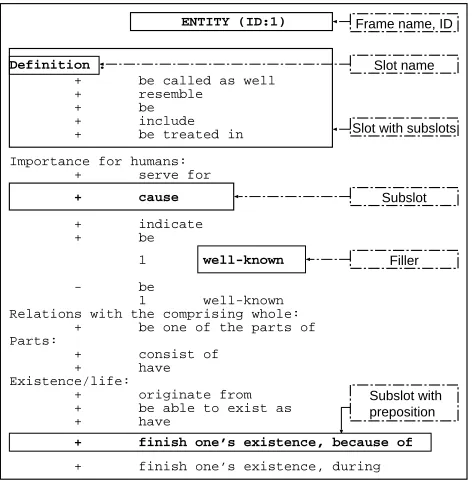
“occurrents”, cf. Guarino (1997)). In a simplistic view, the propositions are formed of the frame name as the subject, the subslot name as the predicate, and the filler name as the object of a sentence. In subsection 2.1., we give a more detailed presentation of the structure of the concept frames used in the system. Subsections 2.2. and 2.3. explain, re-spectively, the default information contained in the system, and how frames are arranged into a hierarchy.
2.1. A structure for concept frames
Since Minsky’s (1975) first proposal of frames, the frame idea has been used and further developed for various areas (cf. L¨onneker (2001)). Fillmore’s sentence frames (cf. e.g. Fillmore (1968)), whose center of interest are the verb and its “case roles”, have further been developed to more complex and abstract frames or “scenarios” (Fillmore, Wooters & Baker, 2001) being a background for diverse lexicalizations focusing on different aspects of the frame. In addition to Fillmore’s frames, propositional and graph-ical frames are used in linguistics. Propositional frames consist of a list of propositions about a concept, graphi-cal frames display frame elements and relationships or net-works of frames in diagrams. In some graphical frames, all relations (those between “frame elements” or fillers as well as those between a frame and its “elements”) are supposed to be “contiguity relations”, and are not further differenti-ated (Koch, 1999; Blank, 1999).
In order to have a common and clear structure for propo-sitional frames, we extended the frame structure of the Generic Frame Protocol (Karp, Myers & Gruber, 1995) used for knowledge representation tasks. Our concept frames consist of the following parts:
a frame name, which is a noun or a nominal phrase (e.g., “entity”);
slots (“aspects” of the concept), named by nouns or nominal phrases (e.g. “existence”), grouping
Entity
Occurrent/ Event Continuant
Role/Viewpoint on Entity
Primary Object
Object Inst./Soci-al Group
Matter Person
w. Role Whole State
Part Artefact
Person w. Profession
Orga-nism Action
Figure 2: Frame hierarchy based on Konerding (1993).
A ROLE, PERSON WITH A PROFESSION and AR-TEFACT in the hierarchy is problematic. The word “object” is highly polysemous and is also used in the names of higher-level frames. The names of the other problematic frames are lexicalized only in very spe-cific areas, if at all. In our hierarchy, these frames are at the same level as other, lexicalized items (cf. the dotted line in figure 2). The annotation of some of their subframes will show whether they have to be “lifted up” in the hierarchy, melted together or re-placed.
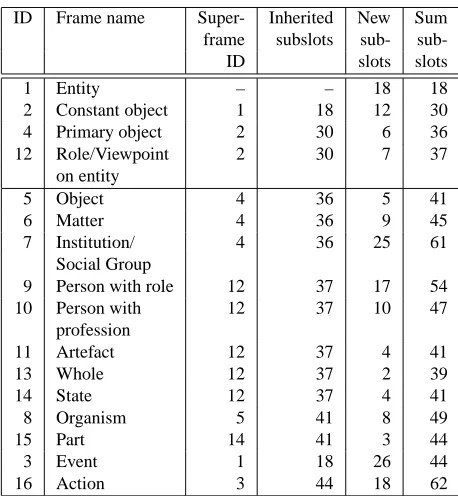
The frames of our hierarchy are potential superframes for subframes to be annotated. During the annotation of a new subframe, all the lexical information contained in the superframe is available to the user: He can reuse all sub-slots and fillers defined in the superframe. This advantage mainly concerns subslots up to now. The number of prede-fined subslots (inherited and new ones) in each frame can be found in table 1. For the less abstract frames, which are most likely to be chosen as superframes for concepts to an-notate, the predefined subslots range between 40 and 60. It is of course also possible to directly annotate the lexicalized frames of the hierarchy; however, it seems more useful to derive the most often used fillers from their subframes.
Concluding this section, we can summarize that we have set up a detailed structure for propositional frames, as well as a hierarchy of frames containing default infor-mation, which is represented in natural language entities. The default information is available for inheritance and an-notation. The hierarchy itself relies on this natural language information.
3.
Using the annotation tool
Our annotation tool provides the user with an inter-active interface for gathering concept-specific information that will be stored in a database. All information about a concept is arranged into the propositional frame structure explained in section 2.1. In our current work, the informa-tion relies on text resources that are collected on the
inter-ID Frame name Super- Inherited New Sum frame subslots sub-
sub-ID slots slots
1 Entity – – 18 18
2 Constant object 1 18 12 30
4 Primary object 2 30 6 36
12 Role/Viewpoint 2 30 7 37
on entity
5 Object 4 36 5 41
6 Matter 4 36 9 45
7 Institution/ 4 36 25 61
Social Group
9 Person with role 12 37 17 54
10 Person with 12 37 10 47
profession
11 Artefact 12 37 4 41
13 Whole 12 37 2 39
14 State 12 37 4 41
8 Organism 5 41 8 49
15 Part 14 41 3 44
3 Event 1 18 26 44
16 Action 3 44 18 62
Table 1: Number of default subslots per frame.
in-Think of a concept
Annotations for examples concerning the concept
Wrapper WWW, Search engine Web
pages
Example extractor Examples and
meta data
Tool for annotating the examples
Top level frames
Output scripts
Concept frame for chosen concept
Annotations for one exam-ple in frame structure
Figure 3: Context of the annotation tool.
formation.
3.1. Context
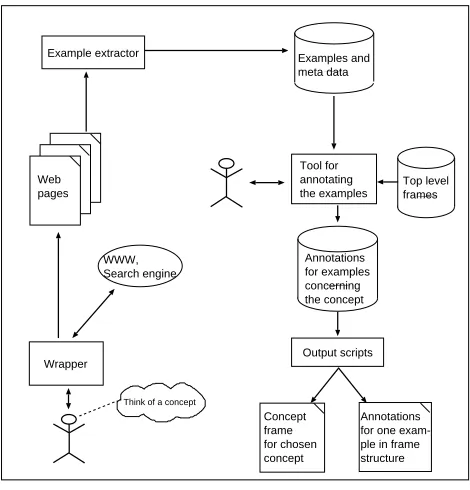
Figure 3 shows the context in which the annotation tool is used.
The text examples to be annotated are first collected from the internet (see left hand side of the figure) and writ-ten into a database. The concept for which a frame is to be established has to be defined by the user at the beginning of the collection phase. Among other parameters, he has to define at least one search string or regular expression which is likely to refer to the chosen concept. The example extrac-tor splits the web pages collected by the wrapper into small pieces (e.g. paragraphs, list entries), each of them contain-ing at least one occurrence of the specified search strcontain-ing. From these text portions, further referred to as examples, it will be easy for the user to extract propositions about the concept.
The annotation tool (see right hand side of figure 3) dis-plays one example after another and asks the user to anno-tate them. It uses the information contained in the top level frames. The user can extend the hierarchy. Annotations are done in various steps using a web browser as graphical user interface (cf. subsection 3.2.). The annotations are written into the database as new frame information and can be dis-played in various layouts (cf. subsection 3.4.).
3.2. Steps of the annotation process
During the annotation process, the user is confronted with an example (a portion of text) in which—due to the way in which the examples are collected—some informa-tion on the analyzed concept can be found. The annotainforma-tion is performed in the following steps:
1. The example, together with some meta-information on where and when it has been collected, is displayed, as
List of available frame names
Selected frame name
Metainformation on the example Example
Figure 4: Selecting a frame for an example text.
Number of new subslots to be defined Example
Slot names
List of available subslots
Figure 5: Annotating subslots.
shown in figure 4. In the example, some words are written in bold characters. Those words matched the search string or regular expression of the collecting phase and are most likely to refer to the concept for which the user wants to build a frame.
The frame name is selected from a list of known frames. It is possible to select more than one frame name, if the same example is to be used for the anno-tation of different frames. If the name of the needed concept frame is missing from the list, the frame can be created by the user as a subframe of one of the ex-isting frames. It has to be given a name, and its super-frame has to be chosen from the list of known super-frames.
2. The relations expressed in the example or inferred from it can be chosen for annotation from a concept-specific set of subslots (cf. figure 5). This list contains only those relations, in the guise of subslots, that have been defined as suitable for the concept frame or one of its superframes.
New fillers in 2 languages
Modifiers for fillers Slot name
Subslot name
Figure 6: Defining new fillers.
enters the number of subslots per slot that he wants to create, as shown in figure 5. He will then be pre-sented a form in which he defines a boolean value, a verb, and possibly a preposition for the new subslot(s). From then on, they are available in the subslot list for annotations of that frame.
3. In the last step, the user is shown the example together with the frame name(s) and the subslot(s) he chose for annotation. For each subslot, he can choose from a list the filler names for the connected concepts that he finds in the text. The available fillers are those which are known to the system as possible fillers for this sub-slot in this frame or in one of its superframes.
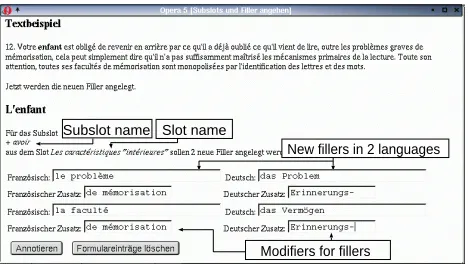
If a filler name is missing from the list, the filler can be added analogously to step 2. There are two fields for each filler, the first one for the noun and the sec-ond one for modifiers of this noun, like adjectives or prepositional phrases. Figure 6 shows how two new fillers are defined in two languages in parallel.
All information once defined by the user will automati-cally be available for direct selection during the annotation of further examples. This decreases the time needed for annotation of examples belonging to the same frame.
It has to be stressed that the information to be annotated might be contained quite implicitly in the example text, so that it is extremely helpful for the user to have some “de-fault information” to choose from. This is especially the case for the relations. In many cases, it is easy to detect that the text relates the concept frame to another concept in some way, but a verb or verbal phrase that expresses the relation is not explicitly present in the text. This is why the slots and subslots inherited by the top level frames are the most important default information in our system. Among them, the user might find the relation that is implicit in the example text. This issue is illustrated by some example an-notations in the next subsection.
3.3. Examples and discussion
The examples in table 2 (see next page) illustrate that re-lations are expressed more or less explicitly in the text, and rarely by a verb. The French example texts have been taken from annotations concerning the CHILD frame, where they had been annotated with the subslot “+ ˆetre l’une des parties
de” (“+ be a part of”). In the first row, the example text ex-tracted from the internet is shown. The second row contains a translation of the example into English. The third row in-dicates the filler of the subslot that is expressed in the exam-ple. In the first two examples, the relation is expressed by the (more specialized) verb-preposition combinations “ap-partenir `a” (“belong to”) and “grandir au sein de” (“grow up in”). These verbs are more specialized than the verb phrase “ˆetre l’une des parties de” used in the annotation. The other examples show: an enumeration of the “subgroup” (chil-dren) and the group they belong to (example 3), an explicit specification (“en particulier”) of the group to which chil-dren can belong (example 4), and a preposition introducing the name of the comprising group (example 5) as means for expressing the relation.
We annotated 50 examples for this frame and this sub-slot, in which the “+ be a part of”-relation is very rarely ( 10%) expressed by verbs. Other means like enumera-tions and preposienumera-tions (in various forms) are not specific to this relation, but can also indicate other subslots like “+ avoir” (“+ have”), “+ inclure” (“+ comprise”). Further-more, the constructions indicating the subslot “+ ˆetre l’une des parties de” in the examples in table 2 are not the only ones encountered. These are the reasons why we do not try to annotate the examples automatically. Our annotations can, however, be useful for defining rules or patterns to au-tomate some of the annotations in the future. In order to do so, possible relations or subslots for the analyzed con-cept will have to be known, and rules or patterns have to be defined for preprocessed texts, as usual in Information Ex-traction. Definitions for rules have to be based on previous annotations. Because of the “overlap” of some construc-tions just mentioned, the automatic extraction will reach neither the precision nor the recall of the human annota-tor. As a first step, we are concentrating on revising and refining the valid subslots for the superframes in our frame hierarchy on the basis of our annotations.
Concerning the annotations shown in table 2, a remark has to be added on the status of the fillers. We encode ev-ery proposition about the concept, also those that do not seem to express “typical” information. The typicality of the fillers and propositions, or their prominence in discourse, can only be quantified after a large number of annotations. This is why the example number 1 of table 2 (“Children be-long to minority groups”) has to be annotated in spite of its obvious or apparent marginality.
Until now, the tool has been used to annotate frames for the following concepts: NATURE, ADVENTURE, DAN-GER, and CHILD. This is a chain of frame and filler names (ADVENTURE is one of the fillers of the NATURE frame, and so on). The concept NATURE has been annotated with three different superframes (“roles”). Table 3 shows the number of examples collected for these concepts, and the number of propositions encoded in the database.
3.4. Displaying annotations and frames
Example Text Translation Filler, Modifier 1 [. . . ] besoins linguistiques des enfants [. . . ] linguistic needs of autochthone le groupe,
autochtones ou appartenant `a un groupe children or of children minoritaire
minoritaire belonging to a minority group
2 aide au d´eveloppement des enfants qui help for the development la famille, grandissent principalement au sein de of children who mainly grow up monoparental familles monoparentales [. . . ] in monoparental families [. . . ]
3 Enfant & famille Canada Child & family Canada la famille 4 Faire en sorte que tous les Proceed in such a way that la soci´et´e
groupes de la soci´et´e, en particulier all groups of the society, especially les parents et les enfants, rec¸oivent [. . . ] the parents and the children, get [. . . ]
5 Le mode de vie impos´e aux enfants The lifestyle imposed on children la soci´et´e, dans les soci´et´es d´evelopp´ees, [. . . ] in the developed societies, [. . . ] d´evelopp´e
Table 2: Examples and fillers for the subslot “+ ˆetre l’une des parties de” of the CHILD frame, in French
Concept name Number of Annotated examples propositions
NATURE 457 252
ADVENTURE 239 202
DANGER 197 132
CHILD 965 2022
Table 3: Number of examples and annotations.
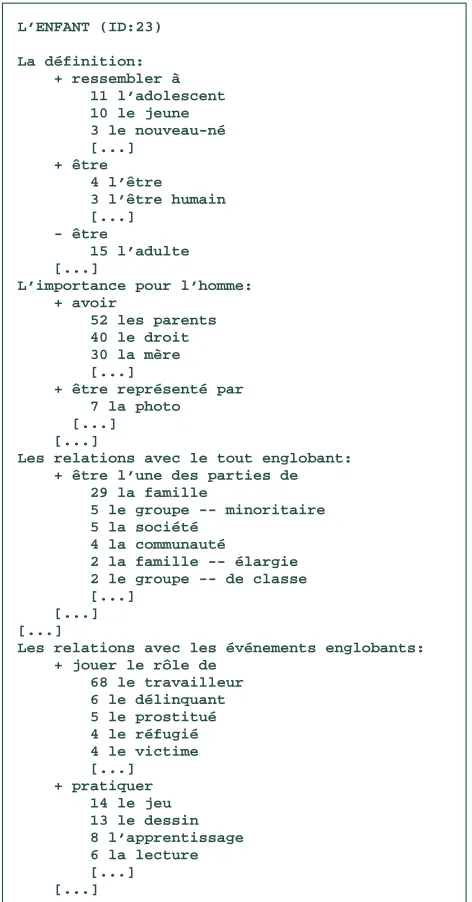
as many different fillers as found in the examples. These frames get so rich that it is impossible in this paper to show an example of an entire frame based on annotations. Fig-ure 7 (see next page) therefore shows only small parts of the CHILD frame that we have annotated (in French). The number in front of a filler shows how often we chose this filler in this subslot. So, if we want to show only the most “typical” propositions about the concept that were found in the corpus, we could fix a minimum number or percentage of occurrences.
Another script, displaying annotations regarding indi-vidual examples, is integrated into the graphical user inter-face. It can be used in order to verify the annotations, or to have an overview of all annotations for one example. Its output is displayed in figure 8 (see next page).
Many other scripts can easily be written using the SQL query language of the database. For example, we used SQL scripts displaying all fillers and examples of a given subslot (similar to the information contained in table 2), in order to analyze by which means the relation encoded in the subslot was originally expressed in the text examples.
We can also imagine that a program displaying co-occurring fillers or subslot-filler combinations is useful for finding out internal relations between fillers. For example, if one of the fillers is “victim”, in the example there might also be mentioned “of what”. So there should be a filler for the slot “to be afflicted by”. Do co-occurring subslot-filler combinations in the External characteristics or Inter-nal characteristics slot in these cases refer to causes or ef-fects of the victimhood? Another example is that of con-tradicting fillers or subslot-filler combinations: In this case, we could have a look at other fillers of the examples in order
to find out why this predication is subject to discussion.
4.
Related work
This section deals with two categories of related work: Ontology-orientated approaches (4.1.) and lexicographic resources (4.2.).
4.1. Ontological approaches
The large ontology and knowledge base Cyc2 aims at representing “all” the background knowledge people need in order to communicate. In addition, it contains more spe-cialized encyclopaedic knowledge. Much of the knowledge represented in Cyc was indirectly built on the basis of cor-pora. The knowledge enterers figured out what a reader of a desktop encyclopaedia or a newspaper had to know in or-der to unor-derstand the texts, and encoded this background knowledge in Cyc (Lenat & Guha (1990)). However, they did not link the encoded concepts to these corpora.
Automatic extraction of ontologies or other informa-tion from unstructured or semistructured texts requires pre-processing (syntactic parsing or Part-of-Speech-tagging). Rules for discovering a hierarchy or concepts and relation-ships based on the input texts have to be defined. ASIUM (Faure & N´edellec, 1998) and WebOntEx (Han & Elmasri, 2001) are systems that try to build ontologies from texts.
ASIUM (Faure & N´edellec, 1998) learns from syntac-tically parsed domain-specific texts which concepts are al-lowed to take which position in a verb frame. Nouns oc-curring in the same syntactical role after a given verb are grouped into basic clusters; these clusters are fused with similar clusters. In parallel, the subcategorization frames of the verbs are generalized. The new general cluster of nouns is validated and labeled by the user, which results in a domain relevant hierarchy of user-specified concept names subsuming the extracted nouns. No specific concept frames are built.
WebOntEx (Han & Elmasri, 2001) is supposed to semi-automatically extract domain ontologies from manually chosen web pages. It uses the tagging of the HTML source in order to identify the most relevant concepts appearing in the page. After Part-of-Speech-tagging, candidate concepts
2
L’ENFANT (ID:23)
La définition: + ressembler à 11 l’adolescent 10 le jeune 3 le nouveau-né [...]
+ être 4 l’être 3 l’être humain [...]
- être
15 l’adulte [...]
L’importance pour l’homme: + avoir
52 les parents 40 le droit 30 la mère [...]
+ être représenté par 7 la photo [...] [...]
Les relations avec le tout englobant: + être l’une des parties de 29 la famille
5 le groupe -- minoritaire 5 la société
4 la communauté
2 la famille -- élargie 2 le groupe -- de classe [...]
[...] [...]
Les relations avec les événements englobants: + jouer le rôle de
68 le travailleur 6 le délinquant 5 le prostitué 4 le réfugié 4 le victime [...] + pratiquer 14 le jeu 13 le dessin 8 l’apprentissage 6 la lecture [...] [...]
Figure 7: Small parts of the CHILD frame, in French.
Fillers attested in this example Frame name
Figure 8: Overview of an annotated example.
are extracted taking nouns as candidates for types, verbs for relations, and adjectives for attributes, following Chen (1983). The extracted information has thus to be explicitly present in the texts.
Prot´eg´e (Grosso, 1999) and OntoEdit3are tools that can be used to build knowledge bases. The knowledge to be entered is supposed to be “known” by an expert. If the user is not an expert, he can annotate a concept with our tool and choose the most relevant information for entering into one of the professional tools. An easy way to do so would be to define a certain threshold of number of occurrences for the fillers.
4.2. Lexical resources
Lexical resources mainly do not aim at representing “typical” or “world” knowledge. For example, in the French EuroWordNet4(Vossen, 1999), most of the relations
are hypernym relations. When annotating with our tool, a user is not bound to more or less conventional semantic re-lations between words, but he can define virtually any rela-tion between concepts using natural language.
FrameNet5(Fillmore, Wooters & Baker, 2001) is struc-tured according to cognitive principles and relies on a large general corpus. In the FrameNet approach, frames are tra-ditionally centered around a verb. Frame elements (corre-sponding mainly to “case roles” of that verb) are marked in the corpus and annotated. They have to be explicitly present in a sentence. The main aim of the example sentences is to illustrate the grammatical constructions in which the frame elements can be used, and not to quantify their occurrences: not every matching example in the corpus gets annotated.
The explanatory-combinatorial dictionary of French by Mel’cuk et al. (1984) lists words that can be used to re-late one word to another. The relations are represented as various “lexical functions”. For example, the value of the lexical function Oper (word) indicates the verb that cor-rectly relates the first agent to the situation denominated by word, where the agent is the grammatical subject of a sen-tence and the situation is the direct object. As one of the values of the function Oper (envie) is avoir, we know that we are allowed to define “envie” (“desire”) as one of the fillers of a subslot with the verb “avoir” (“have”), attached to a frame which refers to the agent. Information of this “functional” kind is thus also contained in our frame system (as well as in the FrameNet data). A frame with some an-notated subslot-filler entries, however, contains even more information, as for example it could say who typically has a desire, or even who typically has the desire for what.
5.
Conclusions and future work
We have explained the background and use of an an-notation tool for concept frames based on corpora. In or-der to store and provide reusable information, the frames have a common structure and are arranged in a hierarchy. Some default information is associated with the upper lev-els of this hierarchy and can be used for annotating their3
http://www.ontoprise.de
4
http://www.hum.uva.nl/˜ewn
5
subframes. The user can enter new information, which will then be available for further annotations. The names of frames, slots, subslots and fillers are defined in natural language, according to the given frame structure.
The tool is easy to use because it does not expect the user to have any knowledge of logic or formal ontologies. The resulting frames contain typical knowledge about the analyzed concepts and can be further used in discourse analysis and cultural studies. After a transformation which has to filter out the slot level of the frame structure, they can also be used as extension to existing knowledge bases. Until now, the tool has been used to annotate frames for the concepts NATURE (in different “roles”), ADVENTURE, DANGER, and CHILD.
The encoded propositions represented in the frames are inferred by the user from text examples collected from the internet. In the collection phase, the user has to define some values for parameters in order to get a corpus of examples containing information on the concept. The examples are stored in the same database together with the default frame information and the annotations. This combination allows of two further research possibilities:
1. Find out internal regularities in filler- or subslot-filler-combinations of frames (“co-occurrences” of fillers) and on which cognitive principle they might be built.
2. Look at the examples in order to find heuristic rules for automatically extracting some of the subslot-filler combinations. This task is extremely difficult if you want to infer the subslot from a text in which it is not explicitly mentioned as a verb.
We plan to build subframes for each of the lower frames in our frame hierarchy in order to verify and refine the de-fault slots and subslots of the upper frames. We are also working on the two research issues mentioned above.
6.
Acknowledgements
This work is funded by a Hamburg University grant and was repeatedly supported by the Hansische Univer-sit¨atsstiftung.
7.
References
A. Blank. 1999. Co-presence and Succession. A Cogni-tive Typology of Metonymy. In K.-U. Panther and G. Radden (eds.), Metonymy in Language and Thought (= Human Cognitive Processing, V. 4), pp. 169–191. Ams-terdam/Philadelphia: John Benjamins.
P. P. Chen. 1983. English Sentence Structure and Entity-Relationship Diagrams. Information Sciences 29:127– 149.
T. A. van Dijk. 1987. Communicating Racism. Newbury Park: Sage.
D. Faure & C. N´edellec. 1998. A Corpus-based Con-ceptual Clustering Method for Verb Frames and Ontol-ogy Acquisition. Proceedings of the LREC workshop on Adapting lexical and corpus ressources to sublanguages and applications, 5–12.
C. Fillmore. 1968. The Case for Case. In E. Back and R. T. Harms (eds.), Universals in Linguistic Theory, pp. 1-90. New York: Holt, Rinehart & Winston.
C. J. Fillmore, C. Wooters & C. F. Baker. 2001. Build-ing a Large Lexical Databank Which Provides Deep Semantics. Proceedings of the Pacific Asian Confer-ence on Language, Information and Computation. Avail-able http://framenet.icsi.berkeley.edu/˜framenet/papers/ dsemlex16.pdf.
W. E. Grosso. 1999. Knowledge Modeling at the Millen-nium. The Design and Evolution of Prot´eg´e-2000. Stan-ford University, StanStan-ford Medical Informatics. Available http://smi-web.stanford.edu/pubs/SMI Abstracts/SMI-1 999-0801.html.
N. Guarino. 1997. Semantic Matching: Formal Ontolog-ical Distinctions for Information Organization, Extrac-tion, and Integration. In M. T. Pazienza (ed.), Informa-tion ExtracInforma-tion, pp. 139–170. Berlin: Springer.
H. Han & R. Elmasri. 2001. Architecture of WebOntEx: A System For Semi-Automatic Extraction Of Ontologies From Web Pages. Proceedings of the World Multiconfer-ence on Systemics, Cybernetics and Informatics, X:81– 86.
P. D. Karp, K. L. Myers & T. Gruber. 1995. The Generic Frame Protocol. Proceedings of the 1995 International Joint Conference on Artificial Intelligence, 1:768–774. J. Klein & Iris Meißner. 1999. Wirtschaft im Kopf.
Frank-furt a.M.: Lang.
P. Koch. 1999. Frame and Contiguity. On the Cognitive Basis of Metonymy and Certain Types of Word Forma-tion. In K.-U. Panther and G. Radden (eds.), Metonymy in Language and Thought (= Human Cognitive Process-ing, V. 4), pp. 139–167. Amsterdam/Philadelphia: John Benjamins.
K.-P. Konerding. 1993. Frames und lexikalisches Bedeu-tungswissen. T¨ubingen: Niemeyer.
D. B. Lenat & R. V. Guha 1990. Building large knowledge-based systems. Reading, MA: Addison-Wesley.
B. L¨onneker. 2001. The Frame Idea in Semantics and Knowledge Representation. Proceedings of the World Multiconference on Systemics, Cybernetics and Infor-matics, XIV:490–495.
I. A. Mel’cuk et al. 1984. Dictionnaire explicatif et com-binatoire du franc¸ais contemporain. Recherches lexico-s´emantiques 1. Montr´eal: PUM.
M. Minsky. 1975. A framework for representing knowl-edge. In P. H. Winston (ed.), The psychology of computer vision, pp. 211–277. New York et al.: McGraw-Hill. P. Vossen. 1999. EuroWordNet General Document.