CSEIT183178 | Received : 07 Jan 2018 | Accepted : 20 Jan 2018 | January-February-2018 [(3) 1 : 268-276 ]
International Journal of Scientific Research in Computer Science, Engineering and Information Technology © 2018 IJSRCSEIT | Volume 3 | Issue 1 | ISSN : 2456-3307
268
Kernel Based Intrusion Detection Using Data Mining Techniques
Shivalingari Bhanu Sree
PG Scholar, Department of IT, VNR Vignan Jyothi Institute of Engineering and Technology, Hyderabad , TS, India
ABSTRACT
From the onset of internet arrangement, protection menaces normally recognized as intrusions has return to be a highly important and demanding issue in internet arrangements, knowledge and information system. In this system to overcome these menaces every time a detection arrangement was requested because of extreme development in networks. within the growth of the arrangement, attackers came to be stronger and every single amount compromises the protection of the network.Hence a requirement of the Intrusion Detection arrangement came to be a very important and important instrument in net security. Detection and hindrance of such aggressions loud intrusions typically depends on the talent and potency of Intrusion Detection Arrangement (IDS). In this apporch number of component has been directed for using the methods, these systems have their own advantages and deficiencies”. Here mainly focusing on different classification methods. Keywords : Intrusion Detection, Anomaly Detection, Misuse Detection, KDD Cup99.
I.
INTRODUCTION
From past decades aboard fast progress within the web established data, new request spans for computer web have emerged. At the alike period, expansive vary progress within the LAN and WAN request spans in company, commercial, industry, protection and healthcare sectors made us extra reliant on the computer networks. All of these request spans made the web an associate appealing target for the mistreatment and huge vulnerability for the community. An interesting work to do or an attempt to realize action for a touch folks came to be a foul dream for the others. In unnumerable occurrence malicious deeds created this nightmare to come back to e a reality.
In addition to hacking, new entities like worms, Trojans and viruses gave extra panic into the net- worked society.As the present scenario could be a moderately new development,web armaments are
weak.Though, due to the recognition of computer net, their property and however, manufacturing dependency on them, knowledge of the menace will have desecrating consequences. Safeguarding such an important groundwork has return to be the priority one scrutiny span for unnumerable researchers.
reserved from a reliable protecting arrangement, although the main believed is to create it probable to note novel web attacks.
One of the main concerns is to create positive that just in case of associate intrusion endeavor, the arrangement is in a position to note and to report it. when the detection is reliable, the subsequent pace should to be to guard the online (response). In additional, the IDS arrangement will be upgraded to an associate Intrusion Detection and Reply Arrangement (IDRS). Though, no segment of the IDS is presently at a completely reliable level. Even nevertheless, researchers are unit at the same time involved in working each detection and answer factions of the system. A main blow within the IDS is that the promise for the intrusion detection. A main issue in the IDS is to agreement for the intrusion detection.This is the cause why in numerous cases IDS employ the intrusion detection.During this methodology, IDS is really helping the online protection master and it is not valid enough to be sure in its own. The reason is the in- ability of IDS arrangements to notice the new or modified attack patterns. Even supposing the most recent method of the detection ways has enhanced the detection rate.However, there is an extended methodology to go.
There are 2 main ways in which for identifying intrusions, signature-based and anomaly-based intrusion detection. In the early method, attack outlines or the activities of the intruder is modeled(attack signature is modeled). Here the arrangement can gesture the intrusion when a match is detected. Though, within the subsequent neither method normal actions of the online is modeled. During this method, the arrangement can raise the alarm when the act of the online doesn't match aboard its traditional behavior. there's an added Intrusion Detection (ID) method that's loud specification-based intrusion detection. During this method traditional deeds (expected behavior) of the host is enumerated and after sculpturesque. . In this
way, manage worth for protection, freedom of procedure for the host is limited. In this paper, these ways will be briefly debated and compared.
The believed of possessing associate entrant accessing the arrangement lacking even having the ability to note it's the worst nightmare for every net protection officer. As the present ID data isn't correct masses to enhance a reliable detection, heuristic methodologies can be a way out. As for the last line of protection, and so as to cut the quantity of unseen intrusions, heuristic ways like Honey Jars (HP) may be deployed. Honey jars may be installed on every arrangement and act as mislead or decoy for a resource.
Another main issue during this survey span is that the speed of detection. Computer webs have a dynamic nature in a truly sense that knowledge and knowledge within them are unceasingly changing. Therefore, noticing associate intrusion exactly and duly, the arrangement has got to add real time. Working in the real period isn‟t merely to per-form the location in real period; but is to change to the new elements within the system. Real period operating IDS is associate alert scrutiny span pursued by countless researchers. Most of the scrutiny works are unit aimed to familiarise the foremost amount effectual methodologies. The aim is to create the requested methods suitable for the real period implementation.
firewalls, web routers or web switches as well as the client machines.
The paper focuses on the detection portion of the intrusion detection and reply drawback. Re- searchers have pursued disparate ways in which or a mixture of disparate ways in which to resolve this drawback. Every single way has its own theory and presumptions. This is so because their no precise activity ideal for the legitimate user, the intruder or the online itself.
II.
RELATED WORK
S. Duque and Omar [2] proposed a K-Mean clustering on NSL-KDD dataset. “The calculation is connected on various five groups. The best outcomes are acquired when 22 bunches were utilized. (74%),implementation measures are execution time (120ms) and memory use (54%)”. precision result is better i.e. 99% in this work. Both crossover approaches utilizes KDD'99 dataset”.
Liang and Nannan et al. [7] proposed a framework “which is blend of K-Mean and Fluffy C Mean (FCM) calculations to dispose of false positive from the dataset DARPA 2000. The finish of the work is the impact of FCM calculation is superior to anything that of K-Mean grouping”. Zhengjie and Yongzhong [8] proposed approach the “K-Mean and molecule Swarm Advancement strategy (PSO-KM). The recognition rate of known assaults is 75.82% and of obscure assaults is 60.8%”.
“To enhance the execution of SVM, Horng and Yang,et al. [9] one and half SVM with various leveled bunching.The BRICH progressive bunching calculation is utilized for addition choice system to dispose of immaterial highlights from dataset with the goal that SVM characterize the information all the more precisely. The precision rate of proposed framework is 95.72% and false positive rate is 0.7%”.
Classifier
Method
Parameters
Advantages
Disadvantages
hyperplane
is allotted to the
class
of
the
Bayesian Method Algorithm
rule.[13]
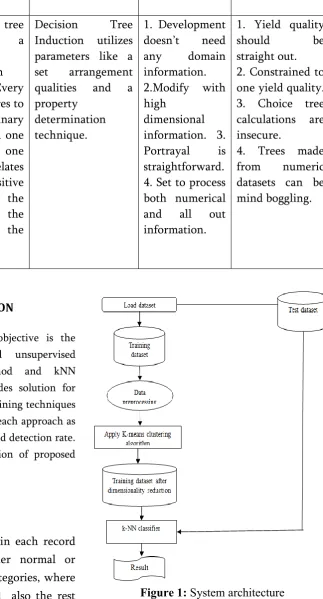
Decision tree
Decision
tree
constructs
a
binary
organization
tree. “Every
hub compares to
a
binary
establish on one
feature;
one
branch
relates
to the positive
samples of the
found and the
other to the
negative
cases”.[11]
Decision
Tree
Induction utilizes
parameters like a
set arrangement
qualities
and
a
property
determination
technique.
1. Development
doesn‟t
need
any
domain
information.
2.Modify with
high
dimensional
information. 3.
Portrayal
is
straightforward.
4. Set to process
both numerical
and
all
out
information.
1. Yield quality
should
be
straight out.
2. Constrained to
one yield quality.
3. Choice tree
calculations are
insecure.
4. Trees made
from
numeric
datasets can be
mind boggling.
III.
IMPLEMENTATION
In proposed approach,the major objective is the combination of supervised and unsupervised learning.K-mean clustering method and kNN classification method should provides solution for identify the anomalous data. Data mining techniques is to identify the intrusions and for each approach as different accuracy,false alarm rate and detection rate. Following figure shows the depiction of proposed work.
3.1. DATASET :
Dataset consists of 41 attributes in each record
and it contains of labels either normal or
anomalous.There are 5 unique categories, where
one shows standard conduct and also the rest
demonstrate assaults. Assaults are ordered as
Denial
of
service(DoS),
Probing(Prob),
Root2Local(R2L), and User2Root(U2R).
Figure 1:
System architecture
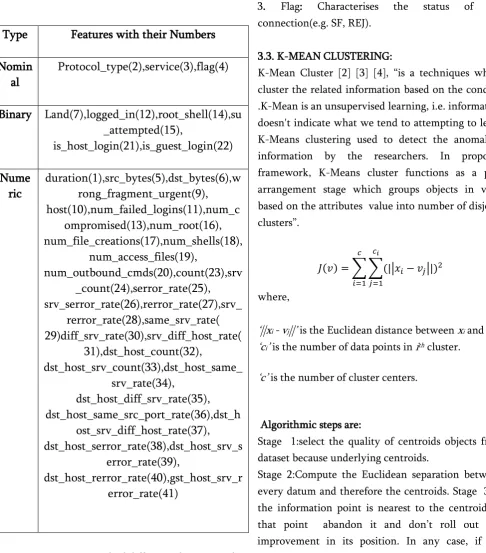
Table 1: Feature of KDD cup-99 Dataset and their types and numbers
In preprocessing method,different between the configuration of information, it is important to preprocess to convert the character information into numeric information. In KDD dataset, three features are symbolic. These are:
1. Protocol_type: Characterises the convention utilized as a part of the association (e.g. TCP, UDP).
2. Service: Characterises which goal arranges benefit utilized (e.g. Telnet, FTP).
3. Flag: Characterises the status of the connection(e.g. SF, REJ).
3.3. K-MEAN CLUSTERING:
K-Mean Cluster [2] [3] [4], “is a techniques which cluster the related information based on the conduct .K-Mean is an unsupervised learning, i.e. information doesn't indicate what we tend to attempting to learn K-Means clustering used to detect the anomalous information by the researchers. In proposed framework, K-Means cluster functions as a pre-arrangement stage which groups objects in view based on the attributes value into number of disjoint clusters”.
( ) ∑ ∑( | | )
where,
„||xi - vj||‟ is the Euclidean distance between xi and vj.
„ci‟ is the number of data points in ith cluster.
„c‟ is the number of cluster centers.
Algorithmic steps are:
Stage 1:select the quality of centroids objects from dataset because underlying centroids.
Stage 2:Compute the Euclidean separation between every datum and therefore the centroids. Stage 3: If the information point is nearest to the centroid, at that point abandon it and don‟t roll out any improvement in its position. In any case, if the information point isn't nearest to the centroid, at that point move to its nearest one.
Stage 4: Calculate the centroid of both adjusted groups.
Stage 5: Repeat stage 3 till the point that we get the relentless centroids.
Here euclidean distance between the data point. Euclidean distance is:
Dist((x,y), (a,b)) = √(x-a)²+(y-b)²
Type
Features with their Numbers
Nomin
al
Protocol_type(2),service(3),flag(4)
Binary Land(7),logged_in(12),root_shell(14),su
_attempted(15),
is_host_login(21),is_guest_login(22)
Nume
ric
duration(1),src_bytes(5),dst_bytes(6),w
rong_fragment_urgent(9),
host(10),num_failed_logins(11),num_c
ompromised(13),num_root(16),
num_file_creations(17),num_shells(18),
num_access_files(19),
num_outbound_cmds(20),count(23),srv
_count(24),serror_rate(25),
srv_serror_rate(26),rerror_rate(27),srv_
rerror_rate(28),same_srv_rate(
29)diff_srv_rate(30),srv_diff_host_rate(
31),dst_host_count(32),
dst_host_srv_count(33),dst_host_same_
srv_rate(34),
dst_host_diff_srv_rate(35),
dst_host_same_src_port_rate(36),dst_h
ost_srv_diff_host_rate(37),
dst_host_serror_rate(38),dst_host_srv_s
error_rate(39),
3.4. k-Nearest Neighbour:
k-NN is a simple and basic classification techniques.k-NN is also referred as lazy learning and instance based learning.k-NN is employed within the classification and regression on the applications of the method in many areas.In classification method,k-NN algorithm is a method for classifying the objects based on the closest training data.In regression,k-NN algorithm assigning the property value for the object to be the average of the values of the k-Nearest Neighbours.
Algorithm steps are:
Step 1:Find the K training instance that are nearest to unknown instance.
Step 2:choose the most commonly happening classification for the k instance.
IV. RESULTS
The experimental outcomes are assessed from the proposed system in figure1 on KDD dataset.
In the proposed system,we reduces the dimensions of the training dataset by applying the K-means clustering method to the data.where the number of clusters equal to the number of classes labels.After obtaining the clusters the another steps is to find the nearest neighbour between the data samples and the cluster centers with k-NN classifier then distance are computed.Test data is to estimate the class labels of
the test dataset by assigning the label of the neighbour by k-NN classifier.Calculating the performance of the intrusion detection by a accuracy,detection rate and false alarm rate.Hardware necessities used are 2 GB RAM, and 160 GB Hard disk. Fig.2 Shows perform of intrusion detection by the graphically representation.
Performance measures of proposed system are:
Accuracy = TP+TN/TP+TN+FP+FN Detection Rate = TP/TP+FP
False Alarm = FP/FP+TN
Predicted→
Actual↓
Normal Intrusions(Attacks)
Normal TN FP Intrusions FN TP
True Positives(TP): The number of malicious recognized as malicious.
True Negatives(TN): The number of benign programs properly recognized as benign.
False Postive(FP): The number of benign programs incorrectly recognized as attacks.
False Negative(FN): The number of malicious dishonestly recognizes as malicious.
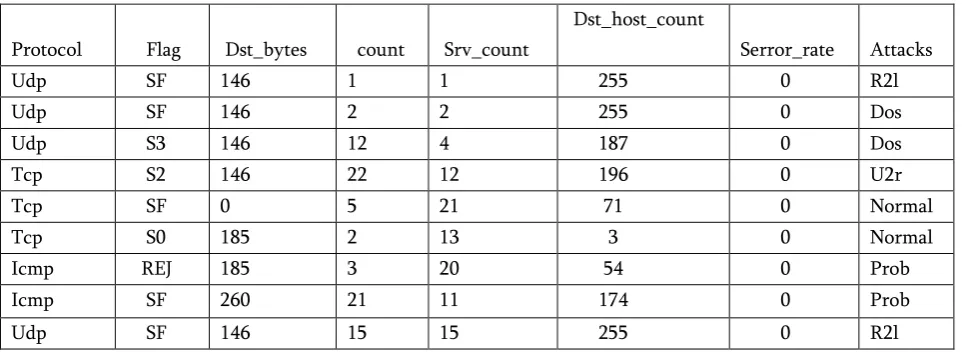
Table 2 : Sample KDD cup-99 dataset
Protocol
Flag
Dst_bytes count
Srv_count
Dst_host_count
Serror_rate Attacks
Udp SF 146 1 1 255 0 R2l
Udp SF 146 2 2 255 0 Dos
Udp S3 146 12 4 187 0 Dos
Tcp S2 146 22 12 196 0 U2r
Tcp SF 0 5 21 71 0 Normal
Tcp S0 185 2 13 3 0 Normal
Icmp REJ 185 3 20 54 0 Prob
Icmp SF 260 21 11 174 0 Prob
Figure 2. Graphical Analysis of results
V.
CONCLUSION
In this work, main contribution is in defining the clusters and the nearest neighbor by combining. “The measure designed is Euclidean distance based on the distance between data samples.K-means approach is chosen for clustering using the distance measure to cluster both the training dataset. k-NN in supervised learning based interruption discovery effectively. Here, k-NN maps the system activity into predefined classes i.e. attack type or normal composes based on the training the label dataset. k-NN based IDS, detection rate and false alarm rate. In this investigation,we propose K-means clustering approach and k-NN approach based on IDS that take care of the issue on the network. It causes IDS to accomplish high Detection Rate,False Alarm Rate, enhance accuracy and thusly high intrusion detection ability”.
VI.
REFERENCES
[1]. L. Dhanabal, S.P. Shantharajah, "A study of NSL-KDD Dataset for Intrusion Detection System based on Classification Algorithms", International Journal of Advanced Research in Computer and Communication Engineering, Vol.4, Issue 6, pp. (446-452), June 2015.
[2]. S. Duque, N.B Omar, "Using data Mining Algorithms for Developing a Model for Intrusion Detection System (IDS)", Proceedings of Science direct: Procedia Computer Science 61, pp. (46-51), 2015.
[3]. B. Sharma and H. Gupta, "A design and Implementation of Intrusion Detection System by using Data Mining", IEEE Fourth International Conference on Communication Systems and Network Technologies, pp.700-704, 2015.
[4]. U. Ravale, M. marathe, P. Padiya, "Feature Selection based Hybrid Anomoly Intrusion Detection System using K Means and RBF Kernal Function", Proceedings of Science Direct: International Conference on Advanced Computing Technologies and Applications (ICACTA), pp. 428-435, 2015.
[5]. W. C. Lin, S. W. Ke, C. F. Tsai, "CANN: An intrusion detection system based on combining cluster centers and nearest neighbors", Proceedings of Science direct: Knowledge-Based Systems, pp. 13-21, 2015.
[6]. J. Haque, K.W. Magld, N. Hundewale, "An Intelligent Approach for Intrusion Detection based on Data Mining Techniques", Proceedings of IEEE, 2012.
[7]. Liang Hu, Taihui Li, Nannan Xie, Jiejun hu, "False Positive Elemination in Intrusion Detection based on Clustering", IEEE International Conference on Funny System and Knowledge Discovery (FSKD), pp. 519-523, 2015.
[8]. Zhengjie Li, Yongzhong Li, Lei Xu, "Anomoly Intrusion Detection Method based on K-Means Clustering Algorithm with Particle Swarm Optimization", IEEE International Conference
Tcp S3 329 2 23 255 0 R2l
Udp S2 923 22 1 177 0 Dos
Icmp S0 137 13 4 196 0 U2r
Icmp RSTU 735 2 12 54 0 Normal
Udp RSTU 260 1 2 255 0 Normal
of Information Technology, Computer Engineering and Management Sciences, pp. 157-161, 2011.
[9]. S. J. Horng, M.Y. Su, Y. H. Chen, T. W. Kao, R. J. Chen, J. L. Lai, C. D. Perkasa, "A novel intrusion detection system based on hierarchical clustering and support vector machines", Proceedings of Science direct: Expert Systems with Applications, pp. 306-313, 2011.
[10]. Baowei Song Chunxue Wei," Algorithm of Constructing Decision Tree Based on RoughSet Theory, " International Conference on Computer and Communication Technologies Agriculture Engineering, IEEE 2010.
[11]. Weiguo Yi, Jing Duan, Mingyu Lu "Optimization of Decision Tree Based on Variable Precision Rough Set" International Conference on Artificial Intelligence and Computational Intelligence IEEE 2010.
[12]. V. R. Dinavahi and S. C. Srivastava, "ANN based voltage stability margin prediction," in Proc. IEEE Power Eng. Soc. Summer Meeting, vol. 2, pp. 1275–1280, July 2001.