Using Non-Local Features to Improve Named Entity Recognition
Recall
∗Xinnian Mao1, Wei Xu1, Yuan Dong1, 2, Saike He2, and Haila Wang1 1France Telecom R&D Center (Beijing), Beijing, 100080, P.R.China {xinnian.mao, wxu.ext, yuan.dong,haila.wang}@orange-ftgroup.com 2University of Posts and Telecommunications, Beijing, 100876, P.R.China
[email protected]; [email protected]
Abstract. Named Entity Recognition (NER) is always limited by its lower recall resulting from the asymmetric data distribution where the NONE class dominates the entity classes. This paper presents an approach that exploits non-local information to improve the NER recall. Several kinds of non-local features encoding entity token occurrence, entity boundary and entity class are explored under Conditional Random Fields (CRFs) framework. Experiments on SIGHAN 2006 MSRA (CityU) corpus indicate that non-local features can effectively enhance the recall of the state-of-the-art NER systems. Incorporating the non-local features into the NER systems using local features alone, our best system achieves a 23.56% (25.26%) relative error reduction on the recall and 17.10% (11.36%) relative error reduction on the F1 score; the improved F1 score 89.38% (90.09%) is significantly superior to the best NER system with F1 of 86.51% (89.03%) participated in the closed track.
Keywords: Named Entity Recognition, Non-local Feature, Conditional Random Field
1.
Introduction
Named entity recognition (NER) is a subtask of information extraction that seeks to locate and classify predefined entities, such as names of persons, locations, organizations, etc. in unstructured texts. It is the fundamental step to many natural language processing applications, like Information Extraction (IE), Information Retrieval (IR) and Question Answering (QA). Most empirical approaches currently employed in NER task make decision only on local context for extract inference, which is based on the data independent assumption (Krishnan and Manning, 2006). But often this assumption does not hold because non-local dependencies are prevalent in natural language (including the NER task). How to utilize the non-local dependencies effectively is a key issue in NER task. Unfortunately, few researches have been devoted to this issue, existing works mainly focus on using the non-local information for further improving NER label consistency.
There are two methods to use non-local information. One is to add additional edges to graphical model structure to represent the distant dependencies and the other is to encode the non-locality with non-local features. However, in the first approach, heuristic rules are used to find the dependencies (Bunescu and Mooney, 2004; Sutton and McCallum, 2004) or penalties for label inconsistency are required to handset ad-hoc (Finkel et al., 2005). Furthermore, high computational cost is spent for approximate inference. In order to establish the long dependencies easily and overcome the disadvantage of the approximate inference, Krishnan and Manning (2006) propose a two-stage approach using Conditional Random Fields (CRFs) with extract inference. They represent the locality with local features, and extract the non-local features from the output of the first stage CRF using non-local context alone; then they incorporate the non-local features into the second CRF. But the features in this approach are
The fist stage CRF labels for token directly depends on the labels corresponding the previous and next token, namely C-2, C-1, C0, C-1, C2, C-2C-1, C-1C0, C0C-1, C1C2, and C-1C1, where C0 is the current character, C1 the next character, C2 the second character after C0, C-1 the character preceding C0, and C-2 the second character before C0. In addition, the first CRF used the tag bi-gram feature. Although these local features are simple, they give us state-of-the-art baseline using local information alone as described in Section 4.
2.3. Low recall in NER task
As Kambhatla (2006) points out that NER system typically have a higher precision and a lower recall and tends to overproduce the NONE class because the NONE class dominates all other classes in the task. In natural language, different sentences contain different useful contextual information; the missed entities are happened when their context surroundings are not indicative enough for the statistical-based approaches (including the CRFs) to make a correct decision. When we analyze these missed occurrences of the missed entities further, we can put them into three groups. The first is the seen entities in the training data; the second is the unseen occurrences, but some other occurrences of the entities have been correctly recognized in certain indicative context surroundings. The third is the unseen occurrences with no any occurrences recognized correctly. In NER task, considering influences between extractions can be very useful, if the context surrounding one occurrence of a token sequence is very indicative of it being an entity, then this should also influence the tagging of another occurrence of the same token sequence in a different context that is not indicative of entity (Bunescu and Mooney, 2004). So if we consider the non-local dependencies between the same entities, some of these missed occurrences will be recognized correctly. We will describe how to capture the non-locality to recall more missed entities in Section 3.
3.
Recalling Missed Entities with Non-local Features
In natural language, difference sentences contain different useful context information; the missed entities happen when their context surroundings are not indicative enough for the first stage CRF to make correct decisions. If the context surrounding one occurrence of a token sequence is very indicative of it being an entity, then this should also influence the labeling of another occurrence of the same token sequence in a different context that is not indicative of entity (Bunescu and Mooney, 2004). So considering the non-local dependencies between the same entities can be very useful, if these non-local dependencies are incorporated into the CRF model, some of the missed entities will be recalled correctly.
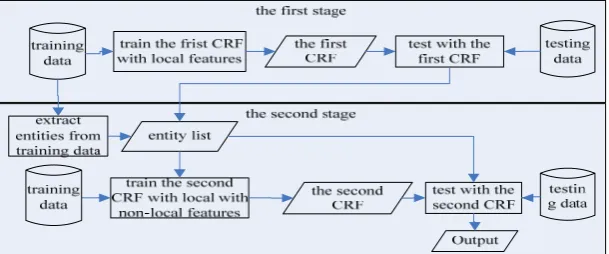
3.1. Flow chart using non-local features
Figure 1. The flow using non-local features in two-stage architecture
3.2. Four kinds of non-local features
We design four kinds of non-local features which encode different useful information for the two NER subtasks, i.e. entity boundary detection and entity semantic classification, the non-local features are fired on the token sequences if they are matched with certain entity in the entity list in forward maximum matching (FMM) way. I will describe them one by one as follows.
Entity-occurrence features (F1): These refer to the occurrence information assigned to the
token sequence which is matched with the entity list exactly. These features capture the dependencies between the identical candidate entities; which results in the same candidate entities of different occurrences can be recalled favorably.
Token-position features (F2): These refer to the position information (start, middle and last)
assigned to the token sequence which is matched with the entity list exactly. These features enable us to capture the dependencies between the identical candidate entities and their boundaries.
Entity-majority features (F3): These refer to the majority label assigned to the token sequence
which is matched with the entity list exactly. These features enable us to capture the dependencies between the identical entities and their classes, so that the same candidate entities of different occurrences can be recalled favorably, and their label consistencies can be considered too.
Token-position & entity-majority features (F4): These features capture non-local information
from F2 and F3 simultaneously. They take into account the entity boundary and semantic class information at the same time.
These non-local features are applied in English NER in one-step approach (Krishnan and Manning, 2006; Wong and Ng, 2007), they employ these features to improve entity consistence among their different occurrences. These features are assigned to token sequences that are matched exactly with the (entity, majority-type) list in forward maximum matching (FMM) way. During training or testing, when the CRFs tagger encounters a token sequence C1...Cn such that
(Ck...Cs) (k≥1, s ≤n) is the longest token sequence existing in the entity list; the correspondent
features will be turned on to each token in Ck....Cs. For example, considering the following
sentence: 我(wo)爱(ai)北(bei)京(jing)天(tian)安(an)门(men)(I love Beijing Tiananmen). If (北
京, Maj-LOC), (京, Maj-LOC), and (天安门, Maj-LOC) are presented in the (entity, majority type) list, the features below will be turned on as table 1 shows.
Notice that the feature turned on for 京is EE--MMaajj--LLOOCC,,not B-MMaajj--LLOOC, because the longest C
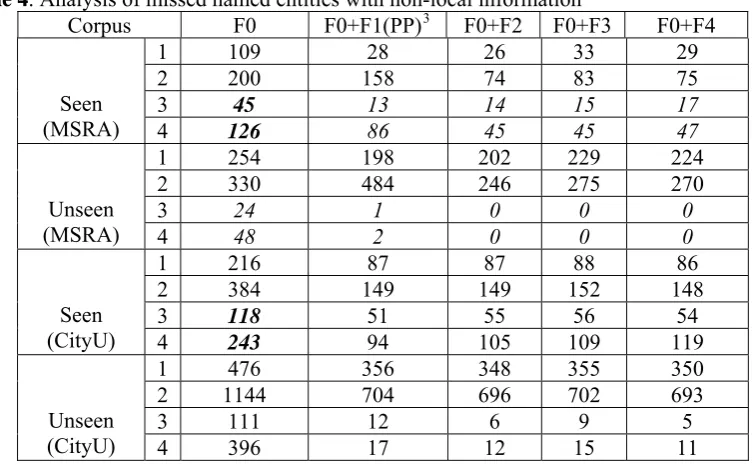
Table 3 displays the performance on MSRA and CityU NER closed track. The F0 row lists the precision, recall and F-measure (β=1) got by the first CRF (described in Section 2) using local features alone. The score makes the first CRF rank the top position on the MSRA and the second on the CityU in SIGHAN bakeoff (Levow, 2006)2. It shows that our baseline has achieved the state-of-the-art performance. However, comparing the recall with the precision on each dataset, we find that the performance is impaired by the relatively low recall. To investigate the causes of this problem, we analyze the missed entities further. We categorize them into two classes, seen and unseen in training data. Five kinds of statistic information are collected and listed in F0 column in table 4. (1) The number of different missed named entities; (2) The times of missing occurrences; (3) The number of different missed named entities which are detected correctly at least once; (4) The times missing occurrences under the case of (3). From (1) and (2) measurements of the seen entities in the F0 column in table 4, we find that there are many seen named enmities are missed. Though identifying unseen named entities is more difficult than seen named entities, the boldfaced number indicates that about 10% (24 of 254) for MSRA and 23% (111 of 476) for CityU of unseen and missed named entities have been labeled out correctly for at least once. The difficulty to capture unseen named entities in training data is because of the nature of machine learning techniques. However, the statistical results in Table 4 show there is a great potential (200+48)/(200+330)=47% for MSRA and (384+396)/ (384+1144)=51% for CityU, to improve recall by enhancing the capture of seen named entities and making use of labeled outputs from test data to capture more unseen named entities. What is more, performance can be improved further when more named entities are labeled correctly, because many models, such as CRF, assign labels according to the possibilities of whole sequence.
4.3. Influence of using non-local features in NER
After we feed the non-local features (described in Section 3) to the second CRF, we test it on the testing data of MSRA and CityU again. Table 3 lists the performance got by each kind of feature configurations. F0 means the first CRF (baseline) using local features alone, and the F0+Fi (i=1, 2, 3, 4) means the second CRF using local features (F0) as well as the non-local features Fi. From the table 3, we can conclude that exploiting non-local information is a good choice to recall more missed entities. Comparing with the baseline using only local context, the recalls of NER systems are improved after taking nonlocal information into account by 0.34%~3.76% on MSRA, 2.92%~3.68% on CityU. And the overall Fmeasures increase by -0.54%~2.19% and 0.72%~1.27% on MSRA and CityU each. The MSRA performance got by F0+F1 decrease slightly because there are many consecutive entities in the testing data. Since F1 does not encode boundary and class information, more entity tokens are recalled, but their boundaries or classes are wrong. After we implement a post-processing step with person name list extracted from the MSRA training data to separate the consecutive candidate entities, the performance lists with F0+F1 (PP) increases. The performance difference among F1, F2, F3 and F4 are mainly because they encode different useful non-local information as described in Section 3.2. For F1, it only encode whether a token sequence is an entity. No boundary and class are considered which are represented in F2 and F3 respectively, so F2 and F3 both achieve high performance than F0, and F4 consider both boundary and class simultaneously, so it is the best choice of exploiting non-local information to improve NER recall. We can not compare between F2 and F3 directly because boundary detection and semantic class classification are the two different sub-tasks in NER.
The performance difference between the performance on CityU and MSRA come from two folds. One is because CityU testing data contains more seen entities than that of MSRA since the seen entities can be captured easily by the non-local features. The other is because MSRA data sets contain much more consecutive named entities than CityU. Since NER with non-local information prefers to dig out more and thereby longer named entities, it may tend to label more
continuous named entities as a single named entities and introduce more errors damaging both in recall and precision.
Table 3. NER performance on MSRA and CityU
Corpus System P R F
F0 90.58 84.04 87.19
F0+F1 89.81 83.70 86.65
F0+F1(PP) 89.40 85.46 87.39
F0+F2 89.73 85.96 87.81
F0+F3 90.58 87.16 88.84
MSRA
F0+F4 91.01 87.80 89.38
F0 92.48 85.43 88.82
F0+F1 90.73 88.35 89.53
F0+F2 90.96 88.83 89.88
F0+F3 90.90 88.65 89.76
CityU
F0+F4 91.09 89.11 90.09
Then, we investigate the situation of missed seen and missed unseen named entity in NER with non-local information by filling the Table 4. F0 is the first CRF (baseline) using local features alone, and the F0+Fi (i=1, 2, 3, 4) means the second CRF using local features (F0) as well as the non-local features Fi. The four same measurements are used as described in Section 4.2. Compared with the numbers in F0 column, significant reduction of missing of seen entities is achieved by adding non-local features. What is more, the hit of unseen entities is also increased as we predicted in previous analysis.
Table 4. Analysis of missed named entities with non-local information
Corpus F0 F0+F1(PP)3 F0+F2 F0+F3 F0+F4
1 109 28 26 33 29
2 200 158 74 83 75
3 45 13 14 15 17
Seen
(MSRA) 4 126 86 45 45 47
1 254 198 202 229 224
2 330 484 246 275 270
3 24 1 0 0 0
Unseen
(MSRA) 4 48 2 0 0 0
1 216 87 87 88 86
2 384 149 149 152 148
3 118 51 55 56 54
Seen
(CityU) 4 243 94 105 109 119
1 476 356 348 355 350
2 1144 704 696 702 693
3 111 12 6 9 5
Unseen
(CityU) 4 396 17 12 15 11
5.
Conclusions and Future Work
In this paper, we propose an approach of exploiting non-local information to improve NER recall. To our best knowledge, our work is the first attempt to utilize non-local information to improve NER recall, our work demonstrates that non-local information are effective to recall the missed entities which are seen in training data or unseen but some occurrences of these unseen
entities have been recognized correctly with local context alone. We also compare the different kinds of non-local features which fit to different NER sub-tasks and find that non-local feature considering the boundary and class information simultaneously is the best. Our approach is language independent, due to lack of annotated corpora of other languages, the experiments have only been conducted on Chinese corpora, and related experiments on other languages can be done in the future.
References
R. Bunescu and R. J. Mooney. 2004. Collective information extraction with relational Markov networks. Proceedings of the 42nd ACL, pp. 439–446.
R.H. Byrd, J. Nocedal and R.B. Schnabel. 1994. Representations of quasi-Newton matrices and their use in limited memory methods. Mathematical Programming, (63):129-156.
J.N. Darroch and D. Ratcliff. 1972. Generalized iterative scaling for log-linear models. The Annals of Mathematical Statistics, 43 (5):1470-1480.
J. Finkel, T. Grenager, and C. D. Manning. 2005. Incorporating non-local information into information extraction systems by gibbs sampling. Proceedings of the 42nd ACL, pp. 363–370.
N. Kambhatla. 2006. Minority Vote: At-Least-N Voting Improves Recall for Extracting Relations. Proceeding of the 44th ACL, pp. 460–466.
V. Krishnan and C. D Manning. 2006. An Effective Two-Stage Model for Exploiting Non-Local Dependencies in Named Entity Recognition. Proceedings of the 44th ACL, pp. 1121–1128.
J. Lafferty, A. McCallum, and F. Pereira. 2001. Conditional Random Fields: Probabilistic models for segmenting and labeling sequence data. Proceedings of the 18th ICML, pp. 282–289. Morgan Kaufmann, San Francisco, CA
G. Levow. 2006. The Third International Chinese Language Processing Bakeoff: Word Segmentation and Named Entity Recognition. Proceedings of SIGHAN-2006, pp. 108-117. Sydney, Australia.
R. Malouf. 2002. A comparison of algorithms for maximum entropy parameter estimation. Proc. of CoNLL-2002, 49-55. Taipei, Taiwan.
S.D. Pietra, V. Della Pietra, and J. Lafferty, 1997. Inducing features of random fields. IEEE Transactions on Pattern Analysis and Machine Intelligence, 19(4):380-393, 1997.
F. Sha and F. Pereira. 2003. Shallow parsing with conditional random fields. Proc. of HLT/NAACL-2003, 213-220. Edmonton, Canada.
C. Sutton and A. McCallum. 2004. Collective segmentation and labeling of distant entities in information extraction. In ICML Workshop on Statistical Relational Learning and Its connections to Other Fields.