Proceedings of the Student Research Workshop associated with RANLP 2017, pages 1–9,
Dish Classification using Knowledge based Dietary Conflict Detection
Nadia ClairetLIRMM (Laboratoire d’Informatique, de Robotique et de Micro´electronique de Montpellier) 860 rue de St Priest 34000 Montpellier, France
LIMICS (Laboratoire d’Informatique Mdicale et d’Ingnieurie des Connaissances en e-Sant) 74 rue Marcel Cachin 93017 Bobigny, France
Lingua et Machina
7 Boulevard Anatole France, 92100 Boulogne-Billancourt, France [email protected]
Abstract
The present paper considers the problem of dietary conflict detection from dish ti-tles. The proposed method explores the se-mantics associated with the dish title in or-der to discover a certain or possible incom-patibility of a particular dish with a partic-ular diet. Dish titles are parts of the elu-sive and metaphoric gastronomy language, their processing can be viewed as a com-bination of short text and domain-specific texts analysis. We build our algorithm on the basis of a common knowledge lexical semantic network and show how such net-work can be used for domain specific short text processing.
1 Introduction
The dish classification according to some dietary criteria is a challenging task. Performing such classification given the dish title as it may appear in a restaurant menu implies solving the follow-ing issues: context scarcity, relevant information selection, and output qualification. In the frame-work of our method, these issues have been dealt with following two steps. First, domain specific knowledge1 has been immersed into a large
gen-eral knowledge lexical semantic network. Second, a graph traversal algorithm has been defined and parametrized in order to grasp relevant lexical and semantic information for the dietary conflict de-tection.
In terms of structure, the network we use is a di-rected graph where nodes may represent simple or compound terms, linguistic information, phrasal expressions, and sense refinements2. The arcs of
1Terms and relationships related to nutrition, cooking techniques, cooking recipes and their typical parts, diets and typical dietary restrictions.
2Unlike the dictionary sense, the sense refinement reflects the typical use of a term, its sense activated by a particular context.
the graph are directed, weighted, and typed ac-cording to the ontological, semantic, lexical as-sociations between the nodes. They also may be semantically annotated (ex.: quiche −−−−−−−→part−whole
frequent
egg) which is convenient for working with do-main specific expert knowledge. During the traversal (interpretation) of the graph, the nodes and the arcs are referred to as respectively terms and relationships.. Throughout this paper, re-lationship corresponds to a quadruplet R = {termsource, type, weight, termtarget}. Weight
denotes an association force of the relationship be-tween two terms of the graph.
The paper will be structured as follows. First, we will recall main state-of-the-art achievements related to short text analysis and cooking recipe analysis. Second, we will detail materials of the approach: knowledge resource structure, text pre-processing steps. Third, we will describe our graph traversal method. Finally, we will present and discuss the output of our system and introduce its possible evolutions.
2 State of the Art
2.1 Distributional Methods for Short Text Analysis
The processing of dish titles can be considered as a possible specialization of some general method for short text analysis. Given the importance of the distributional hypothesis3 in the current NLP
practice, we will empathize knowledge based dis-tributional method and logic based disdis-tributional method to the short text processing. A relevant knowledge based distributional method has been proposed by (Hua et al., 2015) in the framework of the Probase4 lexical semantic network. The
3The main idea behind the distributional hypothesis : ”a word is characterized by the company it keeps”(Firth,1957).
4https://www.microsoft.com/en-us/
research/project/probase/.
Probase associated tools allow obtaining a con-cept distribution based on different scoring func-tions (conditional probability distribution5,
point-wise mutual information6etc.). Prior to the
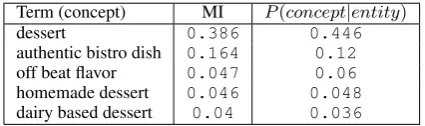
analy-sis of short texts, the authors in (Hua et al.,2015) acquire knowledge from web corpus, Probase net-work as well as a verb and adjective dictionary. They solve the segmentation task by introducing a multi-fold heuristic for simple and multi-word term detection. It takes into account the presence of is-a and co-occurrence relationships between the candidate terms. Subsequently, the terms are typed according to different categories : part of speech, concept/entity distinction etc. Finally, the disambiguation is done using the weighted vote (conceptual connections of the candidate term considering the ”vote of context”). This method seems to be relevant for queries, however it would be difficult to use it for the dish classification. The main difficulty comes from the fact that it is con-cept driven. Indeed, for a term such as ”creme brulee”, we obtain the concept distribution scores shown in Table 1. Due to the underlying
se-Term (concept) MI P(concept|entity)
dessert 0.386 0.446
authentic bistro dish 0.164 0.12
off beat flavor 0.047 0.06
homemade dessert 0.046 0.048
dairy based dessert 0.04 0.036
Table 1: Concept distribution for creme brulee (Probase conceptualization tool)
mantic relationship types (is-a,relatedness), these examples bring very few information about the composition and the semantic environment (that needs considering relationship types expressing part-whole,location,instrument,sensory charac-teristicrelationships) of the dish titles and one can hardly qualify some of the returned scores (e.g.off beat flavor) in order to approximate the underlying relationship type. An improvement of the knowl-5Conditional probability distribution of two discrete vari-ables (words)
P(A|B) = P(AP)(B∩)(B)
.
6Point-wise Mutual Information is calculated according to the formula :
P MI(x;y) = logPP(x(x, y)P()y)
edge based distributional method could be made using an additional semantic resource containing a rich part-whole semantics7such as WordNet
(Fell-baum,1998).
A different kind of methods for short text analy-sis relies on general-purpose first order probabilis-tic logic as shows the hybrid approach developed by (Beltagy et al., 2014). The authors use them to generate an on-the-fly ontology that contains the relevant information related to some current semantic analysis task. They adopt probabilistic logic as it allows weighted first order logic for-mulas. The weight of the formulas corresponds to a certainty measure estimated from the distribu-tional semantics (meaning representation, seman-tic relation prediction). First, natural language sentences are mapped to a logical form (using the Boxer tool (Bos, 2015)8). Second, the
on-tology is encoded in the form of weighted infer-ence rules describing the semantic relations (the authors mentionhyponymy,synonymy,antonymy, contextonymyi.e. the relation between ”hospital” and ”doctor”). Third, a probabilistic logic pro-gram answering the target task is created. Such program contains the evidence set, the rule base (RB, weighted first order logical expressions), and a query. It calculates the conditional probabil-ityP(Query|Evidence, RB). This approach has been tested on the SICK9data for the tasks of
se-mantic textual similarity detection and textual en-tailment recognizing. The results showed a good performance of this method over distributional only and logic only methods. This kind of ap-proaches rather considers lexical relations (reveal-ing some l(reveal-inguistic phenomena), than purely se-mantic (language independent, world knowledge phenomena) relations. As the knowledge based distributional method, it suffers from the difficulty to qualify the relationships as it uses mainly the co-occurrence analysis.
7The WordNet part-whole relation splits into three more specific relationships :member-of,stuff-of, andpart-of.
8Boxer (Bos,2015) is a semantic parser for English texts based on Discourse Representation Theory.
2.2 Cooking Instruction Analysis
Besides the approaches focused on flavor net-works which consider cooking recipes as ”bags of ingredients” such as (Ahn et al., 2011), the ex-isting approaches to the recipe analysis concen-trate on recipes taken as a sequence of instruc-tions that can be mapped to a series of acinstruc-tions. Numerous publications concern the implementa-tion of supervised learning methods. For instance, (Mori et al., 2012) use the annotated data to ex-tract predicate-argument structures from cooking instructions in Japanese in order to represent the recipe as a work flow. The first steps of this pro-cess are words segmentation and entity type recog-nition based on the following entity types: Food, Quantity, Tool, Duration, State, chefs action, and foods action. Therefore, this task is similar to the conceptualization process proposed by (Hua et al., 2015) discussed in the previous section. Entity type recognition is followed by syntactic analy-sis that outputs a dependency tree. The final step aims at extracting predicate-argument triples from the disambiguated (through segmentation, entity type recognition, and dependency parsing) recipe text. In this approach, the semantic information that could be attached to the arcs is attached to the nodes. The node type together with the syntac-tic markers (i.e. case marker) helps determining the nature of the predicate-argument relation. This method yields modest results and could be im-proved by adopting a more versatile graph struc-ture (i.e. a strucstruc-ture with typed arcs). (Kiddon et al.,2015) proposed a similar unsupervised tech-nique for mapping recipe instructions to actions based on a hard Expectation Maximization algo-rithm and a restricted set of verb argument types (location,object).
In the paradigm of semantic role labeling, the ap-proach of (Malmaud et al., 2014) uses a Markov decision process where ingredients and utensils are propagated over the temporal order of instruc-tions and where the context information is stored in a latent vector which disambiguates and aug-ments the instruction statement under analysis. The context information corresponds to the state of the kitchen and integrates the changes of this state according to the evolving recipe instructions. It yields a good performance for the instruction analysis.
In the case based reasoning paradigm, (Dufour-Lussier et al.,2012) represent the cooking
instruc-tions as a work-flow and thus propose a method for the automatic acquisition of a rich case representa-tion of cooking recipes for process-oriented case-based reasoning from free recipe text. The cook-ing process is represented uscook-ing the Allen (Allen, 1981) algebra extended with relations over inter-val durations. After applying classical NLP tools for segmentation, part-of speech tagging, syntac-tic analysis, the extraction process from texts fo-cuses on the anaphora resolution and verb argu-ment analysis. The actions are modeled on the basis of the instructional text without consider-ing the implicit information proper to the cook-ing recipes. The underlycook-ing knowledge resource is the case-based reasoning system Taaable (Cordier et al., 2014). The existing methods of cuisine texts analysis converge on the necessity to have a richer context around the terms present in the input text. Various approaches have been pro-posed to provide such context. Some of them propose specific meta-languages such as MILK10
(Tasse and Smith, 2008) or SIMMR (Jermsura-wong and Habash,2015)11. MILK has been
pro-posed as a machine-readable target language to create sets of instructions that represent the ac-tions demanded by the recipe statements. It is is based on the first-order logic, but allows handling the temporal order as well as creation/deletion of ingredients. A small corpus of 250 recipes has been manually annotated using MILK (CURD (Carnegie Mellon University Recipe Database)). Similarly, SIMMR (Jermsurawong and Habash, 2015) allows to represent a recipe as a dependency tree. The leaves of the tree are the recipe ingredi-ents and its internal nodes are the recipe instruc-tions. MILK tags have been used to construct the SIMMR trees. Machine learning methods (SVM12
classification) have then been used for instruction-ingredient linking, instruction-instruction linking using SIMMR. Other approaches for getting more context for the cooking recipe analysis are dy-namic data structures (i.e. latent vector used by (Malmaud et al., 2014)) and graph-shaped re-sources (ontologies, semantic networks) as in our case.
3 Preliminaries
The dietary restrictions are defined as follows: Diabetes, GlutenFree, Halal, Hindu, Kosher , LowCalories,LowFat,LactoseFree,LowSalt, Ve-gan, Vegetarian. For these diets, we automati-cally extracted and manually validated an initial set of approximately 200 forbidden ingredients. We used domain-specific resources (lists of ingre-dients) found on the Web for this step. These ingredients (if not already present in our graph-based knowledge resource) have been encoded as nodes and linked to the nodes representing the di-ets listed above by the arcs typedr incompatible. The nutritional restrictions differ in terms of their semantic structure (which may rely on composi-tion (part-wholerelation), cutting types (holonymy etc.), cooking state (i.e. boiled carrots are undesir-able in case of diabetes).
3.1 Corpus and Knowledge Resource
For our experiment we used a set of 5,000 dish ti-tles in French, which corresponds to a corpus13.
of 19,000 words and a vocabulary of 2,900 terms (after removing stop words and irrelevant expres-sions such as ”tarte tatin `a ma fac¸on”, tarte tatin my way). This data mirrors the French urban culi-nary tradition as well as the established practice of searching the Web for recipes. The data scarcity proper to the recipe titles is an important obstacle to their processing. Distributional scores used by (Hua et al.,2015) and (Beltagy et al.,2014) may be interesting in terms of flavor associations, but they also demonstrate that we need to know more about the most likely semantic neighborhood of the term to handle the part-whole semantics and incompat-ibility analysis.
The semantic resource we use for the experi-ments is the RezoJDM lexical semantic network for French14. This resource stems from the game
with a purpose AI project JeuxDeMots (Lafour-cade, 2007). Built and constantly improved by crowd-sourcing (games with a purpose, direct con-tribution), RezoJDM is a directed, typed, and weighted graph. Today it contains 1.4M nodes and 90M relations divided into more than 100 types. The structural properties of the network have been detailed in (Lafourcade,2011) and later 13The corpus has been collected from the following Web resources : 15%www.cuisineaz.fr, 20%www. cuisinelibre.orget 65%www.allrecipe.fr
14http://www.jeuxdemots.org/jdm-about.
php
in (Chatzikyriakidis et al.,2015), its inference and annotation mechanisms respectively by (Zarrouk et al.,2013) and (Ramadier,2016). The ever end-ing process of graph population is carried on usend-ing different techniques including games with a pur-pose, crowd-sourcing, mapping to other seman-tic and knowledge resources such as Wikipedia or BabelNet (Navigli and Ponzetto,2012). In ad-dition, endogenous inference mechanisms, intro-duced by (Zarrouk et al., 2013) are also used to populate the graph. They rely on the transitivity of the is-a, hyponym, and synonym relationships and are built for handling polysemy. In addition to the hierarchical relation types, RezoJDM contains grammatical(part-of-speech), causal, thematic re-lations as well as rere-lations of generativist flavor (ex. telic role). This resource is considered as a closed world i.e. every information that is not present in the graph is assumed as false.
It has been shown by (Ramadier, 2016) that, for the sake of precision, general and domain spe-cific knowledge should not be separated. Thus, for our experiment we immerse nutrition, ssory, technical knowledge into RezoJDM to en-hance the coverage of the graph. This has been done partly through the direct contribution. Ex-ternal resources such as domain specific lexicons and terminological resources have been used. In particular, some equivalence and synonym rela-tion triples have been extracted from IATE15term
base16. The Agrovoc17 thesaurus provided only
a few new terms; it contained no relevant rela-tions. Additionally, as RezoJDM can be enhanced using crowd-sourcing methods and, in particular, games with a purpose, specific game with a pur-pose assignments have been given to the JeuxDe-Mots (contribution interface for RezoJDM) play-ers. Today (June 2017) the domain specific sub-graph corresponds to 40K terms (approximately 2.8% of the RezoJDM). The overall adaptation process took about 3 weeks.
In the framework of our experiment, we use taxon-omy relations, part-wholerelations, object-mater relations and, in some cases,hyponymyand char-acteristic relations. Running the experiment in-volved preprocessing steps (multi-word terms de-tection, lemmatization, disambiguation), browsing
15 http://iate.europa.eu/switchLang.do?
success=mainPagelang=fr
16The part of the IATE resource that has been used corre-sponds to the subject field 6006.
the graph following path constraints, scoring pos-sible incompatibilities, and possibly normalizing scores. Among other approaches using a simi-lar plot, (Poria et al.,2014) use ConceptNet (Liu and Singh,2004) network for the semantic analy-sis task.
4 Method
The preprocessing step includes text segmenta-tion which relies on the multi-word lexical entities detection, followed by stop-words removal. The multi-word term detection is done in two steps. First, the recipe titles are cut into n-grams using a dynamic-length sliding window (2 ≤4). Second, the segments are compared to the lexical entries present in RezoJDM which is therefore used as a dictionary. In RezoJDM, the multi-word terms are related to their ”parts” by the relation typed locu-tion(or ”phrase”). This relation is useful for com-pound terms analysis. Bi-grams and trigrams are the most frequent structures in the domain-specific subgraph as well as in RezoJDM. Indeed, they rep-resent respectively 28% and 16% of the overall set of multi-word terms and expressions (300K units). For our experiment, we often opted for trigrams which turned out to be more informative (i.e. cor-respond to nodes with a higher out degree).
French (English) 1. Carpe `a la foresti`ere (Forest style carp)
2. Carr´e d’agneau dans son jus (Rack of lamb in its own jus) 3. Waterzo´ı de lieu noir (Coley waterzoo´ı)
4. Verrines de lentilles au saumon fum´e (Lentil and smoked salmon verrines)
5. Gˆateau basque `a la confiture de cerises noires (Basque cake with black cherry jam)
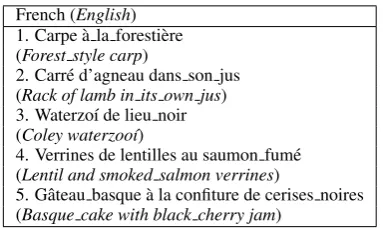
Table 2: Preprocessed recipe titles. Expressions relevant for the domain (1,2) as well as multi-word terms (3,4), and phrases(5) are detected. Some-times, two segmentations are possible for the same input. In such cases, the contrast is favored by ex-ploring syntactic features and outgoing semantic relationships of terms in RezoJDM.
4.1 From Text to Graph
Starting from a sequencew1, w2, ...wnofnterms,
we build acontextnamely the lemmatized and dis-ambiguated representation of the recipe title un-der scope. Such context is the entry point to our knowledge resource.
A context is a sequence of nodes (the text order is preserved) : Cw1,w2,...wn = nw1, nw2, ...nwn
where the node nwn is the most precise
syn-tactic and semantic representation of the surface form available in RezoJDM. To obtain such rep-resentation we search for the node correspond-ing to the surface form if it exists18. Then,
we yield its refinement if the term is polysemic. The irrelevant refinements are discriminated us-ing a list of key terms that define our domain (i.e. thematic subgraph within a lexical seman-tic network). The identification of the refine-ment is done through the cascade processing of relationships of a node typed refinement, do-main, and meaning. The context creation func-tion returns for quiche au thon et aux tomates (quiche with tuna and tomatos) the result [quiche (pr´eparation culinaire), thon (poisson,chair), to-mate l´egume-fruit], respectively:”quiche (prepara-tion), tuna (fish flesh),tomato (fruit-vegetable))”. For each node ni ∈ C we explore paths S = ((n1arn2),(n2arn3),(nm−1arnm)). The type of
relationships we choose for the graph traversal de-pends on the local category of the node:
1. If isa(”preparation”, ni)19, r ∈ {hypo, part−whole, matter}.
This is the case of mixtures, dishes and other complex ingredients;
2. If isa(”ingredient”, ni)20, r ∈ {isa, syn, part−whole, matter, charac}. It is the case of plain ingredients liketomato. The weight of all relations we traverse must be strictly positive. We traverse the graph testing a range of conditions: relevance to the domain of interestDalim (food domain), existence of a path
of a certain length (≤ 2) and type between the candidate node and and the rest of the Context under analysis, co-meronymy relation etc.
To obtain relevant results, two conditions are to be fulfilled. First, there must be a disambiguation strategy and a domain filtering. Second, the simi-larity has to be handled between thepreparation and its hyponyms. Indeed, the exploration of the part-whole relations of the network refers to all the possible ingredients and constituents 18In the opposite case the acquisition process through ex-ternal resources like Wikipedia, Web and through crowd-sourcing (Games with a purpose) may be triggered (if an open world hypothesis is favored).
of the preparation. If the preparation has a conceptual role (i.e. ”cake”), the part-whole relations analysis will output a lot of noise. In our example, it is important to grasp the absence of pork (meat) and the presence of tuna (fish) in the quiche under scope. Therefore, instead of directly exploring the part-whole relations of the quiche(preparation), we rather try to find similar quiche(preparation) hyponyms for the contextC=”quiche (preparation), tuna (fish flesh), tomato (fruit-vegetable))” and yield the typical parts they have in common with the generic quiche(preparation). Our function finds the hyponym which maximizes the similarity score. This score is a normalized Jaccard index over all the positive outgoing part-whole, isa, matter relations.
J(SC, SChypo) =
SC∩SChypo
SC∪SChypo where Chypo is the
hyponym contextbuilt on the go.
Different threshold values have been experi-mented. Empirically, the threshold fixed at 0.30 allows capturing generic similarities such as (for our example) quiche saumon courgette (”quiche salmon zucchini”) score=0.32, a quiche with some fish and a vegetable. More precise similarity corresponds to higher scores.
Using the described strategy, the irrelevant recipes such as quiche lorraine (score=0.20) are efficiently discriminated. Once the relevant hyponym is identified, its part-whole neighbors can be grasped. A specific graph traversal strat-egy is used for the LowSalt diet. It includes exploring the characteristic relation type for the preparationand its parts.
4.2 From Graph to Incompatibilities
The incompatibility calculation takes as input the list of diets and the queue F containing terms related to main context. This function looks for an dietary incompatibility pathSincsuch thatN0 ∈F ∧ Sinc = ((N0, rtype, N),(N, rinc, NDIET)) ∧
type ∈ (holo|isa|haspart|substance|hypo). The output is a key value pair (diet, score). The score depends on the distance in the RezoJDM graph and on the relation type between the diet and the incompatible node in the context. Besides the refinement relation type21, it is calculated as
follows for the distance d : 1
1+d. The score for
the whole context corresponds to the addition of 21Which participates to the disambiguation process.
the individual scores of the context nodes. It is adapted in order to bring it closer to a probability distribution and allow further statistical or pre-dictive processing. Our system first obtains a list of nodes linked to the context (see 3.1). After following a traversal strategy, it returns a list of probabilistic scores for each part of the context. I.e. (wcorresponds toweightanddcorresponds todistance) :
recipe : quiche thon tomate quiche>preparation,thon>poisson, tomate>legume
Further follows similarity processing as de-scribed in 3.2., then processing of parts shared by quiche and its hyponyms similar to the context. For each part, the isa, part-whole, mater and characteristicrelations are further explored
r_has_part pte d=1 w=6*dough*
r_has_part oeufs d=1 w=105*eggs* etc.
Intermediate raw scores are returned (exam-ple :quiche(preparation)):
Diabetes 1.3, LactoseFree 3.0, Halal 0.0, Kosher 0.3, LowCalories 1.5, LowSalt 0.5, GlutenFree 1.8, Hindu 0.5, LowFat 0.8, Vegan 0.5, Vegetarian 0.3
Same processing is performed for all the other nodes from the context. The output summarizes scores per ingredient and per diet. It can be ”nor-malized” according to the following rule applied to the raw score in order tos ∈ Ls (raw list of
scores) in order to produce a probabilistic score sp : if s ≥ 0.5, sp ← 1, ifs ≤ 0.5, sp ← 0.5.
The range of this new score is restricted to three values : compatible (0), uncertain (0.5), and incompatible (1).
final probabilistic scores for "quiche thon tomate"
Diabetes 0.5, LactoseFree 1.0, Halal 0.0, Kosher 0.5, LowCalories 1.0, LowSalt 1.0, GlutenFree 1.0, Hindu 1.0, LowFat 1.0, Vegan 1.0, Vegetarian 1.0
compatibility of a dish with his or her nutritional restrictions and alerted about some potential incompatibilities that would need further infor-mation from the caterer. The list of terms that are not present in the resource (for example,sibnekh, zwiebelkuchen) is output by the system. It serves to the further improvement of the RezoJDM graph from external resources.
4.3 Evaluation and Discussion
The system has been evaluated using a incompati-bility annotated corpus of 1,500 recipe titles. The evaluation data has been partially collected us-ing structured document retrieval simultaneously with the raw corpus constitution. Relevant meta-tags (HTML meta-tags present in micro-formats22) have
been used to pre-build incompatibility scores. The overlap between the different diets (vegan recipes are compatible with a vegetarian diet etc.) has been taken into account. The labels have been adjusted and enriched (LawSalt, Kosher diets) by hand by the author because the structured meta-tags do not contain such information. The ob-tained evaluation scores are binary. Our system is under improvement, we estimated that the score returned by the system should be ≥ 0.5 to be ranked as acceptable. Later, a finer grained evalu-ation will be adopted.
Our results expressed in terms of precision, recall and f-measure (F1 score) are listed in Table 4. The most important score is the precision as, for an allergic or intolerant restaurant customer, even a very small quantity of a forbidden product may be dangerous. The average value correspond to the macro-average (arithmetic mean), F-score average is therefore the harmonic mean of precision aver-age rate and recall averaver-age rate.
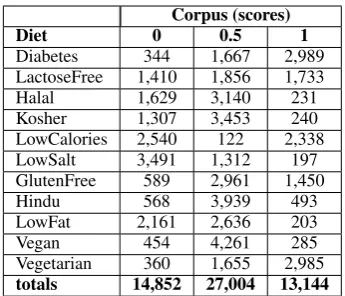
For the halal diet, there are very few terms in the graph that point to this diet. The low calories and vegetarian diets are well known among the RezoJDM community and well represented in the graph. In 13% of cases, the graph traversal did not return any result as the terms corresponding to the words of the context do not exist in the graph. It was the case of borrowings (such asquinotto) or lexical creations23(i.e. anti-tiramisuas our
analy-sis scheme doesn’t take into account morphology). The average number of incompatibility scores6= 0
22Micro-formats(µF) refer to standardized semantic markup of web-pages.
23The termlexical creationrefers to the neology (creation of new terms).
Corpus (scores)
Diet 0 0.5 1
Diabetes 344 1,667 2,989 LactoseFree 1,410 1,856 1,733
Halal 1,629 3,140 231
Kosher 1,307 3,453 240
LowCalories 2,540 122 2,338 LowSalt 3,491 1,312 197 GlutenFree 589 2,961 1,450
Hindu 568 3,939 493
LowFat 2,161 2,636 203
Vegan 454 4,261 285
Vegetarian 360 1,655 2,985
totals 14,852 27,004 13,144
Table 3: Repartition between the 3 possible prob-abilistic scores in the whole corpus.
Evaluation set Diet Precision Recall F1 score
Diabetes 92% 92% 92%
LactoseFree 71% 73% 72%
Halal 65% 75% 70%
Kosher 67% 60% 63%
LowCalories 60% 75% 67%
LowSalt 88% 65% 75%
GlutenFree 80% 73% 76%
Hindu 86% 80% 83%
LowFat 67% 70% 68%
Vegan 80% 90% 85%
Vegetarian 83% 90% 86%
macro-average 76% 77% 76%
Table 4: Corpus-based evaluation. We specify the repartition between the 3 possible probabilistic scores in the whole corpus and detail the quality of our scoring for an sub-corpus annotated for evalu-ation. The evaluation set is a subset of our corpus annotated in incompatibilities. We totally ignore the annotations during the processing.
per recipe title is of about 3.8. Traditional diets (such as halal diet and kosher diet) have been very challenging as the nature of nutritional restriction for them may concern food associations. The low salt diet incompatibility detection is still difficult because salt is everywhere and it is sometimes difficult to find a criterion to separate the property from the possibility of being salted.
Given the specificity of our resource, a low score may depend on the lack of some relevant information in the graph. Thus, the output may be considered as correct (at least at the development stage) but with a low ”confidence” which corre-sponds to a lower mean24value.
24The mean, as it is understood here, weights each score
si according to its probability given the dataset,si. Thus, µ=Ps
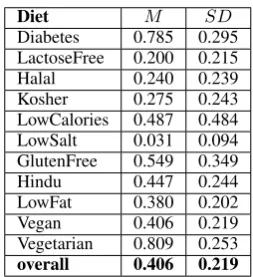
The mean (M) and standard deviation (SD) values reveal this confidence issue (Table 5). A low M value together with a low SD indicates that there were too many uncertain scores (≤0.5) among the resulting scores of a particular diet. On the contrary, M ≥ 0.5 and SD ≤ 0.5 reveal a good confidence about the incompatibility. in the case of ”no salt” diet, very few incompatibilities have been detected with low confidence, thus finer grained approach is needed (i.e. relation-ship annotation). In the case of GlutenFree and LowCalories the scores are quite confident but sparse : the data is unequally distributed in the resource, more relationship types should be explored. the overall M and SD values reveal low confidence but uniform scores. To
Diet M SD
Diabetes 0.785 0.295 LactoseFree 0.200 0.215 Halal 0.240 0.239 Kosher 0.275 0.243 LowCalories 0.487 0.484 LowSalt 0.031 0.094 GlutenFree 0.549 0.349 Hindu 0.447 0.244 LowFat 0.380 0.202 Vegan 0.406 0.219 Vegetarian 0.809 0.253
overall 0.406 0.219
Table 5: Mean values per diet (evaluation)
maximize the confidence related to the score, the knowledge resource must be continuously enhanced. Today this is achieved using two main strategies: exogenous and endogenous. The first one may include term extraction from corpora, relationship identification based on word embed-dings, direct contribution, specific games with a purpose assignments. The second one refers to propagation of the relations already existing in the graph using inference schemes based on the transitivity of the isa, part-whole, and synonym semantic relations as proposed by (Zarrouk et al., 2013). Using a lexical semantic network for text processing offers some clear advantages. First, there is no need to use multiple data structures during the processing. Second, the graph structure supports encoding various kinds of information that can be useful for text processing tasks. Every piece of information encoded using the graph formalism is machine interpretable and can be accessed during the traversal. Finally, the graph based analysis strategy has an explanatory feature,
it is always possible to know why the system returned some particular output. However, two main issues must be tackled : the knowledge resource population method and the filtering
strategy while traversing the resource. To test the portability of the approach, we run it using the ConceptNet common knowledge network and a restricted set of aligned recipe titles in English and French. The obtained scores have been compared across languages. They are given as follows in our example: ”score for French [score for English]”.
”blanquette de veau”["veal blanquette"] Vegan 1.0[0.5],Vegetarian 1.0[0.5] Hindu 1.0[0.5],Diabetes 0.6[0.0], LowLactose 0.5[0.0],Kosher 0.4[0.0], LowFat 0.4[0.0], LowSalt 0.4[0.0]
Thus, the portability of the method is pro-portional to the quantity of available resources that can be assimilated to human contribution (i.e.corpora of user contributed recipes for a given language) and to the amount of direct human ex-pert or non exex-pert contribution.
5 Conclusion
We introduced the use of a lexical-semantic net-work for dietary conflict detection based on dish titles. The scores obtained by our system can be used for building specific resources for machine learning tasks such as classifier training. Among the perspectives, we can list :
• knowledge resource population using exter-nal resources and endogenous approaches ;
• mapping the resource to other existing se-mantic resources;
• making the system evolve towards a multilin-gual (language independent?) dietary conflict detection.
References
Yong-Yeol Ahn, Sebastian E. Ahnert, James P. Bagrow, and Albert-Lszl Barabsi. 2011. Flavor network and the principles of food pairing. CoRRabs/1111.6074. James F. Allen. 1981. An interval-based representation of temporal knowledge. In Proceedings of the 7th International Joint Conference on Artificial Intelli-gence, IJCAI ’81, Vancouver, BC, Canada, August 24-28, 1981. pages 221–226.
I. Beltagy, Katrin Erk, and Raymond Mooney. 2014. Semantic parsing using distributional semantics and probabilistic logic. In Proceedings of ACL 2014 Workshop on Semantic Parsing (SP-2014). Balti-more, MD, pages 7–11.
Johan Bos. 2015. Open-domain semantic parsing with boxer. In Proceedings of the 20th Nordic Con-ference of Computational Linguistics, NODALIDA 2015, May 11-13, 2015, Institute of the Lithuanian Language, Vilnius, Lithuania. pages 301–304. Stergios Chatzikyriakidis, Mathieu Lafourcade, Lionel
Ramadier, and Manel Zarrouk. 2015. Type Theories and Lexical Networks: Using Serious Games as the Basis for Multi-Sorted Typed Systems. InESSLLI: European Summer School in Logic, Language and Information. Barcelona, Spain.
Am´elie Cordier, Valmi Dufour-Lussier, Jean Lieber, Emmanuel Nauer, Fadi Badra, Julien Cojan, Em-manuelle Gaillard, Laura Infante-Blanco, Pascal Molli, Amedeo Napoli, and Hala Skaf-Molli. 2014. Taaable: a Case-Based System for personalized Cooking. In Stefania Montani and Lakhmi C. Jain, editors, Successful Case-based Reasoning Applications-2, Springer, volume 494 of Studies in Computational Intelligence, pages 121–162. Valmi Dufour-Lussier, Florence Le Ber, Jean Lieber,
Thomas Meilender, and Emmanuel Nauer. 2012. Semi-automatic annotation process for procedural texts: An application on cooking recipes. CoRR abs/1209.5663.
Christiane Fellbaum, editor. 1998. WordNet An Elec-tronic Lexical Database. The MIT Press, Cam-bridge, MA ; London.
J. R. Firth. 1957. A synopsis of linguistic theory 1930-55. 1952-59:1–32.
Wen Hua, Zhongyuan Wang, Haixun Wang, Kai Zheng, and Xiaofang Zhou. 2015. Short text under-standing through lexical-semantic analysis. In Jo-hannes Gehrke, Wolfgang Lehner, Kyuseok Shim, Sang Kyun Cha, and Guy M. Lohman, editors, ICDE. IEEE Computer Society, pages 495–506. Jermsak Jermsurawong and Nizar Habash. 2015.
Pre-dicting the structure of cooking recipes. In Llus Mrquez, Chris Callison-Burch, Jian Su, Daniele Pighin, and Yuval Marton, editors,EMNLP. The As-sociation for Computational Linguistics, pages 781– 786.
Chlo Kiddon, Ganesa Thandavam Ponnuraj, Luke Zettlemoyer, and Yejin Choi. 2015. Mise en place: Unsupervised interpretation of instructional recipes, Association for Computational Linguistics (ACL), pages 982–992.
Mathieu Lafourcade. 2007. Making people play for Lexical Acquisition with the JeuxDeMots prototype. InSNLP’07: 7th International Symposium on Natu-ral Language Processing. Pattaya, Chonburi, Thai-land, page 7.
Mathieu Lafourcade. 2011. Lexicon and semantic analysis of texts - structures, acquisition, computa-tion and games with words. Habilitacomputa-tion `a diriger des recherches, Universit´e Montpellier II - Sciences et Techniques du Languedoc.
H. Liu and P. Singh. 2004. Conceptnet — a practi-cal commonsense reasoning tool-kit. BT Technology Journal22(4):211–226.
Jonathan Malmaud, Earl Wagner, Nancy Chang, and Kevin Murphy. 2014. Cooking with semantics. In Proceedings of the ACL 2014 Workshop on Semantic Parsing. Association for Computational Linguistics, Baltimore, MD, pages 33–38.
Shinsuke Mori, Tetsuro Sasada, Yoko Yamakata, and Koichiro Yoshino. 2012. A machine learning ap-proach to recipe text processing.
Roberto Navigli and Simone Paolo Ponzetto. 2012. BabelNet: The automatic construction, evaluation and application of a wide-coverage multilingual se-mantic network. Artificial Intelligence 193:217– 250.
Soujanya Poria, Basant Agarwal, Alexander Gel-bukh, Amir Hussain, and Newton Howard. 2014. Dependency-Based Semantic Parsing for Concept-Level Text Analysis, Springer Berlin Heidelberg, Berlin, Heidelberg, pages 113–127.
Lionel Ramadier. 2016. Indexation and learning of terms and relations from reports of radiology. The-ses, Universit´e de Montpellier.
Dan Tasse and Noah A. Smith. 2008. Sour cream:toward semantic processing of recipes. T.R. CMU-LTI-08-005page 9.