$3URSRVDOIRUWKH,QWHJUDWLRQRI1/37RROVXVLQJ6*0/WDJJHGGRFXPHQWV
;$UWROD$'tD]GH,ODUUD]D1(]HL]D.*RMHQROD$0DULW[DODU$6RURD
Faculty of Computer Science
University of the Basque Country (UPV/EHU) 649 p.k., 20080 Donostia (The Basque Country)
$EVWUDFW
In this paper we present the strategy used for an integration, in a common framework, of the NLP tools developed for Basque during the last ten years. The documents used as input and output of the different tools contain TEI-conformant feature structures (FS) coded in SGML. These FSs describe the linguistic information that is exchanged among the integrated analysis tools.
The tools integrated until now are a lexical database, a tokenizer, a wide-coverage morphosyntactic analyzer, and a general purpose tagger/lemmatizer. In the future we plan to integrate a shallow syntactic parser.
Due to the complexity of the information to be exchanged among the different tools, FSs are used to represent it. Feature structures are coded following the TEI’s DTD for FSs, and Feature Structure Definition descriptions (FSD) have been thoroughly defined.
The use of SGML for encoding the I/O streams flowing between programs forces us to formally describe the mark-up, and provides software to check that these mark-up hold invariantly in an annotated corpus.
A library of Abstract Data Types representing the objects needed for the communication between the tools has been designed and implemented. It offers the necessary operations to get the information from an SGML document containing FSs, and to produce the corresponding output according to a well-defined FSD.
,QWURGXFWLRQ
In this paper we present a strategy followed for the integration of different NLP tools developed for Basque
during the last ten years in the IXA research group1.
SGML, the Standard Generalized Markup Language, provides us with a well-formalized basis for the exchange of linguistic information among the different text analysis tools. TEI-P3 conformant feature structures (Sperberg-McQueen & Burnard, 1994) constitute the representation schema for the different documents that convey the information from one linguistic tool to the next in the analysis chain. So, SGML-coded documents are used as input and output of the integrated tools.
SGML is a well-defined standard for representing structured documents. Its value consists of the fact that it closes off the option of a proliferation of ad-hoc notations and the associated software needed to read and write them. The most important reason for using SGML to encode the I/O streams between programs is that it forces us to formally describe the mark-up used, and that there exists software to check that these mark-up invariants hold in an annotated corpus.
The tools integrated so far are:
1. EDBL, a lexical database for Basque, which at the moment contains more than 75,000 entries
(Aduriz HWDO, 1998a).
2. A tokenizer that identifies tokens from the input text.
3. 0RUSKHXV, a wide-coverage morphosyntactic
analyzer for Basque (Alegria HW DO, 1996). It
attaches to each input word form all its possible interpretations. The result is a set of possible morphosyntactic readings of a word in which each morpheme is associated with its corresponding features in the lexicon: category, subcategory, declension case, number, and definiteness, as well
as its syntactic function (Karlsson HW DO, 1995)
1
URL: http://ixa.si.ehu.es
and some semantic features. It is composed of several modules such as:
• A segmentizer, which splits up a word into its
constituent morphemes.
• A morphosyntactic analyzer (Aduriz HW DO,
2000), whose goal is to group the morphological information associated with each morpheme obtaining the morphological information of the word form considered as a unit. This is an important step in our analysis process due to the agglutinative character of Basque.
• A recognizer of multiword lexical units
(MWLUs), which performs the morphosyntactic analysis of multiword units
present in the text (Aduriz HWDO, 1996).
4. (XV/HP, a general-purpose tagger/lemmatizer.
(Ezeiza HWDO, 1998).
T o k e ni z a t io n
M o r p h o l o g i c a l S e g m e n t a t i o n
M o r p h o s y n t a c t i c T r e a t m e n t
T r e a t m e n t o f M W L U s
M o r p h o s y n t a c t i c T r e a t m e n t o f
M W L U s
( X V / H P
( l e m m a t i z e r ) T e x t ( S G M L )
S e g m e n t a t i o n s
M o r p h o s y n t a c t i c A n a l y s e s
L e m m a t i z a t i o n s M W L U s ’
S t r u c t u r e T o k e n i z e d
T e x t
G e n e r a l L e x i c o n
M W L U s ’ L e x i c o n
0RUSKHXV
In the future we plan to integrate other tools currently under development, such as a shallow syntactic analyzer,
a lexical disambiguator, etc. (Aduriz HWDO, 1998b).
The main goals of this methodology of integration are twofold. Firstly, to formally define the input and output formats for the whole linguistic analysis chain. Secondly, we would like to propose a formal and standardized
framework for the exchange of information that will make effective the communication between the analysis tools.
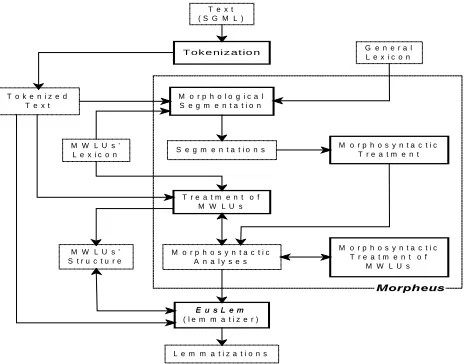
The information flow between the different tools in the chain is shown in Figure 1. Having an SGML-tagged text as the input document, the tokenizer produces, as output,
the list of tokens identified in the input text (7RNHQL]HG
7H[Win the figure).
<p> <!--- kartera, non-standard noun unit --->
<IVW\SH 1RXQV>
<f name=".H\"> <fs type="Key">
<f name="Entry"><str>kartera</str></f> <f name="Homograph-Id"><nbr value="0"></f> </fs>
</f>
<f name="326"><sym value="NOUN"></f> <f name="6WDQGDUGL]DWLRQ6WDWXV"> <fs type="Non-Standard-FS">
<f name="Non-Standard-Code"><sym value="LD_MA"</f> <f name="Variant"><minus></f>
<f name="Corresponding-Standards" org="set"> <fs type="Key">
<f name="Entry"><str>diru-zorro</str></f> <f name="Homograph-Id"><nbr value="0"></f> </fs>
... </f> </fs> </f>
<f name="6WUXFWXUH">
<fs type="OneWordUnit-Features-FS"> <f name="Morphotactics" org="set"> <fs type="Morphotactics-FS">
<f name="TWOL-Form"><str>karterA</str></f> <f name="Continuation-Class"><str>I</str></f> <f name="Lexicon"><str>et_izenak</str></f> </fs>
</f> </fs> </f>
<f name="1RXQ)HDWXUHV"> <fs type="Noun-Features-FS">
<f name="SUBCAT"><sym value="COMMON"></f> <f name="ANIM"><minus></f>
<f name="COUNT"><plus></f> <f name="MEAS"><plus></f> <f name="PLU"><minus></f> </fs>
</f> </fs>
</p> <!--- kartera --->
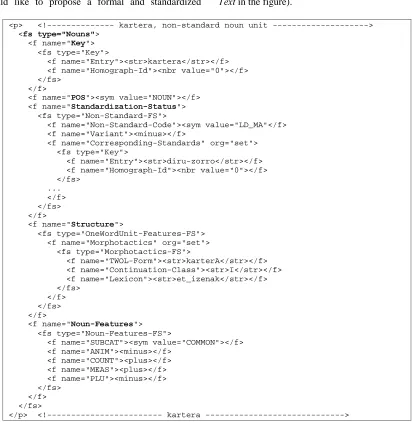
Figure 2. Output of the unit NDUWHUD (non-standard Basque for ZDOOHW) as exported from the lexical database.
The main source of lexical information in the system is the lexical database, which is considered as a permanent store developed and maintained by an independent process. The lexical information in the database needs to
be extracted so as to compile it into 0RUSKHXVor any
other program that might need it. Hence, the output of the lexical database is carried out in two steps, so distinguishing the exportation of the general lexicon
(single-word units) and that of MWLUs (Figure 1)2.
The segmentizer in 0RUSKHXV, taking as input the
general lexicon exported from EDBL, performs the morphological segmentation of the input text, splitting up
2
As can be seen in Figure 1, the MWLUs’ lexicon is already needed in the Morphological Segmentation process, in order to be able to recognize in the text MWLU’s constituents that are not by themselves entries of the lexical database.
each token into its constituent morphemes. A more comprehensive morphosyntactic treatment of words follows the segmentation process and, finally, multiword
lexical units are treated in two stages (7UHDWPHQW RI
0:/8V and 0RUSKRV\QWDFWLF 7UHDWPHQW RI 0:/8V),
taking as input in this case the MWLUs’ lexicon.
Finally, the general-purpose lemmatizer, (XV/HP,
refines the previous documents eliminating contextually incorrect analyses and reducing the ambiguity on single and multiword units.
8VLQJIHDWXUHVWUXFWXUHVWRLQWHUFKDQJH
FRPSOH[OLQJXLVWLFLQIRUPDWLRQ
for the representation of phonemes. The ability of feature structures to serve as a general-purpose linguistic metalanguage led us to use them as the basis of our encoding.
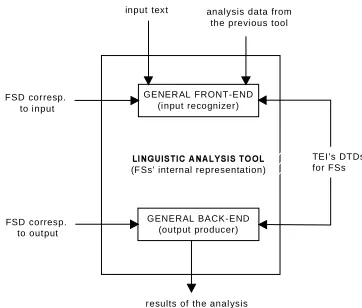
The feature structures in the integrated system are coded following the TEI’s DTD for FSs, and they fulfill the Feature Structure Definitions (FSD) that have been
thoroughly described for all the inputs/outputs in the tool pipeline.
Here are two examples. The first one (Figure 2)
corresponds to the non-standard noun entry NDUWHUD
(Basque for ZDOOHW) exported from the lexical database
into the general lexicon.
<tei.2> ... <p>
<IVW\SH 6HJPHQWDWLRQ> <!-- first segmentation: softwaregile + ek -->
<f name=")RUP"><str>softwaregileek</str></f> <f name="Lemma-Morphemes" org="list"> <fs type="/HPPD">
<f name="TWOL"><str>softwaregile</str></f> <f name="Unit">
<fs type="Key">
<f name="Entry"><str>softwaregile</str></f> <f name="Homograph-Id"><nbr value="0"></f> </fs>
</f>
<f name="Features"> <fs type="Feature-List">
<f name="POS"><sym value="NOUN"></f> ...
<f name="ROOT"> <fs type="Key">
<f name="Entry"><str>software</str></f> <f name="Homograph-Id"><nbr value="0"></f> </fs>
</f>
<f name="SUFL" org="list"> <fs type="Key">
<f name="Entry"><str>gile</str></f> <f name="Homograph-Id"><nbr value="1"></f> </fs>
...
<fs type="0RUSKHPH">
<f name="TWOL"><str>ek</str></f> <f name="Unit">
<fs type="Key">
<f name="Entry"><str>ek</str></f>
<f name="Homograph-Id"><nbr value="1"></f> </fs>
</f>
<f name="Features"> <fs type="Feature-List">
<f name="POS"><sym value="DEC"></f> <f name="CASE"><sym value="ERG"></f> ...
</fs> <!--- end of first segmentation ---> </p>
<p>
<IVW\SH 6HJPHQWDWLRQ> <!-- second segmentation: software + gile + ek -->
...
</fs> <!--- end of second segmentation ---> </p>
... </tei.2>
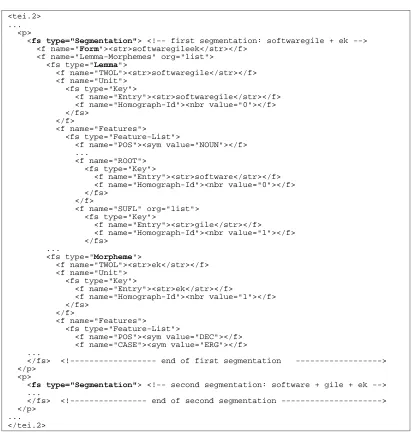
Figure 3. Multiple segmentations for VRIWZDUHJLOHHN.
The second example (Figure 3) represents a partial view of the output of the segmentizer for the derivative
word form VRIWZDUHJLOHHN (Basque term for VRIWZDUH
PDNHUV in the ergative case). The word form
VRIWZDUHJLOHHN can be split up in two different ways:
a) VRIWZDUHJLOH + HN
b) VRIWZDUH + JLOH + HN
The first one reflects the case in which VRIWZDUHJLOH is
analyzed as a lexicalized term (the information about the constituents of the word then comes from EDBL). As can be seen in the figure, in this case the two constituents of
the word are represented by two <fs> elements: <fs
type="lemma"> and <fs type="morpheme">3. In the second case (not in the figure), the number of constituents is three: two parts of the lemma (the root and the lexical suffix) and one declension morpheme.
A linguistic analysis may consist of many different
types of <fs> elements, each of which may group
together different types of <f> elements. In order to
distinguish among the different types of <fs> elements, a
type attribute that specifies the FS type is provided (for
3
An <fs> element represents a feature structure. It is composed by a set of features and their values, represented by <f>
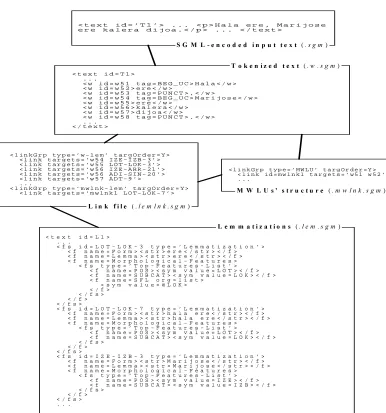
• Analysis collection:
3) The lemmatization analyses produced
(OHPVJP). It constitutes a library of the
different analyses (FSs) found in the given input text.
• Links from the text elements to their
corresponding analysis or analyses:
4) Finally, the document OHPOQNVJP, which
contains the links between the single-word
tokens in the 1st file and their corresponding
analyses included in the 3rd, and the MWLU’s
in the 2nd and their analyses in the 3rd.
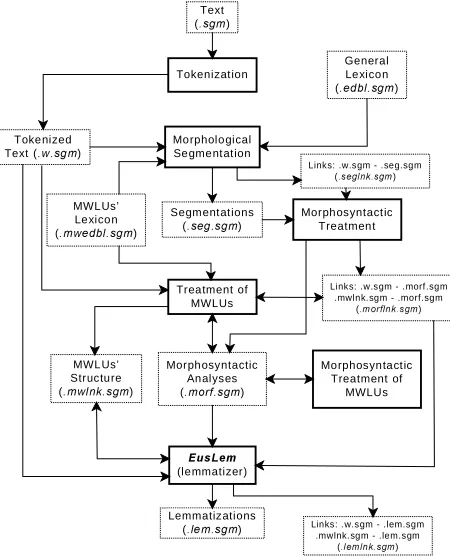
So, we speak about a four-document set system that gives, as pointed out in (Ide & Véronis, 1995), more independence and flexibility to the different processes, and greater facilities for their integration (see Figure 6).
It is interesting to note that, in the case of (XV/HPas
well as in that of 0RUSKHXV, the collection of links
between the text elements and their corresponding
analysis FSs (OHPVJP file) is divided into two different
parts, grouped into two different <linkgrp> elements:
(1) the links between single-word text elements and their
analyses (<linkgrp type=’w-lem’>), and (2) the links
between the multiword text elements and their analyses
(<linkgrp type=’mwlnk-lem’>).
As has been mentioned above, the 3rd document can be
considered as a library that stores the different analyses (FSs) found in the text. It is clear that, before adding a new analysis FS to this document, the lemmatizer’s back-end will always check whether it has already been stored because of a previous occurrence of the same text element in the input. In this case, the lemmatizer will not add it again (it will just add a new link to the 4th file).
We are already building an environment for manual disambiguation of the output of the lemmatization process, which will facilitate the disambiguation task for the linguists, providing them with a graphical interface with hypertextual facilities, based on the four-document set and on the input text.
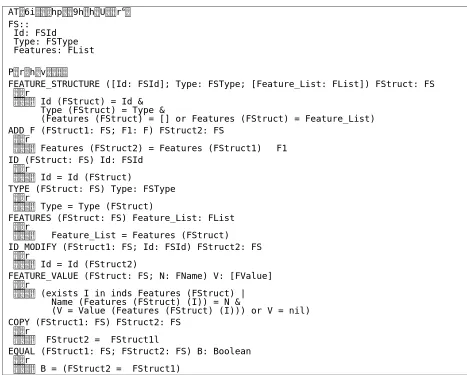
)6$EVWUDFW'DWD7\SH
FS:: Id: FSId Type: FSType Features: FList
2SHUDWLRQV
FEATURE_STRUCTURE ([Id: FSId]; Type: FSType; [Feature_List: FList]) FStruct: FS
SUH
SRVW Id (FStruct) = Id &
Type (FStruct) = Type &
(Features (FStruct) = [] or Features (FStruct) = Feature_List) ADD_F (FStruct1: FS; F1: F) FStruct2: FS
SUH
SRVW Features (FStruct2) = Features (FStruct1) • F1
ID (FStruct: FS) Id: FSId
SUH
SRVW Id = Id (FStruct)
TYPE (FStruct: FS) Type: FSType
SUH
SRVW Type = Type (FStruct)
FEATURES (FStruct: FS) Feature_List: FList
SUH
SRVW Feature_List = Features (FStruct)
ID_MODIFY (FStruct1: FS; Id: FSId) FStruct2: FS
SUH
SRVW Id = Id (FStruct2)
FEATURE_VALUE (FStruct: FS; N: FName) V: [FValue]
SUH
SRVW (exists I in inds Features (FStruct) |
Name (Features (FStruct) (I)) = N &
(V = Value (Features (FStruct) (I))) or V = nil) COPY (FStruct1: FS) FStruct2: FS
SUH
SRVW FStruct2 = FStruct1l
EQUAL (FStruct1: FS; FStruct2: FS) B: Boolean
SUH
SRVW B = (FStruct2 = FStruct1)
Figure 7. Formal specification of the FS Abstract Data Type.
6
F, FName, and FValue are ADTs specified in the same way.
$UHSRVLWRU\RI$EVWUDFW'DWD7\SHVRQ
)HDWXUH6WUXFWXUHV
In this section we present the library designed in order to facilitate the work with the FSs describing the linguistic
Aduriz I., Aldezabal I., Ansa O., Artola X., Díaz de Ilarraza A., Insausti J. M., 1998. EDBL: a Multi-Purposed Lexical Support for the Treatment of Basque.
In 3URFRIWKH)LUVW,QW&RQIRQ/DQJXDJH5HVRXUFHV
DQG(YDOXDWLRQ, vol II, 821-826. Granada (Spain).
Aduriz I., Agirre E., Aldezabal I., Arregi X., Arriola J.M., Artola X., Gojenola K., Maritxalar A., Sarasola K., Urkia M., 2000. A Word-Level Morphosyntactic
Grammar For Basque. In 3URFRIWKH6HFRQG,QW&RQI
RQ /DQJXDJH 5HVRXUFHV DQG (YDOXDWLRQ. Athens
(Greece).
Alegria I., Artola X., Sarasola K., Urkia M., 1996.
Automatic morphological analysis of Basque. /LWHUDU\
/LQJXLVWLF&RPSXWLQJ, 11, no. 4, 193-203.
Ezeiza N., Aduriz I., Alegria I., Arriola J.M., Urizar R., 1998. Combining Stochastic and Rule-Based Methods for Disambiguation in Agglutinative Languages. In
3URF&2/,1*$&/, 10-14. Montreal (Canada).
Ide N., Véronis J. (eds.), 1995. 7H[W(QFRGLQJ,QLWLDWLYH
%DFNJURXQGDQG&RQWH[WKluwer Academic Pub.
Jacobson R., 1949. The Identification of Phonemic
Entities. 7UDYDX[ GX &HUFOH /LQJXLVWLTXH GH
&RSHQKDJXH, 5, 205-213.
Karlsson F., Voutilainen A., Heikkilä J., Anttila A., 1995. &RQVWUDLQW*UDPPDU$/DQJXDJHLQGHSHQGHQW6\VWHP
IRU3DUVLQJ8QUHVWULFWHG7H[W. Mouton de Gruyter.
Mckelvie, D., Brew, C., Thompson, H., 1997. Using
SGML as a basis for Data-Intensive NLP. In 3URF
$1/3. Washington (USA).
Sperberg-McQueen C.M., Burnard L., 1994. *XLGHOLQHV
IRU(OHFWURQLF7H[W(QFRGLQJDQG,QWHUFKDQJH. TEI P3