Development of a Dependency Treebank for Russian
and its Possible Applications in NLP
Igor BOGUSLAVSKY, Ivan CHARDIN, Svetlana GRIGORIEVA, Nikolai GRIGORIEV,
Leonid IOMDIN, L
е
onid KREIDLIN, Nadezhda FRID
Laboratory for Computational Linguistics Institute for Information Transmission Problems
Russian Academy of Sciences
Bolshoj Karetnyj per. 19, 101447, Moscow – RUSSIA {bogus, ic, sveta, grig, iomdin, lenya, nadya}@iitp.ru
Abstract
The paper describes a tagging scheme designed for the Russian Treebank and presents tools used for corpus creation.
1. Introductory Remarks
The present paper describes a project aimed at developing the first annotated corpus of Russian texts. Large text corpora have been used in the computational linguistics community for quite a long time now; at present, over 20 large corpora for the main European languages are available, the largest of them containing hundreds of millions of words (Language Resources (1997); Marcus, Santorini and Marcinkiewicz (1993); Kurohashi, Nagao (1998)). For Russian, annotated corpora had been nonexistent until 2000 when the first part of the corpus reported here was compiled (Boguslavsky et al., 2000). Since then, Russian corpus linguistics has been evolving rapidly, and several groups of researchers announced their intent to create corpora. Of these, the CLD-MSU Corpus project looks particularly promising. It aims at building a morphologically tagged corpus, and an upgrade to syntactic annotation is envisaged in the future even though it is not pursued at the present stage (Sichinava, 2001). Different tasks require different annotation levels that entail different amount of information about text structure. The corpus that is being created in the framework of the project under discussion consists of several subcorpora that differ in the level of annotation. The following three levels are envisaged:
· lemmatized texts: for every word, its normal form (lemma) and part of speech are indicated;
· morphologically tagged texts: for every word, along with the lemma and the part of speech, a full set of inflectional morphological attributes is specified;
· syntactically tagged texts: apart from the full
morphological markup at the word level, every sentence is assigned a syntactic structure.
We annotate Russian texts with dependency structures – a formalism which we consider more suitable for Slavonic languages with their relatively free word order than constituent structures. The structure not only contains information as to which words of the sentence are syntactically linked, but also relegates each link to one of the several dozen syntactic types (at present, we use 78
syntactic relations). This is an important feature, since the majority of syntactically annotated corpora, both those already available and under construction, represent the syntactic structure by means of constituents.
The closest analogue to our work is Prague Dependency Treebank (PDT) – an annotated corpus of Czech collected at Charles University in Prague (see Hajicova, Panevova, Sgall, 1998). In this corpus, the syntactic data are also expressed in the dependency formalism, although the inventory of syntactic functional relations is much smaller than ours as it only has 23 relations. Our corpus therefore gives a more fine-grained representation of syntactic phenomena. On the other hand, Czech researchers made an extremely interesting attempt to incorporate into their annotation information on discourse structure (topic-focus opposition) (Bemova et al., 1999).
Besides PDT, several other corpus-related projects use some kind of dependency structures; worth noticing are NEGRA for German (Brants et al, 1999) and Alpino Dependency Treebank for Dutch (Van der Beek et al., 2001).
In what follows, we describe the types of texts used to create the corpus (Section 2), markup format (Section 3), annotation tools and procedures (Section 4), and types of linguistic data included in the markup (Section 5).
2. Source Text Selection
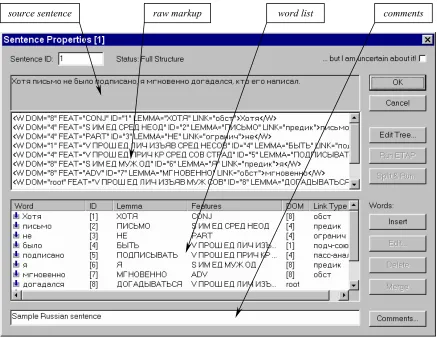
Fig. 1 presents the main dialog window for editing sentence properties. An operator can edit the markup directly in any text editor, or edit single properties using a graphical interface. The source text under analysis is written in the top line of the edit window: Xotja pis’mo ne bylo podpisano, ja mgnovenno dogadalsja, kto ego napisal [Although the letter was not signed, I instantly
guessed who had written it]. The information about
particular words is written into a list: e.g. the first word
xotja [although] has an identifier ID="1"; the lemmatized form is XOTJA; its feature list consists of a single feature – a part-of-speech characteristic (it is a conjunction); the word depends on a word with ID="8"
by the adverbial relation (link type is "adverb"). By double-clicking an item in the word list or pressing the button, a linguist can invoke dialog windows for editing
properties of single words. However, the most convenient
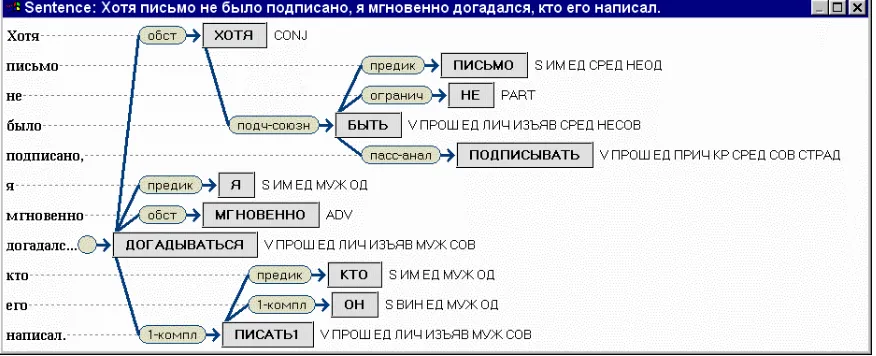
way of editing the structure consists in invoking a Tree Editor window, shown in Fig. 2 with the same sentence as in the previous picture.
The Tree Editor interface is simple and natural. Words of the source sentence are written on the left, their lemmas are placed into gray rectangles, and their morphological features are written on the right. The syntactic relations are shown as arrows directed from the master to the slave; the link types are indicated in rounded rectangles on the arcs. All text fields except for the source sentence are editable in-place. Moreover, one can drag the rounded rectangles: dropping it on a word means that this word is declared a new master for the word from which the rectangle was dragged. A single right-button click on the lemma rectangle pops up the word properties dialog. All
colors, sizes and fonts are customizable. Figure 1. Sentence Properties dialog in StrEd.
5. Types of Linguistic Information by Level
5.1. Morphological Information
The morphological analyzer ascribes features to every word. The feature set for Russian includes:
part of speech, animateness, gender, number, case, degree of comparison, short form (for adjectives and participles), representation (of verbs), aspect, tense, person, and voice.
5.1. Syntactic Information
As we have already mentioned , the result of the parsing is a tree composed of links as leaves and words as nodes. All the links are binary and oriented; they link single words rather than syntactic groups. For every syntactic group, one word (head) is chosen to represent it as a slave in larger syntactic units; all other members of the group become slaves of the head.
In a typical case, the number of nodes in the syntactic tree corresponds to the number of word tokens. However, several exceptional situations occur in which the number of nodes may be either less or greater than the number of word tokens. The latter case is especially interesting. We postulate such a description in the following cases:
a) Copulative sentences in the present tense where the auxiliary verb can be omitted. This is treated as a special “zero-form” of the copula, e.g. On – uchitel’ [He is a teacher, lit. He – teacher]. The copula should be introduced in the syntactic representation.
b) Elliptical constructions (e.g. omitted members of contrasted coordinative expressions), like in Ja kupil rubashku, a on galstuk [I bought a shirt, and he bought a necktie, lit. I bought a shirt, and he a necktie].
The latter type of sentences should be discussed in more detail. Elliptical constructions are known to be one of the toughest problems in the formalization of natural language syntax. In our corpus, we decided to reconstruct the omitted elements in the syntactic trees, marking them with a special “phantom” feature. In the above example, a phantom node is inserted into the sentence between the
words on ‘he’ and galstuk ‘necktie’. This new node will have a lemma POKUPAT` [BUY] and will bear exactly the same morphological features as the wordform kupil [bought] physically present in the sentence, plus a special “phantom” marker. In certain cases, the feature set for the phantom may differ from that of the prototype, e.g. in a slightly modified phrase Ja kupil rubashku, a ona galstuk [I bought a shirt, and she (bought) a necktie] the phantom node will have the feminine gender, as required by the agreement with the subject of the second clause. Most real-life elliptical constructs can be represented in this way.
The inventory of syntactic relationship types generated by the ETAP-3 system is vast enough: at present, we count 78 different syntactic function types. All relations are divided into 6 major groups: actant, attributive, quantitative, adverbial, coordinative, auxiliary. For readers’ convenience, we will give equivalent English examples:
Actant relations link the predicate word to its arguments. Some examples ([X] – master, [Y] – slave):
predicative – Pete [Y] knows [Х]; completive (1, 2, 3) –translate [Х]
the book [Y, 1-compl] from [Y1, 2-compl] English into [Y2, 3-compl] Russian
Attributive relations often link a noun to a modifier expressed by an adjective, another noun, a participle clause, etc:
relative –The house [Х] we live[Y] in.
Quantitative relations link a noun to a quantifier or numeral, or two such words together:
quantitative –five [Y] pages [Х];
auxiliary-quantitative – thirty [Y] five [Х];
Adverbial relations link the predicate word to various adverbial modifiers:
adverbial – He came [Х] every evening [Y]; parenthetic – In [Y] my opinion, he is [Х] right.
Coordinative relations serve phrases and clauses coordinated by conjunctions: